Chapter 3
Current Electricity
CBSE · 12 subtopics
Formula SheetEvery formula this chapter can be examined on, in one table.
Electric current
| Formula | Symbols, units and conditions |
|---|---|
| |
| |
| |
|
Ohm's law, resistance and resistivity
| Formula | Symbols, units and conditions |
|---|---|
| |
| |
| |
| |
| |
|
Drift of electrons, conductivity and mobility
| Formula | Symbols, units and conditions |
|---|---|
| |
| |
| |
| |
| |
| |
|
Resistivity of various materials
| Formula | Symbols, units and conditions |
|---|---|
|
Temperature dependence of resistivity
| Formula | Symbols, units and conditions |
|---|---|
| |
| |
| |
|
Electrical energy and power
| Formula | Symbols, units and conditions |
|---|---|
| |
| |
| |
| |
|
Combination of resistors
| Formula | Symbols, units and conditions |
|---|---|
| |
| |
|
Cell, emf and internal resistance
| Formula | Symbols, units and conditions |
|---|---|
| |
| |
| |
| |
|
Cells in series and in parallel
| Formula | Symbols, units and conditions |
|---|---|
| |
| |
| |
| |
|
Kirchhoff's rules
| Formula | Symbols, units and conditions |
|---|---|
| |
|
Wheatstone bridge and metre bridge
| Formula | Symbols, units and conditions |
|---|---|
| |
| |
| |
|
Constants and data CBSE expects
Quantity Symbol Value Electronic charge Electron mass Free-electron density in copper Typical drift speed Thermal speed of atoms at 300 K — Speed at which the field is set up Unit of energy on a bill kWh Transition temperature of mercury
Short NotesThe chapter subtopic by subtopic, in the textbook's own order.12 subtopics
- 1Electric Current
- 2Electric Currents in Conductors3 board questions
- 3Ohm's Law6 board questions
- 4Drift of Electrons and the Origin of Resistivity21 board questions
- 5Limitations of Ohm's Law1 board question
- 6Resistivity of Various Materials2 board questions
- 7Temperature Dependence of Resistivity8 board questions
- 8Electrical Energy, Power4 board questions
- 9Cells, Emf, Internal Resistance12 board questions
- 10Cells in Series and in Parallel7 board questions
- 11Kirchhoff's Rules8 board questions
- 12Wheatstone Bridge4 board questions
The whole chapter in brief
Electric current
- Charges in motion constitute an electric current. For a steady current, ; in general .
- SI unit: ampere (A), an SI base unit, defined through the magnetic effect of currents. .
- Conventional current is in the direction of flow of positive charge; in a metal the electrons drift the opposite way.
- Current is a scalar even though it is drawn with an arrow — currents add algebraically at a junction, not by the parallelogram law. Formally , a scalar product of two vectors.
- Orders of magnitude: domestic appliances a few A, lightning tens of thousands of A, nerve currents in A.
- Charge transferred = area under the – graph. Number of electrons .
Electric currents in conductors
- In metals some electrons are practically free; the positive ions are fixed. In electrolytes both positive and negative ions carry the current. In insulators the electrons stay bound.
- With no field, electrons move randomly, collide with the ions and emerge with the same speed in a random direction; the average velocity is zero, so there is no net current.
- With a field, a small drift is superposed on the random motion and a current flows. The random motion itself is unchanged in character.
- NCERT's cylinder with and discs at its ends carries a current only for a short while — the charges neutralise. A steady current needs a cell or battery to replenish the charge and maintain a steady field.
Ohm's law
- Statement: at constant temperature the current through a conductor is proportional to the potential difference across its ends, , i.e. .
- merely defines resistance and applies to every device; Ohm's law is the extra assertion that is independent of , i.e. that the – plot is a straight line through the origin.
- Geometry: doubling the length doubles ; halving the area doubles . Hence .
- Point form: , or — a material obeys Ohm's law when does not depend on the magnitude or direction of the applied field.
- and are properties of the material (and its temperature) alone; depends also on shape and size.
Drift of electrons and the origin of resistivity
- Drift velocity: the average velocity acquired by the free electrons under an applied field, superposed on their random thermal motion, directed opposite to .
- Relaxation time : the average time between two successive collisions of a free electron with the lattice ions.
- Results to memorise: ; ; ; ; ; .
- Ohm's law follows: , so is a constant at fixed temperature.
- Drift speed is tiny (), about of the thermal speed and of the speed at which the field is set up. The current starts almost instantly because the field is established throughout the circuit at nearly the speed of light, not because electrons travel from one end to the other.
- Large currents are possible in spite of the tiny drift speed because is enormous, .
- Between collisions the paths are straight lines when there is no field, and curved (parabolic) when there is one.
Mobility
- Mobility is the magnitude of the drift velocity per unit electric field: .
- SI unit ; practical unit , and .
- Mobility is always positive; it depends only on (hence on temperature and the material), never on the applied voltage, the field or the geometry.
- Conductivity in terms of mobility: .
- Charge carriers: electrons in metals; electrons and positive ions in an ionised gas; positive and negative ions in an electrolyte.
Limitations of Ohm's law
- Ohm's law is not a fundamental law of nature. Deviations are of three kinds.
- (a) is not proportional to — the – curve bends away from the straight line at large currents (for instance when rises with ).
- (b) The relation depends on the sign of : reversing the polarity does not give the same current in the opposite direction. A junction diode behaves this way.
- (c) The relation is not unique: more than one value of gives the same . Gallium arsenide (GaAs) shows this.
- Negative resistance: the region of a characteristic where the current falls as the voltage rises, . On the GaAs curve this is the falling portion (labelled DE in CBSE's figure); the straight portion through the origin (AB) is where Ohm's law holds.
Resistivity of various materials
| Class | Resistivity at room temperature | Behaviour with rising temperature |
|---|---|---|
| Conductors (metals) | to | increases, positive |
| Alloys (nichrome, manganin, constantan) | high, of order | almost unchanged, very small |
| Semiconductors (Si, Ge) | intermediate | decreases, negative |
| Insulators (glass, rubber, ceramic, plastic) | about times that of metals or more | decreases |
- Adding a small amount of a suitable impurity (doping) lowers the resistivity of a semiconductor — the basis of electronic devices.
- Standard resistors are wire-wound from alloys because they have a very low temperature coefficient of resistivity (the value hardly drifts as they warm up) together with a high specific resistance (a short length gives a large resistance).
Temperature dependence of resistivity
- , and the same form for . is the fractional change in resistivity per degree rise, unit K.
- Why a metal's resistivity rises: . Heating makes the ions vibrate more, collisions get more frequent, falls; is practically unchanged, so rises.
- Why a semiconductor's resistivity falls: increases sharply with temperature and more than compensates the fall in .
- Graphs to be able to sketch: copper — nearly a straight line of small positive slope over the ordinary range, curving and falling steeply towards a small value well below C; nichrome — a straight line of very small slope; a semiconductor — a curve falling steeply as rises.
- Superconductivity: the resistance of mercury falls smoothly on cooling and then drops abruptly to zero at ; below it offers no resistance at all.
- Reading an – graph: is the reciprocal of the slope, so the steeper line is the smaller resistance. For a metal, the steeper line is at the lower temperature; for two wires of equal length and diameter, the less steep line is the higher resistivity.
Electrical energy and power
- In time the charge falls through , so the energy delivered is . Because collisions pass this energy to the lattice, it appears as heat.
- ; heat . .
- Series: the current is common, so — the larger resistance heats up more (nichrome heats more than copper). Parallel: the voltage is common, so — the smaller resistance dissipates more.
- Bulb rated has ; at another supply voltage it draws .
- Transmission: to deliver power at voltage through cables of resistance , the wasted power is . It falls as , which is why transmission is at very high voltage, stepped down by a transformer at the far end.
Combination of resistors
| Feature | Series | Parallel |
|---|---|---|
| Common quantity | current | potential difference |
| Equivalent | ||
| Compared with the parts | larger than the largest | smaller than the smallest |
| Sharing | ||
| Power |
- Two resistors in parallel: . equal resistors in parallel: .
- Points joined by a resistanceless wire are at the same potential; a resistor across two such points carries no current and may be ignored.
Cells, emf and internal resistance
| Emf | Terminal voltage |
|---|---|
| Potential difference between the terminals on open circuit | Potential difference between the terminals on closed circuit |
| No current is drawn | Current flows |
| Fixed for a given cell, set by its chemistry | Depends on the current and the external resistance |
| Cause | Effect |
| , less than while discharging |
- Internal resistance is the resistance of the electrolyte between the electrodes. Dry cells have a much higher than ordinary electrolytic cells. may be neglected when .
- ; largest current when , (usually far above the safe limit of a real cell).
- While charging, current is pushed into the positive terminal and .
- Graph against : a straight line, intercept on the -axis, slope , meeting the -axis at . The intercept gives the emf and the magnitude of the slope gives the internal resistance.
- Graph against : a curve from the origin, rising steeply then flattening, approaching asymptotically as .
- Direction of current: from negative to positive terminal inside the cell, from positive to negative outside it.
Cells in series and in parallel
| Series | Parallel |
|---|---|
| Reversed cell enters with a minus sign | Reversed cell: put |
| identical cells: | identical cells: |
- For two cells in parallel, and .
- Series is worth using when , parallel when ; the two give the same current when .
- If identical cells are in parallel, the equivalent emf is that of one cell and the equivalent internal resistance is .
Kirchhoff's rules
- Junction rule: at any junction the sum of the currents entering equals the sum of the currents leaving, . Based on conservation of charge — no charge piles up at a junction in the steady state.
- Loop rule: the algebraic sum of the changes in potential round any closed loop is zero, . Based on conservation of energy — potential is a function of position, so returning to the same point must give zero net change.
- Signs: going through a resistor along the assumed current, the change is ; against it, . Going through a cell from to , the change is ; from to , it is .
- A negative answer for a current simply means the real current is opposite to the arrow you drew.
- Bending or re-routing a wire does not affect the junction rule.
Wheatstone bridge
- Four resistors form a quadrilateral ABCD; the cell is across the diagonal AC (battery arm) and a galvanometer across BD (galvanometer arm).
- Balance condition: the galvanometer shows no deflection when , i.e. .
- At balance B and D are at the same potential; the galvanometer arm carries no current and may be removed or replaced by a wire without changing anything.
- A null method: the balance condition contains only the four resistances, so the result does not depend on the emf of the cell or the sensitivity of the galvanometer — which is why it is accurate.
- Metre bridge is a practical Wheatstone bridge: two of the arms are the two parts of a uniform one-metre wire on either side of the jockey, so , and then for the material of the unknown wire.
Traps that cost marks
- Writing and calling it Ohm's law. defines ; the law is the claim that does not depend on .
- Saying resistivity depends on the length or the area. It depends only on the material and its temperature; it is that depends on the dimensions.
- Saying mobility or relaxation time changes when the applied voltage changes. Both depend on the material and its temperature, not on .
- In a wire of non-uniform cross-section, only the current is the same everywhere. , and all vary as — they are larger where the wire is thinner.
- Two wires in parallel across the same battery and of the same material and length have the same current density and the same drift speed, whatever their areas — because they share the same field .
- Confusing " is negative" with " is negative". Only the coefficient is negative for a semiconductor; resistivity itself is always positive.
- Forgetting to use before comparing bulbs, and forgetting that the rated power is only drawn at the rated voltage.
- Dropping the internal resistance from , or writing for a discharging cell (it is ; the plus sign is for charging).
- Adding emfs of cells in parallel as if they were in series. For a parallel combination use .
- In Kirchhoff problems, writing more loop equations than there are independent loops, or changing the assumed current directions halfway through.
- Quoting the bridge condition upside down. Keep the same order: the ratio of the two arms of one branch equals the ratio of the two arms of the other, taken from the same end.
- On a metre bridge, using in metres in . The formula is written for in cm; only the ratio matters, so keep both lengths in the same unit.
- Rounding to C, or forgetting SI units in the final line — CBSE deducts for a missing unit.
Solved Numerical ExamplesWorked numericals to attempt first, each with a hint before the full solution.Coming soon
These are being added chapter by chapter. They are solved numericals from the prescribed book and the reference guides — not previous board questions, which live under Practice — so that you can work through the method before meeting it in a real paper.
Important DerivationsEvery derive / obtain / prove question in this chapter.13
- 1Derivation 1Using the concept of drift velocity of charge carriers in a conductor, deduce the relationship between current density and resistivity of the conductor.
Asked in: CBSE Class 12 Physics — SA · Delhi 2015C, An · Section B, 2 marks
Show the derivationHide the derivation
Drift velocity: Current density: , where Since resistivity ,
- 2Derivation 2(a) Define the term 'conductivity' of a metallic wire. Write its SI unit. (b) Using the concept of free electrons in a conductor, derive the expression for the conductivity of a wire in terms of number density and relaxation time. Hence obtain the relation between current density and the applied electric field .
Asked in: CBSE Class 12 Physics — SA · 2018 · Section C, 3 marks
Show the derivationHide the derivation
(a) Conductivity () is the reciprocal of resistivity, . SI unit: . (b) Current density Comparing with : Hence the relation between current density and applied field:
- 3Derivation 3(a) Deduce the relation between the current flowing through a conductor and the drift velocity of the electrons. (b) The figure shows a plot of current '' flowing through the cross-section of a wire versus time ''. Use the plot to find the charge flowing in 10 s through the wire. [Graph: rises linearly from 0 to 5 A over to s, then stays constant at 5 A from s to s.]
Asked in: CBSE Class 12 Physics — Long Answer · AI 2015C · Section E, 5 marks
Show the derivationHide the derivation
(a) Consider a conductor of length , area of cross-section , with free electrons per unit volume. Total number of free electrons, . Time taken for an electron drifting with speed to cross the length : . Charge crossing a cross-section in this time: (b) Charge = area under the – graph: C
- 4Derivation 4(i) Explain how free electrons in a metal at constant temperature attain an average velocity under the action of an electric field. Hence obtain an expression for it. (ii) Consider two conducting wires and of the same diameter but made of different materials, joined in series across a battery. The number density of electrons in is 1.5 times that in . Find the ratio of drift velocity of electrons in wire to that in wire .
Asked in: CBSE Class 12 Physics — Long Answer · Delhi 2017, Ev · Section E, 5 marks
Show the derivationHide the derivation
(i) The field exerts a force on each electron, giving it an acceleration between collisions. Since successive collisions randomize the electron's velocity, the average velocity gained (the drift velocity) is , where is the average time between collisions (relaxation time); the negative sign shows is opposite to . (ii) . Since and are in series, the current is the same: . Since the wires have the same diameter, , so:
- 5Derivation 5(i) Derive an expression for the drift velocity of electrons in a conductor. Hence deduce Ohm's law. (ii) A wire whose cross-sectional area is increasing linearly from one end to the other is connected across a battery of volts. Which of the following quantities remain constant in the wire: drift speed, current density, electric current, electric field? Justify your answer.
Asked in: CBSE Class 12 Physics — Long Answer · Delhi 2017/2023, Ev · Section E, 5 marks
Show the derivationHide the derivation
(i) As derived above, . Now , and since : So , which is Ohm's law, with constant for a given conductor at constant temperature. (ii) The rate of flow of charge through a conductor of non-uniform cross-section is the same at every section (steady state), so the electric current remains constant. Since the area of cross-section varies along the wire, the current density , drift speed and electric field all vary — decreasing as the area increases.
- 6Derivation 6Define the term 'drift velocity' of charge carriers in a conductor. Obtain the expression for the current density in terms of relaxation time.
Asked in: CBSE Class 12 Physics — SA · 2/5, Foreign 2014 · Section B, 2 marks
Show the derivationHide the derivation
Drift velocity: the average velocity with which free electrons drift towards the positive end of a conductor under an applied electric field. Current density:
- 7Derivation 7Two conductors, made of the same material, have equal lengths but different cross-sectional areas and (). They are connected in parallel across a cell. Show that the drift velocities of electrons in the two conductors are equal.
Asked in: CBSE Class 12 Physics — SA · 2023 · Section B, 2 marks
Show the derivationHide the derivation
Since the conductors are in parallel across the same cell, the potential difference across each is the same. , Since neither expression depends on the area, .
- 8Derivation 8(a) Two cells of emf and have their internal resistances and respectively. Deduce an expression for the equivalent emf and internal resistance of their parallel combination when connected across an external resistance . Assume that the two cells are supporting each other. (b) In case the two cells are identical, each of emf V and internal resistance , calculate the voltage across the external resistance .
Asked in: CBSE Class 12 Physics — SA · 2020 · Section C, 3 marks
Show the derivationHide the derivation
(a) Let be the potential difference between the terminals and the total current. For cell : ; for cell : Solving for : Comparing with : , (b) V, V, A Voltage across : V
- 9Derivation 9Two cells of emf and internal resistance and are connected in parallel. Derive the expressions for the emf and internal resistance of a single cell which can replace this combination.
Asked in: CBSE Class 12 Physics — SA · 2019C · Section C, 3 marks
Show the derivationHide the derivation
By the same derivation as above (equating to the parallel combination's terminal relation): ,
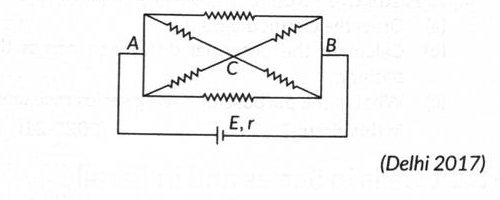
- 10Derivation 10(i) State the two Kirchhoff's laws. Explain briefly how these rules are justified. (ii) The current is drawn from a cell of emf and internal resistance connected to the network of resistors, each of resistance , as shown in the figure. Obtain the expression for (a) the current drawn from the cell and (b) the power consumed in the network.
Asked in: CBSE Class 12 Physics — Long Answer · Delhi 2017 · Section E, 5 marks
Show the derivationHide the derivation
(i) Same as stated in Q69 above: the junction rule follows from conservation of charge, the loop rule from conservation of energy. (ii) The network between and can be redrawn as four resistors, , , and , all in parallel: Net resistance of the circuit (including the cell's own internal resistance , in series with ): (a) Current drawn from the cell: (b) Power consumed in the network:
- 11Derivation 11Derive an expression for the balance condition of a Wheatstone bridge.
Asked in: CBSE Class 12 Physics — SA · 1½/3, 2020 · Section C, 3 marks
Show the derivationHide the derivation
(Same derivation as in Q73.) Applying Kirchhoff's rules to loops and and setting the galvanometer current at balance gives:
- 12Derivation 12(a) Explain the term drift velocity of electrons in a conductor. Hence obtain the expression for the current through a conductor in terms of drift velocity. (b) Two cells of emfs and and internal resistances and respectively are connected in parallel, as shown in the figure. Deduce the expressions for the (i) equivalent emf, (ii) equivalent internal resistance of the combination, and (iii) potential difference between the points and .
Asked in: CBSE Class 12 Physics — Long Answer · Section E, 5 marks · CBSE sample question
Show the derivationHide the derivation
(a) Drift velocity is the average velocity acquired by the free electrons of a conductor under an applied electric field, superposed on their random thermal motion. For a conductor of length , area , with free electrons per unit volume, all free electrons cross a section in time , carrying charge . (b) Let = potential difference between and , the total current. , , which on solving for gives Comparing with : (i) (ii) (iii) Potential difference between and : , using the values from (i) and (ii).
- 13Derivation 13(a) State Kirchhoff's first rule. Explain briefly how it is justified. State Kirchhoff's second rule and explain how it is justified. (b) Using Kirchhoff's rules, derive the balance condition for a Wheatstone bridge.
Asked in: CBSE Class 12 Physics — Long Answer · Section E, 5 marks · CBSE sample question
Show the derivationHide the derivation
(a) Kirchhoff's first rule (junction rule): the algebraic sum of currents meeting at a junction is zero, for currents at a junction; justified by conservation of charge. Kirchhoff's second rule (loop rule): the algebraic sum of the applied emfs in a closed loop equals the algebraic sum of the drops across the resistors of that loop, ; justified by conservation of energy. (b) (As derived in Q73/Q75 of the board questions.) Applying Kirchhoff's rules to the two loops of the bridge and setting the galvanometer current to zero at balance gives:
Finished revising this chapter? Practise Current Electricity →