3.12
Kirchhoff's Rules
Current Electricity · CBSE
Theory
Why the rules are needed, and how to set a problem up
- Real circuits contain several cells and resistors interconnected in ways that no amount of series-and-parallel reduction will simplify. Kirchhoff's two rules handle any such network.
- Label a current with a symbol and an arrow in every branch. If the answer comes out positive, the current really flows the way the arrow points; if negative, it flows the other way — do not redraw, just report the sign.
- Label each source's positive and negative electrodes and the current through it. Between the terminals of a cell, when flows from N to P inside the cell, and if the labelled current runs from P to N.
- Use the junction rule first, at every junction, so that as few unknowns as possible are left; then write loop equations, one for each independent loop, until you have as many equations as unknowns.
The two rules, with their justifications
- Junction rule. At any junction, the sum of the currents entering the junction equals the sum of the currents leaving it; equivalently the algebraic sum of the currents meeting at a junction is zero, .
- Justification: conservation of charge. When currents are steady there is no accumulation of charge at any junction or at any point of a line, so the rate at which charge flows in must equal the rate at which it flows out. It applies equally to a point in an unbranched wire, and bending or re-routing the wire changes nothing.
- Loop rule. The algebraic sum of the changes in potential around any closed loop involving resistors and cells is zero; equivalently, around any closed loop, .
- Justification: conservation of energy. Electric potential is a single-valued function of position, so on going round a closed loop and returning to the starting point the total change of potential must be zero. Equivalently, the net work done by the electric force on a charge taken round a closed loop is zero.
Sign conventions to state before you write an equation
| Element traversed | Change in potential |
|---|---|
| Resistor, moving along the assumed current | |
| Resistor, moving against the assumed current | |
| Cell, entering at and leaving at | |
| Cell, entering at and leaving at |
- Go round each loop in one fixed sense and do not change it halfway.
- Only independent loops give new information: applying the loop rule to the remaining loops of a network reproduces equations you already have.
Series and parallel resistors as a special case
- Series: the junction rule forces the same current through each; the loop rule gives , so
- Parallel: the loop rule forces the same across each; the junction rule gives , so
- exceeds the largest resistance in the group; is less than the smallest. In series ; in parallel .
- Two points joined by a wire of zero resistance are at the same potential; anything connected between two such points carries no current and can be ignored when finding the equivalent resistance.
Worked examples of the kind CBSE sets
- Symmetry, then the loop rule (NCERT's cube). Twelve equal resistors form the edges of a cube, and a battery of emf is across a body diagonal. By symmetry the current from the battery splits equally into along each of the three edges at the entry corner, then into along each of the six middle edges, then recombines. Round the loop from one corner to the opposite one, , so and
- With and , the total current is , so .
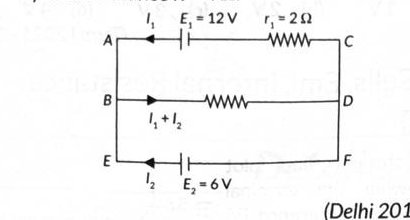
- Two meshes with two cells. With through the 12 V branch (internal resistance ), through the 6 V branch, and through : mesh 1 gives , i.e. ; mesh 2 gives , i.e. . Solving, and , so the current through is and .
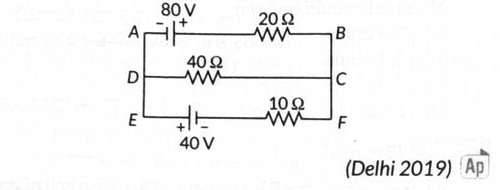
- Two meshes with three resistors. With in the branch, in the branch and in the branch: loop ABCDA gives , i.e. ; loop DCFED gives , i.e. . Solving, , so the resistor carries zero current and the resistor carries 4 A.
- A branch carrying no current. If no current flows in one arm, the same current runs round the outer loop, and the loop rule applied to the smaller loop gives that current directly; the potential difference between two points is then found by walking from one to the other and adding the emfs and drops with their signs.
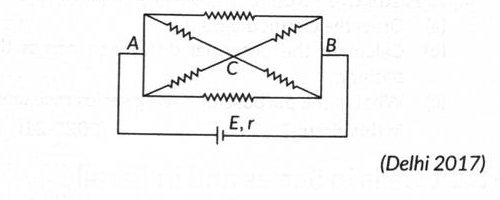
- A network of equal resistors. If a network between A and B reduces to four resistors , , , in parallel, , so . With the cell's own internal resistance in series, , so and the power consumed in the network is .
Standard results
- at a junction (conservation of charge); round a loop (conservation of energy).
- Number of independent loop equations = number of unknown currents left after the junction rule.
- ; ; for two.
- Cube of twelve equal resistors across a body diagonal: .
- A negative current means the arrow was drawn the wrong way; the magnitude is still correct.
Theory Questions Asked on This Subtopic
Real board questions. Answers are at the end of the page.
- 1
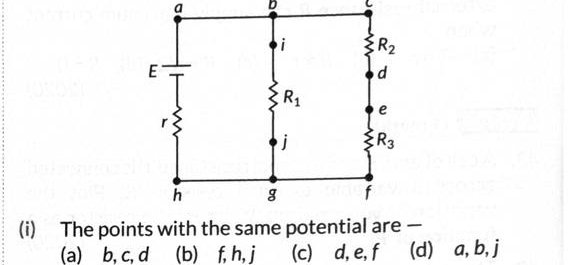
An experiment was set up with the circuit diagram shown in the figure. Given that , , and V. (i) The points with the same potential are — (a) (b) (c) (d) (ii) The current through branch is — (a) 1 A (b) 1/3 A (c) 1/2 A (d) 2/3 A (iii) The power dissipated in is — (a) 2 W (b) 2.5 W (c) 3 W (d) 4.5 W (iv) The potential difference across is — (a) 1.5 V (b) 2 V (c) 2.5 V (d) 3 V
- 2
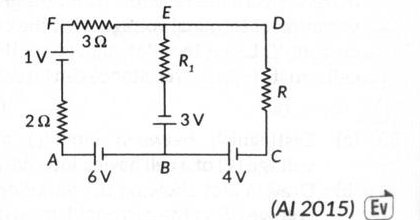
Use Kirchhoff's rules to determine the potential difference between the points and , when no current flows in the arm of the electrical network shown in the figure.
- 3
State Kirchhoff's rules. Explain briefly how these rules are justified.
- 4
In the electric network shown in the figure, use Kirchhoff's rules to calculate the power consumed by the resistance .
- 5
Using Kirchhoff's rules, calculate the current through the and resistors in the following circuit.
- 6
(i) State the two Kirchhoff's laws. Explain briefly how these rules are justified. (ii) The current is drawn from a cell of emf and internal resistance connected to the network of resistors, each of resistance , as shown in the figure. Obtain the expression for (a) the current drawn from the cell and (b) the power consumed in the network.
Numericals
Every numerical set on this subtopic. Full working is at the end of the page.
- 7
Kirchhoff's first rule and second rule (where the symbols have their usual meanings) are respectively based on
- (a)
conservation of momentum and conservation of charge
- (b)
conservation of energy, conservation of charge
- (c)
conservation of charge, conservation of momentum
- (d)
conservation of charge, conservation of energy
- (a)
- 8
Kirchhoff's first rule at a junction in an electrical network deals with conservation of
- (a)
energy
- (b)
charge
- (c)
momentum
- (d)
both energy and charge
- (a)
Answers & Solutions
Work the questions above first, then check yourself here. Each answer is set out the way it should be written in the paper.
Answer: (i) (b); (ii) (c); (iii) (b); (iv) (c) (i) Since , there is no resistance in the wire joining , , , so they are all at the same potential. Answer: (b) (ii) and are in series: . This is in parallel with : . Total current from the cell: A. Current through branch (i.e. through ): A. Answer: (c) 1/2 A (iii) W. Answer: (b) 2.5 W (iv) Current through : A. V. Answer: (c) 2.5 V
Since no current flows through , the same current flows around the outer loop . Applying Kirchhoff's voltage law around this loop: ...(i) In the smaller loop (containing the V cell, the and the resistors): A ...(ii) Using (ii) in (i): To find , apply Kirchhoff's voltage law along path (through the V, V cells and the , A branch):
Kirchhoff's first (junction) rule: the algebraic sum of currents meeting at a junction is zero, . It is justified by the conservation of charge — charge cannot accumulate at a junction in a steady state, so total current in must equal total current out. Kirchhoff's second (loop) rule: the algebraic sum of the emfs in any closed loop equals the algebraic sum of the products (potential drops) around that loop, . It is justified by the conservation of energy — the net change in electric potential energy around any closed path must be zero.
Let flow through (branch ) and through (branch ); their sum flows through (branch ). Applying KVL to closed mesh : ...(i) Applying KVL to closed mesh : ...(ii) Solving (i) and (ii): A, A Current through : A Power consumed by : W
Let be the current in the branch () and the current in the branch (); the current through the branch () is . Applying KVL to loop : ...(i) Applying KVL to loop : ...(ii) Solving (i) and (ii): A, A Current through A Current through A
(i) Same as stated in Q69 above: the junction rule follows from conservation of charge, the loop rule from conservation of energy. (ii) The network between and can be redrawn as four resistors, , , and , all in parallel: Net resistance of the circuit (including the cell's own internal resistance , in series with ): (a) Current drawn from the cell: (b) Power consumed in the network:
Kirchhoff's first (junction) rule follows from conservation of charge; the second (loop) rule follows from conservation of energy.
The question is a real board question. Its answer and working are ours — this paper was published without an official answer key.
Answer
Charge.
Why
- Kirchhoff's first rule, the junction rule, states that at any junction of a network the sum of the currents entering the junction equals the sum of the currents leaving it:
- A junction is a point of zero volume. In the steady state no charge can accumulate there, so charge must leave a junction exactly as fast as it arrives. Since current is the rate of flow of charge, this statement *is* the conservation of charge applied to a junction.
- Ruling out the others: conservation of energy (a) is the basis of Kirchhoff's **second** rule, the loop rule, , which says the algebraic sum of the potential changes round a closed loop is zero. Momentum (c) plays no part in either rule — the carriers are continually scattered by the lattice and their momentum is certainly not conserved. Option (d) would be right only if the junction rule involved energy as well, and it does not.
Option (b).