3.6
Limitations of Ohm's Law
Current Electricity · CBSE
Theory
Why there are limitations at all
- Ohm's law is not a fundamental law of nature. It came out of a model in which the relaxation time and the free-electron density are constants independent of the field; where that assumption fails, so does the law.
- Ohm's law holds for many substances over a range of fields. If the field becomes too strong, departures appear in all cases — even in homogeneous conductors like silver and in pure or doped germanium.
The three kinds of deviation
- (a) ceases to be proportional to . The – graph starts along the dashed straight line of Ohm's law near the origin and then bends away from it. This is what happens when rises with even at fixed temperature.
- (b) The relation between and depends on the sign of . Reversing the polarity while keeping the magnitude of fixed does not give a current of the same magnitude in the opposite direction. A junction diode is the standard example, and its characteristic is drawn on different scales for the forward and reverse halves.
- (c) The relation is not unique: more than one value of gives the same current . Gallium arsenide (GaAs) behaves this way.
- A rectifier combines features (a) and (b); GaAs shows feature (c).
- These non-ohmic materials and devices are not curiosities — they are what electronic circuits are built from.
The GaAs characteristic, described
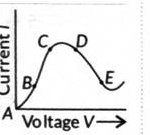
- Sketch on the vertical axis against on the horizontal axis. From the origin the curve rises: the first portion, labelled AB in CBSE's figure, is a straight line through the origin, so Ohm's law is obeyed there.
- Beyond that the rise slows and becomes non-linear (region BC), and the curve reaches a peak around region CD.
- After the peak the current falls as the voltage keeps increasing — region DE. Here , so the resistance is negative. This is the region of negative resistance.
- The same reading applies to a resistance-versus-voltage sketch labelled with other letters: whichever portion has the current falling while the voltage rises is the negative-resistance region.
Ohmic against non-ohmic
| Ohmic conductor | Non-ohmic device |
|---|---|
| – graph is a straight line through the origin | Graph is curved, or unsymmetrical, or many-valued |
| is the same at every point of the graph | changes from point to point on the graph |
| Reversing the polarity reverses the current with the same magnitude | Reversing the polarity may give a quite different current |
| Metallic conductors at constant temperature | Diode, transistor, thermistor, electrolyte, GaAs |
Standard results
- Three deviations: non-linear –; sign-dependent – (diode); non-unique – (GaAs).
- Negative resistance is the region where decreases as increases.
- Ohm's law holds in the linear region through the origin.
- still defines the resistance of a non-ohmic device at a given operating point; it is Ohm's law, not the definition, that fails.
Theory Questions Asked on This Subtopic
Real board questions. Answers are at the end of the page.
- 1
The graph showing the variation of current versus voltage for a material GaAs is shown in the figure. Identify the region of (i) negative resistance (ii) where Ohm's law is obeyed.
Answers & Solutions
Work the questions above first, then check yourself here. Each answer is set out the way it should be written in the paper.
(i) In the region of the graph, the current decreases as the voltage increases, i.e. , giving a negative resistance. (ii) In the region , the graph is a straight line through the origin, so Ohm's law () is obeyed there.