3.5
Drift of Electrons and the Origin of Resistivity
Current Electricity · CBSE
Theory
Derivation of the drift velocity — write it exactly like this
- Consider free electrons in the conductor. With no field their velocities are random, so
- Switch on a field . Each electron of charge and mass is accelerated:
- Look at the -th electron at time . Let its last collision have been a time earlier and let be its velocity immediately after that collision. Then its velocity now is
- Average over all electrons. The average of the is zero, because the direction just after any collision is completely random. The average of the is the relaxation time , the average time between two successive collisions. Hence the average velocity — the drift velocity — is
- The result is remarkable: although each electron is being accelerated, the average velocity is constant in time. The minus sign says the drift is opposite to — electrons drift towards the higher potential.
- In magnitude, and using for a conductor of length across which is applied,
Definitions CBSE wants word-perfect
- Drift velocity: the average velocity acquired by the free electrons of a conductor, superposed on their random thermal motion, under the influence of an applied electric field; it is directed opposite to the field. Its physical significance is that it is the drift, not the random motion, that produces the net current.
- Relaxation time: the average time that elapses between two successive collisions of a free electron with the lattice ions. Its significance is that it controls the resistivity, and its variation with temperature explains how resistivity varies with temperature.
Current in terms of drift velocity
Method 1 — the slab of length (NCERT). Take a plane area inside the conductor with its normal along . In a time , every electron within a distance on one side crosses it. If is the free-electron density, that is electrons, carrying charge . Since this charge is by definition,
Method 2 — the whole wire (the version CBSE prints). For a conductor of length , area and free-electron density , the total number of free electrons is , carrying charge . An electron drifting with speed crosses the length in . Hence
- Dividing by gives the current density:
Origin of resistivity, and Ohm's law deduced
- Substituting into ,
- Comparing with identifies the conductivity, and hence the resistivity:
- For the whole conductor, , and with ,
- So : Ohm's law, with a constant for a given conductor at a given temperature. The derivation assumes and do not depend on — which is exactly why Ohm's law has limits.
Mobility (NCERT 3.5.1)
- Conductivity arises from mobile charge carriers: electrons in a metal, electrons and positive ions in an ionised gas, positive and negative ions in an electrolyte.
- Mobility is defined as the magnitude of the drift velocity per unit electric field:
- SI unit ; this is times the practical unit . Mobility is always positive.
- Conductivity in terms of mobility: .
- Because contains only , and , mobility does not change when the applied potential difference is doubled at fixed temperature, and does not change along a wire of varying thickness.
Numbers and comparisons CBSE quotes
- Copper wire of area carrying , with :
- With instead, the same calculation gives .
- Thermal speed of a copper atom at 300 K is about , so the drift speed is about times the thermal speed.
- The field travels along the conductor at the speed of an electromagnetic wave, ; the drift speed is smaller by a factor of about .
The five conceptual answers (NCERT Example 3.2)
- Current is established almost instantly because the field is set up throughout the circuit at nearly the speed of light and starts a local drift everywhere at once; nobody waits for an electron to travel from one end to the other. It does take a little while for the current to settle to its steady value.
- Electrons do accelerate, but each one is stopped and randomised by a collision with an ion; on the average they therefore acquire only a steady drift speed, not an ever-growing one.
- Large currents are possible despite the tiny drift speed and the tiny charge because the free-electron density is enormous, .
- The drift velocity is superposed on the large random velocities, so it is not true that all the free electrons move in one direction.
- Between collisions the paths are straight lines when there is no field, and in general curved when there is one.
Standard results
- ; , , .
- ; ; ; ; ; ; .
- The slope of a against graph is , which is inversely proportional to length: the line with the smaller slope belongs to the longer wire.
- A conductor of length replaced by one of length at the same voltage: becomes . Stretched to at the same voltage: becomes .
- Doubling at constant temperature doubles but leaves and unchanged.
- Raising the temperature reduces , hence reduces at a fixed field.
- Two wires of the same diameter in series with : equal currents give , so .
- Two conductors of the same material and length but areas in parallel across a cell: for both, so their drift velocities are equal.
- Along a wire whose thickness decreases from A to B, both and increase from A to B (and with them), while stays the same.
Theory Questions Asked on This Subtopic
Real board questions. Answers are at the end of the page.
- 1
How does the mobility of electrons in a conductor change, if the potential difference applied across the conductor is doubled, keeping the length and temperature of the conductor constant?
- 2
How is the drift velocity in a conductor affected with the rise in temperature?
- 3
Define the term drift velocity of charge carriers in a conductor and write its relationship with the current flowing through it.
- 4
Write the expression for the drift velocity of charge carriers in a conductor of length '' across which a potential difference '' is applied.
- 5
Define the term 'drift velocity' of electrons in a current carrying conductor. Obtain the relationship between the current density and the drift velocity of electrons.
- 6
Define the term 'mobility' of charge carriers in a current carrying conductor. Obtain the relation for mobility in terms of relaxation time.
- 7
Using the concept of drift velocity of charge carriers in a conductor, deduce the relationship between current density and resistivity of the conductor.
- 8
Estimate the average drift speed of conduction electrons in a copper wire of cross-sectional area carrying a current of 1.5 A. Assume the density of conduction electrons to be .
- 9
Define drift velocity of electrons in a conductor connected across a battery. The figure shows the variation of the drift velocity of electrons in two copper wires and of different lengths, versus the potential difference applied across their ends. Line is the steeper of the two. (i) What does the slope of the line represent? (ii) Which one of the two wires is longer?
- 10
The thickness of a conductor continuously decreases from its one end () to another end (). It is connected across the terminals of a battery. What will be the effect on the value of (a) electric field, (b) current density, and (c) mobility of the electron, at a point on the conductor as one moves from end to end ?
- 11
(a) Define the terms 'drift velocity' and 'relaxation time' giving their physical significance. (b) A conductor of length is connected across a dc source of emf . If the conductor is replaced by another of the same material and area of cross-section but of length , by what factor will the drift velocity change?
- 12
(a) Define the term 'conductivity' of a metallic wire. Write its SI unit. (b) Using the concept of free electrons in a conductor, derive the expression for the conductivity of a wire in terms of number density and relaxation time. Hence obtain the relation between current density and the applied electric field .
- 13
(a) Find the relation between the drift velocity and relaxation time of charge carriers in a conductor. (b) A conductor of length is connected to a dc source of emf . If the length of the conductor is tripled by stretching it, keeping constant, explain how the drift velocity would be affected.
- 14
A steady current flows in a metallic conductor of non-uniform cross-section. Which of these quantities is constant along the conductor: current, current density, electric field, drift speed?
- 15
(a) Deduce the relation between the current flowing through a conductor and the drift velocity of the electrons. (b) The figure shows a plot of current '' flowing through the cross-section of a wire versus time ''. Use the plot to find the charge flowing in 10 s through the wire. [Graph: rises linearly from 0 to 5 A over to s, then stays constant at 5 A from s to s.]
- 16
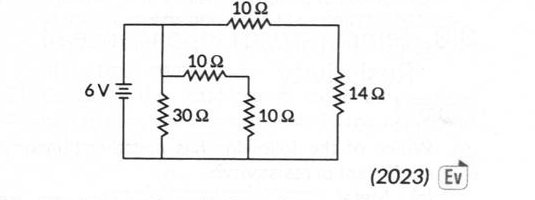
(i) Define mobility of electrons. Give its SI unit. (ii) A steady current flows through a wire of non-uniform cross-section (thickness decreasing from to ), as shown in the figure. What happens to the electric field and the drift velocity along the wire? Justify your answer. (iii) Consider the circuit shown in the figure. Find the effective resistance of the circuit and the current drawn from the battery.
- 17
(i) Explain how free electrons in a metal at constant temperature attain an average velocity under the action of an electric field. Hence obtain an expression for it. (ii) Consider two conducting wires and of the same diameter but made of different materials, joined in series across a battery. The number density of electrons in is 1.5 times that in . Find the ratio of drift velocity of electrons in wire to that in wire .
- 18
(i) Derive an expression for the drift velocity of electrons in a conductor. Hence deduce Ohm's law. (ii) A wire whose cross-sectional area is increasing linearly from one end to the other is connected across a battery of volts. Which of the following quantities remain constant in the wire: drift speed, current density, electric current, electric field? Justify your answer.
- 19
Define the term 'drift velocity' of charge carriers in a conductor. Obtain the expression for the current density in terms of relaxation time.
Numericals
Every numerical set on this subtopic. Full working is at the end of the page.
- 20
If , , and have their usual meanings, then the resistance of a wire of length and cross-sectional area is given by
- (a)
- (b)
- (c)
- (d)
- (a)
- 21
The potential difference applied across a given conductor is doubled. The mobility of the electrons in the conductor
- (a)
is doubled
- (b)
is halved
- (c)
remains unchanged
- (d)
becomes four times
- (a)
Answers & Solutions
Work the questions above first, then check yourself here. Each answer is set out the way it should be written in the paper.
Mobility depends only on the relaxation time (fixed by temperature) and constants ; it does not depend on the applied potential difference. Hence, keeping the temperature constant, the mobility of the electrons remains unchanged even when the potential difference is doubled.
Drift velocity . As temperature rises, the ions of the conductor vibrate more and collide with the free electrons more frequently, so the relaxation time decreases. Since , the drift velocity decreases with the rise in temperature (for a fixed applied field).
Drift velocity is the average velocity acquired by the free electrons of a conductor, superposed on their random thermal motion, under the influence of an externally applied electric field; it is directed opposite to the field. Relationship with current: , where is the free-electron density, the area of cross-section and the electronic charge.
, and since ,
Drift velocity: the average velocity with which free electrons drift towards the positive end of a conductor under an applied electric field (superposed on their random thermal motion). Since , current density
Mobility () is defined as the magnitude of the drift velocity acquired by a charge carrier per unit electric field: . Since ,
Drift velocity: Current density: , where Since resistivity ,
Drift velocity: the average velocity with which free electrons drift towards the positive end of a conductor under an applied field. Since , (i) Slope , i.e. the slope of the – line represents , which is inversely proportional to the length of the wire. (ii) Since slope , the wire with the smaller slope (line B) has the greater length. Hence wire is longer.
[Note on this record: the original figure was lost in import. Which wire is longer depends only on which line is the steeper, so that one fact has been stated in the question. Nothing else about the question or its answer has changed.]
Since the current is the same throughout in the steady state, and , i.e. and : (a) As the area decreases from to , the electric field increases from end to end . (b) Current density also increases from end to end , since decreases. (c) Mobility depends only on the material and temperature, not on the area of cross-section. Hence the mobility of the electron remains unchanged from end to end .
(a) Drift velocity: the average velocity acquired by free electrons in a conductor under an applied electric field, superposed on their random thermal motion; it determines the net current in the conductor. Relaxation time: the average time elapsed between two successive collisions of a free electron with the lattice ions; it is a measure of how a conductor's resistivity depends on temperature. (b) , where is the applied emf and is the conductor's length. For the new conductor of length (with the same ): So the drift velocity becomes one-fifth of its original value.
(a) Conductivity () is the reciprocal of resistivity, . SI unit: . (b) Current density Comparing with : Hence the relation between current density and applied field:
(a) Force on an electron, ; acceleration . Starting from rest after each collision (on average) and accelerating for the relaxation time : (b) . When the conductor is stretched to length keeping constant, So the drift velocity reduces to one-third of its original value.
In the steady state, charge cannot accumulate anywhere in the conductor, so the same current must flow through every cross-section. Since , and the area varies along a non-uniform conductor, the current density , drift speed and electric field must all vary (each is inversely proportional to ) so that their product with stays equal to the constant current . Hence only the current remains constant along the conductor.
(a) Consider a conductor of length , area of cross-section , with free electrons per unit volume. Total number of free electrons, . Time taken for an electron drifting with speed to cross the length : . Charge crossing a cross-section in this time: (b) Charge = area under the – graph: C
(i) Mobility . SI unit: . (ii) Since the current is the same everywhere, and the area decreases from to , the drift velocity is smaller at (larger area) and greater at (smaller area) — i.e. drift velocity increases from to . Also , so the electric field is correspondingly smaller at and greater at — i.e. the electric field also increases from to . (iii) The (right) and resistors are in series: . The (upper) and (lower-right) resistors are in series: . , and are all in parallel between the battery terminals: Current from battery: A
(i) The field exerts a force on each electron, giving it an acceleration between collisions. Since successive collisions randomize the electron's velocity, the average velocity gained (the drift velocity) is , where is the average time between collisions (relaxation time); the negative sign shows is opposite to . (ii) . Since and are in series, the current is the same: . Since the wires have the same diameter, , so:
(i) As derived above, . Now , and since : So , which is Ohm's law, with constant for a given conductor at constant temperature. (ii) The rate of flow of charge through a conductor of non-uniform cross-section is the same at every section (steady state), so the electric current remains constant. Since the area of cross-section varies along the wire, the current density , drift speed and electric field all vary — decreasing as the area increases.
Drift velocity: the average velocity with which free electrons drift towards the positive end of a conductor under an applied electric field. Current density:
and
Answer: (c) remains unchanged Mobility depends only on the relaxation time and the mass and charge of the electron — not on the applied potential difference (or field).