Chapter 1
Rotational Dynamics
Maharashtra HSC · 11 subtopics · textbook pages 1–25
Formula SheetEvery formula this chapter can be examined on, in one table.
Kinematics of Circular Motion
| Formula | Symbols, units and conditions |
|---|---|
| |
| |
| |
| |
| |
|
Dynamics of Circular Motion
| Formula | Symbols, units and conditions |
|---|---|
| |
|
Applications of Uniform Circular Motion
| Formula | Symbols, units and conditions |
|---|---|
| |
| |
| |
| |
| |
| |
| |
| |
| |
| |
|
Vertical Circular Motion (governed by gravity)
| Formula | Symbols, units and conditions |
|---|---|
| |
| |
| |
| |
| |
| |
| |
|
Moment of Inertia
| Formula | Symbols, units and conditions | ||||||||||||||||||||||||||||||||||||||||||
|---|---|---|---|---|---|---|---|---|---|---|---|---|---|---|---|---|---|---|---|---|---|---|---|---|---|---|---|---|---|---|---|---|---|---|---|---|---|---|---|---|---|---|---|
| |||||||||||||||||||||||||||||||||||||||||||
| |||||||||||||||||||||||||||||||||||||||||||
| |||||||||||||||||||||||||||||||||||||||||||
| |||||||||||||||||||||||||||||||||||||||||||
|
Radius of Gyration
| Formula | Symbols, units and conditions |
|---|---|
| |
| — |
Theorem of Parallel Axes and Theorem of Perpendicular Axes
| Formula | Symbols, units and conditions |
|---|---|
| |
| |
| — | |
| — |
Angular Momentum
| Formula | Symbols, units and conditions |
|---|---|
| |
| |
| — |
Torque in Terms of Moment of Inertia
| Formula | Symbols, units and conditions |
|---|---|
| |
|
Conservation of Angular Momentum
| Formula | Symbols, units and conditions |
|---|---|
| — | |
| |
|
Rolling Motion
| Formula | Symbols, units and conditions | |||||||||||||||
|---|---|---|---|---|---|---|---|---|---|---|---|---|---|---|---|---|
| ||||||||||||||||
| ||||||||||||||||
|
Standard Values Used in Board Numericals
- m/s in textbook problems unless otherwise stated; m/s wherever the paper states it.
- (or ); some problems set .
- km/h m/s. rpm rps.
Short NotesThe chapter subtopic by subtopic, in the textbook's own order.11 subtopics
- 1Introduction
- 2Characteristics of Circular Motion14 board questions
- 3Applications of Uniform Circular Motion18 board questions
- 4Vertical Circular Motion6 board questions
- 5Moment of Inertia as an Analogous Quantity for Mass3 board questions
- 6Radius of Gyration3 board questions
- 7Theorem of Parallel Axes and Theorem of Perpendicular Axes13 board questions
- 8Angular Momentum or Moment of Linear Momentum2 board questions
- 9Expression for Torque in Terms of Moment of Inertia8 board questions
- 10Conservation of Angular Momentum6 board questions
- 11Rolling Motion3 board questions
The whole chapter in brief
1.1 Introduction
- Revolution: every particle of the object moves in a circle about a point outside the object, or about another object.
- Rotation: the motion is about an axis of rotation that passes through the object itself.
1.2 Characteristics of Circular Motion
- It is an accelerated motion — the direction of velocity changes at every instant, even when the speed is constant.
- It is a periodic motion — the particle repeats the same path, so the motion is periodic in space.
- Uniform circular motion (U.C.M.): circular motion in which the speed of the particle remains constant. Only the direction of changes, and is always tangential.
- Non-uniform circular motion: the speed changes as well, so both (magnitude no longer constant) and are present.
- Tangential acceleration in U.C.M. is always zero.
- ; and lie along the axis of rotation, direction given by the right-hand thumb rule (curl the fingers along the sense of rotation, the outstretched thumb gives ).
- For increasing speed is along ; for decreasing speed it is opposite to .
- If has a component perpendicular to the axis, it changes the direction of and hence the plane of rotation. If is constant in magnitude but always perpendicular to , it changes only the direction of and never its magnitude.
- Kinematical equations , , hold only for constant, axial .
Centripetal and centrifugal force
- Centripetal force is the resultant of all the real forces acting on the body, directed towards the centre: , .
- "Centripetal" is not the name or type of a force — it is an adjective describing its direction (centre-seeking). The force itself is gravity, tension, friction or normal reaction.
- The converse is not true: a force directed towards a centre need not produce circular motion (S.H.M. is a counter-example). A matching tangential velocity is also essential.
- Centrifugal force is the net pseudo force in the rotating (non-inertial) frame: . It is non-real, but not imaginary — an instrument in that frame records it.
- Only in the frame of the rotating body can we say that centrifugal force balances centripetal force; there the resultant is zero.
| Centripetal force | Centrifugal force |
|---|---|
| Directed along the radius, towards the centre | Directed along the radius, away from the centre |
| It is a real force | It is a pseudo force |
| Considered in an inertial frame of reference | Considered in a non-inertial frame of reference |
1.3 Applications of Uniform Circular Motion
Vehicle on a horizontal circular track
- Forces: weight down, normal reaction up (), and static friction towards the centre. Friction is static because it prevents outward slipping (skidding).
- , and since , the speed has an upper limit — independent of the mass.
- A two-wheeler rider must lean at with the vertical so that the torque of the weight balances the torque of the centrifugal and frictional forces. A four-wheeler does not lean because its four normal reactions (unequal during a turn) already supply the balancing torque.
Well (wall) of death
- Vertical cylindrical wall of radius . Normal reaction is horizontal and is the entire centripetal force; static friction acts vertically upwards and equals (the only upward force).
- gives a lower limit: . The largest allowed period is .
- holds only at the minimum speed; at all higher speeds is still exactly .
- Banking angle here is , which is why it imposes a lower limit. For there are both an upper and a lower limit.
Vehicle on a banked road
- Roads are banked so that the horizontal component of the normal reaction supplies the centripetal force and we need not depend on friction, whose value is limited and not uniform over a road surface.
- Frictionless analysis: , , hence and — the most safe speed, not a maximum or minimum, and independent of the mass.
- Below , friction acts up the incline; above , it acts down the incline.
- and .
- If then (true for most rough roads banked at small angles). If then ; since , this means no upper limit for .
- Even a two-wheeler benefits from banking — it then needs to lean less, and the same limits apply.
- If friction were zero the vehicle could still move at exactly , but at any other speed it would skid; so the honest board answer is "No, the vehicle will skid in the absence of friction."
Conical pendulum
- A bob revolving in a horizontal circle so that the string sweeps out a right circular cone of vertical axis.
- (balances the weight), (the centripetal force). Dividing, .
- With : , period , frequency .
- Period and frequency depend on , and — never on the mass of the bob.
- The string can never become horizontal: at the vertical component of tension vanishes and nothing balances ; also , the kinetic energy and the frequency would all become infinite and the period zero.
1.4 Vertical Circular Motion
- Two kinds: (a) controlled, such as a giant wheel, where the speed is not governed by gravity alone; (b) controlled only by gravity, where energy is supplied once at the lowest point and thereafter K.E. and gravitational P.E. interconvert.
- Only two forces act at any position: constant weight , and the force due to tension (or normal reaction ) along the string towards the centre.
- The resultant is purely centripetal only at the uppermost and lowermost points. Elsewhere part of it is tangential and changes the speed.
| Position | Force equation | Minimum speed |
|---|---|---|
| Uppermost, A | ||
| Midway (string horizontal), C or D | ||
| Lowermost, B |
- Energy conservation over the drop gives ; over the drop , .
- and . These are independent of and — they depend only on the weight.
- can never be exactly zero for a string (it would slacken), so in practice .
- At an arbitrary angle from the lowest point, , and the rise above the lowest point is .
- Rod instead of string: the rod can push as well as pull, so zero speed is possible at the top. Then , , and still .
- Sphere of death: identical dynamics with in place of .
- Convex over-bridge: ; falls as rises and contact is just lost at .
- No parameter is constant in this motion, so the kinematical equations of Table 1 do not apply, and the period cannot be found theoretically (only measured).
1.5 Moment of Inertia
- Definition: the moment of inertia of a rigid body about an axis of rotation is the sum of the products of the mass of each particle and the square of its perpendicular distance from that axis.
- . SI unit kg m; dimensions .
- It depends on (i) the individual masses and (ii) how those masses are distributed about the given axis — so the same body has different about different axes.
- Rotational K.E. , the exact analogue of ; this is what identifies as the rotational analogue of mass.
- Uniform ring about its own axis: the whole mass is at distance , so with no integration.
- Uniform disc about its own axis: integrating over concentric rings, .
1.6 Radius of Gyration
- Definition: the distance between the axis of rotation and the point at which the whole mass of the body may be supposed to be concentrated so as to give the same moment of inertia about that axis. .
- Its use: can be calculated only for mathematically integrable shapes, but it can be measured for any object. Writing separates out the mass and leaves carrying the information about how the mass is distributed.
- depends on the distribution of mass about the given axis (and on the shape and the choice of axis); it does not depend on the mass of the body.
- Larger means the mass sits farther from the axis. For the same and : , , so — among objects of the same mass and radius, the ring has the largest and hence the largest .
- Like the centre of mass, is a single equivalent location that stands in for the whole distribution — but it is defined with respect to an axis, not a point.
1.7 Theorems of Parallel and Perpendicular Axes
| Theorem of parallel axes | Theorem of perpendicular axes |
|---|---|
| Needs two parallel axes, one passing through the centre of mass | Needs three mutually perpendicular concurrent axes |
| Applies to any object, laminar or not | Applies only to a laminar (two-dimensional) object |
| = distance between the axes | and lie in the plane, is perpendicular to it |
- In terms of radius of gyration, the parallel axes theorem reads .
- Useful transforms: disc about a diameter ; disc about a tangent in its plane ; disc about a tangent perpendicular to its plane ; ring about a diameter ; sphere about a tangent ; rod about a transverse axis through one end .
1.8 Angular Momentum
- ; in magnitude , the product of linear momentum and its perpendicular distance from the axis.
- For a rigid body rotating about a fixed axis, — analogous to , which is the physical significance of .
- K.E. .
- SI unit kg m/s; dimensions .
1.9 Torque
- , obtained by summing over all particles — analogous to .
- . SI unit N m; dimensions .
- Work done by a torque ; power .
- A "couple of 20 N m" in a numerical simply means a torque of 20 N m.
1.10 Conservation of Angular Momentum
- Statement: the angular momentum of an isolated system is conserved in the absence of an external unbalanced torque.
- Proof in one line: , and ; so gives = constant.
- Working form: , i.e. . Decreasing raises and vice versa.
- Standard examples: ballet dancers and ice skaters pulling limbs in for fast small-radius rounds and stretching out for slow large-radius ones; a diver folding up after leaving the board to spin faster and stretching out for a clean entry; a planet speeding up near the sun in an elliptical orbit; a person on a rotating platform changing speed by moving weights in and out.
- For a planet in a circular orbit the angular momentum is trivially constant too — conservation applies to both circular and elliptical orbits, because the gravitational force is central and exerts no torque about the sun.
1.11 Rolling Motion
- Pure rolling is treated as rotation of the whole body about its own symmetry axis plus translation of the whole mass concentrated at the centre of mass; the centre of mass performs purely translational motion, and .
- Static friction is essential for pure rolling — it prevents sliding. It is why a pushed sphere first slips and only then starts rolling.
- .
- Down an incline: and . For pure sliding these become and — the factor is the only difference.
- Because contains no mass and no radius, all bodies of the same shape roll down an incline with the same acceleration, whatever their size or mass.
- When a rod rolls, it is really a cylinder that is rolling.
Analogy Between Translational and Rotational Motion
| Translational | Rotational | Relation |
|---|---|---|
| Displacement | Angular displacement | |
| Velocity | Angular velocity | |
| Acceleration | Angular acceleration | |
| Mass | Moment of inertia | |
| Linear momentum | Angular momentum | |
| Force | Torque | |
| Work | Work | — |
| Power | Power | — |
| K.E. | K.E. | — |
Traps That Cost Marks
- Writing "centripetal force" as a separate extra force in a free-body diagram. It is the resultant of the real forces already drawn, not another arrow.
- Forgetting that points along the axis, not along the velocity. A fan seen from below turning anticlockwise and slowing has upwards (towards the viewer, downwards in space terms is the common error) and opposite to .
- Converting rpm carelessly. Always , then . For angular displacement, revolutions is rad.
- Quoting for the well of death. There it is — the moves to the denominator.
- Using at the top of a vertical circle. is the top, the midway point, the bottom.
- Applying the perpendicular axes theorem to a solid sphere or a cylinder. It works only for laminar objects.
- Applying the parallel axes theorem from an axis that is not through the centre of mass. in must be about the centre-of-mass axis.
- Using alone for a rolling body. The rotational share is times the translational share.
- Mixing up (rod about its centre) with (rod about one end).
- Leaving the answer in cm, g or rpm when the question asks for SI units.
Two Quick Results Worth Memorising
- A uniform disc and a uniform hollow right circular cone have the same central-axis formula — because in both, the mass per unit radial distance is distributed in the same proportional way about the axis.
- If a disc has about its central transverse axis, then , so ; about a tangent in its plane gives , i.e. in the same units.
Solved Numerical ExamplesWorked numericals to attempt first, each with a hint before the full solution.Coming soon
These are being added chapter by chapter. They are solved numericals from the prescribed book and the reference guides — not previous board questions, which live under Practice — so that you can work through the method before meeting it in a real paper.
Important DerivationsEvery derive / obtain / prove question in this chapter. 4 have come up in two or more papers.14
- 1Kinetic energy of a rotating body (uniform angular speed) RepeatsDerive an expression for the kinetic energy of a body rotating with a uniform angular speed.
Asked in: March 2022 (Q.19, 3 marks); July 2022 (Q.17, 3 marks)
Show the derivationHide the derivation
Derivation of an expression for the kinetic energy of a body rotating with a uniform angular speed:Step 1Consider a rigid object rotating with a constant angular speed ω about an axis perpendicular to the plane of paper.Step 2For theoretical simplification, let us consider the object to be consisting of N particles of masses at respective perpendicular distances from the axis of rotation.Step 3As the object rotates, all these particles perform UCM with the same angular speed ω, but with different linear speeds,Step 4Translational K.E. of the first particle is,Translational K.E. of the second particle is,Similar will be the case of all the remaining particles.Step 5Rotational K.E. of the object is the sum of individual translational kinetic energies. Thus,Rotational K.E.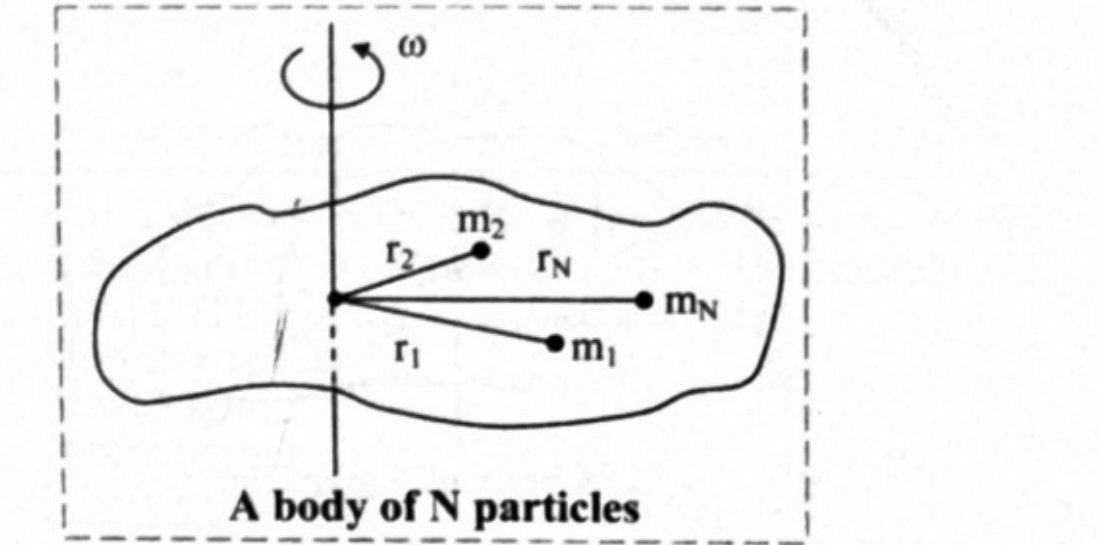
- 2Principle of conservation of angular momentum RepeatsState and prove the principle of conservation of angular momentum.
Asked in: October 2015; February 2023 (Q.5, 2 marks)
Show the derivationHide the derivation
Step 1Statement: Angular momentum of an isolated system is conserved in the absence of an external unbalanced torque.Step 2Illustration — Ballet dancers: a. During ice ballet, the dancers have to undertake rounds of smaller and larger radii. b. The dancers come together by taking rounds of smaller radius (near the centre). c. In this case, the moment of inertia of their system becomes minimum and the frequency increases, to make it thrilling. d. While during outer rounds, the dancers outstretch their legs and arms. e. This increases their moment of inertia that reduces the angular speed and hence the linear speed. This is essential to prevent slipping.ProofStep 1Angular momentum or the moment of linear momentum of a system is given by,where is the position vector from the axis of rotation and is the linear momentum.Step 2Differentiating with respect to time, we get,Step 3Now, andNowStep 4But is the moment of force or torque .Thus, if , or constant.Hence, angular momentum is conserved in the absence of external unbalanced torque . - 3Theorem of parallel axes RepeatsState and prove the theorem of parallel axes.
Asked in: March 2014; July 2023 (Q.27, 4 marks)
Show the derivationHide the derivation
StatementThe moment of inertia () of an object about any axis is the sum of its moment of inertia () about an axis parallel to the given axis, and passing through the centre of mass and the product of the mass of the object and the square of the distance between the two axes.Mathematically,ProofStep 1Consider an object of mass M. Axis MOP is any axis passing through point O.Step 2Axis ACB is passing through the centre of mass C of the object, parallel to the axis MOP, and at a distance h from it ().Step 3Consider a mass element 'dm' located at point D. Perpendicular on OC (produced) from point D is DN.Step 4Moment of inertia of the object about the axis ACB is , and about the axis MOP it is .Now, andStep 5NC is the distance of a point from the centre of mass. Any mass distribution is symmetric about the centre of mass. Thus, from the definition of the centre of mass,This is the mathematical form of the theorem of parallel axes.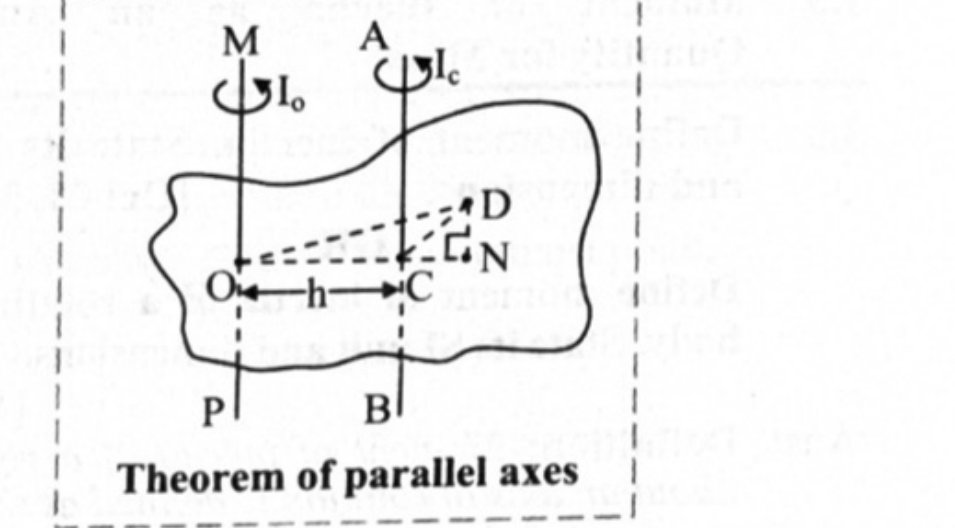
- 4Maximum speed of a vehicle on a horizontal circular trackDerive an expression for maximum speed of a vehicle moving along a horizontal circular track.
Asked in: February 2024 (Q.11, 2 marks)
Show the derivationHide the derivation
Step 1Consider vertical section of a car moving on a horizontal circular track having a radius 'r' with 'C' as centre of track.Step 2Forces acting on the car (considered to be a particle): (a) Weight (mg), vertically downwards, (b) Normal reaction (N), vertically upwards that balances the weight, (c) Force of static friction () between road and the tyres.Step 3Since, normal reaction balances the weight....(1)Step 4The friction over here is static friction which acts as resultant centripetal force because it prevents the vehicle from outward slipping or skidding.Step 5While working in the frame of reference attached to the vehicle, the frictional force balances the centrifugal force.Dividing equation (2) by equation (1),Step 6For a given track, radius r is constant. For given vehicle, mg = N is constant. Thus, as the speed v increases, the force of static friction also increases.Step 7However, has an upper limit , where is the coefficient of static friction between road and tyres of the vehicle. This imposes an upper limit to the speed v.Step 8At the maximum possible speed,This is an expression for maximum possible speed for a vehicle to move on a horizontal circular track.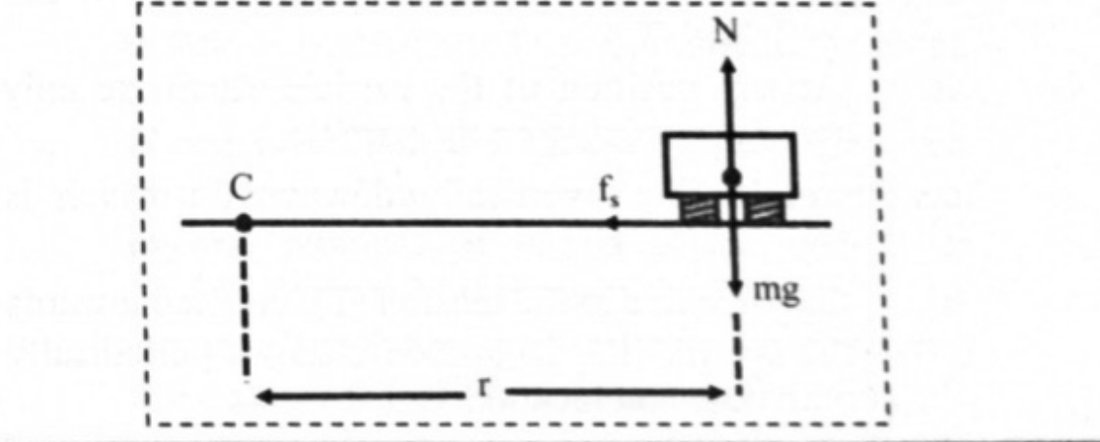
- 5Vertical circular motion -- velocities at lowest, mid-way and top-most positionsDerive expressions for linear velocity at the lowest position, mid-way position and the top-most position for a particle revolving in a vertical circle, if it has to just complete the circular motion without the string slackening at the top.
Asked in: February 2023 (Q.31, 4 marks)
Show the derivationHide the derivation
[From 1.4, Q1 (i)]Step 1Consider a particle of mass m moving along a vertical circle.Step 2At any position of the particle, there are only two forces acting on the particle: a. weight (mg), vertically downwards, which is constant; b. the force due to the tension (T), directed towards the centre. (Its magnitude changes periodically with time and location.)Step 3As the motion is non uniform, the resultant of these two forces is not directed towards the centre except at the uppermost and the lowermost positions of the bob.Step 4Uppermost position (A): a. Both, weight (mg) and force due to tension () are downwards, i.e., towards the centre. In this case, their resultant is used only as the centripetal force. b. Thus, if is the speed at the uppermost point,c. For minimum possible speed at this point (or if the motion is to be realized with minimum possible energy),Step 5Lowermost position (B): a. Force due to the tension, is vertically upwards, i.e., towards the centre, and opposite to mg. In this case, their resultant is the centripetal force. b. If is the speed at the lowermost point,c. While coming down from the uppermost to the lowermost point, the vertical displacement is 2r and the motion is governed only by gravity. d. Hence the corresponding decrease in the gravitational potential energy is converted into the kinetic energy.Step 6Difference between the extreme tensions: Subtracting equation (1) from equation (3),Using equation (4) and rearranging, we get,Hence, difference in tension at extreme positions depends only on weight. to (v) and diagram.vi. Positions when the string is horizontal (C and D): a. Force due to the tension is the only force towards the centre as weight mg is perpendicular to the tension. b. Thus, force due to the tension is the centripetal force used to change the direction of the velocity and weight mg is used only to change the speed. c. At midway position (C), while coming down from the midway point to the lowermost point, the vertical displacement is 'r'. Hence, the corresponding decrease in the gravitational P.E. is converted into K.E.Since,Similarly - 6Minimum speed to perform stunts in a 'well of death'Derive an expression for minimum speed to perform stunts in a well of death.
Asked in: July 2024 (Q.27, 4 marks)
Show the derivationHide the derivation
The question is a real board question. This working is ours — no source printed a derivation for it.
Diagram
Draw a vertical cylinder of inner radius seen from the side, with the motorcycle on the inside of the wall at the level of the centre. Mark three forces at the point of contact: the normal reaction pointing horizontally inwards, towards the axis of the cylinder; the weight vertically downwards; and the force of static friction vertically upwards along the wall.
Setting up
The rider moves in a horizontal circle of radius on the inside of the vertical wall, so the centripetal force must be horizontal and directed at the axis. The only horizontal force acting is the normal reaction, so
The wall is vertical, so it can hold the rider up only through friction. For the rider not to slide down, the upward force of static friction must balance the weight:
Applying the limit on static friction
Static friction cannot exceed its limiting value,
where is the coefficient of static friction between the tyres and the wall. Substituting both results,
The mass cancels — the answer does not depend on how heavy the machine is:
Result
Below this speed the wall cannot press hard enough for friction to carry the weight and the rider slides down. Note what the expression does **not** contain: the mass of the rider and machine, so a heavier rider needs exactly the same minimum speed.
- 7Moment of inertia of a uniform disc about a perpendicular axis through its centreObtain an expression for the moment of inertia of a uniform disc of mass 'M' and radius 'R' rotating about an axis passing through its centre and perpendicular to its plane.
Asked in: June 2025 (Q.3, 2 marks)
Show the derivationHide the derivation
Expression of M.I of uniform disc about an axis passing through its centre and perpendicular to its plane:Step 1Let, M = mass of disc, R = radius of disc, ZZ' = axis passing through the centre of disc and perpendicular to the plane.Step 2The M.I of a thin uniform disc about an axis passing through its centre and perpendicular to its plane is given by, - 8Torque on a rigid body rotating with constant angular acceleration RepeatsObtain an expression for torque acting on a rigid body rotating with constant angular acceleration.
Asked in: July 2016; June 2025 (Q.15, 3 marks)
Show the derivationHide the derivation
Step 1Consider a rigid object rotating with a constant angular acceleration 'α' about an axis perpendicular to the plane of paper.Step 2Let us consider the object to be consisting of N number of particles of masses at respective perpendicular distances from the axis of rotation.Step 3As the object rotates, all these particles perform circular motion with same angular acceleration α, but with different linear (tangential) accelerations ,etc.Step 4Force experienced by the first particle is,Step 5As these forces are tangential, the irrespective perpendicular distances from the axis are .Step 6Thus, the torque experienced by the first particle is of magnitudeSimilarly,Step 7If the rotation is restricted to a single plane, directions of all these torques are the same, and along the axis.Step 8Magnitude of the resultant torque is then given bywhere, is the moment of inertia of the object about the given axis of rotation.ii. Illustration: Ballet dancers: a. During ice ballet, the dancers have to undertake rounds of smaller and larger radii. b. The dancers come together by taking rounds of smaller radius (near the centre). c. In this case, the moment of inertia of their system becomes minimum and the frequency increases, to make it thrilling. d. While during outer rounds, the dancers outstretch their legs and arms. e. This increases their moment of inertia that reduces the angular speed and hence the linear speed. This is essential to prevent slipping.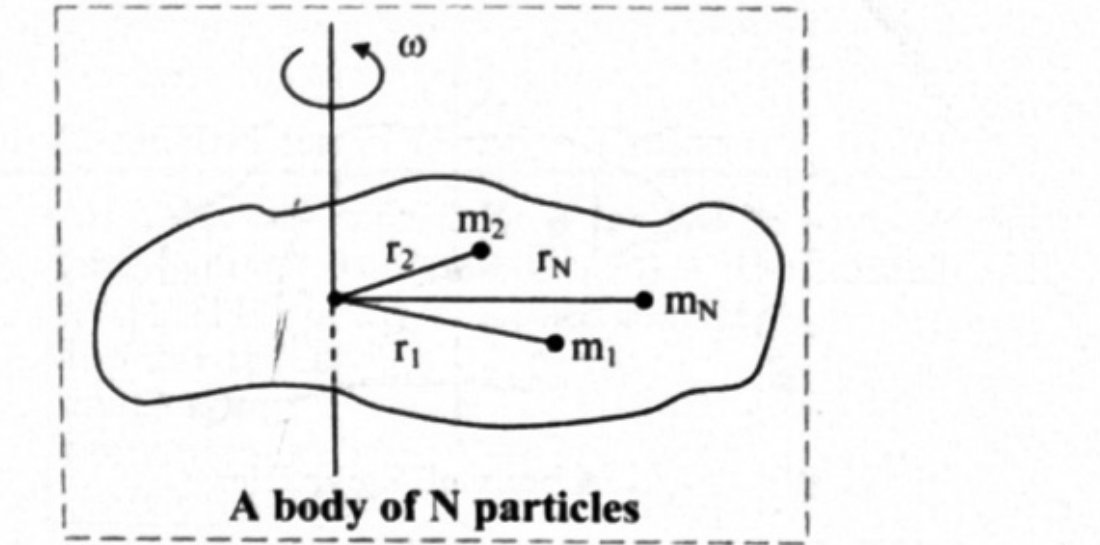
- 9Maximum safety speed on a curved horizontal road (banking of roads)Obtain an expression for the maximum safety speed with which a vehicle should move along a curved horizontal road.
Asked in: February 2026 (Q.28, 4 marks)
Show the derivationHide the derivation
Step 1The vertical section of a vehicle on a curved road of radius 'r' banked at an angle 'θ' with the horizontal is shown in the figure.Step 2Considering the vehicle to be a point and ignoring friction (not eliminating) and other non-conservative forces like air resistance, there are two forces acting on the vehicle: a. weight (mg), vertically downwards; b. normal reaction (N), perpendicular to the surface of the road.Step 3As the motion of the vehicle is along a horizontal circle, the resultant force must be horizontal and directed towards the centre of the track. Hence, the vertical force mg must be balanced.Step 4Thus, normal reaction (N) is resolved into: a. Nsinθ - along the horizontal. b. Ncosθ - along the vertical.Step 5The vertical component Ncosθ balances the weight,....(1)Step 6Horizontal component Nsinθ being the resultant force, must be the necessary centripetal force (or balance the centrifugal force).....(2)Dividing equation (2) by equation (1),Step 7Thus, most safe speed,Step 8As the equation doesnot contain mass m, it is independent of mass of the vehicle.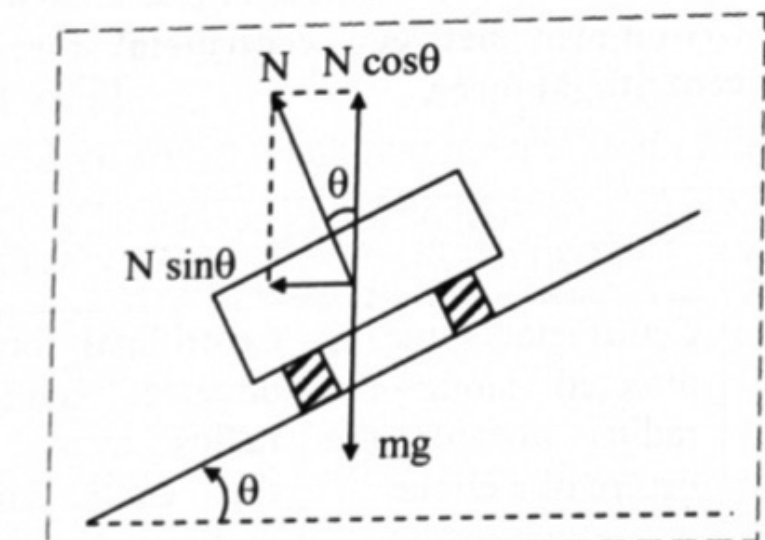
- 10Period of a conical pendulumDerive an expression for the period of a conical pendulum.
Asked in: March 2008
Show the derivationHide the derivation
Step 1Consider the vertical section of a conical pendulum having bob (point mass) of mass m and string of length 'L'.Step 2Here, θ is the angle made by the string with the vertical, at any position (semi-vertical angle of the cone).Step 3In a given position B, the forces acting on the bob are: a. its weight 'mg' directed vertically downwards; b. the force 'T₀' due to the tension in the string, directed along the string, towards the support A.Step 4As the motion of the bob is a horizontal circular motion, the resultant force must be horizontal and directed towards the centre C of the circular motion.Step 5For this, tension (T₀) in the string is resolved into: a. T₀cosθ : vertical component; b. T₀sinθ : horizontal componentStep 6The vertical component (T₀cosθ) balances the weight 'mg'.....(1)Step 7The horizontal component T₀sinθ then becomes the resultant force which is centripetal.....(2)Dividing equation (2) by equation (1),Step 8From the figure,....(4)From equation (3) and (4),Step 9If T is the period of revolution of the bob, thenPeriod,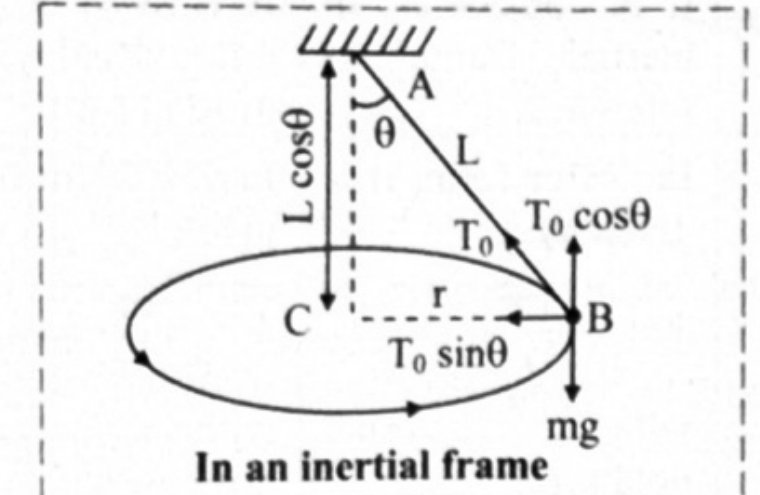
- 11Conical pendulum: relationFor a conical pendulum, prove that .
Asked in: October 2009
Show the derivationHide the derivation
Step 1Consider a bob of mass m tied to one end of a string of length 'l' and other end is fixed to rigid support.Step 2Let the bob be displaced from its mean position and whirled around a horizontal circle of radius 'r' with constant angular velocity ω, then the bob performs U.C.M.Step 3During the motion, string is inclined to the vertical at an angle θ as shown in the figure.S : rigid support; T : tension in the string; l : length of string; h : height of support from bob; v : velocity of bob; r : radius of horizontal circle; θ : semi vertical angle; mg : weight of bobStep 4In the displaced position P, there are two forces acting on the bob: a. The weight mg acting vertically downwards. b. The tension T acting upward along the string.Step 5The tension (T) acting in the string can be resolved into two components: a. Tcosθ acting vertically upwards. b. Tsinθ acting horizontally towards centre of the circle.Step 6Vertical component Tcosθ balances the weight and horizontal component Tsinθ provides the necessary centripetal force.....(1)....(2)Step 7Dividing equation (2) by (1), we get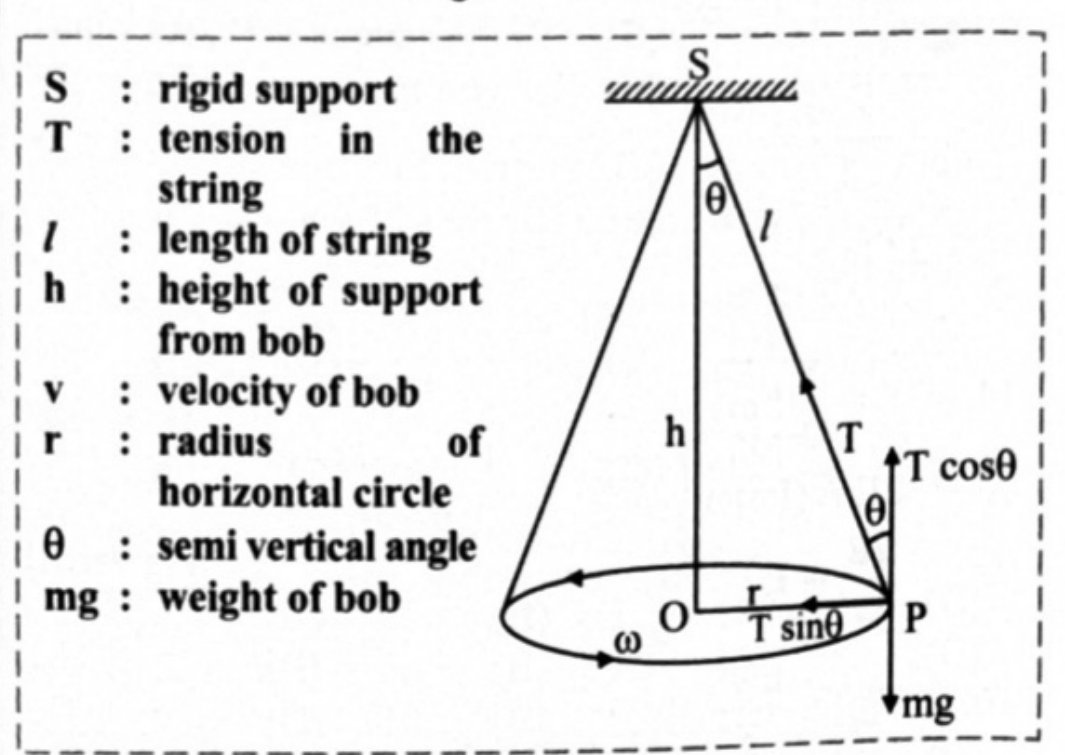
- 12Vertical circular motion: difference in tensions at the highest and lowest pointsA particle of mass m just completes vertical circular motion. Derive the expression for the difference in tensions at the highest and the lowest points.
Asked in: March 2013
Show the derivationHide the derivation
Step 1Consider a particle of mass m moving along a vertical circle.Step 2At any position of the particle, there are only two forces acting on the particle: a. weight (mg), vertically downwards, which is constant; b. the force due to the tension (T), directed towards the centre. (Its magnitude changes periodically with time and location.)Step 3As the motion is non uniform, the resultant of these two forces is not directed towards the centre except at the uppermost and the lowermost positions of the bob.Step 4Uppermost position (A): a. Both, weight (mg) and force due to tension () are downwards, i.e., towards the centre. In this case, their resultant is used only as the centripetal force. b. Thus, if is the speed at the uppermost point,c. For minimum possible speed at this point (or if the motion is to be realized with minimum possible energy),Step 5Lowermost position (B): a. Force due to the tension, is vertically upwards, i.e., towards the centre, and opposite to mg. In this case, their resultant is the centripetal force. b. If is the speed at the lowermost point,c. While coming down from the uppermost to the lowermost point, the vertical displacement is 2r and the motion is governed only by gravity. d. Hence the corresponding decrease in the gravitational potential energy is converted into the kinetic energy.Step 6Difference between the extreme tensions: Subtracting equation (1) from equation (3),Using equation (4) and rearranging, we get,Hence, difference in tension at extreme positions depends only on weight.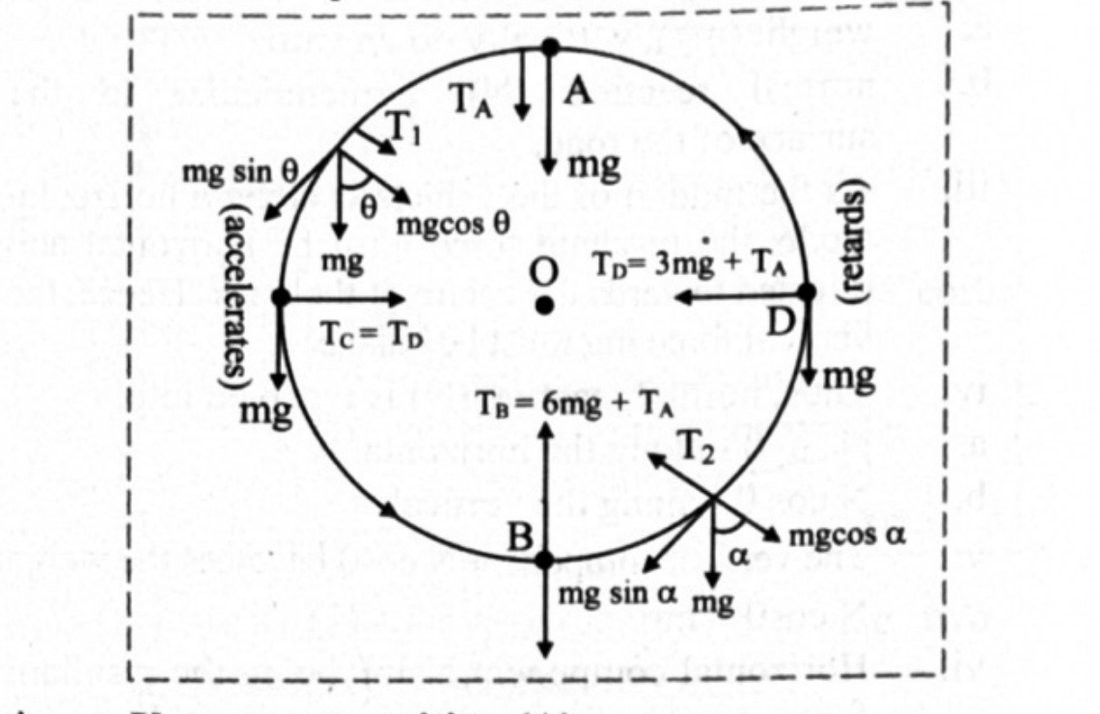
- 13Theorem of perpendicular axesState and prove the theorem of perpendicular axes.
Asked in: March 2010
Show the derivationHide the derivation
StatementThe moment of inertia of a laminar object about an axis (Z) perpendicular to its plane is the sum of its moment of inertia about two mutually perpendicular axes (X and Y) in its plane, all the three axes being concurrent.Mathematically,ProofStep 1Consider a rigid laminar object able to rotate about three mutually perpendicular axes X, Y and Z.Step 2Axes X and Y are in the plane of the object while the Z axis is perpendicular to it, and all are concurrent at O.Step 3Consider a mass element dm located at any point P. PM = y and PN = x are the perpendiculars drawn from P respectively on the X and Y axes.Step 4The respective perpendicular distances of point P from X, Y and Z axes will then be y, x and .Step 5If , and are the respective moment of inertia of the body about x, y and z axes, thenThis is the mathematical form of the theorem of perpendicular axes.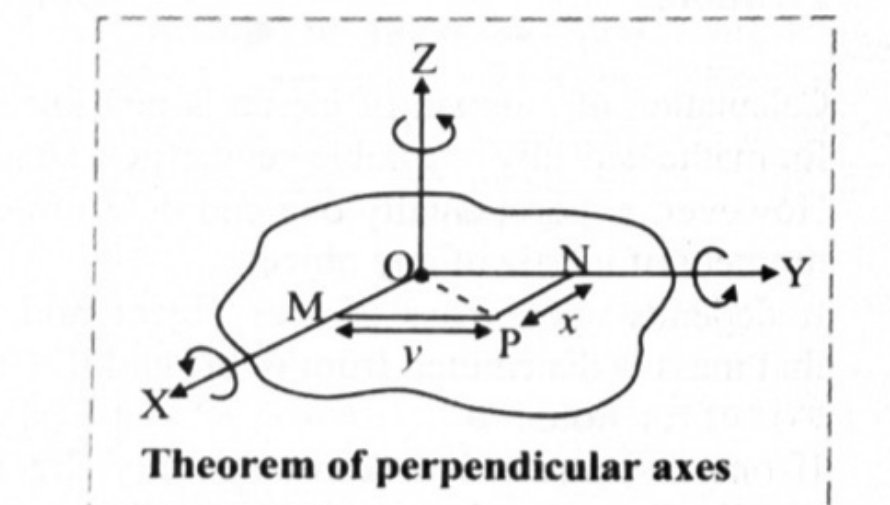
- 14Kinetic energy of a rolling body (translation + rotation)Derive an expression for kinetic energy when a rigid body is rolling on a horizontal surface without slipping. Hence find the kinetic energy for a solid sphere.
Asked in: March 2013
Show the derivationHide the derivation
Expression for kinetic energy of rolling sphere:Step 1Mass of the sphere is given to be M. Let, v = linear velocity of the sphere, ω = angular velocity of the sphere, I = moment of inertia of the sphere, K = radius of gyrationStep 2Total K.E of rolling bodySince the value of 'K' is different for different bodies, so also varies from body to body.
Finished revising this chapter? Practise Rotational Dynamics →