1.7
Theorem of Parallel Axes and Theorem of Perpendicular Axes
Rotational Dynamics · Maharashtra HSC
Theory
Why the Theorems Are Needed
The standard expressions for the moments of inertia of regular geometrical shapes are all about their axes of symmetry, derived by integration. But the axis of rotation need not always be the axis of symmetry: a rod may be rotated about one of its ends (an axis parallel to the symmetry axis), or a disc or a ring about its diameter (an axis perpendicular to the central axis). In such cases simple transformations are possible, and these are the theorem of parallel axes and the theorem of perpendicular axes.
Theorem of Parallel Axes
Statement
The moment of inertia of an object about any axis is the sum of its moment of inertia about an axis parallel to the given axis and passing through the centre of mass, and the product of the mass of the object and the square of the distance between the two axes.
Diagram
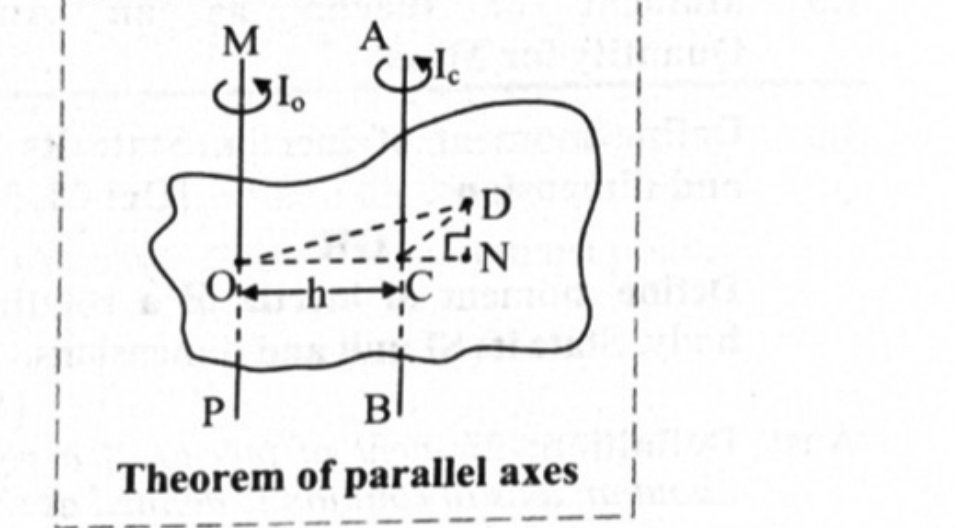
Draw an irregular lamina of mass . Mark its centre of mass and draw the axis through , perpendicular to the plane of the figure as drawn (or vertical in the plane of the figure). Draw a parallel axis through a point at a distance from , so . Mark a mass element at a point . Drop the perpendicular from onto produced.
Proof
To apply this theorem we need two axes parallel to each other, one of them passing through the centre of mass of the object.
Consider an object of mass . The axis is any axis passing through the point . The axis passes through the centre of mass , parallel to , at a distance from it, so . Consider a mass element located at the point ; the perpendicular from on (produced) is .
The moment of inertia of the object about the axis is , and about the axis it is .
Now and .
is the distance of a point from the centre of mass. Any mass distribution is symmetric about the centre of mass, so from the definition of the centre of mass,
This is the mathematical form of the theorem of parallel axes.
In terms of the radius of gyration, dividing throughout by gives .
Condition of application: it applies to any object, laminar or three-dimensional, provided the two axes are parallel and one of them passes through the centre of mass.
Theorem of Perpendicular Axes
Statement
The moment of inertia of a laminar object about an axis perpendicular to its plane is the sum of its moments of inertia about two mutually perpendicular axes and in its plane, all three axes being concurrent.
Diagram
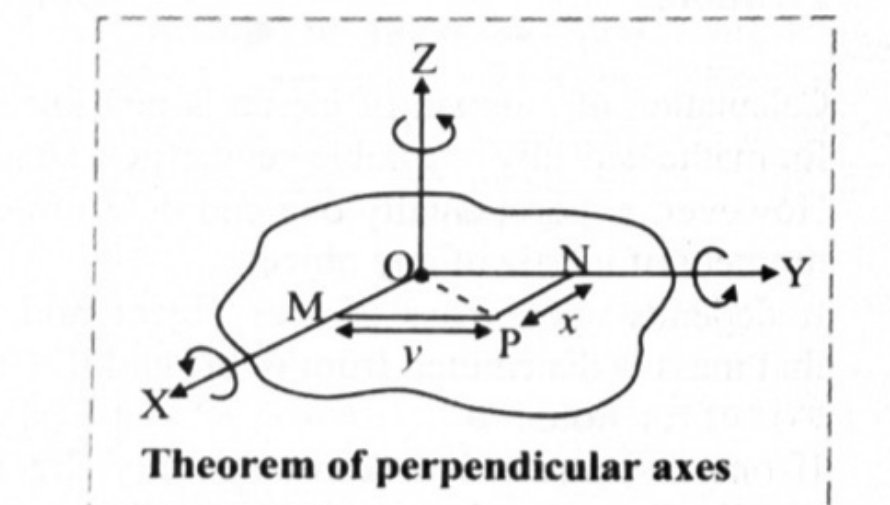
Draw a flat laminar object in the plane of the paper with the and axes in its plane, meeting at , and the axis through perpendicular to the plane. Mark a mass element at a point in the lamina. Drop perpendiculars onto the axis and onto the axis.
Proof
This theorem relates the moments of inertia of a laminar object about three mutually perpendicular and concurrent axes, two of them in the plane of the object and the third perpendicular to it. A laminar object is like a leaf or any two-dimensional object — a ring, a disc, a plane sheet.
Consider a rigid laminar object able to rotate about three mutually perpendicular axes , and . The axes and are in the plane of the object while the axis is perpendicular to it, and all are concurrent at . Consider a mass element located at any point , with and the perpendiculars drawn from on the and axes respectively. The perpendicular distances of from the , and axes are then , and .
This is the mathematical form of the theorem of perpendicular axes.
Condition of application: it applies only to a laminar (two-dimensional) object, and the three axes must be mutually perpendicular and concurrent.
Worked Transformations the Board Sets
Moment of inertia of a uniform disc about its central transverse axis
Let = mass of the disc, = radius, and the axis passing through the centre and perpendicular to the plane. Then
Disc about a diameter
Take any two mutually perpendicular diameters and of the disc. Together with the central axis , the three are mutually perpendicular and concurrent, so the perpendicular axes theorem applies. By symmetry , so
Disc about a tangent in its plane
A tangent in the plane of the disc, parallel to a diameter, is at a distance from that diameter, which passes through the centre of mass. By the parallel axes theorem,
Sphere about a tangent
For a solid sphere of density , , so .
Rod about a transverse axis through one end
Standard Results
- Parallel axes: ; in radii of gyration, — any object, one axis through the centre of mass
- Perpendicular axes: — laminar objects only, three concurrent mutually perpendicular axes
- Disc: central ; diameter ; tangent in plane ; tangent perpendicular to plane
- Ring: central ; diameter ; tangent in plane
- Solid sphere: central ; tangent
- Rod: centre ; one end
- Solid cylinder, transverse axis through the centre:
Theory Questions Asked on This Subtopic
Real board questions. Answers are at the end of the page.
- 1
State and prove the principle of perpendicular axes.
 Maharashtra HSC board question — asked in March 2010Answer 1 ↓
 - 2
State and prove theorem of parallel axes.
 Maharashtra HSC board question — asked in March 2014Answer 2 ↓
 - 3
State theorem of parallel axes and theorem of perpendicular axes about moment of inertia.
Maharashtra HSC board question — asked in March 2015Answer 3 ↓ - 4
State an expression for the moment of inertia of a solid uniform disc, rotating about an axis passing through its centre, perpendicular to its plane.
Maharashtra HSC board question — asked in October 2015Answer 4 ↓ - 5
State and prove theorem of parallel axes about moment of inertia. OR State and prove principle of parallel axes in roational motion OR State and prove the principle of parallel axes.
Maharashtra HSC board question — asked in February 2020; July 2023; March 2016Answer 5 ↓
Numericals
Every numerical set on this subtopic. Full working is at the end of the page.
- 6
A solid cylinder of uniform density of radius 2 cm has mass of 50 g. If its length is 12 cm, calculate its moment of inertia about an axis passing through its centre and perpendicular to its length.
Maharashtra HSC board question — asked in March 2014Answer 6 ↓ - 7
A uniform solid sphere has a radius 0.1 m and density kg/m. Find its moment of inertia about a tangent to its surface.
Maharashtra HSC board question — asked in July 2016Answer 7 ↓ - 8
A uniform solid sphere has radius 0.2 m and density kg/m. Find the moment of inertia about the tangent to its surface. (π = 3.142)
Maharashtra HSC board question — asked in July 2017Answer 8 ↓ - 9
The radius of gyration of a body about an axis, at a distance of 0.4 m from its centre of mass is 0.5 m. Find its radius of gyration about a parallel axis passing through its centre of mass.
Maharashtra HSC board question — asked in March 2019Answer 9 ↓ - 10
Find the radius of gyration of a rod of length 3 m about its transverse axis passing through its one end.
Maharashtra HSC board question — asked in July 2019Answer 10 ↓ - 11
The M.I. of solid sphere about an axis passing through its centre is 2 kg-m. Calculate its M.I. about a tangent passing through any point on its surface.
Maharashtra HSC board question — asked in July 2019Answer 11 ↓ - 12
Calculate the moment of inertia of a uniform disc of mass 10 kg and radius 60 cm about an axis perpendicular to its length and passing through its centre.
Maharashtra HSC board question — asked in March 2022Answer 12 ↓ - 13
The surface density of a uniform disc of radius 10 cm is 2 kg/m. Find its MI about an axis passing through its centre and perpendicular to its plane.
Maharashtra HSC board question — asked in July 2022Answer 13 ↓
Answers & Solutions
Work the questions above first, then check yourself here. Each answer is set out the way it should be written in the paper.
Statement: The moment of inertia of a laminar object about an axis (Z) perpendicular to its plane is the sum of its moment of inertia about two mutually perpendicular axes (X and Y) in its plane, all the three axes being concurrent. Mathematically, Proof: i. Consider a rigid laminar object able to rotate about three mutually perpendicular axes X, Y and Z. ii. Axes X and Y are in the plane of the object while the Z axis is perpendicular to it, and all are concurrent at O. iii. Consider a mass element dm located at any point P. PM = y and PN = x are the perpendiculars drawn from P respectively on the X and Y axes. iv. The respective perpendicular distances of point P from X, Y and Z axes will then be y, x and . v. If , and are the respective moment of inertia of the body about x, y and z axes, then This is the mathematical form of the theorem of perpendicular axes.
Statement: The moment of inertia () of an object about any axis is the sum of its moment of inertia () about an axis parallel to the given axis, and passing through the centre of mass and the product of the mass of the object and the square of the distance between the two axes. Mathematically, Proof: i. Consider an object of mass M. Axis MOP is any axis passing through point O. ii. Axis ACB is passing through the centre of mass C of the object, parallel to the axis MOP, and at a distance h from it (). iii. Consider a mass element 'dm' located at point D. Perpendicular on OC (produced) from point D is DN. iv. Moment of inertia of the object about the axis ACB is , and about the axis MOP it is . Now, and v. NC is the distance of a point from the centre of mass. Any mass distribution is symmetric about the centre of mass. Thus, from the definition of the centre of mass, This is the mathematical form of the theorem of parallel axes.
Parallel axes theorem: [From 1.7, Q2 (Statement only)] Statement: The moment of inertia () of an object about any axis is the sum of its moment of inertia () about an axis parallel to the given axis, and passing through the centre of mass and the product of the mass of the object and the square of the distance between the two axes. Mathematically, Proof: i. Consider an object of mass M. Axis MOP is any axis passing through point O. ii. Axis ACB is passing through the centre of mass C of the object, parallel to the axis MOP, and at a distance h from it (). iii. Consider a mass element 'dm' located at point D. Perpendicular on OC (produced) from point D is DN. iv. Moment of inertia of the object about the axis ACB is , and about the axis MOP it is . Now, and v. NC is the distance of a point from the centre of mass. Any mass distribution is symmetric about the centre of mass. Thus, from the definition of the centre of mass, This is the mathematical form of the theorem of parallel axes. Perpendicular axes theorem: [From 1.7, Q1 (Statement only)] Statement: The moment of inertia of a laminar object about an axis (Z) perpendicular to its plane is the sum of its moment of inertia about two mutually perpendicular axes (X and Y) in its plane, all the three axes being concurrent. Mathematically, Proof: i. Consider a rigid laminar object able to rotate about three mutually perpendicular axes X, Y and Z. ii. Axes X and Y are in the plane of the object while the Z axis is perpendicular to it, and all are concurrent at O. iii. Consider a mass element dm located at any point P. PM = y and PN = x are the perpendiculars drawn from P respectively on the X and Y axes. iv. The respective perpendicular distances of point P from X, Y and Z axes will then be y, x and . v. If , and are the respective moment of inertia of the body about x, y and z axes, then This is the mathematical form of the theorem of perpendicular axes.
Expression of M.I of uniform disc about an axis passing through its centre and perpendicular to its plane: i. Let, M = mass of disc, R = radius of disc, ZZ' = axis passing through the centre of disc and perpendicular to the plane. ii. The M.I of a thin uniform disc about an axis passing through its centre and perpendicular to its plane is given by,
[From 1.7, Q2] Statement: The moment of inertia () of an object about any axis is the sum of its moment of inertia () about an axis parallel to the given axis, and passing through the centre of mass and the product of the mass of the object and the square of the distance between the two axes. Mathematically, Proof: i. Consider an object of mass M. Axis MOP is any axis passing through point O. ii. Axis ACB is passing through the centre of mass C of the object, parallel to the axis MOP, and at a distance h from it (). iii. Consider a mass element 'dm' located at point D. Perpendicular on OC (produced) from point D is DN. iv. Moment of inertia of the object about the axis ACB is , and about the axis MOP it is . Now, and v. NC is the distance of a point from the centre of mass. Any mass distribution is symmetric about the centre of mass. Thus, from the definition of the centre of mass, This is the mathematical form of the theorem of parallel axes.
Given: M = 50 g kg, R = 2 cm m, L = 12 cm m To find: Moment of inertia (I) Formula: Calculation: For a solid cylinder, its M.I. about an axis passing through centre perpendicular to its length, kg m Ans: Moment of inertia of given solid cylinder is kg m.
Given: R = 0.1 m, kg/m To find: M.I of sphere about a tangent to its surface () Formula: Calculation: But kg m Ans: Moment of inertia of solid sphere about a tangent to its surface is 0.3517 kg m.
Given: R = 0.2 m, kg/m To find: Moment of inertia (I) Formulae: i. ii. Mass (M) = volume × density Calculation: From formula (ii), From formula (i), kg m Ans: M.I. of the uniform solid sphere about a tangent to its surface is 15.01 kg m.
Radius of gyration about given axis parallel to the axis passing through centre of mass is, = 0.5 m Distance between two axes h = 0.4 m From parallel axes theorem, m Ans: The radius of gyration about axis passing through the centre of mass is 0.3 m.
Given: L = 3 m To find: Radius of gyration (K) Formulae: i. ii. Calculation: From formulae (i) and (ii), m Ans: Radius of gyration about the transverse axis passing through one end of the rod is m.
Given that, = 2 kg-m According to perpendicular axis theorem (sic — parallel axis theorem), In case of sphere, kg-m Ans: M.I. about the tangent is 7 kg-m.
M.I. of uniform disc about an axis perpendicular to its length and passing through its centre, kg m
Given: R = 10 cm = 0.1 m, kg/m To find: Moment of inertia (I) Formulae: i. ii. Calculation: From formula (i), From formula (ii), kg m Ans: M.I. of the uniform disc about an axis passing through its centre and perpendicular to its plane is kg m.