1.8
Angular Momentum or Moment of Linear Momentum
Rotational Dynamics · Maharashtra HSC
Theory
Definition
The quantity in rotational mechanics analogous to linear momentum is angular momentum, or the moment of linear momentum. It stands to linear momentum as torque stands to force.
If is the instantaneous linear momentum of a particle undertaking circular motion, its angular momentum at that instant is
where is the position vector from the axis of rotation.
In magnitude it is the product of the linear momentum and its perpendicular distance from the axis of rotation:
where is the smaller angle between the directions of and .
- SI unit: kg m/s (equivalently J s)
- Dimensions:
Expression for Angular Momentum in Terms of Moment of Inertia
Diagram
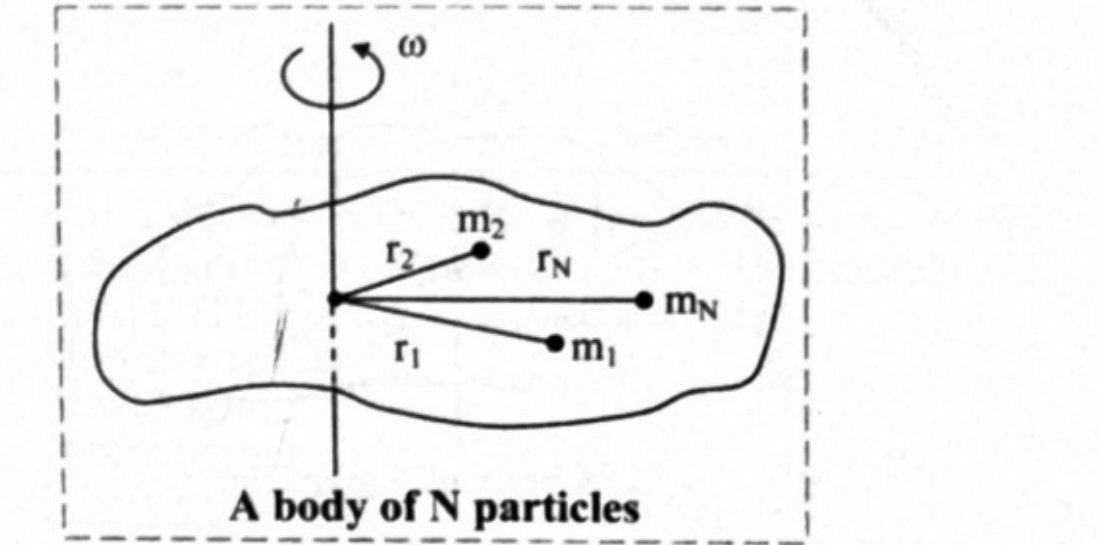
The same figure as for rotational kinetic energy: a rigid body rotating with constant angular speed about an axis perpendicular to the plane of the paper, with particles at perpendicular distances from the axis, each with a tangential velocity.
Derivation
Consider a rigid object rotating with a constant angular speed about an axis perpendicular to the plane of the paper. For theoretical simplification let the object consist of particles of masses at respective perpendicular distances from the axis of rotation.
As the object rotates, all these particles perform U.C.M. with the same angular speed but with different linear speeds
The directions of the individual velocities are along the tangents to their respective tracks. The linear momentum of the first particle is of magnitude
directed along . Its angular momentum is therefore of magnitude
Similarly , , and so on up to .
For a rigid body with a fixed axis of rotation, all these angular momenta are directed along the axis of rotation, the direction being given by the right-hand thumb rule. As all of them have the same direction, their magnitudes can be added algebraically:
where is the moment of inertia of the body about the given axis of rotation.
The expression is analogous to , with the moment of inertia replacing the mass — which is the physical significance of .
Kinetic Energy in Terms of Angular Momentum
The board sets this as a "show that" question, and the expected answer runs through the rotational kinetic energy derivation first.
As above, the translational kinetic energy of the first particle is , and similarly for all the other particles. The rotational kinetic energy of the object is the sum of the individual translational kinetic energies:
But , so
The angular momentum of a rotating body is
Writing (i) as and substituting from (ii),
Equivalently, substituting gives .
Standard Results
- ;
- , analogous to
- SI unit kg m/s; dimensions
- — the rotational analogue of
Theory Questions Asked on This Subtopic
Real board questions. Answers are at the end of the page.
- 1
Show that the kinetic energy of a rotating body about a given axis is equal to , where L is angular momentum and ω is angular velocity.
 Maharashtra HSC board question — asked in March 2008Answer 1 ↓
Numericals
Every numerical set on this subtopic. Full working is at the end of the page.
- 2
A wheel of moment of inertia 1 kg m is rotating at a speed of 40 rad/s. Due to friction on the axis, the wheel comes to rest in 10 minutes. Calculate the angular momentum of the wheel, two minutes before it comes to rest.
Maharashtra HSC board question — asked in March 2013Answer 2 ↓
Answers & Solutions
Work the questions above first, then check yourself here. Each answer is set out the way it should be written in the paper.
i. Consider a rigid object rotating with a constant angular speed ω about an axis perpendicular to the plane of paper. ii. For theoretical simplification, let us consider the object to be consisting of N particles of masses at respective perpendicular distances from the axis of rotation. iii. As the object rotates, all these particles perform UCM with the same angular speed ω, but with different linear speeds, iv. Translational K.E. of the first particle is Similar will be the case of all the other particles. v. Rotational K.E. of the object, is the sum of individual translational kinetic energies. Thus, But angular momentum of rotating body is given by, From equation (i), Substitute Iω from equation (ii), in equation (i), we get,
Given: I = 1 kg m, n = 40 rad/s, = 600 s, = 10−2 = 8 min = 480 s, = 40 rad/s To find: Angular momentum (L) Formulae: i. ii. Calculation: From formula (i), rad/s rad/s From formula (ii), kg m/s Ans: The angular momentum of the wheel, two minutes before it comes to rest would be 8 kg m/s.