1.9
Expression for Torque in Terms of Moment of Inertia
Rotational Dynamics · Maharashtra HSC
Theory
Derivation
Diagram
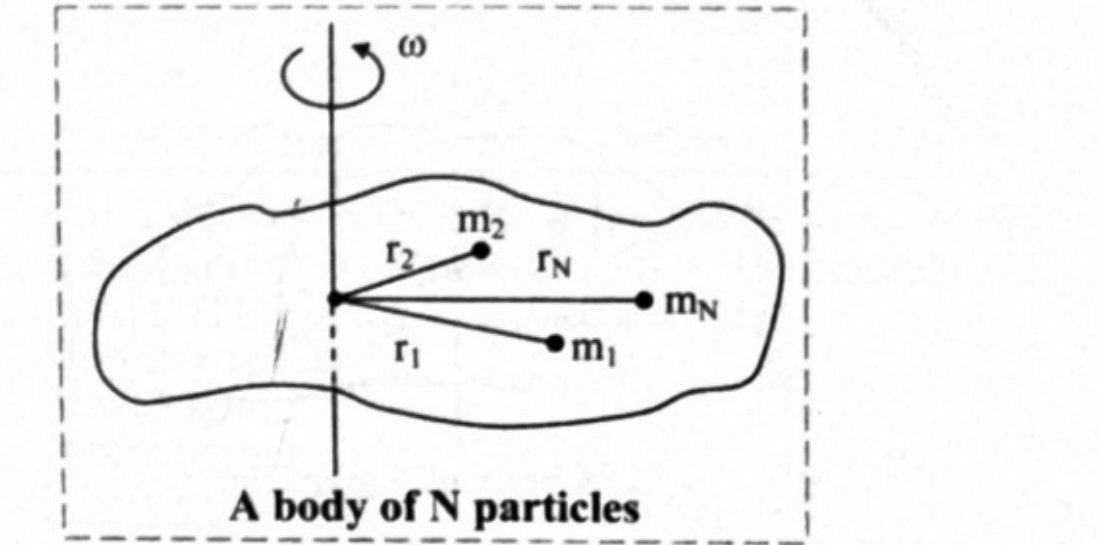
Draw a rigid object rotating with a constant angular acceleration about an axis perpendicular to the plane of the paper through a point . Mark particles of masses at perpendicular distances from , and show the tangential force on the first particle, perpendicular to .
Consider a rigid object rotating with a constant angular acceleration about an axis perpendicular to the plane of the paper. For theoretical simplification let the object consist of particles of masses at respective perpendicular distances from the axis of rotation.
As the object rotates, all these particles perform circular motion with the same angular acceleration , but with different linear (tangential) accelerations
The force experienced by the first particle is
As these forces are tangential, their respective perpendicular distances from the axis are . Thus the torque experienced by the first particle is of magnitude
Similarly , , and so on up to .
If the rotation is restricted to a single plane, the directions of all these torques are the same and along the axis. The magnitude of the resultant torque is therefore
where is the moment of inertia of the object about the given axis of rotation.
The relation is analogous to for translational motion, with the moment of inertia replacing the mass — which is the physical significance of .
SI Unit and Dimensions
- SI unit of torque: N m
- Dimensions:
Related Forms Used in Numericals
For a body whose angular speed changes uniformly from to in time ,
A negative value simply means a retarding (frictional) torque.
Work done by a constant torque through an angular displacement , and the power delivered:
A "couple" quoted in newton metre in a numerical is just a torque of that magnitude.
Standard Results
- , analogous to ; SI unit N m; dimensions
- — the standard rearrangement for finding the moment of inertia
- for uniform angular acceleration
- ,
Theory Questions Asked on This Subtopic
Real board questions. Answers are at the end of the page.
- 1
Obtain an expression for torque acting on a body rotating with uniform angular acceleration.
 Maharashtra HSC board question — asked in July 2016Answer 1 ↓
 - 2
Obtain an expression for torque acting on a rotating body with constant angular acceleration. Hence state the dimensions and SI unit of torque.
Maharashtra HSC board question — asked in March 2017Answer 2 ↓
Numericals
Every numerical set on this subtopic. Full working is at the end of the page.
- 3
A torque of 1500 Nm acting on a body produces an angular acceleration of 3.2 rad/s. Find M.I. of the body.
Maharashtra HSC board question — asked in March 2009Answer 3 ↓ - 4
A torque of magnitude 1000 N m acting on a body produces an angular acceleration of 2 rad/s. Calculate the moment of inertia of the body.
Maharashtra HSC board question — asked in March 2010; October 2009Answer 4 ↓ - 5
A body starts rotating from rest. Due to a couple of 20 Nm it completes 60 revolutions in one minute. Find the moment of inertia of the body.
Maharashtra HSC board question — asked in October 2014Answer 5 ↓ - 6
A solid sphere of diameter 50 cm and mass 25 kg rotates about an axis through its centre. Calculate its moment of inertia. If its angular velocity changes from 2 rad/s to 12 rad/s in 5 seconds, calculate the torque applied.
Maharashtra HSC board question — asked in July 2018Answer 6 ↓ - 7
A wheel of moment of inertia 1 kg m is rotating at a speed of 30 rad/s. Due to friction on the axis, it comes to rest in 10 minutes. Calculate the average torque of the friction.
Maharashtra HSC board question — asked in March 2019Answer 7 ↓ - 8
An automobile engine develops 62.84 kW while rotating at a speed of 1200 rpm. What torque does it deliver?
Maharashtra HSC board question — asked in July 2022Answer 8 ↓
Answers & Solutions
Work the questions above first, then check yourself here. Each answer is set out the way it should be written in the paper.
i. Consider a rigid object rotating with a constant angular acceleration 'α' about an axis perpendicular to the plane of paper. ii. Let us consider the object to be consisting of N number of particles of masses at respective perpendicular distances from the axis of rotation. iii. As the object rotates, all these particles perform circular motion with same angular acceleration α, but with different linear (tangential) accelerations ,etc. iv. Force experienced by the first particle is, v. As these forces are tangential, the irrespective perpendicular distances from the axis are . vi. Thus, the torque experienced by the first particle is of magnitude Similarly, vii. If the rotation is restricted to a single plane, directions of all these torques are the same, and along the axis. viii. Magnitude of the resultant torque is then given by where, is the moment of inertia of the object about the given axis of rotation. ii. Illustration: Ballet dancers: a. During ice ballet, the dancers have to undertake rounds of smaller and larger radii. b. The dancers come together by taking rounds of smaller radius (near the centre). c. In this case, the moment of inertia of their system becomes minimum and the frequency increases, to make it thrilling. d. While during outer rounds, the dancers outstretch their legs and arms. e. This increases their moment of inertia that reduces the angular speed and hence the linear speed. This is essential to prevent slipping.
Expression for torque acting on a rotating body: [From 1.9, Q1]
i. Consider a rigid object rotating with a constant angular acceleration 'α' about an axis perpendicular to the plane of paper. ii. Let us consider the object to be consisting of N number of particles of masses at respective perpendicular distances from the axis of rotation. iii. As the object rotates, all these particles perform circular motion with same angular acceleration α, but with different linear (tangential) accelerations ,etc. iv. Force experienced by the first particle is, v. As these forces are tangential, the irrespective perpendicular distances from the axis are . vi. Thus, the torque experienced by the first particle is of magnitude Similarly, vii. If the rotation is restricted to a single plane, directions of all these torques are the same, and along the axis. viii. Magnitude of the resultant torque is then given by where, is the moment of inertia of the object about the given axis of rotation. ii. Illustration: Ballet dancers: a. During ice ballet, the dancers have to undertake rounds of smaller and larger radii. b. The dancers come together by taking rounds of smaller radius (near the centre). c. In this case, the moment of inertia of their system becomes minimum and the frequency increases, to make it thrilling. d. While during outer rounds, the dancers outstretch their legs and arms. e. This increases their moment of inertia that reduces the angular speed and hence the linear speed. This is essential to prevent slipping.SI unit: Nm Dimensions:
Given: τ = 1500 N m, α = 3.2 rad/s To find: Moment of inertia (I) Formula: Calculation: From formula, kg m Ans: Moment of inertia of the body is 468.79 kg m.
Given: τ = 1000 N m, α = 2 rad/s To find: Moment of inertia (I) Formula: Calculation: From formula, kg m Ans: Moment of inertia of the body is 500 kg m.
Given: T = 20 N m, n = 60 revolutions in 60 s = 1 r.p.s., t = 1 min = 60 s To find: Moment of inertia (I) Formulae: i. ii. iii. Calculation: Using formula (i), rad From formula (ii), rad/s From formula (iii), kg m Ans: Moment of inertia of the body is 95.48 kg m.
Given: (Diameter) D = 50 cm, (Radius) R = 25 cm = 0.25 m, M = 25 kg, = 2 rad/s, = 12 rad/s, t = 5 s To find: Moment of inertia (I), torque (τ) Formulae: i. M.I of sphere, ii. Calculation: From formula (i), kg m From formula (ii), N m Ans: i. The moment of inertia when the angular velocity changes from 2 rad/s to 12 rad/s in 5 second is 0.625 kg m. ii. The torque applied is 1.25 N m.
Given: I = 1 kg m, = 30 rad/s, t = 10 min = 600 s To find: Torque (τ) Formula: i. ii. Calculation: From formula (i), r.p.s. From formula (ii), Nm Ans: Average torque of the friction is −0.05 Nm.
Nm