1.3
Applications of Uniform Circular Motion
Rotational Dynamics · Maharashtra HSC
Theory
Vehicle Along a Horizontal Circular Track
Diagram
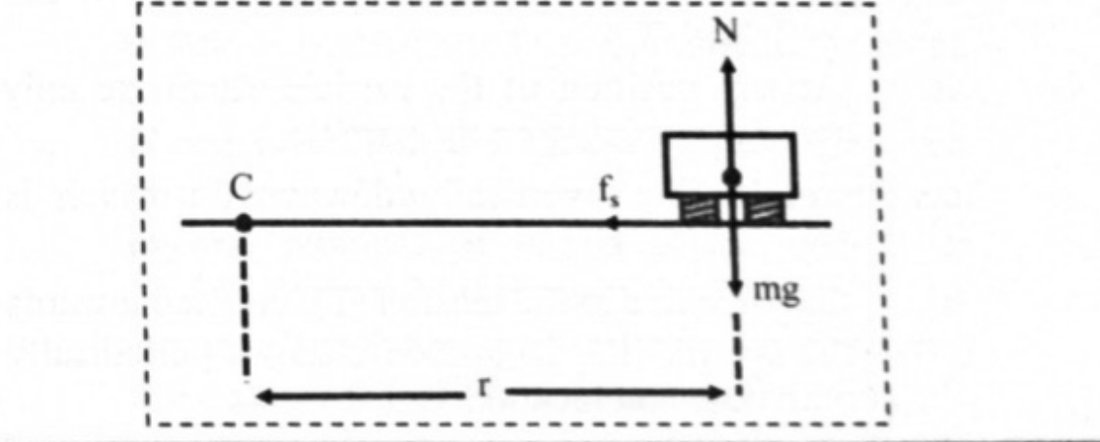
Draw the vertical section of the road through the centre of the circular track of radius . Show the car as a block on a horizontal line. From the car draw: vertically downwards, vertically upwards, and horizontally, pointing towards . Mark from to the car.
Derivation of the maximum speed
The forces acting on the car (treated as a particle) are its weight vertically downwards, the normal reaction vertically upwards which balances the weight, and the force of static friction between the road and the tyres. The friction is static because it prevents the vehicle from slipping outward (skidding), and it is the resultant force, which is centripetal.
Since the normal reaction balances the weight,
Working in the frame attached to the vehicle, the frictional force balances the centrifugal force:
Dividing (2) by (1),
For a given track is constant, and for a given vehicle is constant. Thus as increases, must increase. But has an upper limit , where is the coefficient of static friction between the road and the tyres. This imposes an upper limit on the speed. At the maximum possible speed,
The mass has cancelled, so the safety limit is independent of the mass of the vehicle.
Leaning of a two-wheeler
The frictional force acts at the ground while the centrifugal force acts through the centre of mass, which is above the ground. The two therefore constitute a torque that can topple the vehicle. A two-wheeler rider must lean inwards with the vertical at an angle such that the torque of the weight balances it, giving the same condition
A four-wheeler need not lean because its resultant normal reaction is shared unequally among four tyres, and that redistribution supplies the balancing torque.
Well (or Wall) of Death
Diagram
Draw a vertical cylindrical wall of inner radius ; show the vehicle against the inside of the wall. From it draw horizontally inwards (towards the axis), vertically downwards, and vertically upwards along the wall.
Derivation of the minimum speed
The forces on the vehicle are the normal reaction acting horizontally towards the centre, the weight vertically downwards, and the force of static friction acting vertically upwards between the wall and the tyres. The friction is static because it prevents downward slipping, and since it is the only upward force,
is thus the entire centripetal force:
Since ,
The corresponding largest period and smallest frequency are
Points to note: must always equal ; holds only at the minimum speed, because must always be exactly ; and here the road surface makes with the horizontal, which is why a banking of imposes a lower limit on the speed. Since an unbanked road () imposes an upper limit, any intermediate banking angle imposes both an upper and a lower limit.
Vehicle on a Banked Road
Why roads are banked
On a horizontal road the entire centripetal force must come from friction, which has an upper limit and whose value is not constant since the road surface is not uniform. So in real life we should not depend on it. The surface of a curved road is therefore tilted with the horizontal through an angle ; the road is then said to be banked.
Diagram
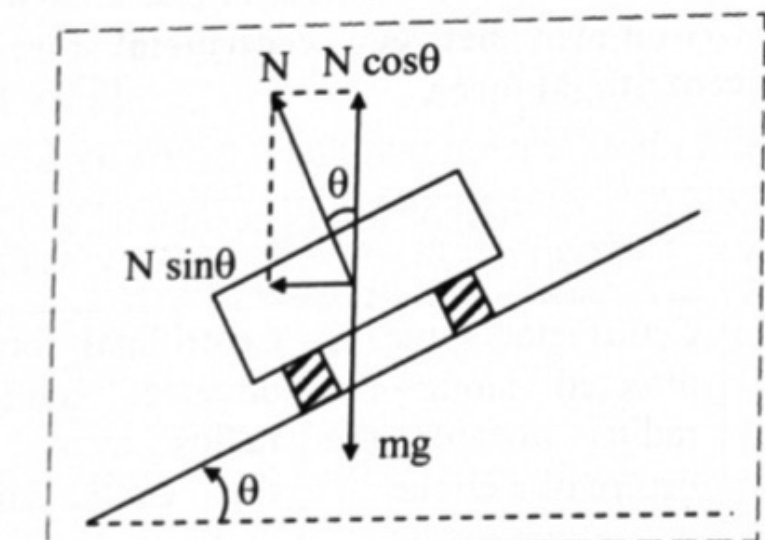
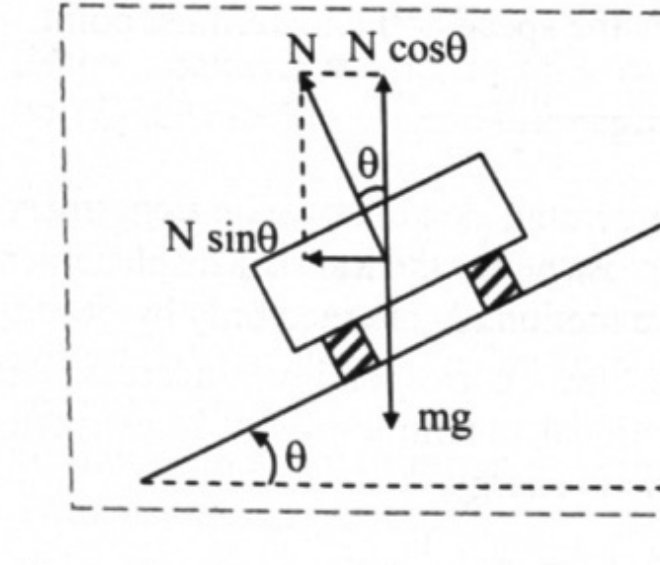
Draw the vertical section of the road inclined at to the horizontal, with the centre of the circular track to one side at the same level as the vehicle. Show vertically downwards from the vehicle, and perpendicular to the road surface. Resolve into vertically upwards and horizontally towards the centre. Mark the banking angle both between the road and the horizontal and between and the vertical. For the friction diagrams, add along the road surface — up the incline for the lower limit, down the incline for the upper limit — and resolve it into along the road-plane horizontal and vertical.
Derivation of the safe speed and the banking angle
Considering the vehicle to be a point and ignoring friction (not eliminating it) and other non-conservative forces such as air resistance, only two forces act: the weight vertically downwards and the normal reaction perpendicular to the road surface.
As the motion is along a horizontal circle, the resultant force must be horizontal and directed towards the centre of the track, which means the vertical force must be balanced. Resolving :
Dividing (2) by (1),
Hence the most safe speed on this road — not a minimum, not a maximum — is
As the expression does not contain the mass , the safety speed limit is independent of the mass of the vehicle. While designing a road the same relation gives the banking angle
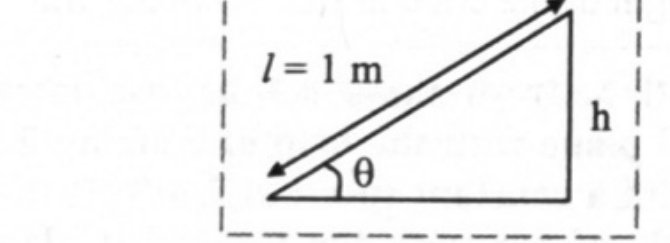
For railway tracks, the elevation of the outer rail above the inner one is , where is the gauge (the distance between the rails); the same formula with = width of the road gives the height of the outer edge of a road.
Speed limits on a rough banked road
For , exceeds the required centripetal force, so static friction acts up the incline. Then
Putting for the extreme case and solving,
For , , which is true for most rough roads banked at small angles.
For , friction acts down the incline. Then
where = radius of the curved road, = angle of banking, = coefficient of static friction and = acceleration due to gravity.
If then ; since , this happens for , and for such heavily banked roads only the lower limit matters. For both expressions collapse to , the safest speed, at which no help from friction is taken.
If friction were made zero, could a vehicle move safely on the road? No — the vehicle will skid in the absence of friction.
Conical Pendulum
Diagram
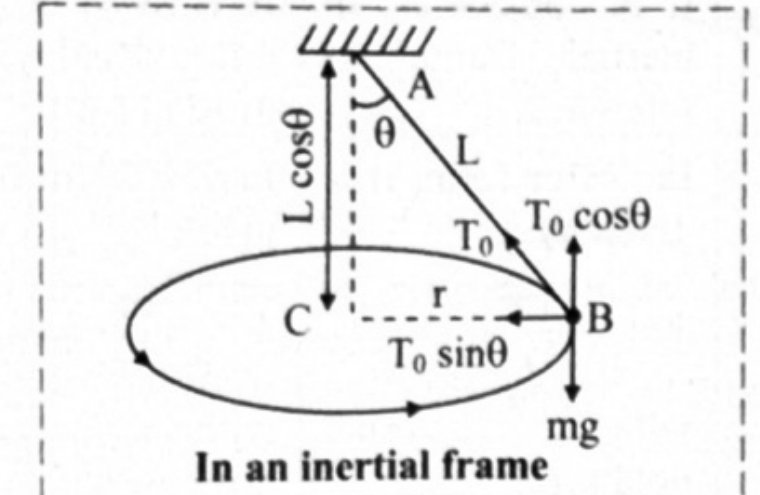
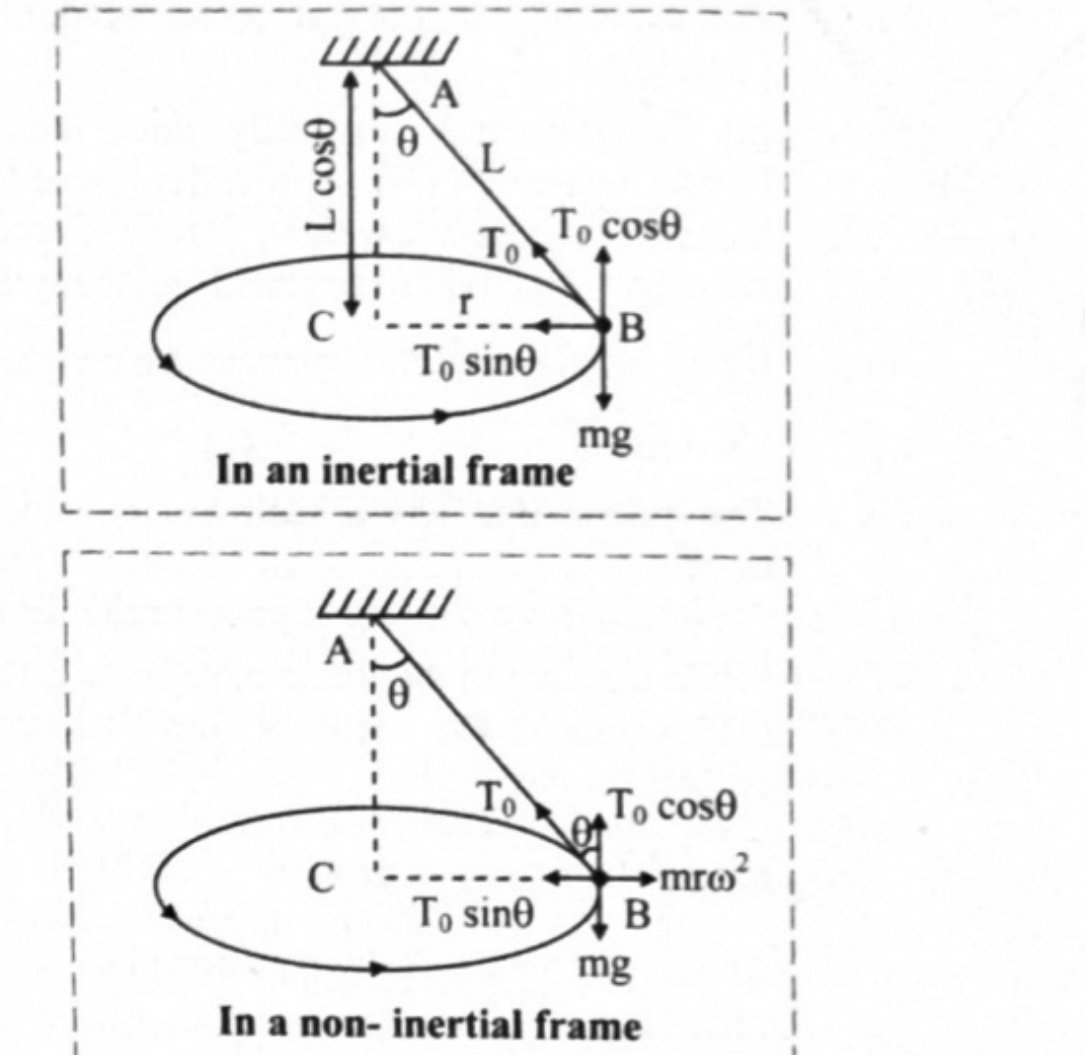
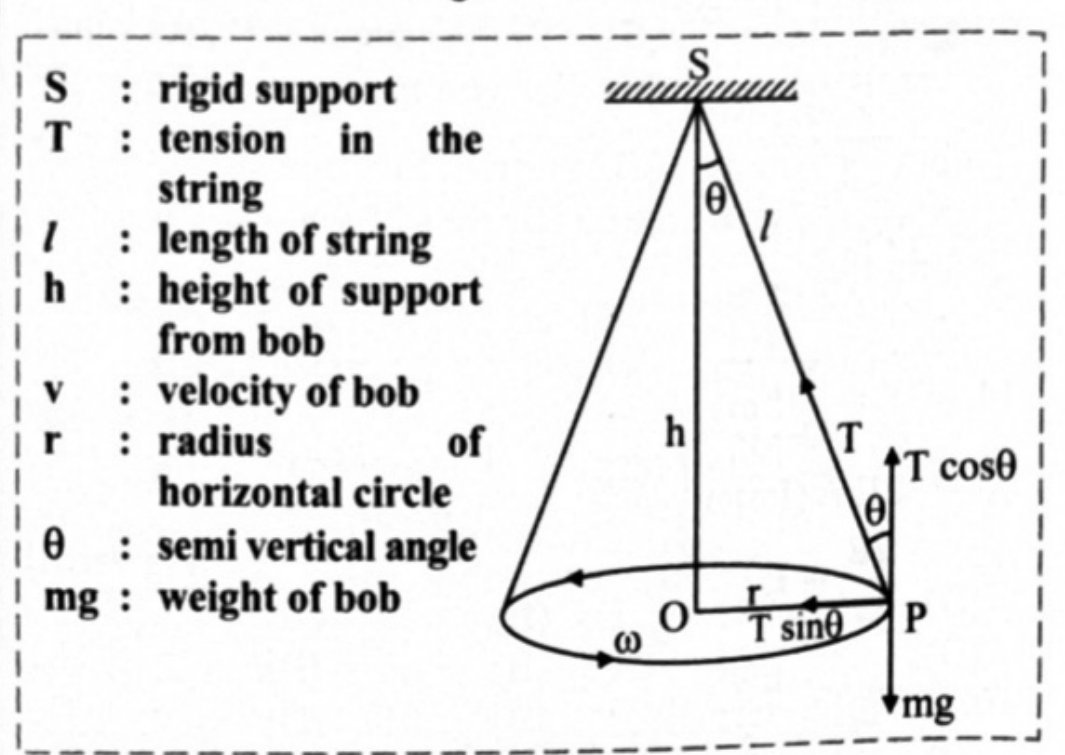
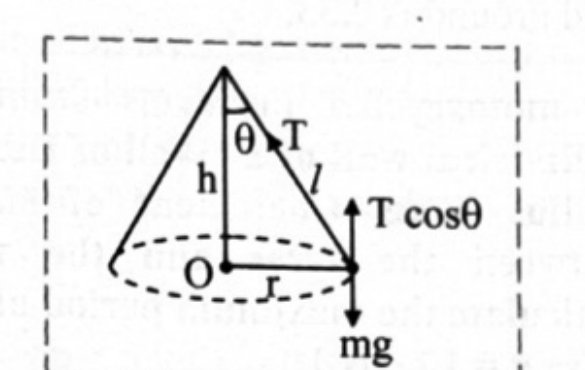
Draw the rigid support at the top. From draw the string of length making an angle with the vertical, ending at the bob . Show the horizontal circle of radius traced by the bob, with centre vertically below , so that and . From draw the weight vertically downwards and the force due to the tension along . Resolve into vertically upwards and horizontally towards .
Definition
A tiny bob connected to a long, flexible, massless, inextensible string suspended from a rigid support is a pendulum. If the string is revolved so that it moves along the surface of a right circular cone of vertical axis while the bob performs a horizontal circular motion, the system is a conical pendulum.
Derivation of the period
In a given position the forces acting on the bob are its weight directed vertically downwards and the force due to the tension in the string, directed along the string towards the support .
As the motion of the bob is a horizontal circular motion, the resultant force must be horizontal and directed towards the centre ; hence all vertical forces must cancel, and we resolve .
The vertical component balances the weight:
The horizontal component is the resultant force and is therefore centripetal:
Dividing (2) by (1),
From the figure, , so . Substituting,
If is the period of revolution, , hence
In the frame attached to the bob, the centrifugal force balances the resultant of the real forces, giving once again.
Two conclusions the board asks for
- For a given set-up and are constant, so both the period and the frequency depend only on . Neither depends on the mass of the bob.
- During revolutions the string can never become horizontal. If it did, the force due to the tension would be horizontal, its vertical component zero, and nothing would balance . Equivalently, at the frequency would be infinite and the period zero — both impossible — and and the kinetic energy would both be infinite.
Standard Results
- Horizontal track: , ,
- Two-wheeler lean angle:
- Well of death: , , ,
- Banked road (frictionless): , ,
- Banked road (rough): ,
- Conical pendulum: , , ,
Theory Questions Asked on This Subtopic
Real board questions. Answers are at the end of the page.
- 1
Derive an expression for period of a conical pendulum.
 Maharashtra HSC board question — asked in March 2008Answer 1 ↓
 - 2
- 3
Obtain an expression for maximum speed with which a vehicle can be driven safely on a banked road. Show that the safety speed limit is independent of the mass of the vehicle.
 Maharashtra HSC board question — asked in March 2010; October 2010Answer 3 ↓
 - 4
Draw a diagram showing all components of forces acting on a vehicle moving on a curved banked road. Write the necessary equation for maximum safety speed and state the significance of each term involved in it.
 Maharashtra HSC board question — asked in October 2014Answer 4 ↓
 - 5
Draw a neat labelled diagram of conical pendulum. State the expression for its periodic time in terms of length.
 Maharashtra HSC board question — asked in October 2015Answer 5 ↓
 - 6
Draw a neat labelled diagram showing the various forces and their components acting on a vehicle moving along curved banked road.
Maharashtra HSC board question — asked in July 2016Answer 6 ↓ - 7
Draw neat, labelled diagram showing different forces acting on a vehicle moving along a banked road.
Maharashtra HSC board question — asked in July 2017Answer 7 ↓ - 8
If friction is made zero for a road, can a vehicle move safely on this road?
Maharashtra HSC board question — asked in February 2023Answer 8 ↓ - 9
Derive an expression for maximum speed of a vehicle moving along a horizontal circular track.
 Maharashtra HSC board question — asked in February 2024Answer 9 ↓
Numericals
Every numerical set on this subtopic. Full working is at the end of the page.
- 10
In a conical pendulum, a string of length 120 cm is fixed at rigid support and carries a mass of 150 g at its free end. If the mass is revolved in a horizontal circle of radius 0.2 m around a vertical axis, calculate tension in the string. (g = 9.8 m/s)
 Maharashtra HSC board question — asked in October 2013Answer 10 ↓
 - 11
A stone of mass 2 kg is whirled in a horizontal circle attached at the end of 1.5 m long string. If the string makes an angle of 30° with vertical, compute its period. (g = 9.8 m/s)
Maharashtra HSC board question — asked in July 2016Answer 11 ↓ - 12
A vehicle is moving on a circular track whose surface is inclined towards the horizon at an angle of 10°. The maximum velocity with which it can move safely is 36 km/hr. Calculate the length of the circular track. [π = 3.142]
Maharashtra HSC board question — asked in March 2017Answer 12 ↓ - 13
A small body of mass 0.3 kg oscillates in vertical plane with the help of a string 0.5 m long with a constant speed of 2 m/s. It makes an angle of 60° with the vertical. Calculate tension in the string (g = 9.8 m/s).
Maharashtra HSC board question — asked in July 2017Answer 13 ↓ - 14
A flat curve on a highway has a radius of curvature 400 m. A car goes around a curve at a speed of 32 m/s. What is the minimum value of coefficient of friction that will prevent the car from sliding? (g = 9.8 m/s)
Maharashtra HSC board question — asked in March 2018Answer 14 ↓ - 15
A metre-gauge train is moving at 72 km/hr along a curved rail-way of radius of curvature 500 m at a certain place. Find the elevation of the outer rail above the inner rail so that there is no side pressure on the rail. (g = 9.8 m/s)
 Maharashtra HSC board question — asked in July 2018Answer 15 ↓
 - 16
A car rounds a curve of radius 625 m with a speed of 45 m/s. What is the minimum value of coefficient of friction which prevents the car from sliding?
Maharashtra HSC board question — asked in July 2019Answer 16 ↓ - 17
A motorcyclist performs stunt along the cylindrical wall of a 'Well of Death' of inner radius 4 m. Coefficient of static friction between the tyres and the wall is 0.4. Calculate the maximum period of revolution. [Use g = 10 m/s]
Maharashtra HSC board question — asked in July 2023Answer 17 ↓ - 18
The radius of a circular track is 200 m. Find the angle of banking of the track, if the maximum speed at which a car can be driven safely along it is 25 m/sec.
Maharashtra HSC board question — asked in February 2024Answer 18 ↓
Answers & Solutions
Work the questions above first, then check yourself here. Each answer is set out the way it should be written in the paper.
i. Consider the vertical section of a conical pendulum having bob (point mass) of mass m and string of length 'L'. ii. Here, θ is the angle made by the string with the vertical, at any position (semi-vertical angle of the cone). iii. In a given position B, the forces acting on the bob are: a. its weight 'mg' directed vertically downwards; b. the force 'T₀' due to the tension in the string, directed along the string, towards the support A. iv. As the motion of the bob is a horizontal circular motion, the resultant force must be horizontal and directed towards the centre C of the circular motion. v. For this, tension (T₀) in the string is resolved into: a. T₀cosθ : vertical component; b. T₀sinθ : horizontal component vi. The vertical component (T₀cosθ) balances the weight 'mg'. ....(1) vii. The horizontal component T₀sinθ then becomes the resultant force which is centripetal. ....(2) Dividing equation (2) by equation (1), viii. From the figure, ....(4) From equation (3) and (4), ix. If T is the period of revolution of the bob, then Period,
i. Consider a bob of mass m tied to one end of a string of length 'l' and other end is fixed to rigid support. ii. Let the bob be displaced from its mean position and whirled around a horizontal circle of radius 'r' with constant angular velocity ω, then the bob performs U.C.M. iii. During the motion, string is inclined to the vertical at an angle θ as shown in the figure. S : rigid support; T : tension in the string; l : length of string; h : height of support from bob; v : velocity of bob; r : radius of horizontal circle; θ : semi vertical angle; mg : weight of bob iv. In the displaced position P, there are two forces acting on the bob: a. The weight mg acting vertically downwards. b. The tension T acting upward along the string. v. The tension (T) acting in the string can be resolved into two components: a. Tcosθ acting vertically upwards. b. Tsinθ acting horizontally towards centre of the circle. vi. Vertical component Tcosθ balances the weight and horizontal component Tsinθ provides the necessary centripetal force. ....(1) ....(2) vii. Dividing equation (2) by (1), we get
i. The vertical section of a vehicle on a curved road of radius 'r' banked at an angle 'θ' with the horizontal is shown in the figure. ii. Considering the vehicle to be a point and ignoring friction (not eliminating) and other non-conservative forces like air resistance, there are two forces acting on the vehicle: a. weight (mg), vertically downwards; b. normal reaction (N), perpendicular to the surface of the road. iii. As the motion of the vehicle is along a horizontal circle, the resultant force must be horizontal and directed towards the centre of the track. Hence, the vertical force mg must be balanced. iv. Thus, normal reaction (N) is resolved into: a. Nsinθ - along the horizontal. b. Ncosθ - along the vertical. v. The vertical component Ncosθ balances the weight, ....(1) vi. Horizontal component Nsinθ being the resultant force, must be the necessary centripetal force (or balance the centrifugal force). ....(2) Dividing equation (2) by equation (1), vii. Thus, most safe speed, viii. As the equation doesnot contain mass m, it is independent of mass of the vehicle.
Equation for maximum safety speed: where, r = radius of curved road, θ = angle of banking, = coefficient of friction, g = acceleration due to gravity
Expression for its periodic time in terms of length:
[From 1.3, Q4]
Equation for maximum safety speed: where, r = radius of curved road, θ = angle of banking, = coefficient of friction, g = acceleration due to gravity.
[From 1.3, Q4]
Equation for maximum safety speed: where, r = radius of curved road, θ = angle of banking, = coefficient of friction, g = acceleration due to gravity.
No, vehicle will skid in the absence of friction on the road.
i. Consider vertical section of a car moving on a horizontal circular track having a radius 'r' with 'C' as centre of track. ii. Forces acting on the car (considered to be a particle): (a) Weight (mg), vertically downwards, (b) Normal reaction (N), vertically upwards that balances the weight, (c) Force of static friction () between road and the tyres. iii. Since, normal reaction balances the weight ....(1) iv. The friction over here is static friction which acts as resultant centripetal force because it prevents the vehicle from outward slipping or skidding. v. While working in the frame of reference attached to the vehicle, the frictional force balances the centrifugal force. Dividing equation (2) by equation (1), vi. For a given track, radius r is constant. For given vehicle, mg = N is constant. Thus, as the speed v increases, the force of static friction also increases. vii. However, has an upper limit , where is the coefficient of static friction between road and tyres of the vehicle. This imposes an upper limit to the speed v. viii. At the maximum possible speed, This is an expression for maximum possible speed for a vehicle to move on a horizontal circular track.
Given: l = 120 cm = 1.2 m, r = 0.2 m, m = 150 g = 0.15 kg To find: Tension in the string (T) Formula: Tension, Calculation: By Pythagoras theorem, m The weight of bob is balanced by vertical component of tension T. From figure, Substituting in formula, N Ans: Tension in the string is 1.491 N.
Given: m = 2 kg, l = 1.5 m, θ = 30°, g = 9.8 m/s To find: Period (T) Formula: Calculation: From formula, s Ans: Period of revolution is 2.29 s.
Given: km h m/s, θ = 10° To find: Length of circular track (l) Formula: Calculation: From formula, m m Ans: The length of the circular track is 363.7 m.
Given: m = 0.3 kg, r = l = 0.5 m, v = 2 m/s To find: Tension (T) Formula: Calculation: From formula, N Ans: The tension in the string is 3.87 N.
Given: v = 32 m/s, r = 400 m, g = 9.8 m/s To find: Coefficient of friction (μ) Formula: Calculation: From formula, Ans: The value of coefficient of friction between tyre and ground is 0.26.
Given: Radius of curve, r = 500 m, Speed of train, km/hr m/s To find: Elevation of rails (h) Formulae: i. ii. From formula (i), From formula (ii), m cm Ans: The elevation of the outer rail above the inner rail is 8 cm.
Given: v = 45 m/s, r = 625 m, g = 9.8 m/s To find: Coefficient of friction (μ) Formula: Calculation: From formula, Ans: The value of coefficient of friction between tyre and ground is 0.33.
Given: r = 4 m, = 0.4, g = 10 m/s To find: Maximum period of revolution (T) Formulae: i. ii. Calculation: From formula (i), m s From formula (ii), s Ans: Maximum period of revolution is 6.284 s.
Given: Radius of the track, r = 200 m, Maximum safety speed, v = 25 m/s, g = 9.8 m/s To find: Angle of banking (θ) Formula: Calculation: From formula, Ans: The angle of banking of the track is 17° 44'.