1.4
Vertical Circular Motion
Rotational Dynamics · Maharashtra HSC
Theory
Vertical Circular Motion
Two types of vertical circular motion are commonly observed.
- A controlled vertical circular motion, such as a giant wheel, in which the speed is either kept constant or is not totally controlled by gravity.
- A vertical circular motion controlled only by gravity. Here the necessary energy is supplied initially, mostly at the lowest point, and thereafter the entire kinetics is governed by the gravitational force, with interconversion of kinetic energy and gravitational potential energy. This is the case the board examines.
Case I: Mass Tied to a String
Diagram
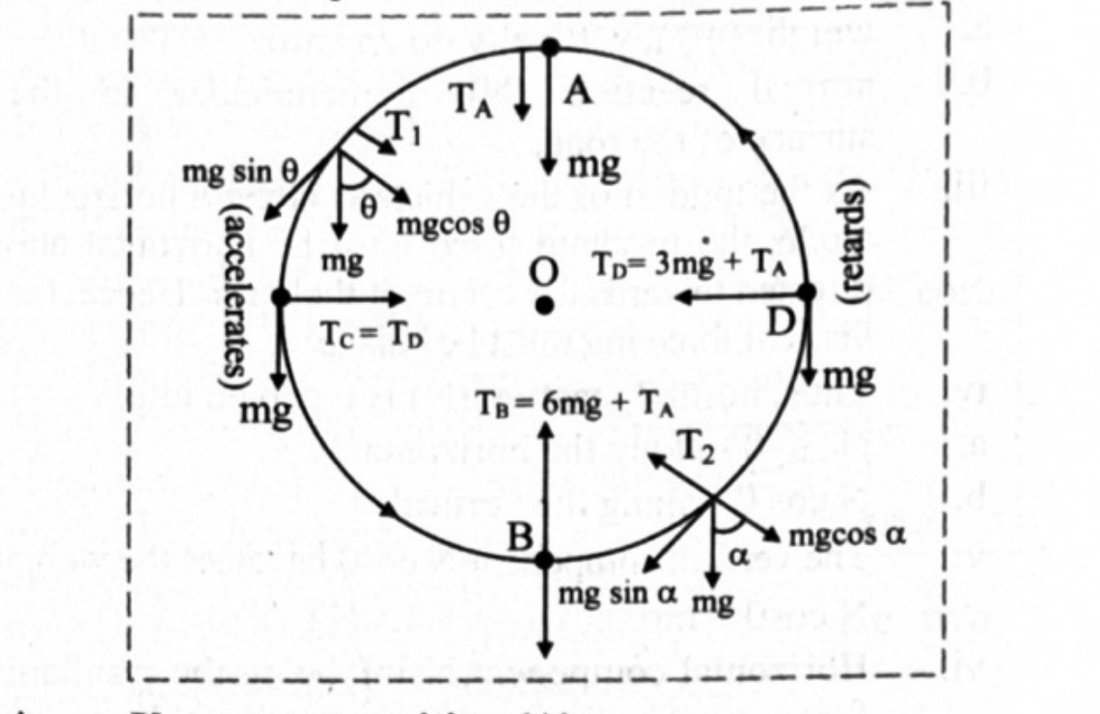
Draw a circle of radius in a vertical plane with centre . Mark at the top, at the bottom, and and at the two ends of the horizontal diameter. At draw both and pointing downwards (towards ). At draw upwards (towards ) and downwards. At draw horizontally towards and vertically downwards, perpendicular to it. Mark the velocities , , tangentially.
At any position of the bob only two forces act: its weight , vertically downwards and constant, and the force due to the tension along the string, directed towards the centre, whose magnitude changes periodically with time and location. Since the motion is non-uniform, the resultant of these two forces is directed towards the centre only at the uppermost and the lowermost positions; at every other position part of the resultant is tangential and changes the speed.
Uppermost position A
Both the weight and the force due to the tension are directed downwards, i.e. towards the centre, so their resultant is used entirely as the centripetal force:
For the minimum possible speed at this point — that is, if the motion is to be realised with the minimum possible energy — , giving
Lowermost position B
The force due to the tension is vertically upwards, towards the centre, and opposite to ; their resultant is the centripetal force:
While coming down from the uppermost to the lowermost point the vertical displacement is and the motion is governed only by gravity, so the decrease in gravitational potential energy is converted into kinetic energy:
Using in (4),
Midway positions C and D (string horizontal)
Here the force due to the tension is the only force towards the centre, as is perpendicular to the tension. Thus the tension is the centripetal force used to change the direction of the velocity, while is used only to change the speed:
Coming down from the midway point to the lowermost point the vertical displacement is , so
Since ,
and similarly .
Difference between the extreme tensions
Subtracting (1) from (3),
Using (4), , hence
The difference between the tensions at the extreme positions depends only on the weight of the object — it is independent of and of . By the same working, .
Arbitrary position
At a general position the force due to the tension and the weight are neither along the same line nor perpendicular. The tangential component of the weight changes the speed — decreasing it while going up and increasing it while coming down. Measuring from the lowermost position,
and the vertical rise above the lowest point is , which fixes through energy conservation.
Four cautions from the textbook
- can never be exactly zero for a string, else the string would slacken; so in practice .
- None of the parameters — including the linear and angular accelerations — is constant during this motion, so the kinematical equations of Table 1 do not apply.
- The position or velocity at any instant can be found from energy conservation, but the radius-vector function is not integrable, so the period or frequency cannot be determined theoretically; it can only be measured experimentally.
- In reality energy must be supplied continuously to overcome air resistance.
Case II: Mass Tied to a Rod
The basic difference between a rod and a string is that a string needs some tension at all points, including the uppermost. A rigid rod can push as well as pull, so no such condition is necessary and a (practically) zero speed is possible at the uppermost point. By similar mathematics,
Sphere of Death
Two-wheeler riders undergo rounds inside a hollow sphere, starting with small horizontal circles and eventually performing revolutions along vertical circles. The dynamics of this vertical circular motion is exactly the same as that of a point mass tied to a string, except that the force due to the tension is replaced by the normal reaction force . In the initial nearly horizontal circles the linear speed is greater for the larger circles while the angular speed (frequency) is greater for the smaller ones, as the theory of the conical pendulum predicts.
Vehicle at the Top of a Convex Over-Bridge
Diagram
Draw the arc of a convex bridge of radius of curvature with its centre below the road. Place the vehicle at the topmost point and draw vertically downwards and vertically upwards.
At the uppermost position the resultant of the two vertical forces must provide the centripetal force, which points vertically downwards towards the centre:
As the speed increases, goes on decreasing. The normal reaction is an indication of contact, so for contact to be just maintained , giving an upper limit
Standard Results
- Top of the circle: ,
- Midway: ,
- Bottom: ,
- ,
- ,
- Any position, from the bottom: , rise
- Rod: , , at top, midway and bottom
- Convex over-bridge: ,
Theory Questions Asked on This Subtopic
Real board questions. Answers are at the end of the page.
- 1
A particle of mass m, just completes the vertical circular motion. Derive the expression for the difference in tensions at the highest and the lowest points.
 Maharashtra HSC board question — asked in March 2013Answer 1 ↓
 - 2
Derive expressions for linear velocity at lowest position, mid-way position and the top-most position for a particle revolving in a vertical circle, if it has to just complete circular motion without string slackening at top.
Maharashtra HSC board question — asked in February 2023Answer 2 ↓
Numericals
Every numerical set on this subtopic. Full working is at the end of the page.
- 3
An object of mass 1 kg is tied to one end of a string of length 9 m and whirled in a vertical circle. What is the minimum speed required at the lowest position to complete a circle?
Maharashtra HSC board question — asked in October 2008Answer 3 ↓ - 4
A stone of mass 5 kg, tied to one end of a rope of length 0.8 m, is whirled in a vertical circle. Find the minimum velocity at the highest point and at the midway point. [g = 9.8 m/s]
Maharashtra HSC board question — asked in October 2014Answer 4 ↓ - 5
A stone of mass 100 g attached to a string of length 50 cm is whirled in a vertical circle by giving velocity at lowest point as 7 m/s. Find the velocity at the highest point. [Acceleration due to gravity = 9.8 m/s]
Maharashtra HSC board question — asked in October 2015Answer 5 ↓ - 6
In a Circus, a motor-cyclist having mass of 50 kg moves in a spherical cage of radius 3 m. Calculate the least velocity with which he must pass the highest point without losing contact. Also calculate his angular speed at the highest point.
Maharashtra HSC board question — asked in February 2020Answer 6 ↓
Answers & Solutions
Work the questions above first, then check yourself here. Each answer is set out the way it should be written in the paper.
i. Consider a particle of mass m moving along a vertical circle. ii. At any position of the particle, there are only two forces acting on the particle: a. weight (mg), vertically downwards, which is constant; b. the force due to the tension (T), directed towards the centre. (Its magnitude changes periodically with time and location.) iii. As the motion is non uniform, the resultant of these two forces is not directed towards the centre except at the uppermost and the lowermost positions of the bob. iv. Uppermost position (A): a. Both, weight (mg) and force due to tension () are downwards, i.e., towards the centre. In this case, their resultant is used only as the centripetal force. b. Thus, if is the speed at the uppermost point, c. For minimum possible speed at this point (or if the motion is to be realized with minimum possible energy), v. Lowermost position (B): a. Force due to the tension, is vertically upwards, i.e., towards the centre, and opposite to mg. In this case, their resultant is the centripetal force. b. If is the speed at the lowermost point, c. While coming down from the uppermost to the lowermost point, the vertical displacement is 2r and the motion is governed only by gravity. d. Hence the corresponding decrease in the gravitational potential energy is converted into the kinetic energy. vi. Difference between the extreme tensions: Subtracting equation (1) from equation (3), Using equation (4) and rearranging, we get, Hence, difference in tension at extreme positions depends only on weight.
[From 1.4, Q1 (i)]
i. Consider a particle of mass m moving along a vertical circle. ii. At any position of the particle, there are only two forces acting on the particle: a. weight (mg), vertically downwards, which is constant; b. the force due to the tension (T), directed towards the centre. (Its magnitude changes periodically with time and location.) iii. As the motion is non uniform, the resultant of these two forces is not directed towards the centre except at the uppermost and the lowermost positions of the bob. iv. Uppermost position (A): a. Both, weight (mg) and force due to tension () are downwards, i.e., towards the centre. In this case, their resultant is used only as the centripetal force. b. Thus, if is the speed at the uppermost point, c. For minimum possible speed at this point (or if the motion is to be realized with minimum possible energy), v. Lowermost position (B): a. Force due to the tension, is vertically upwards, i.e., towards the centre, and opposite to mg. In this case, their resultant is the centripetal force. b. If is the speed at the lowermost point, c. While coming down from the uppermost to the lowermost point, the vertical displacement is 2r and the motion is governed only by gravity. d. Hence the corresponding decrease in the gravitational potential energy is converted into the kinetic energy. vi. Difference between the extreme tensions: Subtracting equation (1) from equation (3), Using equation (4) and rearranging, we get, Hence, difference in tension at extreme positions depends only on weight. to (v) and diagram. vi. Positions when the string is horizontal (C and D): a. Force due to the tension is the only force towards the centre as weight mg is perpendicular to the tension. b. Thus, force due to the tension is the centripetal force used to change the direction of the velocity and weight mg is used only to change the speed. c. At midway position (C), while coming down from the midway point to the lowermost point, the vertical displacement is 'r'. Hence, the corresponding decrease in the gravitational P.E. is converted into K.E. Since, Similarly
Given: m = 1 kg, r = 9 m, g = 9.8 m/s To find: Minimum velocity at the lowest point () Formula: Calculation: From formula, m/s Ans: The minimum velocity at the lowest point is 21 m/s.
Given: m = 5 kg, r = 0.8 m, g = 9.8 m/s To find: i. Minimum velocity at the highest point () ii. Minimum velocity at midway point () Formulae: i. ii. Calculation: From formula (i), m/s From formula (ii), m/s Ans: The minimum velocity at the highest point and midway point is 2.8 m/s and 4.85 m/s respectively.
Given: m = 100 g = 0.1 kg, r = 50 cm = 0.5 m, g = 9.8 m/s, = 7 m/s To find: Velocity at the highest point () Formula: Calculation: Total energy at highest point, at lowest point J From formula, m/s Ans: The velocity at the highest point is 5.422 m/s.
Given: m = 50 kg, r = 3 m To find: i. Velocity at highest point () ii. Angular velocity at highest point (ω) Formulae: i. ii. Calculation: Using formula (i), m/s Using formula (ii), rad/s Ans: The least velocity with which the motor cyclist must pass the highest is 5.42 m/s and the angular velocity at the highest point is 1.8 rad/s.