1.5
Moment of Inertia as an Analogous Quantity for Mass
Rotational Dynamics · Maharashtra HSC
Theory
Why a Rotational Analogue of Mass is Needed
Angular displacement, angular velocity and angular acceleration replace displacement, velocity and acceleration in the kinematical equations, and torque is the analogue of force. But the expressions for linear momentum, force and kinetic energy all contain mass, so a rotational replacement for mass is needed.
Opening a door with hinges gives it an angular displacement, and the effort needed depends not only on the mass of the door but also on the perpendicular distance from the axis of rotation at which the force is applied. So the quantity analogous to mass must include the mass and also account for how that mass is distributed around the axis of rotation. Deriving the rotational kinetic energy shows exactly what that quantity is.
Definition
The moment of inertia of a rigid body about an axis of rotation is defined as the sum of the products of the mass of each particle and the square of its perpendicular distance from the axis of rotation.
For a homogeneous rigid object with a mathematically integrable mass distribution,
If the mass distribution is not integrable, cannot be obtained theoretically, but it can always be determined experimentally.
- SI unit: kg m
- Dimensions:
depends on (i) the individual masses and (ii) the distribution of those masses about the given axis of rotation. For a different axis it will again depend on the distribution about that axis, and will be different if there is no symmetry.
Derivation: Kinetic Energy of a Rotating Body
Diagram
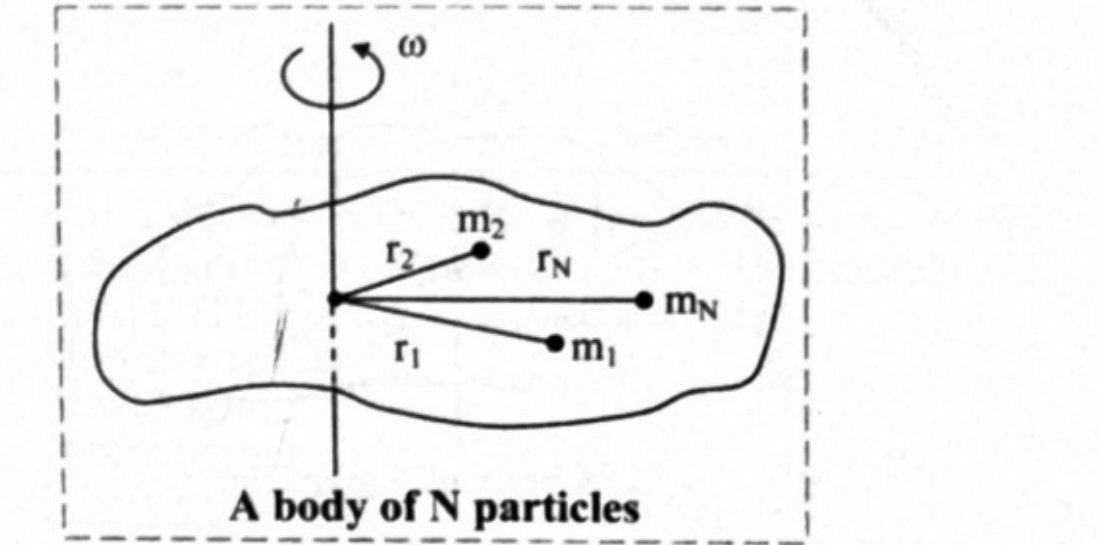
Draw a shaded irregular rigid body rotating with angular speed about an axis perpendicular to the plane of the paper through a point . Mark particles of masses inside it at perpendicular distances from , with tangential velocities .
Consider a rigid object rotating with a constant angular speed about an axis perpendicular to the plane of the paper. For theoretical simplification let the object consist of particles of masses at respective perpendicular distances from the axis of rotation.
As the object rotates, all these particles perform U.C.M. with the same angular speed but with different linear speeds
The translational kinetic energy of the first particle is
and similarly for the second particle,
The rotational kinetic energy of the object is the sum of the individual translational kinetic energies:
But
Comparing with the translational : replaces and replaces . This is why is called the rotational inertia or moment of inertia of the object about the given axis, and it is the physical significance of .
Moment of Inertia of a Uniform Ring
An object is called a uniform ring if its mass is practically situated uniformly on the circumference of a circle; it is a two-dimensional object of negligible thickness. Rotating about its own axis — the line perpendicular to its plane through its centre — its entire mass is practically at a distance equal to its radius from the axis. Hence
Moment of Inertia of a Uniform Disc
Diagram
Draw a circle of radius with centre and the central axis perpendicular to its plane through . Inside, shade a thin concentric ring of average radius and width .
A disc is a two-dimensional circular object of negligible thickness, uniform if its mass per unit area and composition are the same throughout. The surface density is
Consider the disc as consisting of concentric rings of radii increasing from practically zero to . Take one such ring of average radius and width , so small that the whole ring may be treated as being at radius . Its area is , so its mass is
As this is a ring, its entire mass lies at a distance from the axis, so its moment of inertia is . Integrating from to ,
Substituting ,
Using the same method, expressions for the moments of inertia of other integrable geometrical shapes are derived.
Standard Results
- ; SI unit kg m; dimensions
- Rotational K.E.
- Work done in changing the speed:
- Uniform ring about its own axis:
- Uniform disc or solid cylinder about its own axis:
- Solid sphere about a central axis: ; thin-walled hollow sphere:
- Thin uniform rod about a transverse axis through its centre: ; about one end:
- Solid cylinder about a transverse axis through its centre:
Theory Questions Asked on This Subtopic
Real board questions. Answers are at the end of the page.
- 1
Define moment of inertia. State its SI unit and dimensions. OR Define moment of inertia of a rotating rigid body. State its SI unit and dimensions.
Maharashtra HSC board question — asked in March 2018; March 2022; October 2008Answer 1 ↓ - 2
Derive an expression for kinetic energy of a rotating body. OR Derive an expression for the kinetic energy of a body rotating with a uniform angular speed.
 Maharashtra HSC board question — asked in July 2022; March 2022Answer 2 ↓
Numericals
Every numerical set on this subtopic. Full working is at the end of the page.
- 3
Energy of 1000 J is spent to increase the angular speed of a wheel from 20 rad/s to 30 rad/s. Calculate the moment of inertia of the wheel.
Maharashtra HSC board question — asked in February 2020Answer 3 ↓
Answers & Solutions
Work the questions above first, then check yourself here. Each answer is set out the way it should be written in the paper.
Definition: Moment of inertia of a rigid body about an axis of rotation is defined as the sum of product of the mass of each particle and the square of its perpendicular distance from the axis of rotation. i. SI unit of moment of inertia is kgm. ii. Dimensions are .
Derivation of an expression for the kinetic energy of a body rotating with a uniform angular speed: i. Consider a rigid object rotating with a constant angular speed ω about an axis perpendicular to the plane of paper. ii. For theoretical simplification, let us consider the object to be consisting of N particles of masses at respective perpendicular distances from the axis of rotation. iii. As the object rotates, all these particles perform UCM with the same angular speed ω, but with different linear speeds, iv. Translational K.E. of the first particle is, Translational K.E. of the second particle is, Similar will be the case of all the remaining particles. v. Rotational K.E. of the object is the sum of individual translational kinetic energies. Thus, Rotational K.E.
Given: = 20 r.p.s, = 30 r.p.s, ΔE = 1000 J To find: Moment of inertia (I) Formula: Calculation: From formula, Similarly, kg m Ans: The moment of inertia of the wheel is 0.1013 kg m.