Chapter 5
Oscillations
Maharashtra HSC · 15 subtopics · textbook pages 109–130
Formula SheetEvery formula this chapter can be examined on, in one table.
Periodic Motion — Period and Frequency
| Formula | Symbols, units and conditions |
|---|---|
| |
|
Linear S.H.M. — Restoring Force
| Formula | Symbols, units and conditions |
|---|---|
| |
| |
|
Differential Equation of S.H.M.
| Formula | Symbols, units and conditions |
|---|---|
| |
|
Acceleration, Velocity and Displacement
| Formula | Symbols, units and conditions |
|---|---|
| |
| |
| |
| |
| |
| |
| |
|
Amplitude, Period and Frequency
| Formula | Symbols, units and conditions |
|---|---|
| |
| |
| |
| |
|
Reference Circle Method
| Formula | Symbols, units and conditions |
|---|---|
| |
|
Phase in S.H.M.
| Formula | Symbols, units and conditions |
|---|---|
| |
|
Graphical Representation
| Formula | Symbols, units and conditions |
|---|---|
| |
|
Composition of Two S.H.M.s (same period, same path)
| Formula | Symbols, units and conditions |
|---|---|
| |
| |
| |
| |
|
Energy of a Particle Performing S.H.M.
| Formula | Symbols, units and conditions |
|---|---|
| |
| |
| |
| |
| |
| |
| |
| |
| |
| |
|
Simple Pendulum
| Formula | Symbols, units and conditions |
|---|---|
| |
| |
| |
| |
| |
|
Angular S.H.M.
| Formula | Symbols, units and conditions |
|---|---|
| |
| |
| |
| |
| |
|
Damped Oscillations
| Formula | Symbols, units and conditions |
|---|---|
| |
| |
| |
|
Free Oscillations, Forced Oscillations and Resonance
| Formula | Symbols, units and conditions |
|---|---|
| |
|
Standard Values
- m/s unless the question states otherwise; some board numericals use m/s.
- (the board's own working value); .
- dyne/cm N/m; dyne N.
- day s.
- SI units: in m, in m/s, in m/s, in rad/s, in Hz, in s, in N/m, in J, in N m, in kg m, in A m, in T (Wb/m).
Short NotesThe chapter subtopic by subtopic, in the textbook's own order.15 subtopics
- 1Introduction
- 2Explanation of Periodic Motion
- 3Linear Simple Harmonic Motion (S.H.M.)1 board question
- 4Differential Equation of S.H.M.11 board questions
- 5Acceleration (a), Velocity (v) and Displacement (x) of S.H.M.4 board questions
- 6Amplitude (A), Period (T) and Frequency (n) of S.H.M.2 board questions
- 7Reference Circle Method1 board question
- 8Phase in S.H.M.
- 9Graphical Representation of S.H.M.4 board questions
- 10Composition of two S.H.M.s having same period and along the same path3 board questions
- 11Energy of a Particle Performing S.H.M.9 board questions
- 12Simple Pendulum11 board questions
- 13Angular S.H.M. and its Differential Equation4 board questions
- 14Damped Oscillations1 board question
- 15Free Oscillations, Forced Oscillations and Resonance
The whole chapter in brief
5.1–5.2 Periodic and Oscillatory Motion
- Periodic motion: any motion that repeats itself after a definite interval of time. The body goes on repeating the same set of movements; the time for one such set is the period.
- Oscillatory (vibratory) motion: a periodic motion in which the particle moves to and fro repeatedly along the same path about a mean position.
- Every oscillatory motion is periodic, but every periodic motion need not be oscillatory. Uniform circular motion is periodic but not oscillatory.
- The simplest oscillatory periodic motion is simple harmonic motion (S.H.M.). If the path is a straight line it is linear S.H.M.; if the path is an arc of a circle it is angular S.H.M.
- Period : smallest time after which the to and fro motion repeats (s). Frequency : number of oscillations per unit time (Hz). , .
- Harmonic oscillation: expressible by a single harmonic function, or . Non-harmonic oscillation: cannot be written as a single harmonic function, e.g. .
| Periodic motion | Oscillatory motion |
|---|---|
| Repeats after a definite interval of time | Repeats to and fro about a mean position along the same path |
| Need not be to and fro | Always to and fro |
| Example: motion of the earth round the sun, U.C.M. | Example: simple pendulum, spring–mass system, tuning fork prong |
| Not every periodic motion is oscillatory | Every oscillatory motion is periodic |
5.3 Linear S.H.M.
- Definition: Linear S.H.M. is the linear periodic motion of a body in which the force (or acceleration) is always directed towards the mean position and its magnitude is proportional to the displacement from the mean position.
- , where is the force constant (restoring force per unit displacement, N/m); .
- Conditions required for S.H.M.: (i) oscillation is about a fixed point, (ii) the net force or acceleration is always directed towards that fixed point, (iii) the particle returns to the fixed point because of the restoring force.
- Displacement in S.H.M. is always measured from the mean position, and since the motion is along one straight line only and signs are needed, not vector notation.
- A complete oscillation: the object goes from one extreme to the other and back to the initial position.
- Classroom demonstrations of linear S.H.M.: a hydrometer floating in water, depressed and released; mercury in a U-tube, one arm depressed and released; a block attached to a spring on a frictionless horizontal surface.
5.4 Differential Equation of S.H.M.
- , obtained from with and .
- Angular form: .
- Reading straight off the equation is a standard 2-mark question: in , rad/s, so Hz and s.
5.5 Acceleration, Velocity and Displacement
- ; ; .
- Starting from the mean position: . Starting from an extreme position: .
- At time : and .
- "The particle starts S.H.M." means the observer starts counting time then; the particle was already oscillating. is subjective to the observer.
| Quantity | At mean position | At extreme position |
|---|---|---|
| Displacement | Minimum, | Maximum, |
| Velocity | Maximum, | Minimum, |
| Acceleration | Minimum, | Maximum, |
| Restoring force | Zero | Maximum |
| Kinetic energy | Maximum, | Zero |
| Potential energy | Zero | Maximum, |
5.6 Amplitude, Period and Frequency
- Amplitude : the maximum displacement of the particle from its mean position. Path length .
- Period : the time taken to complete one oscillation. .
- Frequency : number of oscillations per unit time, .
- acceleration per unit displacement.
| Springs in series | Springs in parallel |
|---|---|
| Connected one after the other in a single chain | Connected between the same two points |
| Each spring carries the same force | Each spring has the same extension |
| Extensions add: | Forces add: |
| , so | |
| identical springs: (softer, lower frequency) | identical springs: (stiffer, higher frequency) |
- Two identical springs of constant : and , so the frequencies are in the ratio .
5.7 Reference Circle Method
- A linear S.H.M. is the projection of a uniform circular motion (U.C.M.) on any diameter of the reference circle.
- Projection of displacement: — an S.H.M. of amplitude .
- Projection of the tangential velocity : .
- Projection of the centripetal acceleration : .
- This is why , the angular velocity of the reference circle, is called the angular frequency of the linear S.H.M.
5.8 Phase in S.H.M.
- Phase in S.H.M. is the state of oscillation: it fixes the displacement, the direction of velocity and the oscillation number at that instant.
- Displacement alone is not enough (two directions of velocity at each position); velocity alone is not enough (two positions for each velocity). Hence a continuously changing quantity is used: the phase angle .
- Epoch (initial phase) : the physical quantity that describes the state of oscillation of the particle at the start of the motion, i.e. the phase at .
| Phase | State of the particle (first oscillation) |
|---|---|
| At the mean position, moving to the positive | |
| or | At the positive extreme position |
| or | At the mean position, moving to the negative |
| or | At the negative extreme position |
| or | Beginning of the second oscillation |
- A phase greater than tells you the oscillation number: , so during the 4th oscillation the particle is at , moving towards the positive extreme.
5.9 Graphical Representation of S.H.M.
- Starting from the mean position: (sine curve from the origin), (cosine curve starting at ), (inverted sine curve).
- Starting from the positive extreme: , , .
| (from mean) | ||||||
- Conclusions from the graphs: all three are periodic functions of time; the displacement–time and acceleration–time curves are sine curves while the velocity–time curve is a cosine curve; the phase difference between displacement and velocity is , between velocity and acceleration , and between displacement and acceleration ; all shapes repeat after radian, i.e. after a time .
5.10 Composition of Two S.H.M.s (same period, same path)
- Two S.H.M.s of the same period along the same path superpose into a single S.H.M. of the same period: .
- and .
| Phase difference | Resultant amplitude | With |
|---|---|---|
| (in phase) | ||
| () | ||
| (, out of phase) |
- is an S.H.M. of amplitude — the case.
5.11 Energy of a Particle Performing S.H.M.
- ; with time it varies as .
- , obtained as the work done against the restoring force; with time it varies as .
- — independent of and , so energy is conserved in S.H.M.
- Total energy depends on the mass of the particle, the square of the amplitude, the square of the frequency and the force constant, and is inversely proportional to the square of the period.
- At the mean position the energy is entirely kinetic; at the extreme positions it is entirely potential; elsewhere it is partly both.
- at . At the energy is 25% potential and 75% kinetic.
- Graph (energy against displacement ): is an upward parabola with its minimum (zero) at ; is a downward parabola with its maximum at and zero at ; the total energy is a horizontal straight line at . The two parabolas cross at .
5.12 Simple Pendulum
- Ideal simple pendulum: a heavy particle suspended by a massless, inextensible, flexible string from a rigid support.
- Practical simple pendulum: a small heavy (dense) sphere, the bob, suspended by a light and inextensible string from a rigid support.
- Length of the pendulum: distance between the point of suspension and the centre of gravity of the bob.
- In the displaced position, resolves into along the string (balanced by the tension ) and perpendicular to the string (the restoring force). For , , so — hence linear S.H.M.
- , .
- Laws of the simple pendulum: (a) , (b) , (c) is independent of the mass of the bob, (d) is independent of the amplitude (for small amplitude).
- Assumptions in the derivation: the amplitude is very small (at least 20 times smaller than the length), the length of the string is large, and the bob moves in a single vertical plane.
- Experimentally is at , at , at and at — errors of 2%, 5%, 10% and 18%. Hence the recommended maximum angular amplitude is less than .
- Second's pendulum: a simple pendulum whose period is two seconds. , about m at m/s.
| Conical pendulum | Simple pendulum |
|---|---|
| Trajectory and plane of motion of the bob is a horizontal circle | Trajectory and plane of motion is part of a vertical circle |
| K.E. and gravitational P.E. are constant | K.E. and gravitational P.E. are interconverted; their sum is conserved |
| The horizontal component of the tension provides the necessary centripetal force | The tangential component of the weight governs the energy conversions |
| The string makes a fixed angle with the horizontal and can never be horizontal | With a large amplitude the string can be horizontal at some instants |
5.13 Angular S.H.M.
- Angular S.H.M. is the oscillatory motion of a body in which the torque for angular acceleration is directly proportional to the angular displacement and its direction is opposite to that of the angular displacement.
- A metallic disc attached centrally to a thin wire, twisted about the axis of the wire and released, performs angular (torsional) oscillations.
- , where is the restoring torque per unit angular displacement; with , and .
- — the angular counterpart of the linear formula.
- Magnet in a uniform field: for small ; , so the motion is angular S.H.M., with and .
- The symbol is used for the magnetic dipole moment because is already taken by mass.
5.14 Damped Oscillations
- If the amplitude of oscillations of an oscillator is reduced by the application of an external force, the oscillator and its motion are said to be damped.
- Damped harmonic oscillations: periodic oscillations of gradually decreasing amplitude; the oscillator is called a damped harmonic oscillator.
- Standard arrangement: a block on a spring carries a rod ending in a vane submerged in a liquid; the liquid exerts a drag force, and the mechanical energy of the block–spring system is transferred to thermal energy of the liquid and vane.
- with the damping constant, so , whose solution is .
- , so damping increases the period (slows the motion) and decreases the amplitude.
- Graph: the displacement–time curve is a cosine curve whose peaks lie on the two exponential envelopes , closing in on the time axis.
5.15 Free Oscillations, Forced Oscillations and Resonance
- Free oscillations: an object allowed to oscillate on its own oscillates with its natural frequency, e.g. a pendulum of length with .
- Forced oscillations: oscillations produced by an external periodic force; the body then oscillates with the driver (forced) frequency, not with its own natural frequency.
- Resonance: when the driver frequency equals the natural frequency of the driven body, the body absorbs maximum energy from the source and oscillates with maximum amplitude.
- Standard experiment: four pendula A, B, C, D tied to a common string. A (the driver) and C are of equal length, B is shorter and D is longer. When A is set oscillating, B, C and D are forced to oscillate with A's frequency, but C — having the same natural frequency as A — oscillates with the largest amplitude and absorbs the most energy. It is in resonance with A.
- Graph: a plot of the square of the amplitude of the driven body against its natural frequency has a sharp peak at the resonant frequency, falling away on either side.
| Free oscillations | Forced oscillations |
|---|---|
| Body oscillates on its own after an initial disturbance | Body is driven by an external periodic force |
| Frequency is the natural frequency of the body | Frequency is the driver (forced) frequency |
| Amplitude is decided by the initial disturbance | Amplitude is largest when the driver frequency matches the natural frequency (resonance) |
Traps that cost marks
- Displacement is always measured from the mean position. "4 cm from the positive extreme position" with cm means cm.
- "Path length" or "length of path" is , not .
- , never . And , never .
- Convert cgs to SI before substituting: dyne/cm is N/m, not N/m.
- The period of a simple pendulum does not depend on the mass of the bob or (for small amplitude) on the amplitude — do not "use" a given mass in the period formula.
- A second's pendulum has period s (one second per swing, two swings per oscillation), not period s.
- needs in radian and small (). State that condition — the derivation loses marks without it.
- at , not at .
- Total energy goes as and as : doubling the amplitude quadruples the energy.
- In the reference circle, of the circle is the amplitude of the S.H.M.
- In the composition of two S.H.M.s, is a cosine of the phase difference — it is the same for and , both giving .
- Keep the calculator in radian mode when is in radian, and in degree mode when the phase is quoted in degrees.
- The mean position is where the net force is zero, not necessarily where the spring is unstretched (for a vertical spring the mean position is the stretched equilibrium position).
Solved Numerical ExamplesWorked numericals to attempt first, each with a hint before the full solution.Coming soon
These are being added chapter by chapter. They are solved numericals from the prescribed book and the reference guides — not previous board questions, which live under Practice — so that you can work through the method before meeting it in a real paper.
Important DerivationsEvery derive / obtain / prove question in this chapter. 4 have come up in two or more papers.7
- 1Length of a second's pendulumDefine second's pendulum. Derive a formula for the length of second's pendulum.
Asked in: March 2022 (Q.30, 4 marks)
Show the derivationHide the derivation
Step 1A simple pendulum whose period is two seconds is called second's pendulum.Step 2Time period of simple pendulum,For a second's pendulum,Where, is the length of second's pendulum, having period T = 2 s. - 2Differential equation of linear S.H.M. -- acceleration and velocity RepeatsState the differential equation of linear S.H.M. Hence, obtain the expression for: (i) acceleration (ii) velocity
Asked in: March 2018; March 2019; February 2023 (Q.21, 3 marks)
Show the derivationHide the derivation
Differential equation of linear S.H.M.: The differential equation of linear S.H.M. is given as,Step 1Expression for acceleration in linear S.H.M:a. From differential equation,b. But, linear acceleration is given by,From equations (1) and (2),Equation (3) gives acceleration in linear S.H.M.Step 2Expression for velocity in linear S.H.M:a. From differential equation of linear S.H.M,b. Integrating both sides of equation (4),where, C is the constant of integration.c. At extreme position, x = ± A and v = 0.Substituting these values in equation (5),d. Substituting equation (6) in equation (5),This is the required expression for velocity in linear S.H.M.Step 3Expression for displacement in linear S.H.M:a. From differential equation of linear S.H.M, velocity is given by,But, in linear motion,From equation (1) and (2),b. Integrating both sides of equation (3),where, φ is constant of integration which depends upon initial condition (phase angle)This is required expression for displacement of a particle performing linear S.H.M. at time t. - 3Period of a simple pendulum performing S.H.M. RepeatsObtain the expression for the period of a simple pendulum performing S.H.M.
Asked in: March 2013; October 2013; July 2016; July 2023 (Q.18, 3 marks)
Show the derivationHide the derivation
Definition: An ideal simple pendulum is a heavy particle suspended by a massless, inextensible, flexible string from a rigid support.Step 1Let 'm' be the mass of the bob and 'T' be the tension in the string. The pendulum remains in equilibrium in the position OA, with the centre of gravity of the bob, vertically below the point of suspension O.Step 2If now the pendulum is displaced through a small angle θ, called angular amplitude, and released, it begins to oscillate on either side of the mean (equilibrium) position in a single vertical plane.Step 3In the displaced position (extreme position), two forces are acting on the bob.a. Force T′ due to tension in the string, directed along the string, towards the support.b. Weight mg, in the vertically downward direction.Step 4At the extreme positions, there should not be any net force along the string.Step 5The component of mg can only balance the force due to tension.Thus, weight mg is resolved into two components;a. The component mg cosθ along the string, which is balanced by the tension T′.b. The component mg sinθ perpendicular to the string is the restoring force acting on mass m tending to return it to the equilibrium position.Restoring force,Step 6As θ is very small (θ < 10°),From the figure,For small angle,As m, g and L are constant,Step 7Thus, for small displacement, the restoring force is directly proportional to the displacement and is oppositely directed. Hence the bob of a simple pendulum performs linear S.H.M. for small amplitudes.Step 8The period T of oscillation of a pendulum is given by,Using equation (1),(in magnitude)Substituting in the expression for T,This gives the expression for the time period of a simple pendulum.Step 9Period of simple pendulum depends on the length of the pendulum and acceleration due to gravity.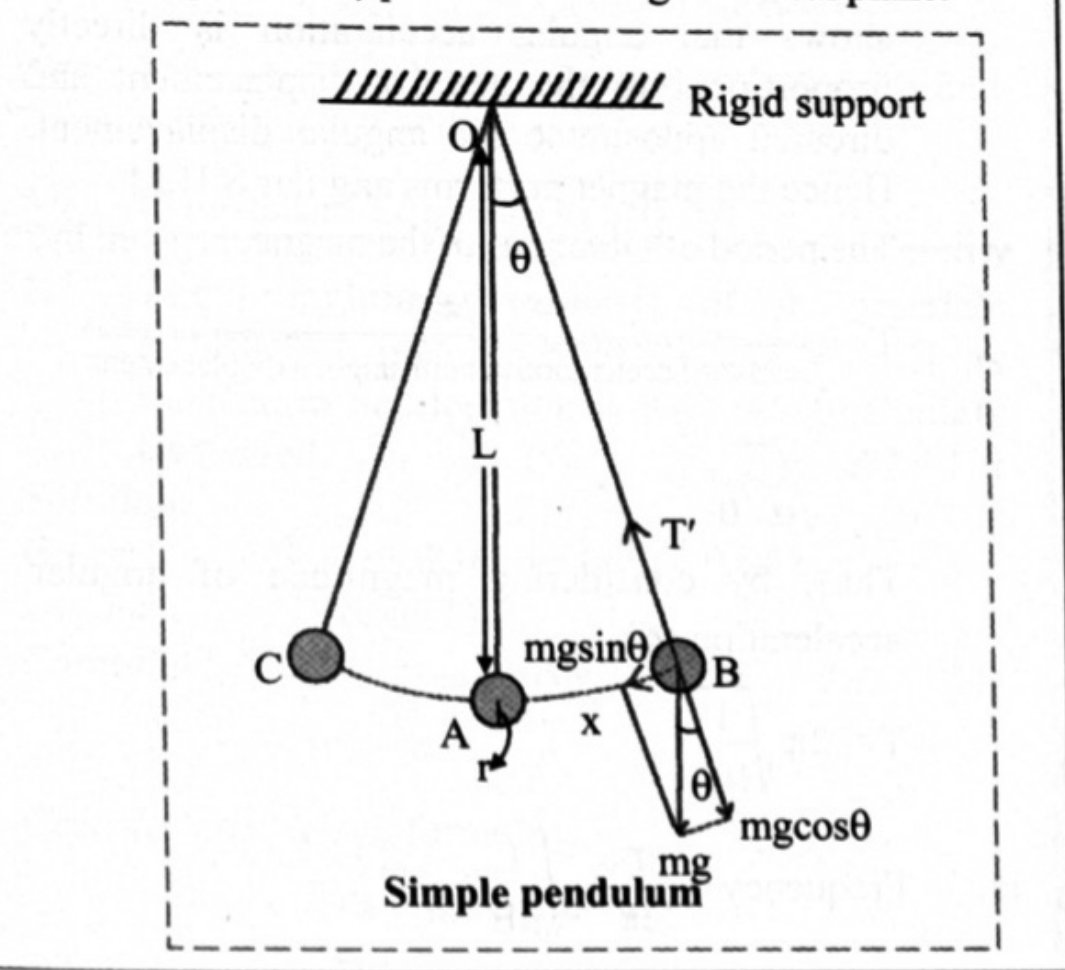
- 4Composition of two SHMs of the same period along the same path (resultant amplitude)Discuss analytically the composition of two linear SHMs having the same period and along the same path. Obtain the expression for resultant amplitude.
Asked in: July 2022 (Q.27, 4 marks)
Show the derivationHide the derivation
[From 5.10, Q1 (except Initial Phase)]Step 1Consider a particle simultaneously subjected to two S.H.M.s having the same period and along same path (let it be along the x-axis), but of different amplitudes and initial phases. The resultant displacement at any instant is equal to the vector sum of its displacements due to both the S.H.M.s at that instant.Step 2Let the two linear S.H.M's be given by equations,where , are amplitudes; , are initial phase angles and , are the displacement of two S.H.M's in time 't'. ω is same for both S.H.M's.Step 3The resultant displacement of the two S.H.M's is given by,Step 4Using equations (1) and (2), equation (3) can be written as,Step 5As , , and are constants, we can combine them in terms of another convenient constants R and δ asandStep 6Using equations (5) and (6), equation (4) can be written as,Equation (7) is the equation of an S.H.M. of the same angular frequency (hence, the same period) but of amplitude R and initial phase δ. It shows that the combination (superposition) of two linear S.H.M.s of the same period and occurring along the same path is also an S.H.M.Resultant Amplitude:Resultant amplitude is,Squaring and adding equations (5) and (6) we get,Equation (8) represents resultant amplitude of two S.H.M's.Initial Phase:Dividing equation (6) by (5), we get,Equation (9) represents resultant or initial phase of two S.H.M's.Step 7a. When phase difference is zero radians:Two S.H.M.s are in phase, i.e.,From equation (8),b. When phase difference is radians:Two S.H.M.s are out of phase, i.e., ,From equation (8), - 5Differential equation of linear S.H.M. (general form) RepeatsObtain the differential equation of linear simple harmonic motion.
Asked in: March 2017; February 2024 (Q.6, 2 marks)
Show the derivationHide the derivation
Step 1In a linear S.H.M., the force is directed towards the mean position and its magnitude is directly proportional to the displacement of the body from mean position.where, k is force constant and x is displacement from the mean position.Step 2According to Newton's second law of motion,From equations (1) and (2),Step 3The velocity of the particle is given by,,Acceleration,Step 4Substituting equation (4) in equation (3),Step 5Substituting , where ω is the angular frequency,This is the differential equation of linear S.H.M. - 6Potential energy of a particle performing S.H.M. RepeatsObtain an expression for the potential energy of a particle performing S.H.M. Hence evaluate the potential energy (i) at the mean position and (ii) at the extreme position.
Asked in: March 2015; March 2019
Show the derivationHide the derivation
Expression for potential energy:Step 1The restoring force acting on the particle at point P is given by,where k is the force constant.Step 2Suppose that the particle is displaced further by an infinitesimal displacement 'dx' against the restoring force 'f'.Step 3The external work done (dW) during this displacement isStep 4The total work done on the particle to displace it from O to P is given by,Step 5This work done is stored as the potential energy (P.E.) of the particle at displacement x.Step 6At time t,Thus, with time, it varies as .Step 7At the mean position, x = 0Potential energy,Step 8At the extreme positions, x = ± APotential energy, - 7Law of conservation of energy for a particle performing S.H.M.Prove the law of conservation of energy for a particle performing simple harmonic motion. Hence graphically show the variation of kinetic energy and potential energy with instantaneous displacement.
Asked in: March 2017
Show the derivationHide the derivation
Expression for potential energy:Step 1The restoring force acting on the particle at point P is given by,where k is the force constant.Step 2Suppose that the particle is displaced further by an infinitesimal displacement 'dx' against the restoring force 'f'.Step 3The external work done (dW) during this displacement isStep 4The total work done on the particle to displace it from O to P is given by,Step 5This work done is stored as the potential energy (P.E.) of the particle at displacement x.Step 6At time t,Thus, with time, it varies as .Step 7At the mean position, x = 0Potential energy,Step 8At the extreme positions, x = ± APotential energy,Step 1Expression for kinetic energy:a. Consider a particle of mass m, performing a linear S.H.M. along the path MN about the mean position O as shown in figure.b. At a given instant, let the particle be at P, at a distance x from O.c. Velocity of the particle in S.H.M. is given aswhere x is the displacement of the particle performing S.H.M. and A is the amplitude of S.H.M.d. Thus, the kinetic energy,This is the kinetic energy at displacement x.e. Also, at time t, kinetic energy is,Thus, with time, it varies as .iii. Expression for total energy:a. The total energy of the particle is the sum of its kinetic energy and potential energy.b. Using equation (1) and equation (2), we getThis expression gives the total energy of the particle at point P.iv. As m, ω and A are constant, the total energy of the particle at any point P is constant (independent of x and t). In other words, the energy is conserved in S.H.M.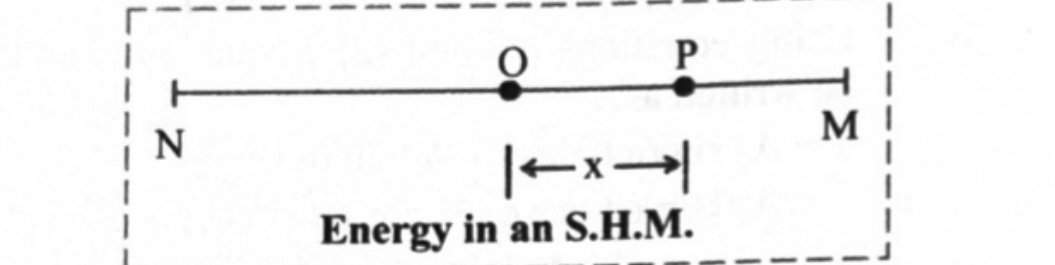
Finished revising this chapter? Practise Oscillations →