5.12
Simple Pendulum
Oscillations · Maharashtra HSC
Theory
Definitions
- An ideal simple pendulum is a heavy particle suspended by a massless, inextensible, flexible string from a rigid support.
- A practical simple pendulum is a small heavy (dense) sphere, called the bob, suspended by a light and inextensible string from a rigid support.
- The distance between the point of suspension and the centre of gravity of the bob (the point of oscillation) is called the length of the pendulum, .
Diagram
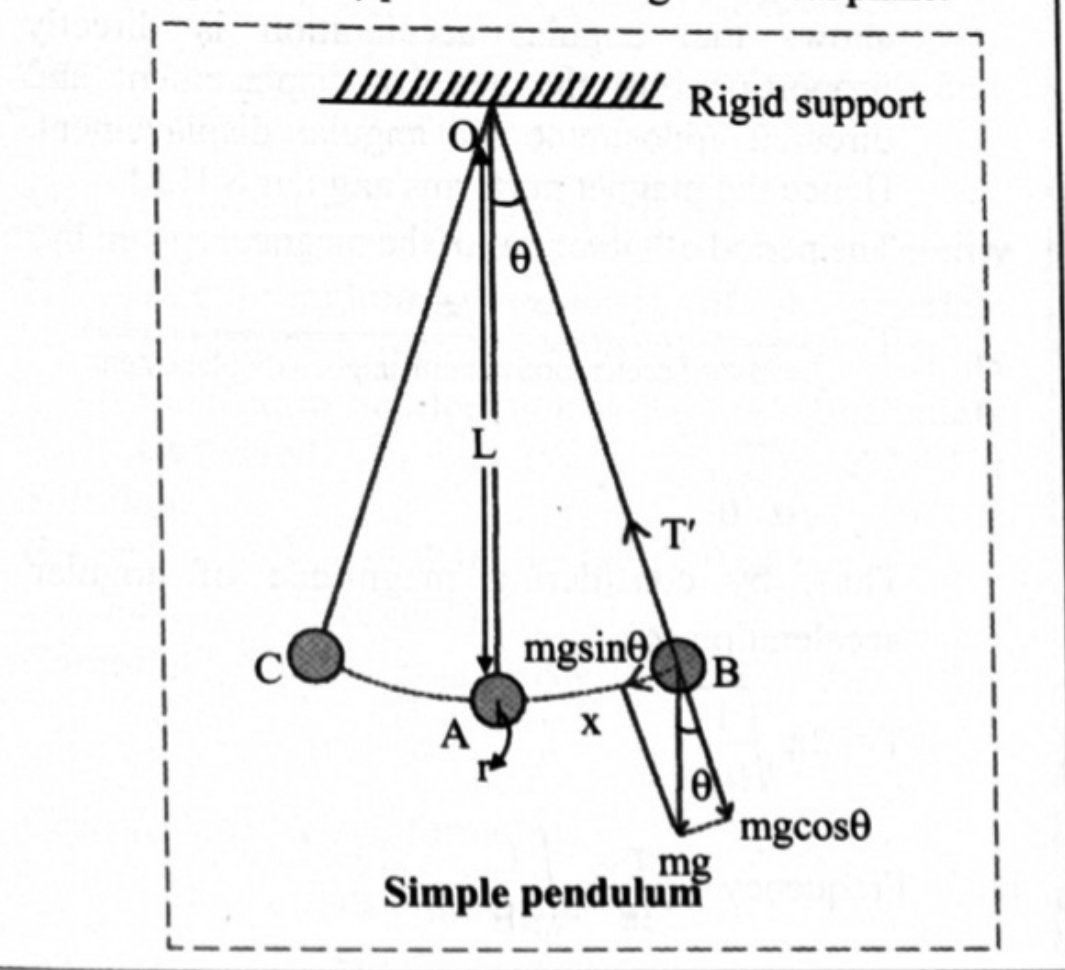
Diagram (Fig. 5.10): a rigid support at O with a string of length carrying a bob of mass . The equilibrium position OA is vertically below O. The bob is shown displaced through a small angle to a position where the string makes angle with the vertical and the bob has moved a horizontal distance from A. Two forces act on the bob at that position: the tension along the string towards the support, and the weight vertically downwards. The weight is resolved into along the string (away from the support) and perpendicular to the string.
Showing that the motion is linear S.H.M.
i. Let be the mass of the bob and the tension in the string. The pendulum remains in equilibrium in the position OA, with the centre of gravity of the bob vertically below the point of suspension O.
ii. If the pendulum is displaced through a small angle (called the angular amplitude) and released, it begins to oscillate on either side of the mean (equilibrium) position in a single vertical plane.
iii. In the displaced (extreme) position two forces act on the bob:
- the force due to tension in the string, directed along the string towards the support,
- the weight , vertically downwards.
iv. At the extreme positions there should not be any net force along the string.
v. The component of can only balance the force due to tension, so the weight is resolved into two components:
- along the string, which is balanced by the tension ,
- perpendicular to the string, which is the restoring force acting on the mass , tending to return it to the equilibrium position.
vi. As is very small (), , so From the figure, for a small angle, , hence As , and are constant, .
vii. Thus, for small displacement, the restoring force is directly proportional to the displacement and is oppositely directed. Hence the bob of a simple pendulum performs linear S.H.M. for small amplitudes.
Expression for the period
viii. The period of oscillation of a pendulum is given by Using equation (1), , and , so Substituting in the expression for , This gives the expression for the time period of a simple pendulum, and the frequency is
ix. The period of a simple pendulum depends on the length of the pendulum and on the acceleration due to gravity.
Assumptions made in the derivation
- The amplitude of oscillations is very small (at least 20 times smaller than the length).
- The length of the string is large.
- During the oscillations the bob moves along a single vertical plane.
Laws of the simple pendulum
- The period of a simple pendulum is directly proportional to the square root of its length.
- The period of a simple pendulum is inversely proportional to the square root of the acceleration due to gravity.
- The period of a simple pendulum does not depend on its mass.
- The period of a simple pendulum does not depend on its amplitude (for small amplitude).
How small must the amplitude be?
Writing for the period at (ideally) very small angular amplitude and for the period at a larger angular amplitude , experiment gives:
| Angular amplitude | |||||
|---|---|---|---|---|---|
The error in the period is about 2% at , 5% at , 10% at and 18% at . Hence the recommended maximum angular amplitude is less than ; it also helps in restricting the oscillations to a single vertical plane.
5.12.1 Second's pendulum
A simple pendulum whose period is two seconds is called a second's pendulum.
From , for a second's pendulum where is the length of the second's pendulum. Squaring and rearranging,
Using this relation we can find the length of a second's pendulum at a place if is known; conversely, if is measured experimentally it can be used to determine at that place. With m/s, m, i.e. nearly 1 m.
Distinguish: conical pendulum and simple pendulum
| Conical pendulum | Simple pendulum |
|---|---|
| The trajectory and the plane of motion of the bob is a horizontal circle | The trajectory and the plane of motion of the bob is part of a vertical circle |
| K.E. and gravitational P.E. are constant | K.E. and gravitational P.E. are interconverted and their sum is conserved |
| The horizontal component of the force due to tension is the necessary centripetal force (the governing force) | The tangential component of the weight is the governing force for the energy conversions during the motion |
| The string always makes a fixed angle with the horizontal and can never be horizontal | With a large amplitude the string can be horizontal at some instants |
In both discussions the stretching of the string and the energy spent on it are ignored, though the string is always stretched — otherwise it would never have tension (except at the extreme positions of the simple pendulum). Non-conservative forces such as air resistance are also neglected.
Standard results
- for
- and
- at the same place
- Second's pendulum: s, m
- Clock problems: oscillations per day ; time gained or lost per day
- Energy of the bob at the extreme position:
Theory Questions Asked on This Subtopic
Real board questions. Answers are at the end of the page.
- 1
Define an ideal simple pendulum. Show that, under certain conditions, simple pendulum performs linear simple harmonic motion.
 Maharashtra HSC board question — asked in March 2013Answer 1 ↓
 - 2
Derive an expression for the period of motion of a simple pendulum. On which factors does it depend?
Maharashtra HSC board question — asked in October 2013Answer 2 ↓ - 3
Define practical simple pendulum. Show that motion of bob of pendulum with small amplitude is linear S.H.M. Hence obtain an expression for its period. What are the factors on which its period depends?
Maharashtra HSC board question — asked in July 2016Answer 3 ↓ - 4
Define an ideal simple pendulum. Show that the motion of a simple pendulum under certain conditions is simple harmonic. Obtain an expression for its period.
Maharashtra HSC board question — asked in July 2018; March 2010Answer 4 ↓ - 5
Define second's pendulum. Derive a formula for the length of second's pendulum.
Maharashtra HSC board question — asked in March 2022Answer 5 ↓ - 6
Obtain the expression for the period of simple pendulum performing S.H.M.
Maharashtra HSC board question — asked in July 2023Answer 6 ↓
Numericals
Every numerical set on this subtopic. Full working is at the end of the page.
- 7
When the length of a simple pendulum is decreased by 20 cm, the period changes by 10%. Find the original length of the pendulum.
Maharashtra HSC board question — asked in March 2014Answer 7 ↓ - 8
A clock regulated by seconds pendulum, keeps correct time. During summer, length of pendulum increases to 1.005 m. How much will the clock gain or lose in one day? [g = 9.8 m/s and π = 3.142]
Maharashtra HSC board question — asked in July 2017Answer 8 ↓ - 9
A simple pendulum of length 1 m has a mass of 10 g and oscillates freely with amplitude 2 cm. Find its potential energy at extreme position. [g = 9.8 m/s]
Maharashtra HSC board question — asked in July 2018Answer 9 ↓ - 10
The length of the second's pendulum in a clock is increased to 4 times its initial length. Calculate the number of oscillations completed by the new pendulum in one minute.
Maharashtra HSC board question — asked in March 2019Answer 10 ↓ - 11
A simple pendulum of length 1 m has mass 10 g and oscillates freely with amplitude of 5 cm. Calculate its potential energy at extreme position.
Maharashtra HSC board question — asked in February 2020Answer 11 ↓
Answers & Solutions
Work the questions above first, then check yourself here. Each answer is set out the way it should be written in the paper.
Definition: An ideal simple pendulum is a heavy particle suspended by a massless, inextensible, flexible string from a rigid support. i. Let 'm' be the mass of the bob and 'T' be the tension in the string. The pendulum remains in equilibrium in the position OA, with the centre of gravity of the bob, vertically below the point of suspension O. ii. If now the pendulum is displaced through a small angle θ, called angular amplitude, and released, it begins to oscillate on either side of the mean (equilibrium) position in a single vertical plane. iii. In the displaced position (extreme position), two forces are acting on the bob. a. Force T′ due to tension in the string, directed along the string, towards the support. b. Weight mg, in the vertically downward direction. iv. At the extreme positions, there should not be any net force along the string. v. The component of mg can only balance the force due to tension. Thus, weight mg is resolved into two components; a. The component mg cosθ along the string, which is balanced by the tension T′. b. The component mg sinθ perpendicular to the string is the restoring force acting on mass m tending to return it to the equilibrium position. Restoring force, vi. As θ is very small (θ < 10°), From the figure, For small angle, As m, g and L are constant, vii. Thus, for small displacement, the restoring force is directly proportional to the displacement and is oppositely directed. Hence the bob of a simple pendulum performs linear S.H.M. for small amplitudes.
[From 5.12, Q1] Definition: An ideal simple pendulum is a heavy particle suspended by a massless, inextensible, flexible string from a rigid support. i. Let 'm' be the mass of the bob and 'T' be the tension in the string. The pendulum remains in equilibrium in the position OA, with the centre of gravity of the bob, vertically below the point of suspension O. ii. If now the pendulum is displaced through a small angle θ, called angular amplitude, and released, it begins to oscillate on either side of the mean (equilibrium) position in a single vertical plane. iii. In the displaced position (extreme position), two forces are acting on the bob. a. Force T′ due to tension in the string, directed along the string, towards the support. b. Weight mg, in the vertically downward direction. iv. At the extreme positions, there should not be any net force along the string. v. The component of mg can only balance the force due to tension. Thus, weight mg is resolved into two components; a. The component mg cosθ along the string, which is balanced by the tension T′. b. The component mg sinθ perpendicular to the string is the restoring force acting on mass m tending to return it to the equilibrium position. Restoring force, vi. As θ is very small (θ < 10°), From the figure, For small angle, As m, g and L are constant, vii. Thus, for small displacement, the restoring force is directly proportional to the displacement and is oppositely directed. Hence the bob of a simple pendulum performs linear S.H.M. for small amplitudes.[(i) to (vii)] viii. The period T of oscillation of a pendulum is given by, Using equation (1), (in magnitude) Substituting in the expression for T, This gives the expression for the time period of a simple pendulum. ix. Period of simple pendulum depends on the length of the pendulum and acceleration due to gravity.
Definition: A practical simple pendulum is a small heavy (dense) sphere (called bob) suspended by a light and inextensible string from a rigid support. Motion of bob of pendulum is linear S.H.M.: [From 5.12, Q1] Definition: An ideal simple pendulum is a heavy particle suspended by a massless, inextensible, flexible string from a rigid support. i. Let 'm' be the mass of the bob and 'T' be the tension in the string. The pendulum remains in equilibrium in the position OA, with the centre of gravity of the bob, vertically below the point of suspension O. ii. If now the pendulum is displaced through a small angle θ, called angular amplitude, and released, it begins to oscillate on either side of the mean (equilibrium) position in a single vertical plane. iii. In the displaced position (extreme position), two forces are acting on the bob. a. Force T′ due to tension in the string, directed along the string, towards the support. b. Weight mg, in the vertically downward direction. iv. At the extreme positions, there should not be any net force along the string. v. The component of mg can only balance the force due to tension. Thus, weight mg is resolved into two components; a. The component mg cosθ along the string, which is balanced by the tension T′. b. The component mg sinθ perpendicular to the string is the restoring force acting on mass m tending to return it to the equilibrium position. Restoring force, vi. As θ is very small (θ < 10°), From the figure, For small angle, As m, g and L are constant, vii. Thus, for small displacement, the restoring force is directly proportional to the displacement and is oppositely directed. Hence the bob of a simple pendulum performs linear S.H.M. for small amplitudes.Expression for time period of simple pendulum: [From 5.12, Q1] Definition: An ideal simple pendulum is a heavy particle suspended by a massless, inextensible, flexible string from a rigid support. i. Let 'm' be the mass of the bob and 'T' be the tension in the string. The pendulum remains in equilibrium in the position OA, with the centre of gravity of the bob, vertically below the point of suspension O. ii. If now the pendulum is displaced through a small angle θ, called angular amplitude, and released, it begins to oscillate on either side of the mean (equilibrium) position in a single vertical plane. iii. In the displaced position (extreme position), two forces are acting on the bob. a. Force T′ due to tension in the string, directed along the string, towards the support. b. Weight mg, in the vertically downward direction. iv. At the extreme positions, there should not be any net force along the string. v. The component of mg can only balance the force due to tension. Thus, weight mg is resolved into two components; a. The component mg cosθ along the string, which is balanced by the tension T′. b. The component mg sinθ perpendicular to the string is the restoring force acting on mass m tending to return it to the equilibrium position. Restoring force, vi. As θ is very small (θ < 10°), From the figure, For small angle, As m, g and L are constant, vii. Thus, for small displacement, the restoring force is directly proportional to the displacement and is oppositely directed. Hence the bob of a simple pendulum performs linear S.H.M. for small amplitudes.and Q. No. 2 Factors affecting time period of simple pendulum: [From 5.12, Q2 (ix)] [From 5.12, Q1] Definition: An ideal simple pendulum is a heavy particle suspended by a massless, inextensible, flexible string from a rigid support. i. Let 'm' be the mass of the bob and 'T' be the tension in the string. The pendulum remains in equilibrium in the position OA, with the centre of gravity of the bob, vertically below the point of suspension O. ii. If now the pendulum is displaced through a small angle θ, called angular amplitude, and released, it begins to oscillate on either side of the mean (equilibrium) position in a single vertical plane. iii. In the displaced position (extreme position), two forces are acting on the bob. a. Force T′ due to tension in the string, directed along the string, towards the support. b. Weight mg, in the vertically downward direction. iv. At the extreme positions, there should not be any net force along the string. v. The component of mg can only balance the force due to tension. Thus, weight mg is resolved into two components; a. The component mg cosθ along the string, which is balanced by the tension T′. b. The component mg sinθ perpendicular to the string is the restoring force acting on mass m tending to return it to the equilibrium position. Restoring force, vi. As θ is very small (θ < 10°), From the figure, For small angle, As m, g and L are constant, vii. Thus, for small displacement, the restoring force is directly proportional to the displacement and is oppositely directed. Hence the bob of a simple pendulum performs linear S.H.M. for small amplitudes.[(i) to (vii)] viii. The period T of oscillation of a pendulum is given by, Using equation (1), (in magnitude) Substituting in the expression for T, This gives the expression for the time period of a simple pendulum. ix. Period of simple pendulum depends on the length of the pendulum and acceleration due to gravity.
[From 5.12, Q1] Definition: An ideal simple pendulum is a heavy particle suspended by a massless, inextensible, flexible string from a rigid support. i. Let 'm' be the mass of the bob and 'T' be the tension in the string. The pendulum remains in equilibrium in the position OA, with the centre of gravity of the bob, vertically below the point of suspension O. ii. If now the pendulum is displaced through a small angle θ, called angular amplitude, and released, it begins to oscillate on either side of the mean (equilibrium) position in a single vertical plane. iii. In the displaced position (extreme position), two forces are acting on the bob. a. Force T′ due to tension in the string, directed along the string, towards the support. b. Weight mg, in the vertically downward direction. iv. At the extreme positions, there should not be any net force along the string. v. The component of mg can only balance the force due to tension. Thus, weight mg is resolved into two components; a. The component mg cosθ along the string, which is balanced by the tension T′. b. The component mg sinθ perpendicular to the string is the restoring force acting on mass m tending to return it to the equilibrium position. Restoring force, vi. As θ is very small (θ < 10°), From the figure, For small angle, As m, g and L are constant, vii. Thus, for small displacement, the restoring force is directly proportional to the displacement and is oppositely directed. Hence the bob of a simple pendulum performs linear S.H.M. for small amplitudes.and Q. No. 2
i. A simple pendulum whose period is two seconds is called second's pendulum. ii. Time period of simple pendulum, For a second's pendulum, Where, is the length of second's pendulum, having period T = 2 s.
[From 5.12, Q2] [From 5.12, Q1] Definition: An ideal simple pendulum is a heavy particle suspended by a massless, inextensible, flexible string from a rigid support. i. Let 'm' be the mass of the bob and 'T' be the tension in the string. The pendulum remains in equilibrium in the position OA, with the centre of gravity of the bob, vertically below the point of suspension O. ii. If now the pendulum is displaced through a small angle θ, called angular amplitude, and released, it begins to oscillate on either side of the mean (equilibrium) position in a single vertical plane. iii. In the displaced position (extreme position), two forces are acting on the bob. a. Force T′ due to tension in the string, directed along the string, towards the support. b. Weight mg, in the vertically downward direction. iv. At the extreme positions, there should not be any net force along the string. v. The component of mg can only balance the force due to tension. Thus, weight mg is resolved into two components; a. The component mg cosθ along the string, which is balanced by the tension T′. b. The component mg sinθ perpendicular to the string is the restoring force acting on mass m tending to return it to the equilibrium position. Restoring force, vi. As θ is very small (θ < 10°), From the figure, For small angle, As m, g and L are constant, vii. Thus, for small displacement, the restoring force is directly proportional to the displacement and is oppositely directed. Hence the bob of a simple pendulum performs linear S.H.M. for small amplitudes.[(i) to (vii)] viii. The period T of oscillation of a pendulum is given by, Using equation (1), (in magnitude) Substituting in the expression for T, This gives the expression for the time period of a simple pendulum. ix. Period of simple pendulum depends on the length of the pendulum and acceleration due to gravity.[(i) to (viii)]
Given: , m To find: Length () Formula: Calculation: From formula, and Squaring both sides, m Ans: The original length of the pendulum is 1.05 m.
Given: L = 1.005 m, g = 9.8 m/s To find: Loss in period (ΔT) Formula: Calculation: From formula, = 2.012 s The period of a seconds pendulum is 2 second. Hence, the given pendulum clock will lose 0.012 s in 2.012 s (during summer). Loss in period per day s Ans: The clock will lose 518.4 s in one day.
Given: l = 1 m, m = 10 g = kg = kg, A = 2 cm = m To find: Potential energy () Formula: Calculation: From formula, J Ans: The potential energy of the simple pendulum at extreme positions is J.
Given: s, To find: Number of oscillations completed in one minute (n) Formula: Calculation: From formula, s Hz No. of oscillations completed in one minute 15 Ans: Number of oscillations completed by the pendulum in one minute is 15.
Given: L = 1 m, m = 10 g = kg, A = 5 cm = 0.05 m To find: Potential energy at extreme position Formulae: i. ii. Calculation: From formula (i) and (ii), J Ans: Potential energy at extreme position is J.