5.13
Angular S.H.M. and its Differential Equation
Oscillations · Maharashtra HSC
Theory
Torsional oscillations
Diagram (Fig. 5.11): a metallic disc is attached centrally to a thin wire (nylon or metallic) hanging from a rigid support. If the disc is slightly twisted about the axis along the wire and released, it performs rotational motion partly in the clockwise and partly in the anticlockwise sense.
Such oscillations are called angular oscillations or torsional oscillations. The motion is governed by the restoring torque in the wire, which is always opposite to the angular displacement. If the magnitude of that torque happens to be proportional to the angular displacement, the motion is an angular S.H.M.
Definition
Angular S.H.M. is defined as the oscillatory motion of a body in which the torque for angular acceleration is directly proportional to the angular displacement and its direction is opposite to that of the angular displacement.
Differential equation of angular S.H.M.
For the angular S.H.M. of a body, the restoring torque for an angular displacement is The constant of proportionality is the restoring torque per unit angular displacement.
If is the moment of inertia of the body, the torque acting on it is where is the angular acceleration. Using this in equation (1),
This is the differential equation for angular S.H.M. From it,
Since and are constants, the angular acceleration is directly proportional to and its direction is opposite to that of the angular displacement. Hence this oscillatory motion is called angular S.H.M.
The period of angular S.H.M. is
5.13.1 Magnet vibrating in a uniform magnetic field
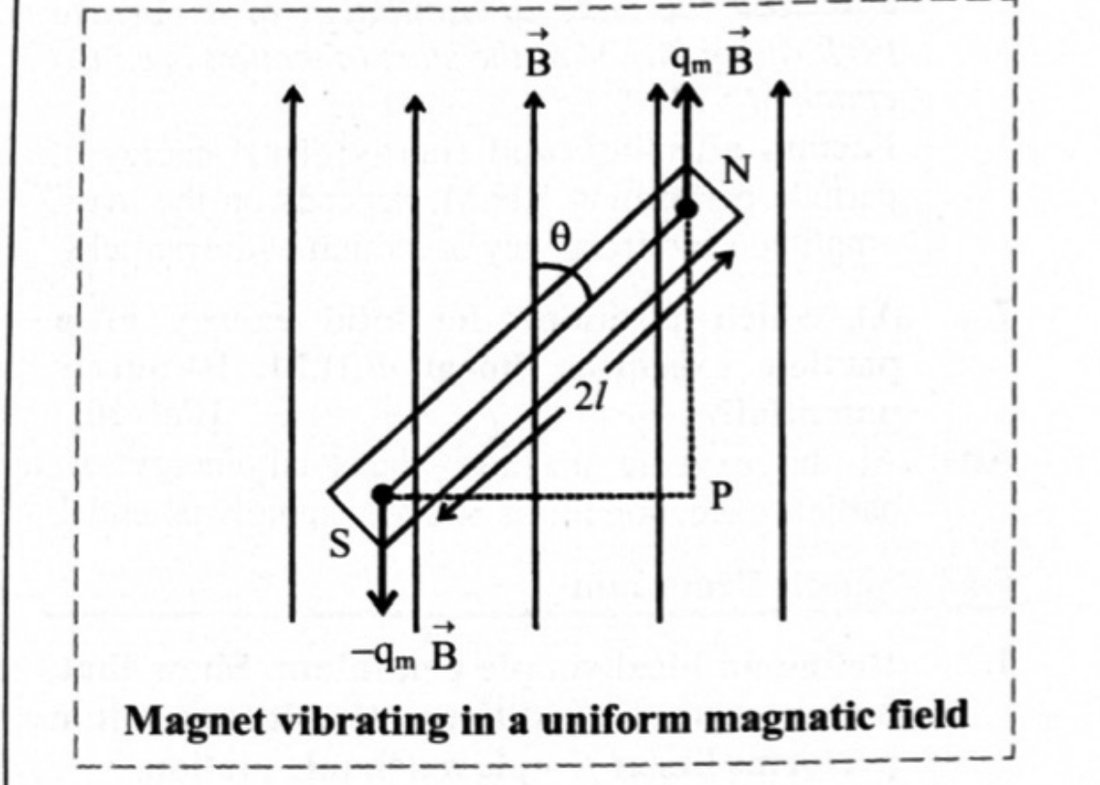
Diagram (Fig. 5.12): a bar magnet freely suspended in the plane of a uniform magnetic field , shown deflected through a small angle from the field direction, with the restoring torque acting to bring it back to alignment.
i. If a bar magnet is freely suspended in the plane of a uniform magnetic field, it remains in equilibrium with its axis parallel to the direction of the field.
ii. If it is given a small angular displacement about an axis passing through its centre, perpendicular to itself and to the field, and released, it performs angular oscillations.
iii. Let be the magnetic dipole moment and the magnetic field. The symbol is used for the magnetic dipole moment because is already used for mass.
iv. In the deflected position a restoring torque acts on the magnet that tends to bring it back to its equilibrium position.
v. The magnitude of this torque is If is small, , so .
vi. For a clockwise angular displacement , the restoring torque is in the anticlockwise direction, so where is the moment of inertia of the bar magnet and its angular acceleration.
vii. Since , and are constants, equation (3) shows that the angular acceleration is directly proportional to the angular displacement and directed opposite to it. Hence the magnet performs angular S.H.M.
viii. The period of vibrations of the magnet is Taking the magnitude of the angular acceleration,
ix. Frequency:
Moments of inertia you may need
- Rectangular bar magnet of mass , length and breadth , oscillating about a central axis perpendicular to the face: .
- Thin circular disc of mass and radius about its central axis (the wire's axis, in torsional oscillations): .
Standard results
- Definition: torque angular displacement, opposite in direction
- ; is the restoring torque per unit angular displacement (N m/rad)
- Differential equation:
- and , with
- Magnet in a uniform field: , ,
Theory Questions Asked on This Subtopic
Real board questions. Answers are at the end of the page.
- 1
Define angular S.H.M. and prove that a bar magnet vibrating in uniform magnetic induction perform uniform angular S.H.M. Obtain an expression for its frequency.
 Maharashtra HSC board question — asked in March 2009Answer 1 ↓
 - 2
Define angular SHM. State its differential equation.
Maharashtra HSC board question — asked in March 2010Answer 2 ↓ - 3
Write the differential equation for angular S.H.M.
Maharashtra HSC board question — asked in March 2022Answer 3 ↓
Numericals
Every numerical set on this subtopic. Full working is at the end of the page.
- 4
A bar magnet of mass 120 g in the form of a rectangular parallelepiped, has dimensions l = 40 mm, b = 100 mm and h = 80 mm, with its dimension 'h' vertical, the magnet performs angular oscillations in the plane of the magnetic field with period π seconds. If the magnetic moment is 3.4 Am, determine the influencing magnetic field.
Maharashtra HSC board question — asked in February 2023Answer 4 ↓
Answers & Solutions
Work the questions above first, then check yourself here. Each answer is set out the way it should be written in the paper.
Angular S.H.M. is defined as the oscillatory motion of a body in which the torque for angular acceleration is directly proportional to the angular displacement and its direction is opposite to that of angular displacement. Expression for frequency: i. If a bar magnet is freely suspended in the plane of a uniform magnetic field, it remains in equilibrium with its axis parallel to the direction of the field. ii. If it is given a small angular displacement θ about an axis passing through its centre, perpendicular to itself and to the field and released, it performs angular oscillations. iii. Let μ be the magnetic dipole moment and B the magnetic field. iv. In the deflected position, a restoring torque acts on the magnet that tends to bring it back to its equilibrium position. v. The magnitude of this torque is If θ is small, vi. For clockwise angular displacement θ, the restoring torque is in the anticlockwise direction. Where, I is the moment of inertia of the bar magnet and α is its angular acceleration. vii. Since μ, B and I are constants, equation (1) shows that angular acceleration is directly proportional to the angular displacement and directed opposite to the angular displacement. Hence the magnet performs angular S.H.M. viii. The period of vibrations of the magnet is given by, Thus, by considering magnitude of angular acceleration (α), ix. Frequency
[From 5.13, Q1 (Definition only)] Angular S.H.M. is defined as the oscillatory motion of a body in which the torque for angular acceleration is directly proportional to the angular displacement and its direction is opposite to that of angular displacement. Expression for frequency: i. If a bar magnet is freely suspended in the plane of a uniform magnetic field, it remains in equilibrium with its axis parallel to the direction of the field. ii. If it is given a small angular displacement θ about an axis passing through its centre, perpendicular to itself and to the field and released, it performs angular oscillations. iii. Let μ be the magnetic dipole moment and B the magnetic field. iv. In the deflected position, a restoring torque acts on the magnet that tends to bring it back to its equilibrium position. v. The magnitude of this torque is If θ is small, vi. For clockwise angular displacement θ, the restoring torque is in the anticlockwise direction. Where, I is the moment of inertia of the bar magnet and α is its angular acceleration. vii. Since μ, B and I are constants, equation (1) shows that angular acceleration is directly proportional to the angular displacement and directed opposite to the angular displacement. Hence the magnet performs angular S.H.M. viii. The period of vibrations of the magnet is given by, Thus, by considering magnitude of angular acceleration (α), ix. Frequency Differential equation for angular S.H.M.:
[From 5.13, Q2 (Equation only)] [From 5.13, Q1 (Definition only)] Angular S.H.M. is defined as the oscillatory motion of a body in which the torque for angular acceleration is directly proportional to the angular displacement and its direction is opposite to that of angular displacement. Expression for frequency: i. If a bar magnet is freely suspended in the plane of a uniform magnetic field, it remains in equilibrium with its axis parallel to the direction of the field. ii. If it is given a small angular displacement θ about an axis passing through its centre, perpendicular to itself and to the field and released, it performs angular oscillations. iii. Let μ be the magnetic dipole moment and B the magnetic field. iv. In the deflected position, a restoring torque acts on the magnet that tends to bring it back to its equilibrium position. v. The magnitude of this torque is If θ is small, vi. For clockwise angular displacement θ, the restoring torque is in the anticlockwise direction. Where, I is the moment of inertia of the bar magnet and α is its angular acceleration. vii. Since μ, B and I are constants, equation (1) shows that angular acceleration is directly proportional to the angular displacement and directed opposite to the angular displacement. Hence the magnet performs angular S.H.M. viii. The period of vibrations of the magnet is given by, Thus, by considering magnitude of angular acceleration (α), ix. Frequency Differential equation for angular S.H.M.:
Given: m = 120 g = 0.12 kg, l = 40 mm = m, b = 10 mm = m, h = 80 mm = m, T = π s, μ = 3.4 Am To find: Magnetic field (B) Formulae: i. ii. Calculation: From formula (i), Am From formula (ii), Squaring both sides, Wb m or T Ans: The influencing magnetic field is of strength Wb m or T.