5.11
Energy of a Particle Performing S.H.M.
Oscillations · Maharashtra HSC
Theory
The setting
While performing an S.H.M. the particle possesses speed, hence kinetic energy, at all positions except the extreme positions. In spite of the presence of a restoring force (except at the mean position) the particle occupies various positions, which shows that work is done and the system has potential energy — elastic in the case of a spring, gravitational for a pendulum, magnetic for a magnet. The total energy is the sum of the kinetic and potential energies.
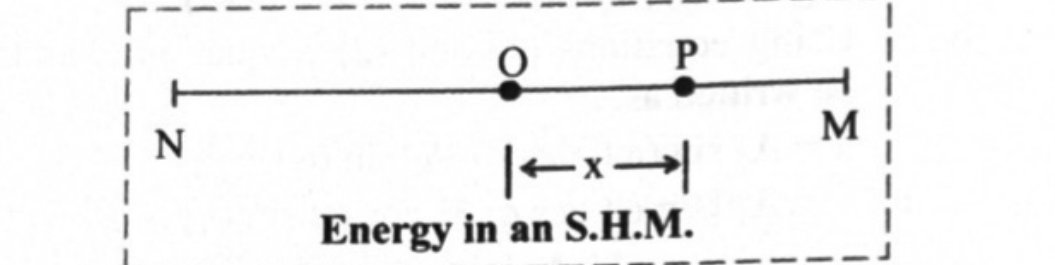
Diagram (Fig. 5.8): a particle of mass performs a linear S.H.M. along the path MN about the mean position O; at a given instant it is at P, a distance from O, with M and N at .
i. Expression for kinetic energy
The velocity of the particle in S.H.M. is Thus the kinetic energy is This is the kinetic energy at displacement . At time , so with time it varies as .
ii. Expression for potential energy
i. The restoring force acting on the particle at P is , where is the force constant.
ii. Suppose the particle is displaced further by an infinitesimal displacement against the restoring force .
iii. The external work done during this displacement is
iv. The total work done to displace it from O to P is
v. This work done is stored as the potential energy of the particle at displacement :
vi. At time , so with time it varies as .
vii. At the mean position, , hence .
viii. At the extreme positions, , hence .
iii. Total energy and its conservation
The total energy is the sum of the kinetic and potential energies. Using equations (1) and (2),
As , and are constants, the total energy of the particle at any point P is constant — independent of and of . In other words, the energy is conserved in S.H.M.
If is the frequency, , so
Factors on which the total energy depends
The total energy in S.H.M. is directly proportional to
- the mass of the particle,
- the square of the amplitude,
- the square of the frequency,
- the force constant,
and inversely proportional to the square of the period.
Special cases
i. At the mean position, and the velocity is maximum, so and .
ii. At the extreme positions the velocity is zero and , so and .
As the particle oscillates, the energy changes between kinetic and potential: at the mean position it is entirely kinetic, at the extreme positions entirely potential, and at other positions partly kinetic and partly potential. The total energy is always conserved.
iii. If K.E. P.E., Thus at , K.E. P.E. .
iv. At , Thus at the energy is 25% potential and 75% kinetic.
Graphical representation
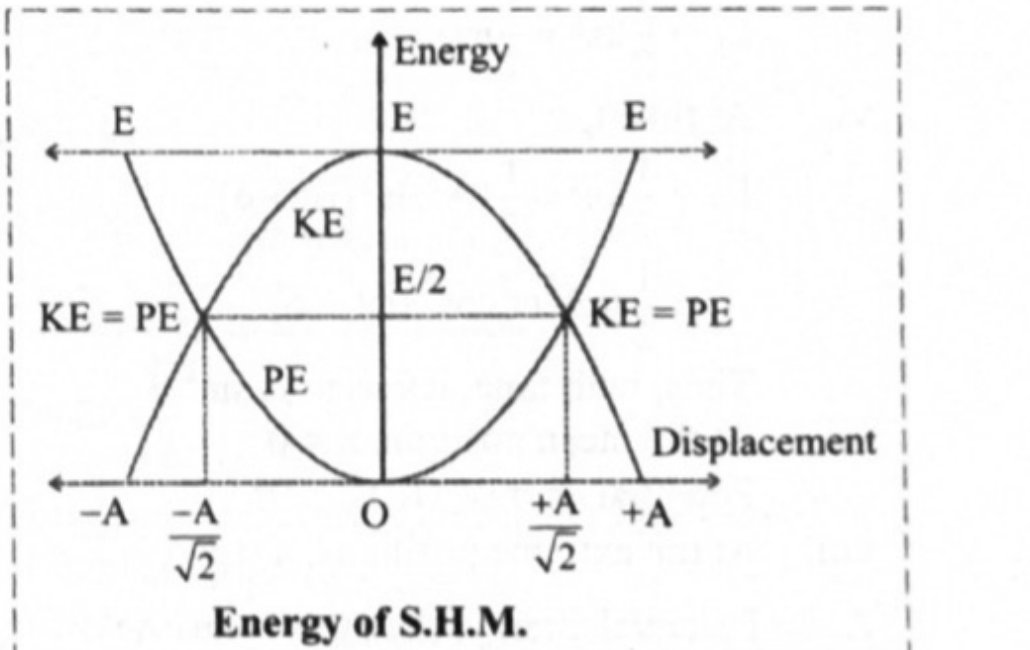
Graph (Fig. 5.9): energy plotted against the instantaneous displacement , with running from to .
- is an upward-opening parabola with its minimum (zero) at , rising to at .
- is a downward-opening parabola with its maximum at , falling to zero at .
- The total energy is a horizontal straight line, the same at every .
- The two parabolas intersect at , where each equals .
Epoch
The physical quantity which describes the state of oscillation of a particle performing S.H.M. at the start of the motion is called the epoch of S.H.M.
Standard results
- ; at time ,
- ; at time ,
- at
- At : ,
- and
- The total energy is purely potential at the extreme positions and purely kinetic at the mean position
Theory Questions Asked on This Subtopic
Real board questions. Answers are at the end of the page.
- 1
Represent graphically the variations of K.E., P.E. and T.E. of a particle performing linear S.H.M. with respect to displacement.
 Maharashtra HSC board question — asked in October 2008Answer 1 ↓
 - 2
State an expression for K. E. (kinetic energy) and P. E. (potential energy) at displacement 'x' for a particle performing linear S.H.M. Represent them graphically. Find the displacement at which K.E. is equal to P. E.
Maharashtra HSC board question — asked in March 2014Answer 2 ↓ - 3
Obtain an expression for potential energy of a particle performing simple harmonic motion. Hence evaluate the potential energy i. at mean position and ii. at extreme position.
Maharashtra HSC board question — asked in March 2015Answer 3 ↓ - 4
Prove the law of conservation of energy for a particle performing simple harmonic motion. Hence graphically show the variation of kinetic energy and potential energy w. r. t. instantaneous displacement.
 Maharashtra HSC board question — asked in March 2017Answer 4 ↓
 - 5
Obtain an expression for potential energy of a particle performing S.H.M. What is the value of potential energy at (i) Mean position and (ii) Extreme position?
Maharashtra HSC board question — asked in March 2019Answer 5 ↓ - 6
Define epoch of S.H.M. State the factors on which the total energy of a particle performing S.H.M. depends.
Maharashtra HSC board question — asked in July 2019Answer 6 ↓ - 7
At which position, the total energy of a particle executing linear S.H.M. is purely potential?
Maharashtra HSC board question — asked in February 2020Answer 7 ↓
Numericals
Every numerical set on this subtopic. Full working is at the end of the page.
- 8
A particle executes S.H.M. with a period of 10 seconds. Find the time in which its potential energy will be half of its total energy.
Maharashtra HSC board question — asked in July 2016Answer 8 ↓ - 9
The displacement of a particle performing simple harmonic motion is rd of its amplitude. What fraction of total energy will be its kinetic energy?
Maharashtra HSC board question — asked in February 2024Answer 9 ↓
Answers & Solutions
Work the questions above first, then check yourself here. Each answer is set out the way it should be written in the paper.
The question is a real board question. Its answer and working are ours — this paper was published without an official answer key.
The Three Energies
For a particle of mass performing linear S.H.M. of amplitude and angular frequency , with force constant , at a displacement from the mean position:
The total energy is independent of , so it is conserved throughout the motion.
The Graph
- Axes: the instantaneous displacement along the horizontal axis, from on the left, through the mean position at , to on the right; energy along the vertical axis.
- P.E. curve: is an upward-opening parabola with its vertex (value zero) at , rising symmetrically to at and at .
- K.E. curve: is a downward-opening parabola with its maximum at , falling symmetrically to zero at . It is the mirror image of the P.E. curve about the horizontal line at .
- T.E. line: is a horizontal straight line at that height, the same at every value of ; the two parabolas add up to it everywhere.
- The two parabolas intersect at , where . Label these crossing points.
- Label all three curves K.E., P.E. and T.E., and mark , and on the displacement axis and on the energy axis.
Values at the Key Points
Position K.E. P.E. T.E. Extreme (left) Crossing point Mean Extreme (right) Conclusion
The energy is wholly kinetic at the mean position and wholly potential at the two extreme positions; between them it is continually converted from one form to the other, but their sum, the total energy, stays constant. Both parabolas are symmetric about the energy axis, so the energies depend only on the magnitude of the displacement, not on its direction.
Refer Subtopic 5.11: Q. No. 1 for graphical representation. i. Kinetic energy of particle executing S.H.M is given by, ii. Potential energy of particle executing S.H.M. is given by, iii. For a particle performing linear S.H.M. If , Thus at ,
Expression for potential energy: i. The restoring force acting on the particle at point P is given by, where k is the force constant. ii. Suppose that the particle is displaced further by an infinitesimal displacement 'dx' against the restoring force 'f'. iii. The external work done (dW) during this displacement is iv. The total work done on the particle to displace it from O to P is given by, v. This work done is stored as the potential energy (P.E.) of the particle at displacement x. vi. At time t, Thus, with time, it varies as . vii. At the mean position, x = 0 Potential energy, viii. At the extreme positions, x = ± A Potential energy,
i. Expression for kinetic energy: a. Consider a particle of mass m, performing a linear S.H.M. along the path MN about the mean position O as shown in figure. b. At a given instant, let the particle be at P, at a distance x from O. c. Velocity of the particle in S.H.M. is given as where x is the displacement of the particle performing S.H.M. and A is the amplitude of S.H.M. d. Thus, the kinetic energy, This is the kinetic energy at displacement x. e. Also, at time t, kinetic energy is, Thus, with time, it varies as . ii. Expression for potential energy: [From 5.11, Q3] Expression for potential energy: i. The restoring force acting on the particle at point P is given by, where k is the force constant. ii. Suppose that the particle is displaced further by an infinitesimal displacement 'dx' against the restoring force 'f'. iii. The external work done (dW) during this displacement is iv. The total work done on the particle to displace it from O to P is given by, v. This work done is stored as the potential energy (P.E.) of the particle at displacement x. vi. At time t, Thus, with time, it varies as . vii. At the mean position, x = 0 Potential energy, viii. At the extreme positions, x = ± A Potential energy, [(i) to (vi)] iii. Expression for total energy: a. The total energy of the particle is the sum of its kinetic energy and potential energy. b. Using equation (1) and equation (2), we get This expression gives the total energy of the particle at point P. iv. As m, ω and A are constant, the total energy of the particle at any point P is constant (independent of x and t). In other words, the energy is conserved in S.H.M. Graphical representation of K.E. and P.E. of S.H.M.: Refer Subtopic 5.11: Q. No. 1
[From 5.11, Q3] Expression for potential energy: i. The restoring force acting on the particle at point P is given by, where k is the force constant. ii. Suppose that the particle is displaced further by an infinitesimal displacement 'dx' against the restoring force 'f'. iii. The external work done (dW) during this displacement is iv. The total work done on the particle to displace it from O to P is given by, v. This work done is stored as the potential energy (P.E.) of the particle at displacement x. vi. At time t, Thus, with time, it varies as . vii. At the mean position, x = 0 Potential energy, viii. At the extreme positions, x = ± A Potential energy,
Definition: The physical quantity which describes the state of oscillation of a particle performing S.H.M at the start of motion is called epoch of S.H.M. Factors affecting total energy: Total energy of particle performing S.H.M. depends on the mass, amplitude and frequency of motion of the particle.
At the extreme position, the total energy of a particle executing linear S.H.M. is purely potential.
Given: T = 10 s, To find: Time (t) Formulae: i. ii. Calculation: From formula (i) and (ii), ... (From given condition) As, s Ans: The time in which the potential energy will be half of total energy is 1.25 s.
Given: x = A/3 To find: Ratio of kinetic and total energy Formulae: i. ii. Calculation: From formula (ii), From formulae (i) and (ii), Ans: The ratio of kinetic and total energy is 8 : 9.