5.7
Reference Circle Method
Oscillations · Maharashtra HSC
Theory
Definition of linear S.H.M.
Linear S.H.M. is defined as the linear periodic motion of a body, in which force (or acceleration) is always directed towards the mean position and its magnitude is proportional to the displacement from the mean position.
The idea
Diagram (Fig. 5.3): a rod rotates along a vertical circle in the x–y plane. A linear source parallel to the rod illuminates it parallel to the x-axis, so the shadow (projection) of the rod falls on the y-axis. The tip of that shadow is seen to oscillate about the origin along the y-axis.
To prove that this projected motion is an S.H.M., we take the projections of displacement, velocity and acceleration of the circular motion on any reference diameter, and check that we get the corresponding quantities of a linear S.H.M.
The proof
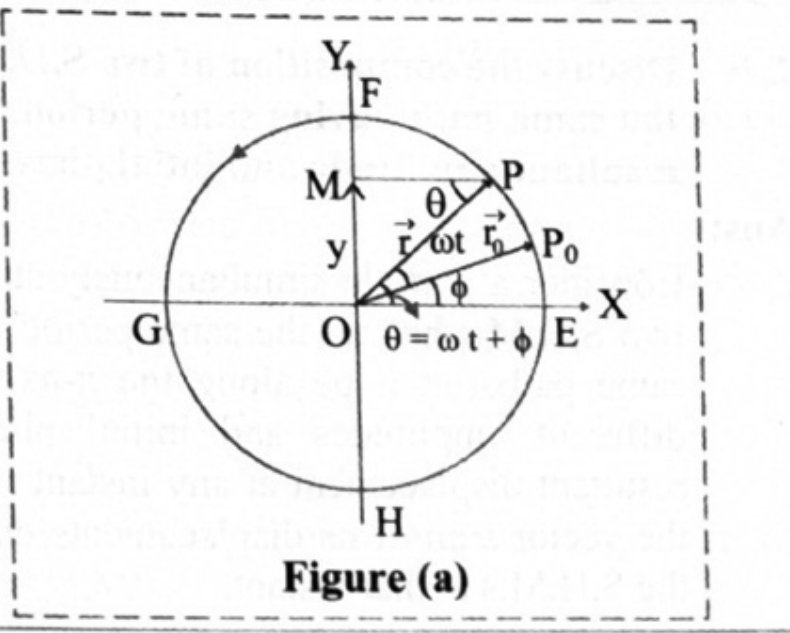
Diagram (Fig. 5.4): a particle P moves anticlockwise in a uniform circular motion of radius with centre at the origin O. Angular positions are measured from the reference OX: at E the angular position is zero, at F it is , at G it is , and back at E it is (not zero). The diameter FH along the y-axis is chosen as the reference diameter, and M is the foot of the perpendicular from P on it.
i. Let be the position vector of the particle. At let the particle be at with reference angle . During time it has an angular displacement , so the reference angle at time is
ii. Projection of displacement: at time , This is the equation of a linear S.H.M. of amplitude .
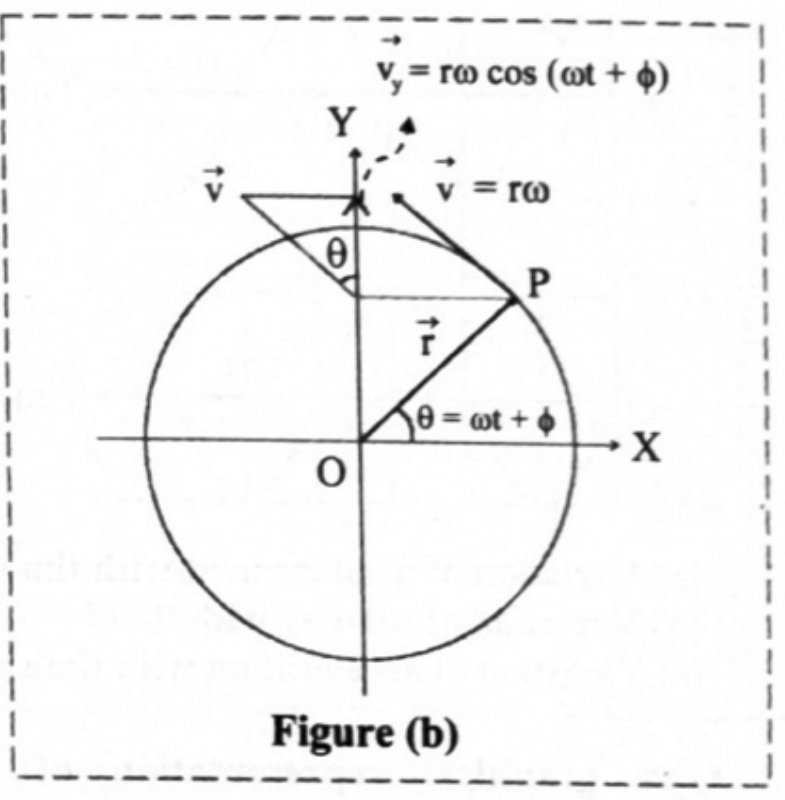
iii. Projection of velocity: the instantaneous velocity of P in the circular motion is the tangential velocity of magnitude . Its projection on the reference diameter is This is the expression for the velocity of a particle performing linear S.H.M.
iv. Projection of acceleration: the instantaneous acceleration of P in the circular motion is the radial or centripetal acceleration of magnitude , directed towards O. Its projection on the reference diameter is This is the corresponding acceleration for the linear S.H.M.
Conclusion
From this analogy it is clear that the projection of any quantity of a uniform circular motion gives us the corresponding quantity of a linear S.H.M. The analogy can be verified for any diameter taken as the reference diameter. Thus, the projection of a U.C.M. on any diameter is an S.H.M.
This also explains why is called the angular frequency of a linear S.H.M.: it is the angular velocity of the reference circular motion, and it decides the periodicity of the S.H.M. The phase angle of the circular motion is used as the phase of the corresponding S.H.M.
Standard results
- — amplitude of the S.H.M. equals the radius of the reference circle
- is the phase of the S.H.M.
Theory Questions Asked on This Subtopic
Real board questions. Answers are at the end of the page.
- 1
Define linear S.H.M. Show that S.H.M. is a projection of U.C.M. on any diameter.
 Maharashtra HSC board question — asked in March 2016Answer 1 ↓
Answers & Solutions
Work the questions above first, then check yourself here. Each answer is set out the way it should be written in the paper.
Definition: [From 5.4, Q2 (Definition only)] Definition: Linear S.H.M. is defined as the linear periodic motion of a body, in which force (or acceleration) is always directed towards the mean position and its magnitude is proportional to the displacement from the mean position. Differential equation of linear S.H.M.: [From 5.4, Q1]
i. In a linear S.H.M., the force is directed towards the mean position and its magnitude is directly proportional to the displacement of the body from mean position. where, k is force constant and x is displacement from the mean position. ii. According to Newton's second law of motion, From equations (1) and (2), iii. The velocity of the particle is given by, , Acceleration, iv. Substituting equation (4) in equation (3), v. Substituting , where ω is the angular frequency, This is the differential equation of linear S.H.M. i. Figure (a) shows the anticlockwise uniform circular motion of a particle P, with centre at the origin O. Its angular positions are decided with the reference OX. ii. It means, if the particle is at E, the angular position is zero, at F it is , at G it is , and so on. If it comes to E again, it will be . iii. Let be the position vector of this particle. At t = 0, let the particle be at with reference angle φ. During time t, it has angular displacement ωt. Thus, the reference angle at time 't' is θ = (ωt + φ). iv. Let us choose the diameter FH along Y-axis as the reference diameter and label OM as the projection of on this. v. Projection of displacement: At time t, the position vector OM = OPsinθ This is the equation of linear S.H.M. of amplitude r. vi. Projection of velocity: Instantaneous velocity of the particle P in the circular motion is the tangential velocity of magnitude 'rω'. Its projection on the reference diameter will be as shown in figure (b), . This is the expression for the velocity of a particle performing a linear S.H.M. vii. Projection of acceleration: Instantaneous acceleration of the particle P in circular motion is the radial or centripetal acceleration of magnitude , directed towards O. Its projection on the reference diameter will be . This is the corresponding acceleration for the linear S.H.M. viii. From this analogy it is clear that projection of any quantity for a uniform circular motion gives us the corresponding quantity of linear S.H.M. This analogy can be verified for any diameter as the reference diameter. Thus, the projection of a U.C.M. on any diameter is an S.H.M.