Chapter 2
Electrostatic Potential and Capacitance
CBSE · 14 subtopics
Formula SheetEvery formula this chapter can be examined on, in one table.
Constants and units CBSE expects
- — Coulomb constant; use this value in every numerical unless the paper gives another.
- — permittivity of free space; same number in .
- Potential : SI unit volt, ; dimensions . Scalar.
- Capacitance : SI unit farad, ; dimensions . Sub-multiples , , .
- Polarisation : unit ; dimensions . Dielectric constant (also written ): dimensionless, .
- ; ; , .
- Dielectric strength of air — the largest field air can hold before breakdown.
2.1–2.2 Electrostatic potential energy and potential
| Formula | Symbols, units and conditions |
|---|---|
| |
| |
| |
|
Potential due to a point charge
| Formula | Symbols, units and conditions |
|---|---|
| |
|
Potential due to an electric dipole
| Formula | Symbols, units and conditions |
|---|---|
| |
| |
|
Potential due to a system of charges
| Formula | Symbols, units and conditions |
|---|---|
| |
| |
| |
|
Equipotential surfaces and the field–potential relation
| Formula | Symbols, units and conditions |
|---|---|
| |
| |
|
Potential energy of a system of charges
| Formula | Symbols, units and conditions |
|---|---|
| |
| |
|
Potential energy in an external field
| Formula | Symbols, units and conditions |
|---|---|
| |
| |
| |
| |
|
Electrostatics of conductors
| Formula | Symbols, units and conditions |
|---|---|
| |
| |
|
Dielectrics and polarisation
| Formula | Symbols, units and conditions |
|---|---|
| |
| |
|
Capacitors and capacitance
| Formula | Symbols, units and conditions |
|---|---|
|
The parallel plate capacitor
| Formula | Symbols, units and conditions |
|---|---|
| |
|
Effect of dielectric on capacitance
| Formula | Symbols, units and conditions |
|---|---|
| |
| |
| |
|
Combination of capacitors
| Formula | Symbols, units and conditions |
|---|---|
| |
| |
|
Energy stored in a capacitor
| Formula | Symbols, units and conditions |
|---|---|
| |
| |
|
Numerical shortcuts CBSE reuses
- Charge sharing between an identical charged and uncharged capacitor: , — exactly half the energy is lost.
- Series pair from a battery of : on each; then , .
- Same (series): . Same (parallel): .
- Battery disconnected, then inserted: fixed, , , , .
- Battery connected, then inserted: fixed, , , unchanged, .
- Battery disconnected, then : fixed, , unchanged, , .
Short NotesThe chapter subtopic by subtopic, in the textbook's own order.14 subtopics
- 1Electrostatic Potential1 board question
- 2Potential due to a Point Charge1 board question
- 3Potential due to an Electric Dipole1 board question
- 4Potential due to a System of Charges4 board questions
- 5Equipotential Surfaces13 board questions
- 6Potential Energy of a System of Charges10 board questions
- 7Potential Energy in an External Field6 board questions
- 8Electrostatics of Conductors1 board question
- 9Dielectrics and Polarisation
- 10Capacitors and Capacitance1 board question
- 11The Parallel Plate Capacitor3 board questions
- 12Effect of Dielectric on Capacitance5 board questions
- 13Combination of Capacitors1 board question
- 14Energy Stored in a Capacitor19 board questions
The whole chapter in brief
Electrostatic potential energy
- Coulomb force is conservative: work done in moving a charge between two points is independent of the path and zero over a closed loop.
- Potential energy difference , the work done by an external force in moving from to without acceleration.
- is fixed only up to an additive constant. Standard choice: at infinity, so .
Electrostatic potential
- at a point = work done per unit positive charge by an external agent in bringing it from infinity to that point, without acceleration.
- . Potential is a scalar; add contributions algebraically, with sign.
- SI unit volt: . A quantity whose unit is is electrostatic potential.
- Work by external agent from to is ; work by the field is . Around any closed loop in an electrostatic field, .
- is the energy gained by an electron accelerated through : .
Potential due to a point charge
- , positive for , negative for , zero at infinity.
- (hyperbola), — the potential curve falls off more slowly than the field curve. On a versus plot the graph is a straight line through the origin of slope , so slope ratio gives charge ratio.
- Potential due to a charge at its own location is undefined (infinite).
Potential due to an electric dipole
| Position | Potential | Field |
|---|---|---|
| Axial point, distance | ||
| Equatorial point, distance | Zero | |
| General point at angle | Not required at Class 12 |
- Dipole potential depends on and on ; it is axially symmetric about .
- It falls as , faster than the of a single charge, because the total charge is zero.
Potential due to a system of charges
- Superposition: — an algebraic sum, never a vector sum.
- Charged conducting sphere or thin shell of radius , charge : outside, and everywhere inside and on the surface. is discontinuous across the surface; is continuous.
- droplets of radius at potential each, coalescing: , .
- Two spheres joined by a wire come to a common potential, not a common charge: if the shared surface density is uniform, i.e. for equal potentials.
- Zero-potential point for and separated by : at from (between them) — and one more point outside, on the side.
Equipotential surfaces
- Definition: a surface on which the potential has the same value at every point.
- Properties CBSE asks to "write two of": no work is done in moving a charge over the surface; is everywhere normal to the surface; two equipotential surfaces never intersect; closer spacing means a stronger field.
- Why normal: a tangential component of would do work along the surface, but there. So the tangential component must vanish.
| Charge configuration | Equipotential surfaces |
|---|---|
| Single point charge | Concentric spheres centred on the charge |
| Uniform field along | Parallel planes perpendicular to the -axis, equally spaced |
| Electric dipole | Closed, non-concentric surfaces symmetric about the axis, denser near each charge, with a zero-potential plane bisecting the axis |
| Two identical positive charges | Separate closed surfaces near each charge, merging into one near-spherical surface far away |
| Charged conductor | Its own surface, and every surface parallel to it just outside |
- Surfaces of a point charge are not equidistant: , so for equal steps in the spacing grows with .
- Uniform field with magnitude increasing along : still parallel planes normal to , but crowded together towards .
Relation between field and potential
- Bringing a unit positive charge through against from surface () to surface () costs work , so .
- : the field is the negative gradient of the potential.
- Conclusion (i): points in the direction of steepest decrease of . Conclusion (ii): its magnitude is the rate of change of per unit displacement normal to the equipotential surface.
- Reverse direction: .
Potential energy of a system of charges
- for a pair; sum over all pairs for charges.
- for like charges (work must be done to push them together), for unlike charges.
- depends only on the final configuration, not on the order of assembly.
- Work needed to separate the charges to infinity .
- Standard results: equilateral triangle of side with gives ; with on a triangle of side , (the terms cancel).
Potential energy in an external field
- Single charge: , with the external potential only.
- Two charges in an external field: .
- Dipole in a uniform field: net force zero, torque , .
| Equilibrium | |||
|---|---|---|---|
| (minimum) | Stable | ||
| (maximum) | — | ||
| (maximum) | Unstable |
- Work to rotate from to : . Rotating from parallel through costs ; from to also costs .
Electrostatics of conductors — the six results
- Inside a conductor the electrostatic field is zero. Free charges rearrange until it is.
- At the surface of a charged conductor is normal to the surface at every point; a tangential component would move surface charges.
- The interior can carry no excess charge in the static state; all excess charge sits on the outer surface (Gauss's law on a vanishingly small interior surface).
- is constant throughout the volume and on the surface — the whole conductor is one equipotential.
- Just outside the surface, (pill-box Gaussian surface).
- Electrostatic shielding: the field in a charge-free cavity is zero, whatever lies outside. Shielding works one way only — charges placed inside the cavity are not screened from the outside.
Dielectrics and polarisation
| Conductor in a field | Dielectric in a field | |
|---|---|---|
| Charge carriers | Free electrons | Bound charges only |
| Response | Free charges migrate to the surface | Molecules stretch or re-orient; bound surface charge appears |
| Net internal field | Exactly zero | Reduced to , never zero |
- Non-polar molecules (, ): centres of positive and negative charge coincide, no permanent dipole moment; a field induces one.
- Polar molecules (, ): permanent dipole moment, randomly oriented by thermal agitation; a field aligns them.
- Polarisation = dipole moment per unit volume; for linear isotropic dielectrics .
- A uniformly polarised slab is equivalent to two sheets of bound charge on the faces normal to ; there is no net volume charge.
- The bound-charge field opposes the applied field, so with .
Capacitors and capacitance
- A capacitor is two conductors separated by an insulator, carrying and ; its total charge is zero and means the charge on one plate.
- ; is fixed by shape, size, separation and the medium, and does not change with or .
- Slope of a – graph is : the steeper line is the larger capacitance.
- A large stores a large at a modest , keeping the field below the dielectric strength of the medium ( for air) so the charge does not leak.
The parallel plate capacitor
- Field of each sheet: . Between the plates they add to ; outside they cancel to zero.
- and , a purely geometric result valid for (fringing ignored).
- is enormous: with it needs plates about on a side.
- Removing one plate halves the field, hence halves the force on a charge between the plates.
- Charging across a dc battery: a momentary current piles electrons on one plate and leaves an equal positive charge on the other; the growing potential difference opposes further charging, and the current stops when the plate voltage equals the battery voltage.
Effect of a dielectric
- Full slab: . Partial slab of thickness : ; a conducting slab is the case, .
- Slabs stacked across the gap are in series; slabs sitting side by side across the area are in parallel.
| Quantity | Battery connected ( fixed) | Battery disconnected ( fixed) |
|---|---|---|
| Unchanged | ||
| Unchanged | ||
| Unchanged | ||
Combination of capacitors
- Series: charge the same on each, , ; the equivalent is smaller than the smallest member.
- Parallel: potential the same across each, , ; the equivalent is larger than the largest member.
- Three equal capacitors : all parallel gives , all series gives , two in series with the third in parallel gives .
- Balanced bridge: if the bridge condition holds, the bridging capacitor carries no charge and can be removed before reducing the network.
Energy stored in a capacitor
- Building the charge bit by bit: , hence .
- Energy density — a general result for any field configuration, not only for parallel plates.
- In series the same flows, so : total energy equals the sum of individual energies (the same holds in parallel with ).
- Sharing charge between an identical charged and uncharged capacitor halves the stored energy; the missing half is dissipated as heat and electromagnetic radiation by the transient current. Charge is conserved, energy is not.
Traps that cost marks
- Potential is a scalar: add with signs, never with the parallelogram law. Field is a vector: add with components.
- does not mean . Inside a charged shell but . Conversely does not mean — on the equatorial plane of a dipole but .
- In , must exclude the potential of itself, which is infinite at its own location.
- Do not quote for a non-uniform field; integrate instead.
- Write , not ; state that is chosen at or you lose the justification mark.
- Decide first whether the battery is still connected. Connected means is fixed; disconnected means is fixed. Every "how is it affected" question turns on this.
- With the battery disconnected, does not depend on the plate separation — pulling the plates apart changes , and , but not .
- In series the charge is the same, not the voltage; in parallel the voltage is the same, not the charge. Reversing the two is the commonest slip in capacitor numericals.
- The dielectric constant multiplies capacitance, so goes in the numerator of , but it divides the field, .
- Two equipotential surfaces can never cross — a point would then have two potentials.
- A force question and a potential-energy question about the same array are different: force needs vector addition at or along a diagonal, energy needs the scalar sum over pairs.
- Both a proton and an electron in the same field feel the same magnitude of force ( with equal ); their potential energies differ in sign.
- Convert , , cm and mm to SI before substituting; most lost numerical marks are unit slips, not physics.
Solved Numerical ExamplesWorked numericals to attempt first, each with a hint before the full solution.Coming soon
These are being added chapter by chapter. They are solved numericals from the prescribed book and the reference guides — not previous board questions, which live under Practice — so that you can work through the method before meeting it in a real paper.
Important DerivationsEvery derive / obtain / prove question in this chapter.17
- 1Derivation 1Derive the expression for the electric potential due to an electric dipole at a point on its axial line.
Asked in: CBSE Class 12 Physics — SA · 2/3, Delhi 2017, Ap · Section C, 3 marks
Show the derivationHide the derivation
Let be an axial point at distance from the centre of a dipole of charges (at ) and (at ), separated by . (using ). For a far away point, : , i.e. for a dipole (unlike for a point charge).
- 2Derivation 2Two small conducting balls and of radius and have charges and respectively. They are connected by a wire. Obtain the expression for charges on and , in equilibrium.
Asked in: CBSE Class 12 Physics — SA · 2023 · Section B, 2 marks
Show the derivationHide the derivation
Charge density on ball 1, ; on ball 2, . After connecting by a wire (long enough time), both balls reach the same potential, so charge redistributes over the combined surface area , with total charge conserved. Common surface charge density, . Charge on ball 1: . Charge on ball 2: .
- 3Derivation 3(a) Draw the equipotential surfaces corresponding to a uniform electric field in the -direction. (b) Derive an expression for the electric potential at any point along the axial line of an electric dipole.
Asked in: CBSE Class 12 Physics — SA · AI 2019 · Section C, 3 marks
Show the derivationHide the derivation
(a) Since the field is uniform along , the equipotential surfaces are planes perpendicular to the -axis (parallel -planes), equally spaced. (b) Let be an axial point at distance from the centre of a dipole of charges (distance ) and (distance ): (using ). For : .
- 4Derivation 4Two closely spaced equipotential surfaces and with potentials and (where is the change in ), are kept distance apart as shown in the figure. Deduce the relation between the electric field and the potential gradient between them. Write the two important conclusions concerning the relation between the electric field and electric potentials. (A point charge sits at ; nearby surface has potential , and surface , a small perpendicular distance further out, has potential ; lies on surface .)
Asked in: CBSE Class 12 Physics — Long Answer · Delhi 2014C, Ev · Section E, 5 marks
Show the derivationHide the derivation
If is the field at due to charge at , a test charge experiences force ; the external force needed to move it against the field is . Work done in a small displacement (against the field, i.e. towards ): . As distance from decreases in the direction of : ...(ii) Also ...(i). From (i) and (ii): , i.e. . Hence electric field at a point is equal to the negative gradient of the electrostatic potential at that point. Conclusions: (i) No work is done in moving a test charge over an equipotential surface. (ii) The electric field is always at right angles to the equipotential surface.
- 5Derivation 5Obtain an expression for electrostatic potential energy of a system of three charges , and placed at the vertices of an equilateral triangle of side .
Asked in: CBSE Class 12 Physics — SA · 2023 · Section B, 2 marks
Show the derivationHide the derivation
There are three pairs of charges, each separated by (equilateral triangle):
- 6Derivation 6Obtain the expression for potential energy of an electric dipole placed with its axis at an angle to an external electric field . What is the minimum value of the potential energy?
Asked in: CBSE Class 12 Physics — Long Answer · AI 2019C · Section E, 5 marks
Show the derivationHide the derivation
Torque on the dipole, . Potential energy . Taking at and : , i.e. . Potential energy is minimum () when , i.e. dipole moment parallel to (stable equilibrium).
- 7Derivation 7(a) Two point charges and are placed distance apart. Obtain the expression for the amount of work done to place a third charge at the midpoint of the line joining the two charges. (b) At what distance from charge on the line joining the two charges (in terms of , and ) will this work done be zero?
Asked in: CBSE Class 12 Physics — SA · 2020, Ev · Section C, 3 marks
Show the derivationHide the derivation
(a) Work done to bring from infinity to the midpoint ( from each charge): . (b) Let this point be at distance from (so from ), where : potential at that point due to equals potential due to (in magnitude): .
- 8Derivation 8(a) Three point charges , and are placed at the vertices of an equilateral triangle of side as shown in the figure. Obtain the expression for the magnitude of the resultant electric force acting on the charge . (b) Find out the amount of work done to separate the charges at infinite distance.
Asked in: CBSE Class 12 Physics — SA · 2018 · Section C, 3 marks
Show the derivationHide the derivation
(a) Force on due to : (attractive). Force on due to : (repulsive). Angle between and is . Resultant: . (b) Work done change in PE of the system
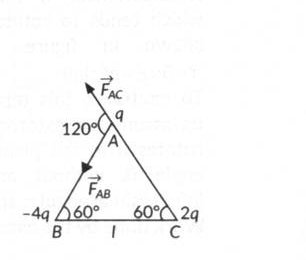
- 9Derivation 9Derive an expression for the potential energy of an electric dipole in a uniform electric field. Explain the conditions for stable and unstable equilibrium.
Asked in: CBSE Class 12 Physics — Long Answer · 3/5, AI 2019 · Section E, 5 marks
Show the derivationHide the derivation
Small work done in rotating the dipole by against the restoring torque: . Net work done in rotating from to : , stored as potential energy (taking at ). Stable equilibrium: (), ; a small displacement produces a restoring torque. Unstable equilibrium: ( antiparallel to ), ; a small displacement produces a torque that increases the displacement further.
- 10Derivation 10An infinitely large thin plane sheet has a uniform surface charge density . Obtain the expression for the amount of work done in bringing a point charge from infinity to a point, distant , in front of the charged plane sheet.
Asked in: CBSE Class 12 Physics — Long Answer · 3/5, AI 2017, Ap · Section E, 5 marks
Show the derivationHide the derivation
Let be a point at distance from the sheet. . (field of an infinite sheet is uniform, , independent of distance). . So : an infinite amount of work is required, since the field of an infinite sheet does not vanish even at infinite distance.
- 11Derivation 11(i)(A) Why does the electric field inside a dielectric slab decrease when kept in an external electric field? (B) Derive an expression for the capacitance of a parallel plate capacitor filled with a medium of dielectric constant . (ii) A charge is placed at the centre of a sphere of radius 20 cm. What is the amount of work done in moving from one point on its surface to another point? (iii) Write a relation for polarisation of a dielectric material in the presence of an external electric field.
Asked in: CBSE Class 12 Physics — Long Answer · AI 2021C · Section E, 5 marks
Show the derivationHide the derivation
Answer(i) (a); (i) (b)(i)(A) A dielectric gets polarised in an external field; the field produced by the induced (bound) surface charges opposes the external field, so the net field inside the dielectric is reduced.(i)(B) With dielectric filling the gap, ; potential difference ; (using ).(ii) Since the sphere's surface is equipotential, the work done in moving a charge from one point on the surface to another is .(iii) , where is the electric susceptibility of the dielectric. - 12Derivation 12(i) Obtain an expression for the potential energy of an electric dipole placed in a uniform electric field. (ii) Three capacitors of capacitance , and are connected in series to a source of volt. Show that the total energy stored in the combination of capacitors is equal to the sum of the energy stored in the individual capacitors. (iii) A capacitor of capacitance is connected across a battery. After charging, the battery is disconnected and the separation between the plates is doubled. How will (a) the capacitance and (b) the electric field between the plates be affected? Justify your answer.
Asked in: CBSE Class 12 Physics — Long Answer · AI 2021C · Section E, 5 marks
Show the derivationHide the derivation
(i) (as derived earlier). (ii) In series, , and the charge on each capacitor is the same. Total energy, . (iii) (a) With separation doubled (), — capacitance halves. (b) Since charge remains constant (battery disconnected) and field does not depend on separation, the field between the plates remains unchanged.
- 13Derivation 13A fully charged parallel plate capacitor is connected across an uncharged identical capacitor. Show that the energy stored in the combination is less than that stored initially in the single capacitor.
Asked in: CBSE Class 12 Physics — Long Answer · AI 2015 · Section E, 5 marks
Show the derivationHide the derivation
Let the fully charged capacitor have charge , so initial energy . When connected to an identical uncharged capacitor , charge redistributes equally by symmetry; total capacitance in parallel , and total charge is conserved. Common potential . Final energy, . Since , the combined energy is less than the initial energy (the difference is dissipated as heat and electromagnetic radiation during the charge redistribution).
- 14Derivation 14Establish the relation between electric field and electric potential at a point. Draw the equipotential surface for an electric field pointing in direction with its magnitude increasing at constant rate along direction.
Asked in: CBSE Class 12 Physics — SA · 2020-21 · Section B, 2 marks · CBSE sample question
Show the derivationHide the derivation
Relation: (derived as in Q14 above, from work done in moving a test charge between two closely spaced equipotential surfaces). Equipotential surfaces: since the field's magnitude changes only along (increasing towards ), the surfaces are again planes perpendicular to the -axis, but now spaced progressively closer together towards (since a stronger field means equipotential surfaces of a given lie closer together).
- 15Derivation 15Deduce an expression for the potential energy of a system of two point charges and located at positions and respectively in an external field .
Asked in: CBSE Class 12 Physics — SA · 2020-21 · Section B, 2 marks · CBSE sample question
Show the derivationHide the derivation
Same as Q33/34: , where is the separation between and .
- 16Derivation 16(a) Three charges , and are placed at equal distances on a straight line. If the potential energy of the system of these charges is zero, what is the ratio ? (b)(i) Obtain the expression for the electric field intensity due to a uniformly charged spherical shell of radius at a point distant from the centre of the shell, outside it. (ii) Draw a graph showing the variation of electric field intensity with , for and .
Asked in: CBSE Class 12 Physics — Long Answer · 2022-23 · Section E, 5 marks · CBSE sample question
Show the derivationHide the derivation
(a) Let at ends, at the middle, each pair separated by : . . (b)(i) By Gauss's law with a spherical Gaussian surface of radius : (for ). (ii) For : (no charge enclosed, all charge is on the shell's surface). For : (maximum). For : falls off as . Graph: zero up to , then a jump to peak at , then decay.
- 17Derivation 17(a) Define an ideal electric dipole. Give an example. (b) Derive an expression for the torque experienced by an electric dipole in a uniform electric field. What is the net force acting on this dipole? (c) An electric dipole of length 2 cm is placed with its axis making an angle of with respect to a uniform electric field of . If it experiences a torque of , calculate the magnitude of charge on the dipole, and its potential energy.
Asked in: CBSE Class 12 Physics — Long Answer · 2020-21, Ev · Section E, 5 marks · CBSE sample question
Show the derivationHide the derivation
(a) An ideal dipole consists of two very large, equal and opposite charges and separated by a vanishingly small distance, such that remains finite. Example: a water molecule (). (b) The two charges of a dipole in a uniform field experience equal and opposite forces , which cancel (net force zero) but being non-collinear, produce a torque: , or . Net force on the dipole in a uniform field is zero. (c) : . Since : . Potential energy, .
Finished revising this chapter? Practise Electrostatic Potential and Capacitance →