Skip to content
CalibratePhysics

2.7

Potential Energy of a System of Charges

Electrostatic Potential and Capacitance · CBSE

Theory

Two charges

Assemble the configuration from infinity. Bringing q1q_1 to r⃗1\vec r_1 costs no work — there is no field yet. Bringing q2q_2 to r⃗2\vec r_2 costs q2q_2 times the potential there due to q1q_1:

U=14πε0q1q2r12 U=\dfrac{1}{4\pi\varepsilon_0}\dfrac{q_1q_2}{r_{12}}

  • Bringing them in the other order gives the same answer, because electrostatic work is path independent. UU characterises the configuration, not the route by which it was built.
  • Sign: q1q2>0q_1q_2>0 gives U>0U>0 — positive external work is needed to push like charges together. q1q2<0q_1q_2<0 gives U<0U<0 — positive work is needed to pull unlike charges apart, so the assembly work is negative.

Three or more charges

Bring them in one at a time. The work in the third step is q3q_3 times the potential of the first two at r⃗3\vec r_3, and adding the steps gives

U=14πε0(q1q2r12+q1q3r13+q2q3r23) U=\dfrac{1}{4\pi\varepsilon_0}\left(\dfrac{q_1q_2}{r_{12}}+\dfrac{q_1q_3}{r_{13}}+\dfrac{q_2q_3}{r_{23}}\right)

  • General rule: one term for every distinct pair, so n(n−1)2\dfrac{n(n-1)}{2} terms for nn charges. Four charges give six terms.
  • Work required to assemble the system =U=U. Work required to separate the charges to infinite distance =0−U=−U=0-U=-U.

Worked patterns CBSE reuses

Equilateral triangle, side aa, charges qq, 2q2q and −3q-3q — three pairs, each at separation aa:

U=14πε0a[q(2q)+2q(−3q)+(−3q)(q)]=14πε0a[2q2−6q2−3q2]=−7q24πε0a U=\dfrac{1}{4\pi\varepsilon_0 a}\left[q(2q)+2q(-3q)+(-3q)(q)\right]=\dfrac{1}{4\pi\varepsilon_0 a}\left[2q^{2}-6q^{2}-3q^{2}\right]=\dfrac{-7q^{2}}{4\pi\varepsilon_0 a}

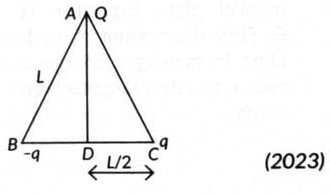
Equilateral triangle, side LL, charges QQ, qq and −q-q:

U=kQ(−q)L+kQqL+k(−q)qL=−kq2L U=\dfrac{kQ(-q)}{L}+\dfrac{kQq}{L}+\dfrac{k(-q)q}{L}=-\dfrac{kq^{2}}{L}

the two QQ terms cancelling. The potential at DD, the midpoint of the side joining −q-q and qq, is V=2kQ3 LV=\dfrac{2kQ}{\sqrt3\,L}, because DD is L/2L/2 from each of ±q\pm q (those cancel) and 32L\dfrac{\sqrt3}{2}L from QQ.

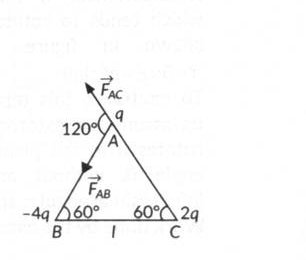
Equilateral triangle, side ll, charges qq, −4q-4q, 2q2q — the two-part question:

  • Force on qq: FAB=14πε04q2l2F_{AB}=\dfrac{1}{4\pi\varepsilon_0}\dfrac{4q^{2}}{l^{2}} (attraction towards −4q-4q) and FAC=14πε02q2l2F_{AC}=\dfrac{1}{4\pi\varepsilon_0}\dfrac{2q^{2}}{l^{2}} (repulsion from 2q2q), with 120∘120^\circ between them, so

F=14πε0q2l216+4+2×4×2×(−12)=14πε0q2l2(23) F=\dfrac{1}{4\pi\varepsilon_0}\dfrac{q^{2}}{l^{2}}\sqrt{16+4+2\times4\times2\times\left(-\dfrac12\right)}=\dfrac{1}{4\pi\varepsilon_0}\dfrac{q^{2}}{l^{2}}\left(2\sqrt3\right)

  • Work to separate to infinity: W=−U=−14πε0l[−4q2−8q2+2q2]=10q24πε0lW=-U=-\dfrac{1}{4\pi\varepsilon_0 l}\left[-4q^{2}-8q^{2}+2q^{2}\right]=\dfrac{10q^{2}}{4\pi\varepsilon_0 l}.

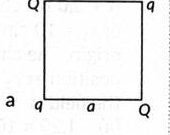
Square of side aa with QQ, qq, QQ, qq at successive corners: four adjacent pairs at aa and two diagonal pairs at a2a\sqrt2:

U=14πε0a[4qQ+q22+Q22] U=\dfrac{1}{4\pi\varepsilon_0 a}\left[4qQ+\dfrac{q^{2}}{\sqrt2}+\dfrac{Q^{2}}{\sqrt2}\right]

and the resultant force on one QQ is F=Q4πε0a2[Q2+2 q]F=\dfrac{Q}{4\pi\varepsilon_0 a^{2}}\left[\dfrac{Q}{2}+\sqrt2\,q\right] along the diagonal.

Three charges +1 μC+1\ \mu\text{C}, −1 μC-1\ \mu\text{C}, +2 μC+2\ \mu\text{C} at the corners of an equilateral triangle of side 10 cm10\ \text{cm}:

W=9×109×10−120.1[(1)(−1)+(1)(2)+(−1)(2)]=9×10⁹×−10−120.1=−0.09 J W=\dfrac{9\times10^{9}\times10^{-12}}{0.1}\left[(1)(-1)+(1)(2)+(-1)(2)\right]=9\times10^{9}\times\dfrac{-10^{-12}}{0.1}=-0.09\ \text{J}

Placing a third charge Q3Q_3 at the midpoint of +Q1+Q_1 and −Q2-Q_2 separated by rr:

W=14πε0Q1Q3r/2−14πε0Q2Q3r/2=14πε02Q3r[Q1−Q2] W=\dfrac{1}{4\pi\varepsilon_0}\dfrac{Q_1Q_3}{r/2}-\dfrac{1}{4\pi\varepsilon_0}\dfrac{Q_2Q_3}{r/2}=\dfrac{1}{4\pi\varepsilon_0}\dfrac{2Q_3}{r}\left[Q_1-Q_2\right]

and this work vanishes at the point where the potential of the pair is zero, x=rQ1Q1+Q2x=\dfrac{rQ_1}{Q_1+Q_2} from Q1Q_1.

Three charges −q-q, QQ, −q-q equally spaced by xx on a line, with U=0U=0:

−2kqQx+kq22x=0 ⇒ q=4Q ⇒ Q:q=1:4 \dfrac{-2kqQ}{x}+\dfrac{kq^{2}}{2x}=0\ \Rightarrow\ q=4Q\ \Rightarrow\ Q:q=1:4

Work done by the field versus change in potential energy

  • Work done by the field =−ΔU=-\Delta U. Moving +3.0 nC+3.0\ \text{nC} from 10 cm10\ \text{cm} to 15 cm15\ \text{cm} away from a fixed +5.0 nC+5.0\ \text{nC}: the magnitude is kqQ(1r1−1r2)=4.5×10⁻⁷ JkqQ\left(\dfrac{1}{r_1}-\dfrac{1}{r_2}\right)=4.5\times10^{-7}\ \text{J}, and because the charge moves away against a repulsive force the work done by the field is −4.5×10⁻⁷ J-4.5\times10^{-7}\ \text{J}.
  • Moving a small positive charge inward along field lines of a positive source, from QQ (far) to PP (near): W=q(VQ−VP)W=q(V_Q-V_P) and VP>VQV_P>V_Q, so the work done by the field is negative.

Diagram to describe in words

Two charges q1q_1 and q2q_2 joined by a line marked r12r_{12}, each with its position vector drawn from a common origin. For three charges, a triangle with q1q_1, q2q_2, q3q_3 at the vertices and r12r_{12}, r13r_{13}, r23r_{23} marked along the sides, one pair term per side.

Standard results

ConfigurationPotential energy
Two charges14πε0q1q2r12\dfrac{1}{4\pi\varepsilon_0}\dfrac{q_1q_2}{r_{12}}
Three chargesSum over the three pairs
nn chargesn(n−1)2\dfrac{n(n-1)}{2} pair terms
Equilateral triangle, q,2q,−3qq,2q,-3q, side aa−7q24πε0a\dfrac{-7q^{2}}{4\pi\varepsilon_0 a}
Equilateral triangle, Q,q,−qQ,q,-q, side LL−kq2L-\dfrac{kq^{2}}{L}
Work to assembleW=UW=U
Work to disperse to infinityW=−UW=-U

Theory Questions Asked on This Subtopic

Real board questions. Answers are at the end of the page.

  1. 1

    Figure shows the field lines due to a positive charge. Is the work done by the field in moving a small positive charge from QQ to PP positive or negative? Give reason. (A positive charge sits at the centre with field lines radiating outward in all directions; point PP lies closer to the charge, point QQ farther away, both along field lines.)

    1 markCBSE Class 12 Physics — Very Short Answer · Foreign 2014, U · Section A, 1 markAnswer 1 ↓
  2. 2

    Obtain an expression for electrostatic potential energy of a system of three charges qq, 2q2q and −3q-3q placed at the vertices of an equilateral triangle of side aa.

    2 marksCBSE Class 12 Physics — SA · 2023 · Section B, 2 marksAnswer 2 ↓
  3. 3

    Three point charges QQ, qq and −q-q are kept at the vertices of an equilateral triangle of side LL as shown in figure. What is (i) the electrostatic potential energy of the arrangement, and (ii) the potential at point DD (midpoint of the side joining −q-q and qq)?

    5 marksCBSE Class 12 Physics — Long Answer · 2023 · Section E, 5 marksAnswer 3 ↓
  4. 4

    Two point charges qq and −q-q are located at (0,0,−a)(0,0,-a) and (0,0,a)(0,0,a) respectively. (a) Depict the equipotential surfaces due to this arrangement. (b) Find the amount of work done in moving a small test charge q0q_0 from point (l,0,0)(l,0,0) to (0,0,0)(0,0,0).

    5 marksCBSE Class 12 Physics — Long Answer · AI 2020C · Section E, 5 marksAnswer 4 ↓
  5. 5

    Obtain the expression for potential energy of an electric dipole placed with its axis at an angle (θ)(\theta) to an external electric field (E⃗)(\vec E). What is the minimum value of the potential energy?

    5 marksCBSE Class 12 Physics — Long Answer · AI 2019C · Section E, 5 marksAnswer 5 ↓
  6. 6

    (a) Two point charges +Q1+Q_1 and −Q2-Q_2 are placed rr distance apart. Obtain the expression for the amount of work done to place a third charge Q3Q_3 at the midpoint of the line joining the two charges. (b) At what distance from charge +Q1+Q_1 on the line joining the two charges (in terms of Q1Q_1, Q2Q_2 and rr) will this work done be zero?

    3 marksCBSE Class 12 Physics — SA · 2020, Ev · Section C, 3 marksAnswer 6 ↓
  7. 7

    Four point charges QQ, qq, QQ and qq are placed at the corners of a square of side aa as shown in the figure. Find (a) the resultant electric force on a charge QQ, and (b) the potential energy of this system.
    3 marksCBSE Class 12 Physics — SA · 2018, An · Section C, 3 marksAnswer 7 ↓
  8. 8

    (a) Three point charges qq, −4q-4q and 2q2q are placed at the vertices of an equilateral triangle ABCABC of side ll as shown in the figure. Obtain the expression for the magnitude of the resultant electric force acting on the charge qq. (b) Find out the amount of work done to separate the charges at infinite distance.
    3 marksCBSE Class 12 Physics — SA · 2018 · Section C, 3 marksAnswer 8 ↓
  9. 9

    Three point charges +1 μC+1\,\mu\text{C}, −1 μC-1\,\mu\text{C} and +2 μC+2\,\mu\text{C} are initially infinite distance apart. Calculate the work done in assembling these charges at the vertices of an equilateral triangle of side 10 cm.

    3 marksCBSE Class 12 Physics — SA · 2017 · Section C, 3 marksAnswer 9 ↓

Numericals

Every numerical set on this subtopic. Full working is at the end of the page.

  1. 10

    A +3.0 nC+3.0\,\text{nC} charge QQ is initially at rest at a distance r1=10 cmr_1=10\,\text{cm} from a +5.0 nC+5.0\,\text{nC} charge qq fixed at the origin. The charge QQ is moved away from qq to a new position at r2=15 cmr_2=15\,\text{cm}. In this process, work done by the field is

    • (a)

      1.29×10⁻⁵ J1.29\times10^{-5}\,\text{J}

    • (b)

      3.6×10⁵ J3.6\times10^5\,\text{J}

    • (c)

      −4.5×10⁻⁷ J-4.5\times10^{-7}\,\text{J}

    • (d)

      4.5×10⁻⁷ J4.5\times10^{-7}\,\text{J}

    1 markCBSE Class 12 Physics — Multiple Choice · Term I 2021-22 · Section A, 1 markAnswer 10 ↓

Answers & Solutions

Work the questions above first, then check yourself here. Each answer is set out the way it should be written in the paper.

  1. Work done =q(VQ−VP)=q(V_Q-V_P), where qq is the small positive charge, and V=14πε0QsourcerV=\dfrac{1}{4\pi\varepsilon_0}\dfrac{Q_{\text{source}}}{r} is the potential due to the positive source charge. Since rP<rQr_P<r_Q, VP>VQV_P>V_Q, so (VQ−VP)<0(V_Q-V_P)<0. Hence the work done by the field in moving the charge from QQ to PP is negative.

  2. There are three pairs of charges, each separated by aa (equilateral triangle): U=14πε0[q(2q)a+2q(−3q)a+(−3q)(q)a]=14πε0a[2q2−6q2−3q2]=−7q24πε0a.U=\dfrac{1}{4\pi\varepsilon_0}\left[\dfrac{q(2q)}{a}+\dfrac{2q(-3q)}{a}+\dfrac{(-3q)(q)}{a}\right]=\dfrac{1}{4\pi\varepsilon_0 a}\left[2q^2-6q^2-3q^2\right]=\dfrac{-7q^2}{4\pi\varepsilon_0 a}.

  3. (i) Potential energy of the arrangement (pairs QQ-(−q)(-q), QQ-qq, and (−q)(-q)-qq, all separated by LL): U=kQ(−q)L+kQqL+k(−q)qL=−kq2LU=\dfrac{kQ(-q)}{L}+\dfrac{kQq}{L}+\dfrac{k(-q)q}{L}=-\dfrac{kq^2}{L} (the QQ-terms cancel). (ii) AD=L2−L24=32LAD=\sqrt{L^2-\dfrac{L^2}{4}}=\dfrac{\sqrt3}{2}L (altitude from AA to BCBC). Potential at DD (distance L/2L/2 from both B(−q)B(-q) and C(q)C(q), and 32L\dfrac{\sqrt3}{2}L from A(Q)A(Q)): V=k(−q)×2L+kq×2L+kQ×23L=2kQ3LV=\dfrac{k(-q)\times2}{L}+\dfrac{kq\times2}{L}+\dfrac{kQ\times2}{\sqrt3 L}=\dfrac{2kQ}{\sqrt3 L} (the ±q\pm q contributions cancel since both are at distance L/2L/2).

  4. (a) The equipotential surfaces are the same non-concentric family as for any dipole (closed surfaces symmetric about the zz-axis, denser near each charge), shown as nested/looped curves around the two charges. (b) As W=q0ΔVW=q_0\Delta V: the charge q0q_0 moves from (l,0,0)(l,0,0) to (0,0,0)(0,0,0), i.e. along the xx-axis. The xx-axis is the equatorial (perpendicular bisector) line of this dipole, on which the potential is zero everywhere (ΔV=0\Delta V=0). So W=0W=0.

  5. Torque on the dipole, τ=pEsin⁡θ\tau=pE\sin\theta. Potential energy =∫θ1θ2τ dθ=∫θ1θ2pEsin⁡θ dθ=pE[cos⁡θ1−cos⁡θ2]=\int_{\theta_1}^{\theta_2}\tau\,d\theta=\int_{\theta_1}^{\theta_2}pE\sin\theta\,d\theta=pE[\cos\theta_1-\cos\theta_2]. Taking U=0U=0 at θ1=90°\theta_1=90° and θ2=θ\theta_2=\theta: U=pE[cos⁡90°−cos⁡θ]=−pEcos⁡θU=pE[\cos90°-\cos\theta]=-pE\cos\theta, i.e. U=−p⃗⋅E⃗U=-\vec p\cdot\vec E. Potential energy is minimum (Umin⁡=−pEU_{\min}=-pE) when θ=0°\theta=0°, i.e. dipole moment p⃗\vec p parallel to E⃗\vec E (stable equilibrium).

  6. (a) Work done to bring Q3Q_3 from infinity to the midpoint (r/2r/2 from each charge): W=U=14πε0Q1Q3r/2−14πε0Q2Q3r/2=14πε02Q3r[Q1−Q2]W=U=\dfrac{1}{4\pi\varepsilon_0}\dfrac{Q_1Q_3}{r/2}-\dfrac{1}{4\pi\varepsilon_0}\dfrac{Q_2Q_3}{r/2}=\dfrac{1}{4\pi\varepsilon_0}\dfrac{2Q_3}{r}[Q_1-Q_2]. (b) Let this point be at distance xx from Q1Q_1 (so r−xr-x from −Q2-Q_2), where W=0W=0: potential at that point due to Q1Q_1 equals potential due to Q2Q_2 (in magnitude): kQ1x=kQ2r−x⇒(r−x)Q1=xQ2⇒rQ1=x(Q1+Q2)⇒x=rQ1Q1+Q2\dfrac{kQ_1}{x}=\dfrac{kQ_2}{r-x}\Rightarrow (r-x)Q_1=xQ_2 \Rightarrow rQ_1=x(Q_1+Q_2) \Rightarrow x=\dfrac{rQ_1}{Q_1+Q_2}.

  7. (a) With QQ at one corner, adjacent corners carry qq each (distance aa) and the opposite corner carries QQ (distance a2a\sqrt2). Force due to each adjacent qq: Fq=14πε0qQa2F_q=\dfrac{1}{4\pi\varepsilon_0}\dfrac{qQ}{a^2} (two such forces, mutually perpendicular). Force due to opposite QQ: FQ=14πε0Q2(a2)2=14πε0Q22a2F_Q=\dfrac{1}{4\pi\varepsilon_0}\dfrac{Q^2}{(a\sqrt2)^2}=\dfrac{1}{4\pi\varepsilon_0}\dfrac{Q^2}{2a^2} (along the diagonal). Net force: Fnet=FQ+Fq2+Fq2=FQ+Fq2=Q4πε0a2[Q2+2 q]F_{\text{net}}=F_Q+\sqrt{F_q^2+F_q^2}=F_Q+F_q\sqrt2=\dfrac{Q}{4\pi\varepsilon_0 a^2}\left[\dfrac{Q}{2}+\sqrt2\,q\right], directed along the diagonal. (b) U=UqQ+UQq+UqQ+UQq+Uqq+UQQ=4UqQ+Uqq+UQQU=U_{qQ}+U_{Qq}+U_{qQ}+U_{Qq}+U_{qq}+U_{QQ}=4U_{qQ}+U_{qq}+U_{QQ} =4qQ4πε0a+q24πε0(a2)+Q24πε0(a2)=14πε0a[4qQ+q22+Q22]=\dfrac{4qQ}{4\pi\varepsilon_0 a}+\dfrac{q^2}{4\pi\varepsilon_0(a\sqrt2)}+\dfrac{Q^2}{4\pi\varepsilon_0(a\sqrt2)}=\dfrac{1}{4\pi\varepsilon_0 a}\left[4qQ+\dfrac{q^2}{\sqrt2}+\dfrac{Q^2}{\sqrt2}\right].

  8. (a) Force on qq due to −4q-4q: FAB=14πε0q(4q)l2=14πε04q2l2F_{AB}=\dfrac{1}{4\pi\varepsilon_0}\dfrac{q(4q)}{l^2}=\dfrac{1}{4\pi\varepsilon_0}\dfrac{4q^2}{l^2} (attractive). Force on qq due to 2q2q: FAC=14πε0q(2q)l2=14πε02q2l2F_{AC}=\dfrac{1}{4\pi\varepsilon_0}\dfrac{q(2q)}{l^2}=\dfrac{1}{4\pi\varepsilon_0}\dfrac{2q^2}{l^2} (repulsive). Angle between F⃗AB\vec F_{AB} and F⃗AC\vec F_{AC} is 120°120°. Resultant: F=FAB2+FAC2+2FABFACcos⁡120°F=\sqrt{F_{AB}^2+F_{AC}^2+2F_{AB}F_{AC}\cos120°} =14πε0q2l216+4+2×4×2×(−12)=14πε0q2l216+4−8=14πε0q2l2(23)=\dfrac{1}{4\pi\varepsilon_0}\dfrac{q^2}{l^2}\sqrt{16+4+2\times4\times2\times(-\tfrac12)}=\dfrac{1}{4\pi\varepsilon_0}\dfrac{q^2}{l^2}\sqrt{16+4-8}=\dfrac{1}{4\pi\varepsilon_0}\dfrac{q^2}{l^2}(2\sqrt3). (b) Work done == change in PE of the system =0−(UAB+UBC+UCA)=0-(U_{AB}+U_{BC}+U_{CA}) =−14πε0l[q(−4q)+(−4q)(2q)+(q)(2q)]=−14πε0l[−4q2−8q2+2q2]=10q24πε0l.=-\dfrac{1}{4\pi\varepsilon_0 l}[q(-4q)+(-4q)(2q)+(q)(2q)]=-\dfrac{1}{4\pi\varepsilon_0 l}[-4q^2-8q^2+2q^2]=\dfrac{10q^2}{4\pi\varepsilon_0 l}.

  9. Let q1=+1 μCq_1=+1\,\mu\text{C} at AA, q2=−1 μCq_2=-1\,\mu\text{C} at BB, q3=+2 μCq_3=+2\,\mu\text{C} at CC; AB=BC=CA=10 cm=10×10−2 mAB=BC=CA=10\,\text{cm}=10\times10^{-2}\,\text{m}. WA=0W_A=0 (first charge, no field to work against). WB=14πε0q1q2r=9×109×(1×10−6)(−1×10⁻⁶)10×10−2=−9×10−2 J×10−1=−1×10−1210×10−2×9×109W_B=\dfrac{1}{4\pi\varepsilon_0}\dfrac{q_1q_2}{r}=9\times10^9\times\dfrac{(1\times10^{-6})(-1\times10^{-6})}{10\times10^{-2}}=-9\times10^{-2}\,\text{J}\times10^{-1}=\dfrac{-1\times10^{-12}}{10\times10^{-2}}\times9\times10^9 WC=14πε0[q1q3r+q2q3r]W_C=\dfrac{1}{4\pi\varepsilon_0}\left[\dfrac{q_1q_3}{r}+\dfrac{q_2q_3}{r}\right] Total, W=WA+WB+WC=9×10⁹[(1)(−1)+(1)(2)+(−1)(2)10×10−2×10−12]=9×10⁹×−1×10−120.1=−0.09 J.W=W_A+W_B+W_C=9\times10^9\left[\dfrac{(1)(-1)+(1)(2)+(-1)(2)}{10\times10^{-2}}\times10^{-12}\right]=9\times10^9\times\dfrac{-1\times10^{-12}}{0.1}=-0.09\,\text{J}.

  10. Work done by field =−Δ(PE)=kqQr1−kqQr2=9×109×5×3×10−18[10010−10015]=9×15×10−7[3−230]=-\Delta(\text{PE})=\dfrac{kqQ}{r_1}-\dfrac{kqQ}{r_2}=9\times10^9\times5\times3\times10^{-18}\left[\dfrac{100}{10}-\dfrac{100}{15}\right]=9\times15\times10^{-7}\left[\dfrac{3-2}{30}\right] =9×15×10−730=4.5×10−7=\dfrac{9\times15\times10^{-7}}{30}=4.5\times10^{-7}; since both charges are positive and QQ moves away (against the repulsive force), work done by the field is negative: W=−4.5×10⁻⁷ JW=-4.5\times10^{-7}\,\text{J}.