2.13
Effect of Dielectric on Capacitance
Electrostatic Potential and Capacitance · CBSE
Theory
The derivation CBSE sets
Two plates of area separated by , carrying , i.e. with .
With vacuum between the plates:
Now fill the gap completely with a dielectric. It is polarised, and is equivalent to two sheets of bound charge on its faces normal to the field, so the effective density producing the field is :
For a linear dielectric , so with a constant of the material and . Then
The dielectric constant is thus the factor, greater than one, by which the capacitance rises when the dielectric fills the gap. Though derived for parallel plates, holds for any capacitor and can be taken as the general definition of .
Equivalently, using directly: and with .
Why the field falls when a slab is inserted
The dielectric is polarised; the bound surface charges produce a field opposing the applied field. With the plate charge fixed, and the net field becomes , smaller by the factor .
Partial filling
Slab of dielectric constant and thickness , the rest of the gap empty:
- A conducting slab is the limit : , and the result does not depend on where in the gap the slab sits.
- NCERT's worked case, : the potential falls by the factor while the free charge is unchanged, so .
Two slabs filling the gap
Stacked one above the other, each of thickness and full area — these are two capacitors in series:
Setting this equal to a single slab of constant filling the gap gives the relation CBSE asks for:
Unequal thicknesses work the same way. Slabs of over a thickness and over :
Side by side, each occupying half the area over the full separation — these are two capacitors in parallel:
- Rule of thumb: slabs stacked across the separation are in series, slabs placed side by side across the area are in parallel.
Battery connected or disconnected
This decides every "how is it affected" question. Insert a dielectric of constant into a capacitor of capacitance :
| Quantity | Battery still connected ( fixed) | Battery disconnected ( fixed) |
|---|---|---|
| Capacitance | ||
| Charge | (extra charge flows in) | , unchanged |
| Potential difference | , unchanged | |
| Field between the plates | Unchanged | |
| Energy stored |
- Worked pattern: , gives ; on , . Insert mica with while the supply stays connected: , six times as much.
- Battery disconnected then inserted: — the potential falls to .
Separation changed with the battery disconnected
With fixed and doubled: , so the capacitance halves; but does not contain at all, so the field between the plates is unchanged. The potential difference doubles and doubles. If a slab of constant with is then inserted to fill the doubled gap, , the field becomes , and
so the stored energy increases.
Diagram to describe in words
Two plates with on the left and on the right. Between them a slab of thickness shaded, with a column of induced signs on its left face and signs on its right face, and thinner field arrows inside the slab than in the empty parts of the gap. For the two-slab cases, one figure with two horizontal shaded bands of thickness stacked between the plates (series), and one with two vertical shaded halves side by side spanning the full gap (parallel).
Standard results
| Arrangement | Capacitance |
|---|---|
| Vacuum | |
| Fully filled, constant | |
| Slab of thickness | |
| Conducting slab of thickness | |
| Two slabs, thickness each | |
| Two slabs, area each | |
| Equivalent single constant for stacked halves |
Theory Questions Asked on This Subtopic
Real board questions. Answers are at the end of the page.
- 1
A sphere of radius encloses a net charge . If there is another concentric sphere of radius enclosing charge , find the ratio of the electric flux through and . How will the electric flux through sphere change if a medium of dielectric constant 5 is introduced in the space inside in place of air? (Concentric spheres (radius , containing charge at the centre) and (radius , with an additional charge between and ).)
- 2
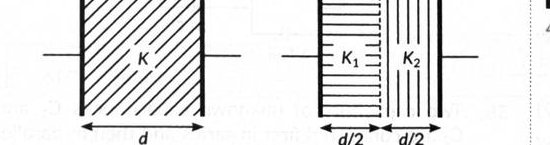
The space between the plates of a parallel plate capacitor is completely filled in two ways. In the first case, it is filled with a slab of dielectric constant . In the second case, it is filled with two slabs of equal thickness and dielectric constants and respectively as shown in the figure. The capacitance of the capacitor is the same in the two cases. Obtain the relationship between , and .
- 3
In a parallel plate capacitor with air between the plates, each plate has an area of and the separation between the plates is 0.3 mm. (i) Calculate the capacitance of the capacitor. (ii) If this capacitor is connected to a 100 V supply, what would be the charge on each plate? (iii) How would charge on the plates be affected, if a 3 mm thick mica sheet of is inserted between the plates while the voltage supply remains connected?
- 4
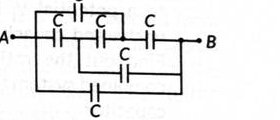
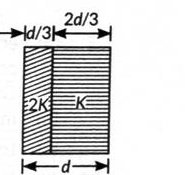
(i) Find the equivalent capacitance between points and in the given diagram (a Wheatstone-bridge-like network of five capacitors, each of capacitance , with a sixth capacitor bridging the midpoints). (ii) A dielectric slab is inserted between the plates of a parallel plate capacitor. The electric field between the plates decreases. Explain. (iii) A capacitor of capacitance , having charge , is connected across another uncharged capacitor of capacitance . Find an expression for (a) the potential difference across the combination and (b) the charge lost by capacitor . OR (iii) Two slabs of dielectric constants and fill the space between the plates of a parallel plate capacitor of plate area and plate separation as shown in figure. Find an expression for capacitance of the system.
Numericals
Every numerical set on this subtopic. Full working is at the end of the page.
- 5
Two capacitors of capacitances and are connected in parallel. If a charge is given to the combination, the ratio of the charge on capacitor to the charge on will be:
- (a)
- (b)
- (c)
- (d)
- (a)
Answers & Solutions
Work the questions above first, then check yourself here. Each answer is set out the way it should be written in the paper.
(charge enclosed by is ). (charge enclosed by is ). Ratio, . If a medium of dielectric constant is introduced inside : — the flux through reduces to one-fifth of its original value.
Case 1: . Case 2: the two slabs (thickness each) act as two capacitors in series: , . Since : .
(i) . (ii) . (iii) With the battery still connected, , so — the charge increases by a factor of .
(i) By symmetry, the bridge is balanced, so the two top-branch capacitors (, in series) and the two bottom-branch capacitors (, in series) each give ; these two series combinations are in parallel: . This is then in parallel with the bridging capacitor : . (ii) With a dielectric slab present, the surface charge density on the conductor plates stays fixed (isolated capacitor) but the dielectric's induced (bound) charges partly cancel the field. Since and , the field decreases by a factor of . (iii) As bridge/switch details are not given further, using the standard sharing-of-charge result: on connecting charged (capacitance , charge ) to uncharged (capacitance ), common potential ; charge on after sharing, ; charge lost by . OR: The two slabs (widths of and of ) act as two capacitors in series: , .
Correct option: (a). In parallel, the potential difference is the same across both capacitors: .