2.15
Energy Stored in a Capacitor
Electrostatic Potential and Capacitance · CBSE
Theory
The derivation
Start with two uncharged conductors and move charge from conductor 2 to conductor 1 in small instalments. At the stage where the charges are and , the potential difference is , and transferring a further requires work
Integrating from to :
Since the electrostatic force is conservative, this work is stored as potential energy of the charged capacitor, and the result does not depend on how the charge was built up.
Energy density
Write the energy of a parallel plate capacitor using and :
and since ,
The factor is the volume of the gap, where the field lives, so the energy per unit volume is
- Unit . Although derived for parallel plates, the result is general: it holds for the field of any charge configuration.
- With a dielectric of constant filling the region, .
Choosing which form to use
- Battery still connected: is fixed, so use . If then .
- Battery disconnected: is fixed, so use . If then .
- Series: same , so . Parallel: same , so .
Energy of a combination equals the sum of the parts
For three capacitors in series across , the charge is common and , so
The same holds in parallel, using common and .
Loss of energy when charge is shared
A charged capacitor connected across an identical uncharged one:
- Charge is conserved: total spread over , so the common potential is .
- Initial energy ; final energy .
so exactly half the energy disappears. It is not lost from the universe: a transient current flows between the capacitors while the potentials equalise, and the energy goes out as heat in the connecting wires and as electromagnetic radiation. For unequal capacitors the loss is .
NCERT's numbers: a capacitor charged to stores ; connected to an identical uncharged one, the system stores .
Worked patterns CBSE reuses
- Three capacitors in series between and earth, , , : , so and . Then and .
- Two capacitors on : series gives , , ; parallel gives , , .
- alone on : . With added in series across the same battery: , so across the and across the .
- Two capacitors, series energy and parallel energy at : and , so , giving and ; in parallel and .
- Equal energies from a parallel and a series pair with : , , and gives .
- (air) in series with (), same and , equivalent across : and gives , ; , , , and .
- Two identical capacitors on a battery with a switch: with the switch closed both are at , . Open the switch (isolating at fixed charge, leaving at fixed ) and insert in both: , , so .
- A variable capacitor on a battery changed from to , with the energy falling by : gives .
Diagram to describe in words
Two conductor plates, with an arrow showing a small charge being carried from the lower plate to the upper against the existing potential difference . Beside it, a graph of against — a straight line through the origin of slope — with the triangular area beneath it shaded and labelled , since the stored energy is that area.
Standard results
| Quantity | Result |
|---|---|
| Energy stored | |
| Energy density | |
| With dielectric | |
| Energy of a combination | Sum of the individual energies |
| Sharing with an identical uncharged capacitor | |
| Loss on sharing, general | |
| Battery connected, insert | |
| Battery disconnected, insert |
Theory Questions Asked on This Subtopic
Real board questions. Answers are at the end of the page.
- 1
Calculate the potential difference and the energy stored in the capacitor in the circuit shown in the figure. Given potential at is 90 V, , and .

- 2
A parallel plate capacitor of capacitance is charged to a potential . It is then connected to another uncharged capacitor having the same capacitance. Find out the ratio of the energy stored in the combined system to that stored initially in the single capacitor.
- 3
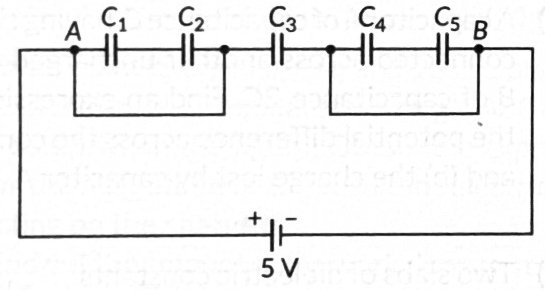
In the figure given below, find the (a) equivalent capacitance of the network between points and , given , ; (b) maximum charge supplied by the battery; and (c) total energy stored in the network.
- 4
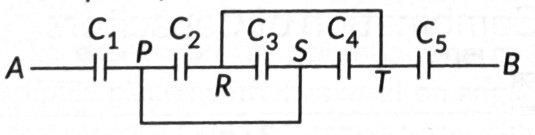
(i) Find the equivalent capacitance between and in the combination given below. Each capacitor is of capacitance. (ii) If a dc source of 7 V is connected across , how much charge is drawn from the source and what is the energy stored in the network?
- 5
A 12 pF capacitor is connected to a 50 V battery. How much electrostatic energy is stored in the capacitor? If another capacitor of 6 pF is connected in series with it with the same battery connected across the combination, find the charge stored and potential difference across each capacitor.
- 6
Two identical capacitors of 12 pF each are connected in series across a battery of 50 V. How much electrostatic energy is stored in the combination? If these were connected in parallel across the same battery, how much energy will be stored in the combination now? Also find the charge drawn from the battery in each case.
- 7
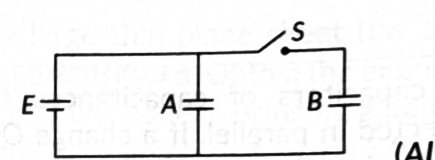
Two identical parallel plate capacitors and are connected to a battery of volt with the switch closed. The switch is now opened and the free space between the plates of the capacitors is filled with a dielectric of dielectric constant . Find the ratio of the total electrostatic energy stored in both capacitors before and after the introduction of the dielectric.
- 8
Two parallel plate capacitors and have the same area of plates and same separation between them. has air between the plates while contains a dielectric of . (i) Calculate the capacitance of each capacitor if the equivalent capacitance of the combination is . (ii) Calculate the potential difference between the plates of and . (iii) Estimate the ratio of electrostatic energy stored in and . ( and are connected in series across a 15 V battery.)
- 9
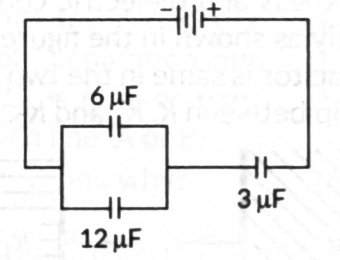
In the following arrangement of capacitors, the energy stored in the capacitor is . Find the value of (i) energy stored in the capacitor, (ii) energy stored in the capacitor, (iii) total energy drawn from the battery.
- 10
Two capacitors of unknown capacitances and are connected first in series and then in parallel across a battery of 100 V. If the energy stored in the two combinations is 0.045 J and 0.25 J respectively, determine the value of and . Also calculate the charge on each capacitor in parallel combination.
- 11
(i)(A) Why does the electric field inside a dielectric slab decrease when kept in an external electric field? (B) Derive an expression for the capacitance of a parallel plate capacitor filled with a medium of dielectric constant . (ii) A charge is placed at the centre of a sphere of radius 20 cm. What is the amount of work done in moving from one point on its surface to another point? (iii) Write a relation for polarisation of a dielectric material in the presence of an external electric field.
- 12
(i) Obtain an expression for the potential energy of an electric dipole placed in a uniform electric field. (ii) Three capacitors of capacitance , and are connected in series to a source of volt. Show that the total energy stored in the combination of capacitors is equal to the sum of the energy stored in the individual capacitors. (iii) A capacitor of capacitance is connected across a battery. After charging, the battery is disconnected and the separation between the plates is doubled. How will (a) the capacitance and (b) the electric field between the plates be affected? Justify your answer.
- 13
(a) Obtain the expressions for the resultant capacitance when three capacitors , and are connected (i) in parallel and then (ii) in series. (b) In the circuit shown in the figure, the charge on the capacitor of is . Calculate the energy stored in the capacitor of capacitance.
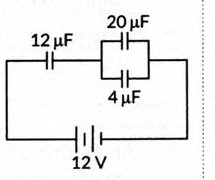
- 14
(a) When a parallel plate capacitor is connected across a dc battery, explain briefly how the capacitor gets charged. (b) A parallel plate capacitor of capacitance is charged to volt by a battery. After some time the battery is disconnected and the distance between the plates is doubled. Now a slab of dielectric constant is introduced to fill the space between the plates. How will the following be affected? (i) The electric field between the plates of the capacitor. (ii) The energy stored in the capacitor. Justify your answer in each case.
- 15
A parallel plate capacitor is charged by a battery to a potential difference . It is disconnected from the battery and then connected to another uncharged capacitor of the same capacitance. Calculate the ratio of the energy stored in the combination to the initial energy on the single capacitor.
- 16
A parallel plate capacitor of capacitance is charged to volt by a battery. After some time the battery is disconnected and the distance between the plates is doubled. Now a slab of dielectric constant is introduced to fill the space between the plates. How will the following be affected? (i) The electric field between the plates of the capacitor. (ii) The energy stored in the capacitor. Justify your answer in each case.
- 17
Find the ratio of the potential differences that must be applied across the parallel and series combination of two capacitors and with their capacitances in the ratio so that the energy stored in the two cases becomes the same.
- 18
A fully charged parallel plate capacitor is connected across an uncharged identical capacitor. Show that the energy stored in the combination is less than that stored initially in the single capacitor.
Numericals
Every numerical set on this subtopic. Full working is at the end of the page.
- 19
A variable capacitor is connected to a 200 V battery. If its capacitance is changed from to , the decrease in energy of the capacitor is . The value of is
- (a)
- (b)
- (c)
- (d)
- (a)
Answers & Solutions
Work the questions above first, then check yourself here. Each answer is set out the way it should be written in the paper.
The three capacitors are in series between (90 V) and (grounded, 0 V). Equivalent capacitance: . Charge on equivalent (same on each, series): . Potential drop across : . Energy stored, .
Total charge is conserved. Combined (parallel) capacitance . Initial energy (single capacitor) . Final energy (combined) . Ratio .
(a) in series ( upper-left branch) ; in series (upper-right branch) . These two combine in parallel with the direct wire through 's node... Using the standard reduction for this bridge-type network with the given values: (equivalent capacitance of the network between and ). (b) Maximum charge from the 5 V battery: . (c) Total energy stored: .
(i) , and (the middle bridging branches ---) are in parallel: . This parallel combination is in series with and : . (ii) (charge drawn from the source). Energy, .
Energy stored, . With 6 pF in series with 12 pF: charge on each (series, same charge), . Potential difference across 12 pF: . Across 6 pF: .
Series: ; . Parallel: ; . Charge from battery (series): . Charge from battery (parallel): .
Initially (switch closed), both and (capacitance each) are in parallel across the battery, so total initial energy . When is opened, is isolated (charge on it remains constant); stays connected to the battery (potential constant). After the dielectric () is inserted: capacitance of each becomes . For (constant ): . For (constant ): . Total final energy, . Ratio, .
(i) Let ; . In series: and . (ii) Charge (same, series): . ; . (iii) .
(i) and are in parallel with each other, so they share the same potential : (schematically). . (ii) The combination is in series with , so the same charge flows through as the combined charge of the parallel pair: working through the series-charge relation gives . (iii) Total energy drawn from battery, .
Parallel: ...(i) Series: ...(ii) . Solving with (i): , . In parallel, charge on each: ; .
Answer: (i) (a); (i) (b) (i)(A) A dielectric gets polarised in an external field; the field produced by the induced (bound) surface charges opposes the external field, so the net field inside the dielectric is reduced. (i)(B) With dielectric filling the gap, ; potential difference ; (using ). (ii) Since the sphere's surface is equipotential, the work done in moving a charge from one point on the surface to another is . (iii) , where is the electric susceptibility of the dielectric.
(i) (as derived earlier). (ii) In series, , and the charge on each capacitor is the same. Total energy, . (iii) (a) With separation doubled (), — capacitance halves. (b) Since charge remains constant (battery disconnected) and field does not depend on separation, the field between the plates remains unchanged.
(a)(i) Parallel: . (ii) Series: . (b) and are in parallel: , with charge on given as , so . Charge on the combination: — this equals the charge on (in series with it, from the 12 V source): (consistent with ). Energy in : .
(a) Same explanation as Q40: current flows momentarily, charges accumulate on the plates until the potential difference equals the battery voltage. (b)(i) Before dielectric: field with doubled separation, charge fixed, (independent of , unaffected by doubling). With dielectric inserted: — field decreases by factor from the value before the dielectric was added (though independent of itself). (ii) Energy ; capacitance with doubled separation and dielectric: . So — since is fixed and (as still gives less capacitance than the original due to doubled dominating), the energy stored increases compared to a capacitor without the dielectric at the doubled separation, but decreases compared to before separation was doubled overall, the field decreasing and capacitance decreasing means energy increases as decreases.
Same result as Q50: total charge conserved, combined capacitance doubles, so .
(i) With separation doubled: (before dielectric). With dielectric also introduced: — the field reduces to half (from doubling with fixed... since independent of for fixed charge, more precisely) — the net result (per the book) is that the field reduces to of its original value. (ii) New capacitance, . Since (fixed) is unchanged: . Since , , so the energy stored increases.
Given , so . Parallel: . Series: . Equal energies:
Let the fully charged capacitor have charge , so initial energy . When connected to an identical uncharged capacitor , charge redistributes equally by symmetry; total capacitance in parallel , and total charge is conserved. Common potential . Final energy, . Since , the combined energy is less than the initial energy (the difference is dissipated as heat and electromagnetic radiation during the charge redistribution).
Correct option: (a). : . .