2.9
Electrostatics of Conductors
Electrostatic Potential and Capacitance · CBSE
Theory
The setting
A metallic conductor has free valence electrons that can move within it but not leave it; the positive ions stay fixed. In the static situation there is no current, and that fixes everything else in this section. NCERT lists six results, and CBSE asks for them individually or as a set.
Result 1 — the field inside a conductor is zero
Consider a conductor, charged or neutral, with or without an external field. As long as the interior field were non-zero, the free electrons would feel a force and drift, and the situation would not be static. In the static state the free charges have arranged themselves so that everywhere inside. This is taken as the defining property of a conductor.
Result 2 — at the surface, the field is normal
If had a tangential component at the surface, the surface charges would feel a force along the surface and would move. In the static state the tangential component must be zero, so the field just outside a charged conductor is normal to the surface at every point. Where the surface carries no charge, the field there is zero.
Result 3 — no excess charge in the interior
Take any small closed surface inside the conductor. Since on , the flux through is zero, so by Gauss's law the charge enclosed is zero. can be shrunk to any point, so there is no net charge anywhere inside: all excess charge resides on the surface.
Result 4 — the whole conductor is at one potential
Since inside and has no tangential component on the surface, no work is done in moving a test charge anywhere within the conductor or over its surface. Hence there is no potential difference between any two points inside or on the surface: is constant throughout the volume and equal to the surface value. In a system of several conductors, each has its own constant potential, and these may differ. This is why the work done in moving a charge between two points on the surface of a charged sphere is zero.
Result 5 — field just outside a charged conductor
Derivation with a pill box. Choose a short cylinder of cross-sectional area and negligible height, straddling the surface at the point — half inside, half outside.
- Just inside, the field is zero, so the inner face contributes no flux.
- The curved side has negligible area.
- Just outside, the field is normal with magnitude , so the outer face contributes .
- The charge enclosed is .
By Gauss's law, , so ; including direction, , outward for and inward for .
Note the contrast with an isolated sheet, whose field is on each side: the conductor has field on one side only, so the same flux comes out of one face instead of two.
Result 6 — electrostatic shielding
The electric field inside a charge-free cavity of a conductor is zero, whatever the shape and size of the cavity, whatever the charge on the conductor and whatever the external field. All charge resides on the outer surface. This is electrostatic shielding, and it is what protects sensitive instruments (and the inside of a car in a lightning strike) from outside electrical influence.
- Shielding works one way only. If charges are placed inside the cavity, the region outside the conductor is not shielded from them.
A neutral conductor between charged plates
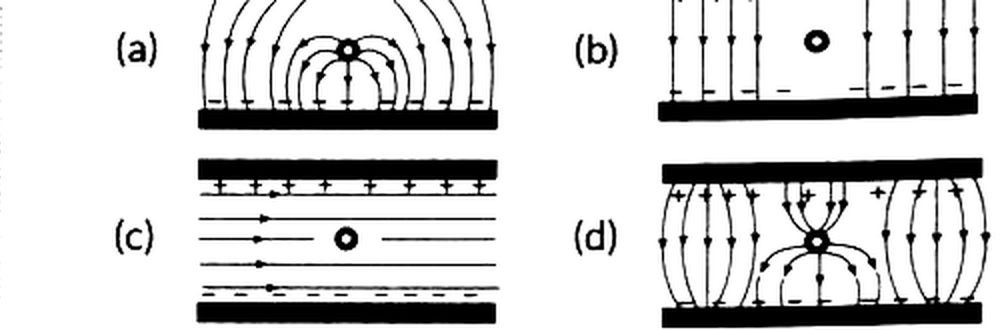
Placing a neutral conductor in the gap of a parallel plate capacitor induces negative charge on the face towards the positive plate and positive charge on the face towards the negative plate. Field lines terminate on the induced charges, the field inside the conductor is zero, and the lines re-emerge on the far side — that is the diagram to pick in the MCQ.
Related conductor facts CBSE reuses
- A comb rubbed on dry hair charges by friction and polarises the molecules of a paper bit, so the bit is attracted. On a humid day friction is reduced, the comb does not charge, and nothing happens.
- Aircraft tyres are made slightly conducting, and vehicles carrying inflammable material trail metal chains, so that frictional charge leaks to the ground instead of accumulating and sparking.
- A bird on a bare high-tension line is safe because both its feet are at the same potential; a person on the ground touching the line completes a large potential difference.
Diagram to describe in words
A closed conductor outline with a cavity inside. Mark in the body of the metal and in the cavity, plus and minus signs distributed on the outer surface only, and short field arrows outside meeting the surface at right angles. Beside it, the pill box: a small cylinder cut by the conductor's surface, with the outer flat face in the field region and the inner flat face inside the metal where , labelled .
Standard results
| Statement | Result |
|---|---|
| Field inside | |
| Field at the surface | |
| Field of an isolated sheet, for comparison | |
| Excess charge | Entirely on the outer surface |
| Potential | Constant inside and on the surface |
| Field in a charge-free cavity | Zero (electrostatic shielding) |
| Work between two surface points | Zero |
Theory Questions Asked on This Subtopic
Real board questions. Answers are at the end of the page.
- 1
Which of the diagrams correctly represents the electric field between two charged plates if a neutral conductor is placed in between the plates?
- (a)
Panel (a): the lines all converge on the conductor from above and end on it; only the lower plate is drawn.
- (b)
Panel (b): the lines run straight down past the conductor as if it were not there.
- (c)
Panel (c): the lines run parallel to the plates and pass straight through the conductor.
- (d)
Panel (d): the lines meet the conductor normally, stop at its surface and re-emerge below it, with induced charge on both faces.
- (a)
Answers & Solutions
Work the questions above first, then check yourself here. Each answer is set out the way it should be written in the paper.
Correct option: (d). When a neutral conductor is placed between the plates, a negative charge is induced on the side facing the positive plate and a positive charge on the side facing the negative plate; the field lines terminate on these induced charges, bulging into and re-emerging from the conductor's surfaces — correctly shown only in (d).