7.6
Refraction of Light at a Plane Boundary Between Two Media
Wave Optics · Maharashtra HSC
Theory
The diagram to draw
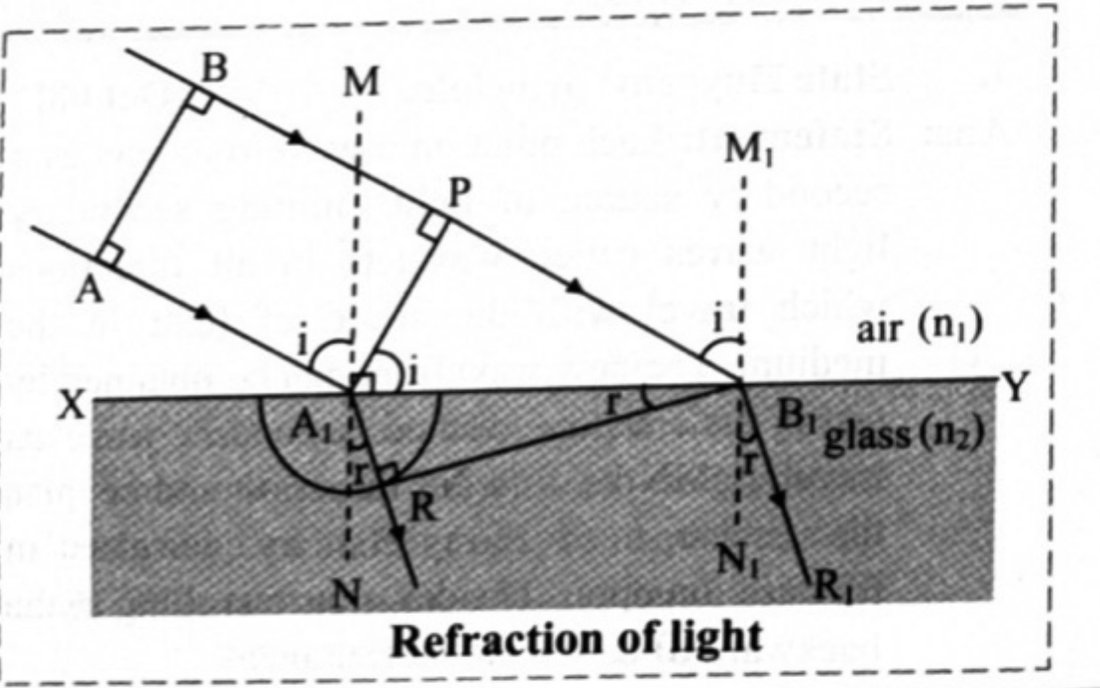
Draw the plane refracting surface separating medium 1 (air, index ) above from medium 2 (glass, index ) below. A plane wavefront advances obliquely towards from air, bounded by the incident rays and . Mark where the wavefront first meets the boundary, and the position of at that instant, with still to be covered. In the glass, draw the hemispherical wavelet centred at of radius , and the refracted wavefront tangential to it, bounded by the refracted rays and . Draw the normals at and at .
Refraction of a plane wavefront on the basis of Huygens' theory
- Let be the plane refracting surface separating two media, air and glass, of refractive indices and respectively.
- A plane wavefront is advancing obliquely towards from air, bounded by the incident rays and .
- When reaches , is at and still has to cover the distance to reach .
- According to Huygens' principle, secondary wavelets originate from and spread over a hemisphere in glass.
- All the rays between and reach in succession and spread over hemispheres of decreasing radii in glass. The surface of tangency of all such hemispheres is , which is the refracted wavefront in glass.
- and are the refracted rays.
- Let and be the velocities of light in air and in glass respectively.
- At any instant : distance covered by the incident wavefront from to is , and the distance covered by the secondary wave from to is .
Proof of the laws of refraction
- From the figure,
From (1) and (2), .
- Similarly, , and
From (3) and (4), .
- In :
- In :
- Dividing (5) by (6):
- Also,
This is Snell's law, the second law of refraction.
- From the construction it is clear that the incident rays , , the refracted rays , and the normals and all lie in the same plane, and the incident ray and the refracted ray lie on opposite sides of the normal . This is the first law of refraction.
Velocity of light is greater in a rarer medium
Continue from the same figure, for light passing from air (rarer) into glass (denser):
Hence the velocity of light in a rarer medium is greater than the velocity of light in a denser medium. This is precisely the prediction that corpuscular theory got the wrong way round.
Dependence of wavelength on the refractive index
Consider monochromatic light incident normally on the boundary between a rarer and a denser medium. Three successive wavefronts , , in medium 1 are separated by , the wavelength in that medium. After refraction they become , , , separated by . In the denser medium the wavefronts move more slowly, cover less distance in the same time, and are therefore more closely spaced: .
Let reach at and the next wavefront , a distance behind, reach at . Then
In medium 2 the distance travelled by the wavefront in the same time is , so
If medium 1 is vacuum, where the wavelength is , and is the refractive index of medium 2,
The ratio of frequencies is
confirming the assumption of a common period : the frequency of a wave is its fundamental property and does not change on going from one medium to another. The speed and the wavelength do change, and both are inversely proportional to the relative refractive index of the second medium with respect to the first.
Refraction and the image
The refracted image is not inverted — there is no lateral reversal in refraction at a plane surface. Except at normal incidence, the image appears bent (broken) at the boundary, because the rays change direction on crossing the surface. At normal incidence the rays continue along the same direction and there is no breaking of the image.
Standard results
- , ; .
- Rarer to denser: , the ray bends towards the normal, and .
- ; ; frequency unchanged.
- Widths of a parallel beam or of a plane wavefront in the two media: .
- , so for "difference of velocities" numericals.
Theory Questions Asked on This Subtopic
Real board questions. Answers are at the end of the page.
- 1
Explain refraction of a plane wavefront at a plane surface on the basis of Huygens' wave theory of light.
 Maharashtra HSC board question — asked in October 2008Answer 1 ↓
 - 2
On the basis of Huygens' wave theory of light, prove that velocity of light in a rarer medium is greater that velocity of light in a denser medium.
Maharashtra HSC board question — asked in March 2013Answer 2 ↓ - 3
Explain refraction of light on the basis of wave theory. Hence prove the laws of refraction.
Maharashtra HSC board question — asked in March 2019Answer 3 ↓
Numericals
Every numerical set on this subtopic. Full working is at the end of the page.
- 4
A ray of light is incident on a water surface of refractive index making an angle of 40° with the surface. Find the angle of refraction.
Maharashtra HSC board question — asked in March 2010Answer 4 ↓ - 5
The refractive indices of water for red and violet colours are 1.325 and 1.334 respectively. Find the difference between velocities of the rays for these two colours in water.
Maharashtra HSC board question — asked in October 2013Answer 5 ↓ - 6
If the difference in velocities of light in glass and water is m/s, find the velocity of light in air. (Refractive index of glass = 1.5, Refractive index of water = 1.333)
Maharashtra HSC board question — asked in March 2014Answer 6 ↓ - 7
Red light of wavelength 6400 Å in air has wavelength 4000 Å in glass. If the wavelength of violet light in air is 4400 Å, find its wavelength in glass. (Assume that )
Maharashtra HSC board question — asked in October 2014Answer 7 ↓ - 8
A parallel beam of monochromatic light is incident on glass slab at an angle of incidence 60°. Find the ratio of the widths of the beam in glass to that in air, if refractive index of glass is 1.5.
Maharashtra HSC board question — asked in October 2015Answer 8 ↓ - 9
Determine the change in wavelength of light during its passage from air to glass. If the refractive index of glass with respect to air is 1.5 and the frequency of light is Hz, find the wave number of light in glass. [Velocity of light in air (c = m/s)]
Maharashtra HSC board question — asked in March 2016Answer 9 ↓ - 10
Determine the change in wavelength of light during its passage from air to glass, if the refractive index of glass with respect to air is 1.5 and the frequency of light is Hz. Find the wave number of light in glass (velocity of light in air c = m/s).
Maharashtra HSC board question — asked in July 2016Answer 10 ↓ - 11
The width of plane incident wavefront is found to be doubled on refraction in denser medium. If it makes an angle of 65° with the normal, calculate the refractive index for the denser medium.
Maharashtra HSC board question — asked in March 2017Answer 11 ↓ - 12
The refractive indices of glass and water w.r.t. air are and respectively. Determine the refractive index of glass w.r.t. water.
Maharashtra HSC board question — asked in July 2017Answer 12 ↓ - 13
The refractive indices of water and diamond are and 2.42 respectively. Find the speed of light in water and diamond. (c = m/s)
Maharashtra HSC board question — asked in March 2018Answer 13 ↓ - 14
Determine the change in wavelength of light during its passage from air to glass, if refractive index of glass with respect to air is 1.5 and frequency of light is Hz. [Velocity of light in air = m/s]. OR Find the wave number of light in glass.
Maharashtra HSC board question — asked in July 2018; March 2008Answer 14 ↓ - 15
A parallel beam of monochromatic light is incident on a glass slab at an angle of incidence 30°, gets refracted through an angle of 19° 28′. Find the ratio of width of parallel beam in air to that in glass.
Maharashtra HSC board question — asked in July 2019Answer 15 ↓ - 16
If the difference in the velocities of light in glass and water is m/s, calculate the velocity of light in air. Given that refractive index of glass and water with respect to air are 1.5 and respectively.
Maharashtra HSC board question — asked in February 2020Answer 16 ↓
Answers & Solutions
Work the questions above first, then check yourself here. Each answer is set out the way it should be written in the paper.
Explanation: i. Let XY be the plane refracting surface separating two media air and glass of refractive indices and respectively. ii. A plane wavefront AB is advancing obliquely towards XY from air. It is bounded by rays and which are incident rays. iii. When 'A' reaches '', then 'B' will be at 'P'. It still has to cover distance to reach XY. iv. According to Huygens' principle, secondary wavelets will originate from and will spread over a hemisphere in glass. v. All the rays between and will reach XY and spread over the hemispheres of decreasing radii in glass. The surface of tangency of all such hemispheres is . This gives rise to refracted wavefront in glass. vi. and are refracted rays. vii. Let and be the velocities of light in air and glass respectively. viii. At any instant of time 't', distance covered by incident wavefront from P to Distance covered by secondary wave from to . Proof of laws of refraction: i. From figure, and From equations (1) and (2), ii. Similarly, We have, and From equations (3) and (4), iii. In , iv. In , v. Dividing equation (5) by (6), Also vi. From the explanation, it is clear that incident rays , , refracted rays , and normal MN and lie on the same plane XY. Also, incident ray and refracted ray lie on opposite sides of normal MN. Hence, laws of refraction can be explained.
[From 7.6, Q1]
Explanation: i. Let XY be the plane refracting surface separating two media air and glass of refractive indices and respectively. ii. A plane wavefront AB is advancing obliquely towards XY from air. It is bounded by rays and which are incident rays. iii. When 'A' reaches '', then 'B' will be at 'P'. It still has to cover distance to reach XY. iv. According to Huygens' principle, secondary wavelets will originate from and will spread over a hemisphere in glass. v. All the rays between and will reach XY and spread over the hemispheres of decreasing radii in glass. The surface of tangency of all such hemispheres is . This gives rise to refracted wavefront in glass. vi. and are refracted rays. vii. Let and be the velocities of light in air and glass respectively. viii. At any instant of time 't', distance covered by incident wavefront from P to Distance covered by secondary wave from to . Proof of laws of refraction: i. From figure, and From equations (1) and (2), ii. Similarly, We have, and From equations (3) and (4), iii. In , iv. In , v. Dividing equation (5) by (6), Also vi. From the explanation, it is clear that incident rays , , refracted rays , and normal MN and lie on the same plane XY. Also, incident ray and refracted ray lie on opposite sides of normal MN. Hence, laws of refraction can be explained.[(i) to (v)] vi. From figure, vii. Since, Hence, velocity of light in rarer medium is greater than velocity in denser medium.
[From 7.6, Q1]
Explanation: i. Let XY be the plane refracting surface separating two media air and glass of refractive indices and respectively. ii. A plane wavefront AB is advancing obliquely towards XY from air. It is bounded by rays and which are incident rays. iii. When 'A' reaches '', then 'B' will be at 'P'. It still has to cover distance to reach XY. iv. According to Huygens' principle, secondary wavelets will originate from and will spread over a hemisphere in glass. v. All the rays between and will reach XY and spread over the hemispheres of decreasing radii in glass. The surface of tangency of all such hemispheres is . This gives rise to refracted wavefront in glass. vi. and are refracted rays. vii. Let and be the velocities of light in air and glass respectively. viii. At any instant of time 't', distance covered by incident wavefront from P to Distance covered by secondary wave from to . Proof of laws of refraction: i. From figure, and From equations (1) and (2), ii. Similarly, We have, and From equations (3) and (4), iii. In , iv. In , v. Dividing equation (5) by (6), Also vi. From the explanation, it is clear that incident rays , , refracted rays , and normal MN and lie on the same plane XY. Also, incident ray and refracted ray lie on opposite sides of normal MN. Hence, laws of refraction can be explained..
Given: i = 50°, To find: Angle of refraction (r) Formula: Calculation: Using formula, 35°4′ Ans: Angle of refraction is 35°4′.
Given: , To find: Difference between velocities Formula: Calculation: From formula, and = {antilog[log (27) − log (1.325) − log (1.334)]} × 10 = {antilog[1.4314 − 0.1222 − 0.1252]} × 10 = {antilog (1.184)} × 10 = 15.28 × 10 = m/s. Ans: The difference between the velocities of rays for red and violet colours in water is m/s.
Given: , , m/s To find: Velocity of light in air (c) Formula: Calculation: From formula, and and = {antilog[log(1.333) + log(1.5) + log(2.7) − log(0.167)]} × 10 = {antilog[0.1248 + 0.1761 + 0.4314 − .2227]} × 10 = {antilog[0.7324 − .2227]} × 10 = {antilog[1.5097]} × 10 m/s Ans: The velocity of light in air is m/s.
Given: Å, Å, Å To find: Wavelength Formula: Calculation: From formula, 2750 Å Ans: The wavelength of violet light in glass is 2750 Å.
Given: i = 60°, , Let = width of beam in glass slab, = width of beam in air To find: Ratio of widths Formulae: i. ii. Calculation: From formula (i), From formula (ii), Ratio of the widths of beam = 8 : 5 Ans: The ratio of widths of the beam in glass to that in air is 8 : 5.
Given: , v = Hz, c = m/s To find: i. Change in wavelength of light (Δλ) ii. Wave number of light Formulae: i. ii. iii. Calculation: i. Using formula (iii), m = 8571 Å Using formula (ii), Å 2857 Å ii. Now, using formula (i), m Ans: i. The change in wavelength of light is 2857 Å. ii. The wave number of light is m.
Given: , v = Hz To find: i. Change in wavelength (Δλ) ii. Wave number of light in glass Formulae: i. ii. iii. Calculation: i. Using formula (iii), m = 6000 Å From formula (i), Å Change in wavelength 2000 Å ii. From formula (ii), Wave number of light in glass m Ans: i. Change in wavelength of light is 2000 Å ii. Wave number of light in glass is m.
Given: i = 65°, Let AB be width of incident wavefront and CD be width of refracted wavefront. CD = 2AB To find: Refractive index (n) Formulae: i. ii. Calculation: From formula (i), From formula (ii), Ans: The refractive index for the denser medium is 1.697.
Given: , To find: Refractive index of glass w.r.t. water Formula: Calculation: From formula, and 1.12 Ans: The refractive index of glass w.r.t. water is 1.12.
Given: , , c = m/s To find: i. speed of light in water ii. speed of light in diamond Formula: Calculation: Using formula, For water, m/s For diamond, m/s Ans: i. Speed of light in water is m/s. ii. Speed of light in diamond is m/s.
Given: , v = Hz, c = m/s To find: i. Change in wavelength of light (Δλ) ii. Wave number of light Formulae: i. ii. iii. Calculation: i. Using formula (iii), Å. Using formula (ii), Å. 2500 Å. ii. Now, using formula (i), m Ans: i. Change in wavelength of light is 2500 Å. ii. Wave number of light is m.
Given: i = 30°, r = 19° 28′ Let = width of beam in glass slab, = width of beam in air To find: Ratio of widths Formula: Calculation: From formula, Ratio of the widths of beam = 1.089 : 1 Ans: The ratio of widths of the beam in glass to that in air is 1.089 : 1.
Given: m/s, , To find: Velocity of light in air Formulae: i. ii. Calculation: From formula (i) and (ii), m/s Ans: The velocity of light in air is m/s.