7.5
Reflection of Light at a Plane Surface
Wave Optics · Maharashtra HSC
Theory
The diagram to draw
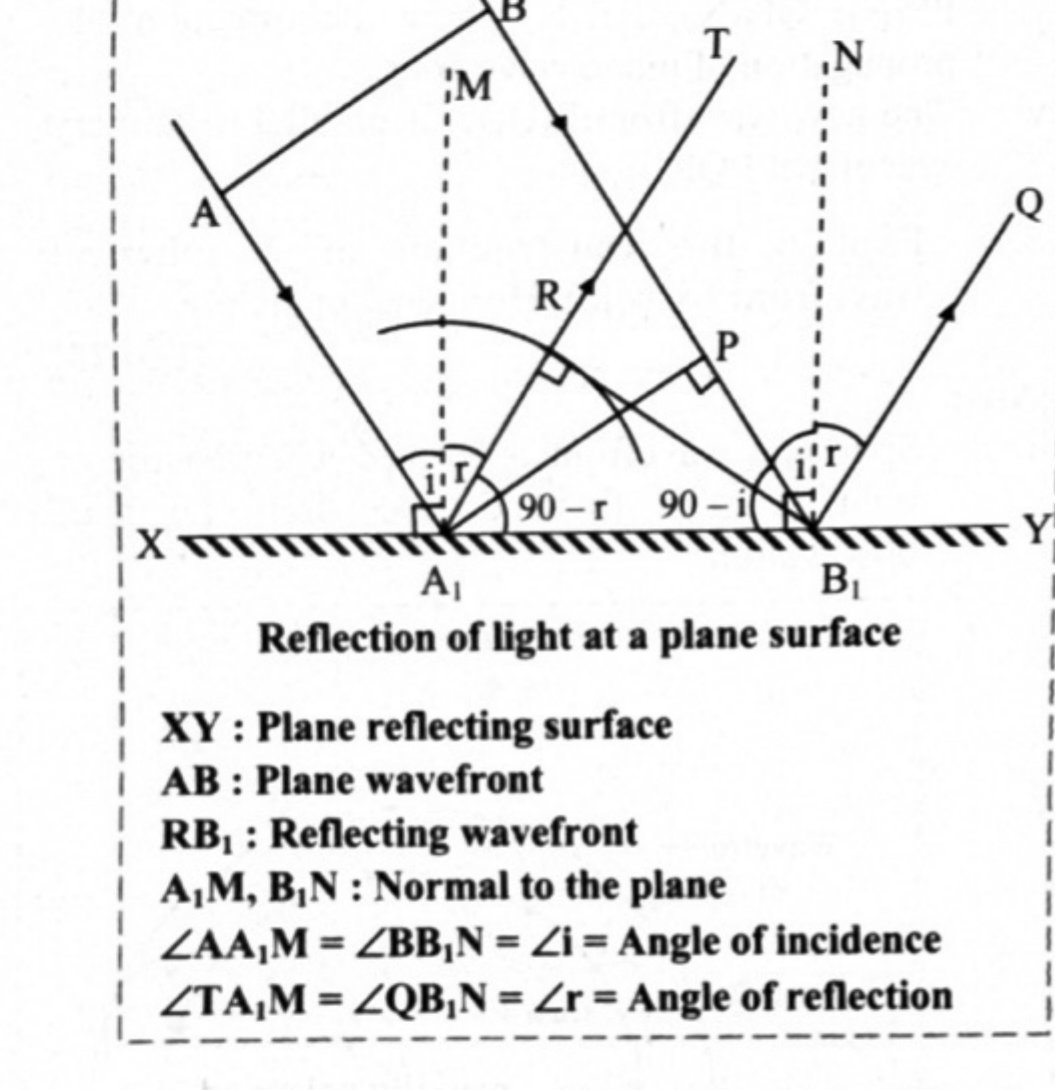
Draw a plane reflecting surface (the mirror), horizontal, with the plane of the paper as the plane of the figure. A plane wavefront advances obliquely towards with speed , bounded by the incident rays and . Mark the point where the wavefront first touches the mirror, and the point on the incident wavefront directly "above" , so that still has the distance to travel. Draw the hemispherical wavelet of radius centred at , and the reflected wavefront tangential to it, bounded by the reflected rays and . Drop the normals and .
Derivation of the laws of reflection using Huygens' principle
- A plane wavefront is advancing obliquely towards the plane reflecting surface with velocity . and are the incident rays.
- When reaches at , the ray at has reached the point and still has to cover the distance to reach the reflecting surface .
- Let be the time required to cover the distance . During this interval, secondary wavelets are emitted from and spread over a hemisphere of radius in the SAME medium. The distance covered by the secondary wavelet from to in time is the same as the distance covered by the primary wave from to :
- All the other rays between and reach after and before , so they emit secondary wavelets of gradually decreasing radii.
- The surface touching all such hemispheres is , which is the reflected wavefront, bounded by the reflected rays and .
- Draw and . Then the angle of incidence is and the angle of reflection is .
- In and :
- This is the first law of reflection.
- It is also clear from the figure that the incident ray, the reflected ray and the normal all lie in the same plane — the plane of the paper. This is the second law of reflection.
- Hence reflection of light from a plane reflecting surface is explained on the basis of Huygens' principle.
Two consequences the textbook draws from the same figure
- Size of the image. If is taken to be the size of the object, the distance between the corresponding reflected rays is the same as , because the two triangles are congruent. So the image in a plane mirror is the same size as the object.
- Lateral inversion. If is the right side of the object and the left side as it faces the mirror, then after reflection the right side at is seen at and the left side at is seen at : right has become left and left has become right. This is called lateral reversal (lateral inversion). It does NOT occur during refraction at a plane surface.
Standard results
- — equal distances, because both are travelled in the same medium.
- gives .
- Incident ray, reflected ray and normal are coplanar.
- Image in a plane mirror: same size as the object, laterally inverted.
Theory Questions Asked on This Subtopic
Real board questions. Answers are at the end of the page.
- 1
With the help of a neat diagram, explain the reflection of light on a plane reflecting surface. OR Derive the laws of reflection of light using Huygens' principle.
 Maharashtra HSC board question — asked in February 2023; July 2022; March 2022Answer 1 ↓
Answers & Solutions
Work the questions above first, then check yourself here. Each answer is set out the way it should be written in the paper.
Reflection of light on a plane surface: i. A plane wavefront AB is advancing obliquely towards plane reflecting surface XY with velocity 'v'. and are incident rays. ii. When 'A' reaches XY at , then ray at 'B' reaches point 'P' and it has to cover distance to reach the reflecting surface XY. iii. Let 't' be the time required to cover distance . During this time interval, secondary wavelets are emitted from and will spread over a hemisphere of radius , in the same medium. Distance covered by secondary wavelets to reach from to R in time t is same as the distance covered by primary waves to reach from P to . Thus . iv. All other rays between and will reach XY after and before . Hence, they will also emit secondary wavelets of decreasing radii. v. The surface touching all such hemispheres is which is reflected wavefront, bounded by reflected rays and . vi. Draw and . Thus, angle of incidence is and angle of reflection is . and vii. In and (Reflected waves travel equal distance in same medium in equal time). ….(common side) viii. Also, from the figure, it is clear that incident ray, reflected ray and normal lie in the same plane. ix. This explains reflection of light from plane reflecting surface on the basis of Huygens' principle.