7.4
Huygens' Theory
Wave Optics · Maharashtra HSC
Theory
7.4.1 Primary and secondary sources of light
- Primary sources emit light of their own, because of (i) their high temperature — the Sun, the stars, objects heated to high temperature, flames of any kind; (ii) current being passed through them — a tube light, a TV; (iii) chemical or nuclear reactions — firecrackers, nuclear energy generators. Light originates in these sources.
- Secondary sources do not produce light of their own. They receive light from another source and reflect or scatter it. Examples: the moon, the planets, humans, animals, plants. Most of the sources we see every day are secondary sources, and most of them are extended sources.
7.4.2 Wavefront
When a stone is dropped in water, ripples travel outward from the point O where it touches. Two particles are in phase if their state of motion is the same — the same displacement and velocity perpendicular to the surface — and they are at the same distance from the source. All particles on a circle centred at O are therefore in phase.
- Definition: a wavefront is the locus of all points of the medium having the same phase at a given instant of time. Equivalently, it is the locus of all points that waves starting simultaneously from the source reach at the same instant.
- The direction of propagation of the wave is always PERPENDICULAR to the wavefront. These perpendiculars are the rays of geometrical optics.
- The wavefronts move with the speed of the wave.
| Type of source | Shape of wavefront |
|---|---|
| Point source (three dimensional waves) | Spherical, centred on the source |
| Linear source | Cylindrical |
| Point source very far away | Plane (a small portion of a large sphere) |
| Source on a water surface | Circular (two dimensional) |
Spherical wavefronts drawn around a source O with arrows radiating outward represent a diverging beam. Converging wavefronts, such as those after a convex lens, are also spherical. A plane wavefront corresponds to a parallel beam, and its rays are parallel — this is the "shape of the wavefront at a point far away from the source" that the board asks for.
7.4.3 Huygens' principle
Statement: each point on a wavefront acts as a secondary source of light emitting secondary light waves called wavelets in all directions, which travel with the speed of light in the medium. The new wavefront can be obtained by taking the envelope of these secondary wavelets travelling in the forward direction, and is thus the envelope of the secondary wavelets in the forward direction. The wavelets travelling in the backward direction are ineffective.
Construction of a plane wavefront
- A plane wavefront is formed when the point of observation is very far away from the primary source.
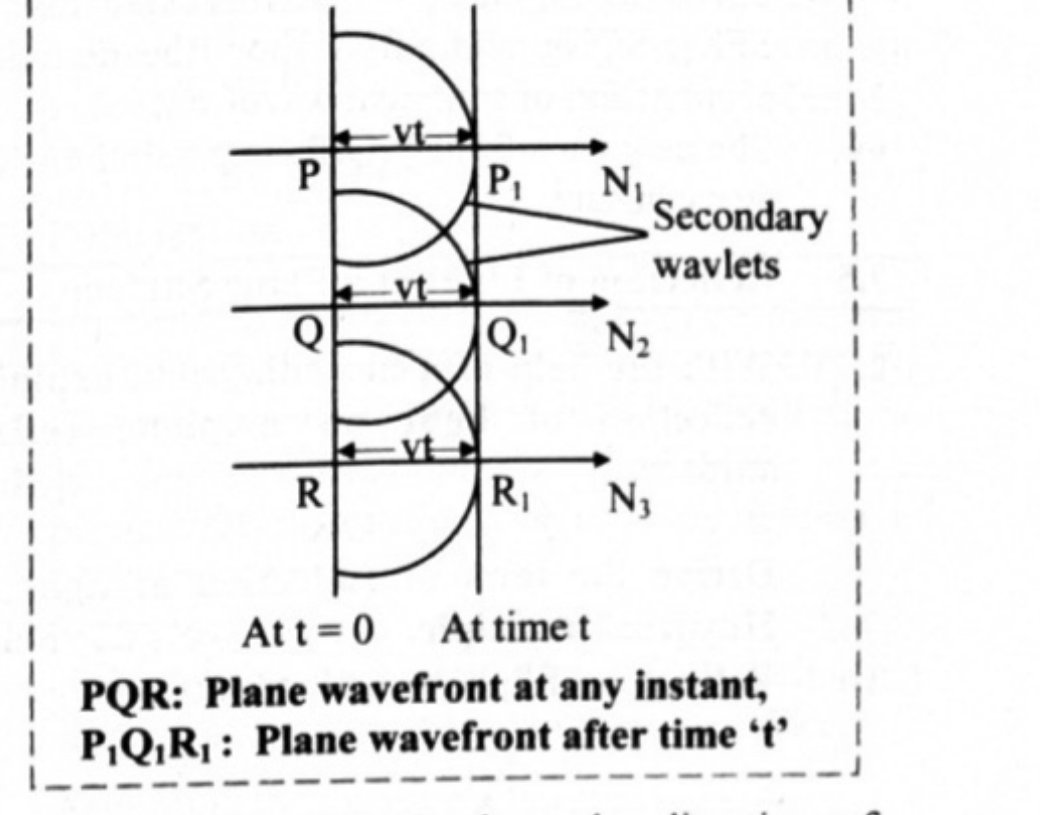
- Let represent a plane wavefront at any instant. By Huygens' principle every point on it acts as a secondary source sending out secondary wavelets in the forward direction, backward travelling wavelets being ineffective.
- Draw hemispheres with as centres and as radius.
- The surface tangential to all these hemispheres is at the instant . It is the new wavefront at time .
- Plane wavefronts propagate as plane waves and stay parallel to one another.
- , , show the direction of propagation of the plane wavefront.
- The new wavefront is parallel to the primary wavefront .
Construction of a spherical wavefront
- A spherical wavefront is formed when the source of light is at a finite distance from the point of observation.
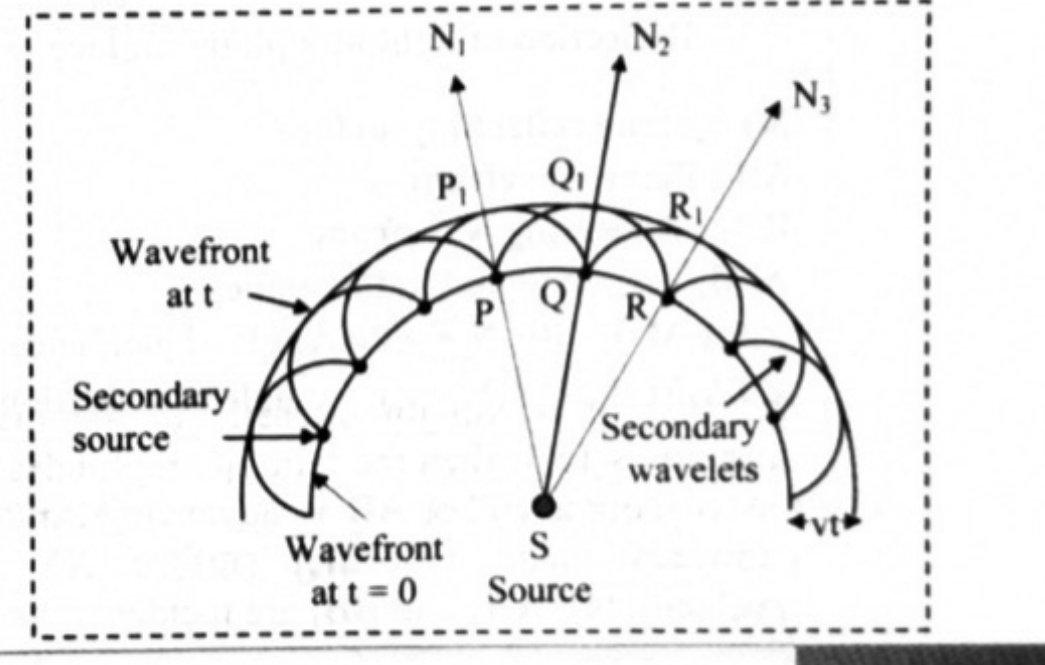
- Let be a point source of light in air, and let represent the spherical wavefront at some instant. acts as the primary wave propagating through air.
- By Huygens' principle all the points on act as secondary sources and send out secondary wavelets with the same velocity in the forward direction; backward travelling wavelets are ineffective.
- The new wavefront at a later instant is the envelope of hemispherical wavelets drawn with as centres and as radius in the forward direction.
- The surface tangential to all these hemispheres passes through the points and touches every hemisphere; this surface is the new wavefront at that instant .
- , , show the direction of propagation of the spherical wavefront.
- The new wavefront is parallel to at every instant.
Limitation of Huygens' theory
Huygens' theory is an empirical theory. There is no reason within the theory why the backward travelling wavelets should be ineffective — that is simply assumed. The theory was accepted because it successfully explained reflection, refraction, interference, diffraction and polarization.
Standard results
- Wavefront: locus of points in the same phase at a given instant. Rays are normals to the wavefront.
- Radius of every secondary wavelet after time is , being the speed of light in that medium.
- New wavefront = forward envelope of the secondary wavelets; it is parallel to the old one in a homogeneous medium.
- Far from the source, a small part of a spherical wavefront is plane.
Theory Questions Asked on This Subtopic
Real board questions. Answers are at the end of the page.
- 1
State Huygens' principle.
Maharashtra HSC board question — asked in October 2008Answer 1 ↓ - 2
Explain the construction of plane wavefront using Huygens' principle.
 Maharashtra HSC board question — asked in July 2017Answer 2 ↓
 - 3
Explain the construction of a spherical wavefront by using Huygens' principle.
 Maharashtra HSC board question — asked in February 2024Answer 3 ↓
Answers & Solutions
Work the questions above first, then check yourself here. Each answer is set out the way it should be written in the paper.
Statement: Each point on a wavefront acts as a secondary source of light emitting secondary light waves called wavelets in all directions which travel with the speed of light in the medium. The new wavefront can be obtained by taking the envelope of these secondary wavelets travelling in the forward direction and is thus, the envelope of the secondary wavelets in forward direction. The wavelets travelling in the backward direction are ineffective.
i. A plane wavefront is formed when point of observation is very far away from the primary source. ii. Let PQR represent a plane wavefront at any instant. According to Huygens' principle, all the points on this wavefront will act as secondary sources of light sending out secondary wavelets in the forward direction as backward travelling wavelets are supposed to be ineffective. iii. Draw hemispheres with P, Q, R…. as centres and 'vt' as radius. The surface tangential to all such hemispheres is …. at instant 't'. It is a new wavefront at time 't'. iv. The plane wavefronts are propagated as plane waves in medium. They are parallel to each other. v. , , show the direction of propagation of plane wavefront. vi. The new wavefront is parallel to primary wavefront PQR.
i. Spherical wavefront is formed when source of light is at a finite distance from point of observation. ii. Let S be the point source of light in air. PQR represents spherical wavefront at any instant. The wavefront PQR acts as a primary wave which is propagated through air. iii. According to Huygens' principle, all the points on PQR will act as secondary sources of light and send secondary wavelets with same velocity 'v' in air in forward direction as backward travelling wavelets are supposed to be ineffective. iv. New wavefront at a later instant 't' will be envelope of hemispherical wavelets with P, Q, R…. as centres and 'vt' as radius in the forward direction. v. The surface tangential to all such hemispheres is an envelope at that instant 't'. Such a surface is passing through the points ….on the hemispheres and touching all the hemispheres. This surface is the new wavefront at that instant 't'. vi. , , and show the direction of propagation of spherical wavefront. vii. The new wavefront is parallel to PQR at every instant.