7.7
Polarization
Wave Optics · Maharashtra HSC
Theory
What polarization is
Light is an electromagnetic wave whose electric field and magnetic field are perpendicular to each other and to the direction of propagation. Light is emitted by atoms: if one atom emits a wave along the -axis, its electric field may be along the -axis, but another atom emitting along the -axis may have its electric field along ANY direction in the - plane, with its magnetic field perpendicular to it. Light from the Sun, from stars, or from a bulb therefore has electric fields in all possible directions in the plane perpendicular to propagation.
- Unpolarized light: the electric field takes all possible directions in the plane perpendicular to the direction of propagation. It is drawn as double headed arrows in many directions, for a beam coming towards us.
- Plane polarized light: the electric field is constrained to one particular direction. It is drawn as double headed arrows along one direction only.
- Definition the board marks: the phenomenon of restriction of the vibrations of light waves to a particular plane perpendicular to the direction of wave motion is called polarization of light.
Polarizer, polaroid, planes
- Certain materials transmit only those light waves whose electric field lies along one particular direction; these are polarizers. The direction along which the electric field of the emergent wave is oriented is called the polarizing axis.
- A polaroid is a kind of synthetic plastic sheet used as a polarizer. Uses: (i) to produce and to analyse polarized light; (ii) in sunglasses, to reduce the intensity of the partially or fully polarized light reflected into the eyes from shiny surfaces (glare).
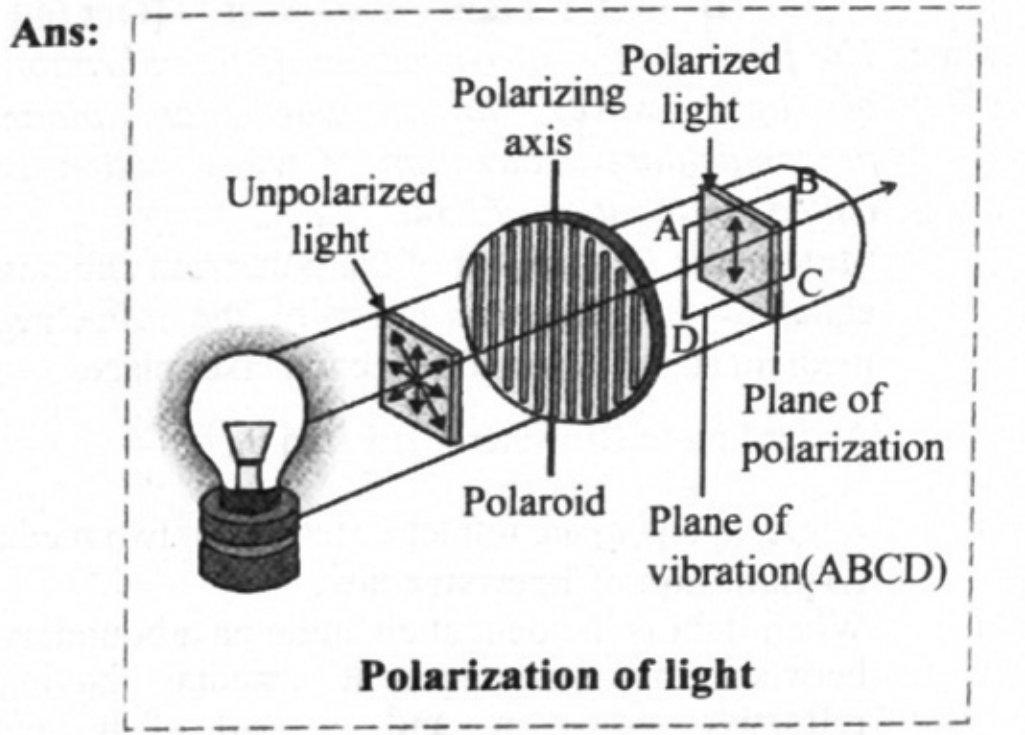
- The plane containing the electric field vectors of plane polarized light is the plane of vibration. The plane perpendicular to the plane of vibration (and to the electric field vector) is the plane of polarization.
- If the polarized light is passed through a second polarizer with its axis perpendicular to that of the first, NO light emerges. If the angle is less than , only the component of the electric field along the second axis passes.
Only transverse waves can be polarized
In a transverse wave the oscillations can be along any direction in the plane perpendicular to the direction of propagation, so they can be restricted to one direction. In a longitudinal wave, for example sound, the particles oscillate only along the direction of propagation, so there is nothing to restrict. This is why polarization proves that light is a transverse wave.
Derivation of Malus' law
Consider an unpolarized wave of angular frequency and wave vector travelling along the -direction, with electric field of magnitude
The intensity is proportional to , and the direction of may be anywhere in the - plane.
Through the first polarizer
Take one particular wave whose electric field makes an angle with the axis of the first polarizer. The component passes; the perpendicular component is obstructed. The intensity of this wave after the polarizer is proportional to .
For unpolarized incident light takes all values from to , so we must average over that range. Since the average of is ,
The intensity of an unpolarized wave is reduced to half after passing through a polarizer, whatever the orientation of the polarizer.
Through the second polarizer
The emerging wave is linearly polarized. Let its electric field be along the -direction:
Let the polarizing axis of the second polarizer make an angle with the -direction. Only the component passes, so the transmitted amplitude is
and the transmitted intensity is
This is Malus' law, after E. L. Malus (1775–1812), who discovered it experimentally. Malus' law gives the intensity of a linearly polarized wave after it passes through a polarizer.
- is the angle between the polarizing AXES of the two polarizers.
- : parallel setting, , the intensity is unchanged by the second polarizer.
- : crossed setting, , no light emerges.
- Three polarizers in succession, unpolarized light entering: .
7.7.1 Polarization by reflection — Brewster's law
Statement: the tangent of the polarizing angle is equal to the refractive index of the refracting medium at which partial reflection takes place.
Explanation and derivation
- When light is incident at an angle on a boundary between two transparent media of refractive indices and , part of it is refracted and the rest is reflected.
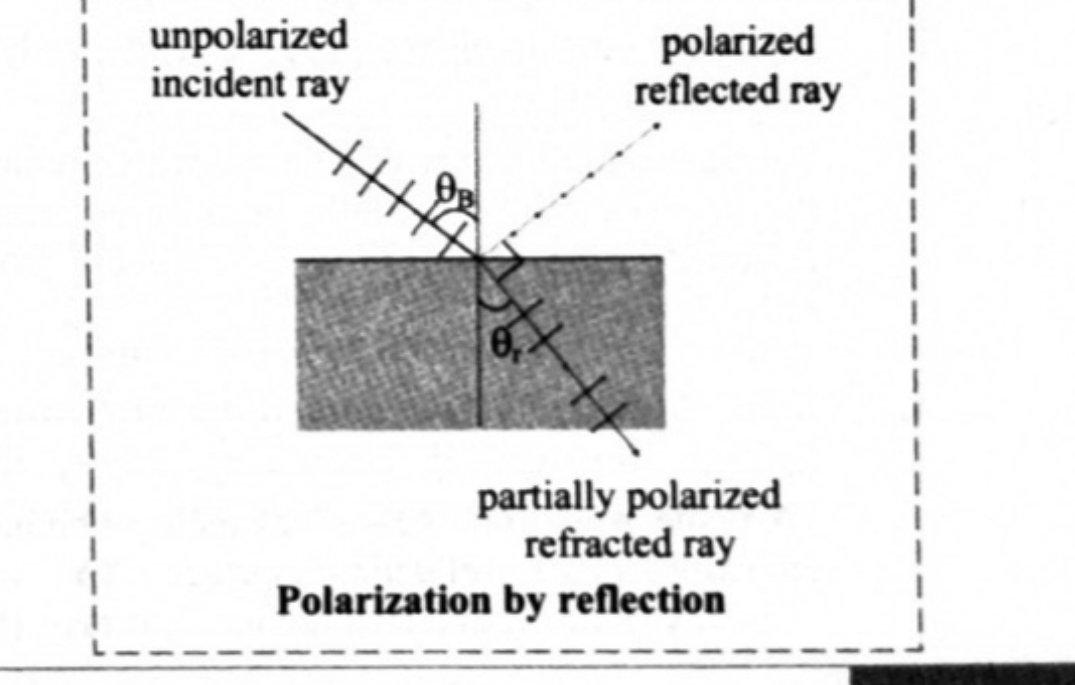
- Consider unpolarized light incident from the rarer medium on such a boundary, drawn perpendicular to the plane of the paper. Resolve the incident electric field into a component parallel to the plane of the paper (double arrows) and a component perpendicular to it (dots); both are of equal magnitude for unpolarized light. In general the reflected and the refracted beams do not carry these two components equally, so both are PARTIALLY polarized.
- D. Brewster discovered experimentally in 1812 that at one particular angle of incidence the reflected wave is COMPLETELY plane polarized, with its electric field perpendicular to the plane of the paper, while the refracted wave is only partially polarized. This angle is Brewster's angle (the polarizing angle).
- At this angle the reflected and refracted rays are perpendicular to each other. Hence, for angle of refraction ,
- From the law of refraction,
Showing that the reflected and refracted rays are perpendicular
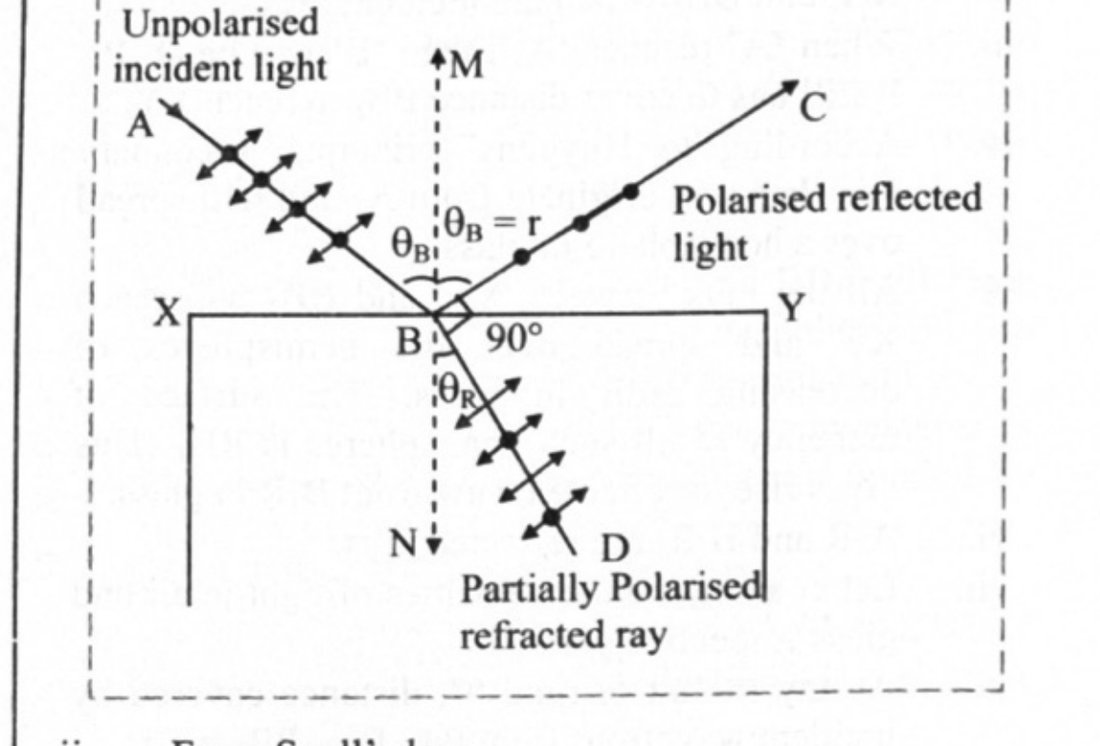
In the figure let be the incident ray, the reflected ray and the refracted ray.
- From Snell's law,
- From Brewster's law,
- From (1) and (2),
- By the law of reflection the angle of reflection equals . Since the three angles at on the straight boundary add to ,
Hence at the polarizing angle the reflected and refracted rays are mutually perpendicular.
Polarization by reflection is used to cut glare from reflecting surfaces with polaroid sunglasses. It works only for NON-METALLIC surfaces. A polaroid also halves the intensity of completely unpolarized sunlight.
7.7.2 Polarization by scattering
When sunlight strikes air molecules or dust particles in the atmosphere it changes direction; this is scattering. Blue light is preferentially scattered, which is why the sky looks blue; without scattering the sky would look dark and stars would be visible by day.
Scattered sunlight is partially polarized, in much the same way as reflected light. The degree of polarization depends on the angle of scattering — the angle between the direction of the incident light and the direction of the scattered light. If this angle is , the scattered light is plane polarized. Light reaching us from different parts of the sky is therefore polarized to different degrees, which is why the brightness of the sky changes as you rotate a polaroid while looking at it.
Standard results
- after the first polarizer, for unpolarized incident light.
- Malus' law: , between the two polarizing axes.
- Brewster's law: ; from air, .
- ; reflected ray refracted ray at the polarizing angle.
- Only transverse waves can be polarized; polarization proves light is transverse.
Theory Questions Asked on This Subtopic
Real board questions. Answers are at the end of the page.
- 1
What is polariszaion of light? State and explain Brewster's law.
 Maharashtra HSC board question — asked in October 2009Answer 1 ↓
 - 2
Draw a neat labelled diagram showing the plane of vibration and plane of polarisation for polarised light.
 Maharashtra HSC board question — asked in October 2014Answer 2 ↓
 - 3
What is a polaroid? State its 'two' uses.
Maharashtra HSC board question — asked in March 2015Answer 3 ↓ - 4
State Brewster's law and show that when light is incident at polarizing angle, the reflected and refracted rays are mutually perpendicular to each other.
 Maharashtra HSC board question — asked in March 2019Answer 4 ↓
Numericals
Every numerical set on this subtopic. Full working is at the end of the page.
- 5
For a glass plate as a polariser with refractive index 1.633, calculate the angle of incidence at which light is polarised.
Maharashtra HSC board question — asked in March 2014Answer 5 ↓ - 6
Find the polarising angle for the material of refractive index .
Maharashtra HSC board question — asked in July 2019Answer 6 ↓
Answers & Solutions
Work the questions above first, then check yourself here. Each answer is set out the way it should be written in the paper.
The phenomenon of restriction of the vibration of light waves in a particular plane perpendicular to direction of wave motion is called polarization of light. Statement: The tangent of the polarizing angle is equal to the refractive index of the refracting medium at which partial reflection takes place. According to Brewster's law, where, and are refractive indices of two media. Explanation of Brewster law: i. When light is incident at an angle on a boundary between two transparent media having refractive indices and , part of it gets refracted and the rest gets reflected. ii. Consider unpolarized light incident from rarer medium of refractive index on such a boundary that is perpendicular to the plane of the paper, as shown below, iii. For a particular angle of incidence (shown in the figure), the reflected wave is completely plane polarized with its electric field perpendicular to the plane of the paper while the refracted wave is partially polarized. This particular angle of incidence is called the Brewster's angle . iv. For this angle of incidence, the refracted and reflected rays are perpendicular to each other. For angle of refraction , From laws of refraction, , This is the expression for Brewster's angle.
The question is a real board question. Its answer and working are ours — this paper was published without an official answer key.
Plane of vibration and plane of polarization
The diagram to draw
- Draw a horizontal axis to the right; this is the direction of propagation of the plane polarized light. Mark it with an arrow.
- Along the beam draw the electric field vectors as double headed arrows, all in ONE direction only (say vertical), perpendicular to the direction of propagation. This single direction of is what makes the light plane polarized.
- Through the beam draw a rectangle that contains both the direction of propagation and all these electric field vectors — a vertical plane containing the beam. Label it PLANE OF VIBRATION.
- Through the same beam draw a second rectangle , perpendicular to and containing the direction of propagation — the horizontal plane containing the beam. Label it PLANE OF POLARIZATION.
- Show clearly that the two planes intersect along the beam and that the angle between them is .
The labels and their meaning
- Plane of vibration: the plane containing the electric field vectors of the plane polarized light, together with the direction of propagation.
- Plane of polarization: the plane perpendicular to the plane of vibration (and perpendicular to the electric field vector), also containing the direction of propagation.
- The two planes are mutually perpendicular and both contain the ray of light.
A polaroid is a kind of synthetic plastic sheet which is used as polarizer. Uses of Polaroids: i. Polaroids are used to produce and analyse polarised light. ii. Sunglasses are fitted with polaroid which reduce the intensity of the partially or fully polarized reflected light coming to the eyes from reflecting surfaces.
[From 7.7, Q1 (Statement only)] The phenomenon of restriction of the vibration of light waves in a particular plane perpendicular to direction of wave motion is called polarization of light. Statement: The tangent of the polarizing angle is equal to the refractive index of the refracting medium at which partial reflection takes place. According to Brewster's law, where, and are refractive indices of two media. Explanation of Brewster law: i. When light is incident at an angle on a boundary between two transparent media having refractive indices and , part of it gets refracted and the rest gets reflected. ii. Consider unpolarized light incident from rarer medium of refractive index on such a boundary that is perpendicular to the plane of the paper, as shown below, iii. For a particular angle of incidence (shown in the figure), the reflected wave is completely plane polarized with its electric field perpendicular to the plane of the paper while the refracted wave is partially polarized. This particular angle of incidence is called the Brewster's angle . iv. For this angle of incidence, the refracted and reflected rays are perpendicular to each other. For angle of refraction , From laws of refraction, , This is the expression for Brewster's angle. i. In the figure, AB = incident ray, BD = refracted ray, BC = reflected ray ii. From Snell's law, From Brewster's law, iii. From equations (1) and (2), iv. In the figure, ….(From laws of reflection) But ….[From equation (3)] Hence reflected and refracted rays are perpendicular at polarising angle.
Given: n = 1.633 To find: Polarising angle Formula: Calculation: From formula we get, 58°31′ Ans: The angle of incidence at which light is polarised is 58°31′
Given: To find: Polarising angle Formula: Calculation: From formula we get, Ans: The angle of incidence at which light is polarised is 61°.