7.8
Interference
Wave Optics · Maharashtra HSC
Theory
What interference is
By the principle of superposition, when two or more waves overlap, the resultant displacement of a particle of the medium at a point is the sum of the displacements produced by the individual waves, as if each were the only one present.
- Where the crests (or troughs) of two waves coincide, the displacement is large; for equal amplitudes it is twice that of one wave. This is constructive interference.
- Where the crest of one wave coincides with the trough of the other, the displacement is a minimum; for equal amplitudes it is zero. This is destructive interference.
- Since intensity is proportional to the square of the amplitude, the intensity becomes non-uniform — larger at some places, smaller at others.
- Definition the board marks: interference of light is the modification in the intensity of light (larger at some places and smaller at some places) produced by the superposition of two or more light waves.
For water waves from two in-phase sources and , crests are drawn as continuous circles and troughs as dotted circles. Points where crest meets crest or trough meets trough are points of constructive interference; points where crest meets trough are points of destructive interference. These lie along straight lines radiating from the midpoint of . Interference of light was first observed by Thomas Young in 1801, and was the first proof of the wave nature of light.
7.8.1 Coherent sources
Two sources which emit waves of the same frequency having a constant phase difference, independent of time, are called coherent sources.
At every point in space, light waves from many sources overlap all the time, and yet we never see interference. This is because different sources emit different frequencies, and even at the same frequency they are not in phase; the phase relations change every instant, so no pattern is sustained long enough to be seen. For a sustained pattern we need coherent sources. Two independent primary sources can never satisfy this, so both secondary sources are derived from a single primary source.
7.8.2 Young's double slit experiment
The set-up
- A plane wavefront falls on an opaque screen containing two similar narrow slits and . The plane wavefront is obtained either by putting a linear source far away or by placing it at the focus of a convex lens kept close to .
- The slits are about 2–4 mm apart and their lengths are perpendicular to the plane of the paper. An observing screen is placed behind , at of about a metre.
- and are equidistant from , so the wavefronts reaching them are always in phase. The two slits then act as coherent secondary sources emitting cylindrical wavelets to the right of .
- Where the wavelets interfere constructively, bright images of the slits (bright fringes) appear on ; midway between them, where crest meets trough, dark fringes appear. The whole pattern of alternate bright and dark bands is the interference pattern.
- The point on the screen is equidistant from and , so the two waves arrive in phase and there is a bright fringe at the centre of the screen.
Expression for the path difference
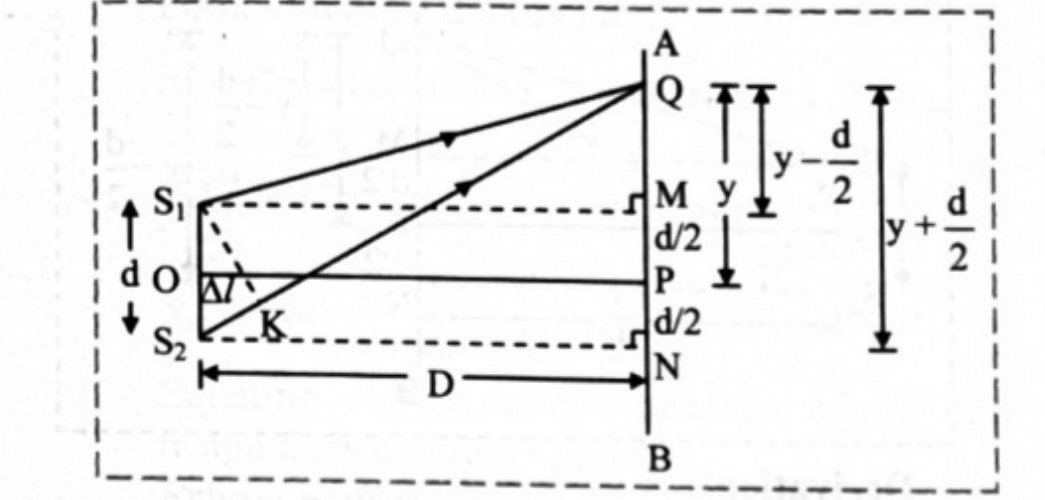
- Let and be two coherent monochromatic sources separated by a small distance , emitting light of wavelength .
- Let be the horizontal distance between the plane of the slits and the screen.
- Draw and perpendicular to the screen, and let be the perpendicular bisector of . Since , the path difference at is zero and is a bright point.
- Consider a point on the screen at a distance from the central point . Waves from and reach along and and superpose there.
In :
In :
Subtracting (1) from (2):
If and , then , so and (3) becomes
This is the path difference between the two interfering waves.
Conditions for bright and dark fringes
Point is BRIGHT if
Equation (5) gives the distance of the bright fringe from the central bright fringe.
Point is DARK if
Equation (6) gives the distance of the dark fringe from the central maximum.
Fringe width
Fringe width is the distance between any two successive bright fringes, or between any two successive dark fringes.
The same subtraction with equation (6) gives . Thus both dark and bright fringes are equidistant and have equal widths, and the width is independent of the order .
In terms of phase difference
- Constructive interference: , (waves in the same phase, phase difference an even multiple of ).
- Destructive interference: , (waves in opposite phase, phase difference an odd multiple of ).
Intensity distribution
At the centre of a bright fringe the amplitude is twice that of one wave, so the intensity is , four times the intensity of the wave from one slit. At the centre of a dark fringe the intensity is zero. In between it varies smoothly between the two.
Writing the two waves at as and , with :
The amplitude is , so
The fringes are therefore equally bright and equally spaced — true only in the limit of vanishingly narrow slits. For wide slits, waves reaching a given point from different parts of the SAME slit have different path lengths, and the pattern is blurred with poor contrast.
If the amplitudes are unequal, and :
so the dark fringes are no longer completely dark.
7.8.3 Conditions for a well defined and steady interference pattern
- The two sources of light must be COHERENT. This is the essential condition. If the phases and phase difference vary with time, the positions of maxima and minima change with time and no steady pattern is seen. This is why both secondary sources are derived from one original source.
- The two sources must be MONOCHROMATIC. The positions and widths of the fringes depend on , so fringes of different colours do not coincide and the pattern becomes a set of coloured, overlapping bands. (Young's original experiment used pin holes and sunlight, giving a coloured pattern with a white centre.)
- The two interfering waves must have the SAME AMPLITUDE. Only then is the intensity at the dark fringes zero and the contrast maximum.
- The separation between the slits must be SMALL compared with the distance to the screen. Since , only then are the fringes wide enough to be measured and well separated.
- The two slits should be NARROW. Broad slits make the distances from different points of the same slit to a point on the screen appreciably different, so waves from one slit interfere among themselves and blur the pattern.
- The two waves should be in the SAME STATE OF POLARIZATION. This is needed only if polarized light is used.
Two further points used in the derivation: was assumed when writing ; and if the two sources have a non-zero constant phase difference, it must be added appropriately — this shifts the whole pattern but does not change the fringe width.
7.8.4 Methods of obtaining coherent sources
- Lloyd's mirror. Light from a source falls at a grazing angle on a plane mirror. Part of the light reaches the screen directly; part reaches it after reflection and appears to come from a virtual source. The two sources are derived from a single source and are therefore coherent, and they produce an interference pattern. The light is monochromatic throughout.
- Fresnel biprism. A biprism is a prism with a vertex angle of nearly ; it can be regarded as two prisms of very small refracting angle (from about to ) joined at their bases. Its refracting edge is kept parallel to the length of the slit. Monochromatic light from a source passes through a narrow slit and falls on the biprism. The two halves form two virtual images and of ; being derived from one secondary source they are coherent, and the waves from them interfere in the overlapping (shaded) region exactly as in Young's experiment.
For the biprism, the separation of the virtual sources is
with the slit-to-biprism distance, the refracting angle of each half (in radian) and the refractive index, since a thin prism deviates by . Experimentally is usually measured with a convex lens: , where is the separation of the magnified virtual images and the magnification is .
7.8.5 Optical path
The phase of a light wave of angular frequency and wave vector travelling in vacuum along is , with . Over a distance in vacuum the phase changes by .
In a medium of refractive index the wave vector is , so over the same distance
So a path in a medium of refractive index produces the same phase change as a path in vacuum. The quantity is the OPTICAL PATH.
- Optical path through a medium is the effective path that light would travel in vacuum to generate the same phase difference. In vacuum, since , the optical path equals the actual path.
- Equivalently: the optical path is the corresponding path in vacuum that light travels in the SAME TIME as it takes in the given medium, since
- How it differs from the actual path length: the actual path is the geometrical distance travelled; the optical path is that distance multiplied by . Since for any material medium, the optical path is always greater than the actual path, and it — not the geometrical path — decides the phase.
- A slab of thickness and refractive index therefore introduces an extra path compared with the same distance travelled in vacuum.
- Two waves interfere constructively when their OPTICAL path lengths are equal or differ by an integral multiple of the wavelength.
Shift of the pattern by a thin plate
If a transparent plate of thickness and refractive index is placed in front of slit , the optical path along increases by . The optical paths from the two slits are then no longer equal at the mid-point ; they are equal at some other point, so the central bright fringe moves there and the whole pattern shifts in that direction. The dark and bright fringes remain symmetric about the new central fringe, and the fringe width does not change:
Interference due to thin films
The brilliant colours of soap bubbles and of thin oil films on water are due to interference between light reflected from the upper and the lower surface of the film.
- The incident wave is partially reflected at the upper surface (ray ). The rest is refracted, travels along , is partially reflected at , travels along , and refracts out into air along .
- The parallel rays and have a phase difference arising from their different path lengths in different media. This phase difference depends on the angle of incidence at the top surface — that is, on the angle of viewing — and on the wavelength, since the refractive index of the film depends on wavelength.
- and interfere, producing maxima and minima for different colours at different angles of viewing. Hence one sees different colours when the film is viewed from different directions, and multiple colours over a film of varying thickness.
- Since the reflection at is from the denser boundary, there is an additional phase difference of radian, that is an extra path difference of , which must be taken into account in the mathematical analysis.
- The colours of butterflies and peacocks arise the same way — from interference, not from pigments.
A standard board question
If white light falls on the two slits but one slit is covered with a red filter and the other with a violet filter, NO interference pattern is obtained. The two slits then emit light of different wavelengths (different frequencies), so they are not coherent, no constant phase difference exists, and the screen shows only the general illumination due to the two colours — not a fringe system.
Standard results
- ; .
- Bright: , ; Dark: , .
- , the same for bright and dark fringes and independent of order.
- ; unequal amplitudes give with .
- Optical path actual path; a plate of thickness adds and shifts the pattern by without changing .
- Immersing the apparatus in a liquid of index replaces by , so and the angular separation both shrink by the factor .
Theory Questions Asked on This Subtopic
Real board questions. Answers are at the end of the page.
- 1
What is interference of light?
Maharashtra HSC board question — asked in March 2008Answer 1 ↓ - 2
Using analytical method for interference bands, obtain an expression for path difference between two light waves.
 Maharashtra HSC board question — asked in July 2016Answer 2 ↓
 - 3
Obtain an expression for path difference and fringe width of interference pattern in Young's double slit experiment. Show that the fringe width is same for consecutive bright and dark bands.
Maharashtra HSC board question — asked in July 2017; October 2008Answer 3 ↓ - 4
State the conditions to get constructive and destructive interference of light.
Maharashtra HSC board question — asked in March 2018Answer 4 ↓ - 5
Give the analytical treatment for interference bands. Hence obtain an expression for path difference between the interfering waves.
Maharashtra HSC board question — asked in July 2019Answer 5 ↓ - 6
State the conditions necessary for obtaining sharp and steady interference pattern. OR State the conditions for a steady interference pattern.
Maharashtra HSC board question — asked in July 2023; March 2008; October 2014Answer 6 ↓ - 7
Using the geometry of the double slit experiment, derive the expression for fringe width of interference bands.
Maharashtra HSC board question — asked in February 2024Answer 7 ↓
Numericals
Every numerical set on this subtopic. Full working is at the end of the page.
- 8
In a biprism experiment the slit is illuminated by a light of wavelength 4800 A.U. The distance between slit and biprism is 20 cm and the distance between biprism and eye piece is 80 cm. If the distance between virtual sources is 3 mm, determine the distance between the 5 bright band on side of the central band and 5 dark band on other side.
Maharashtra HSC board question — asked in October 2009Answer 8 ↓ - 9
In Young's experiment, two slits separated by 4 mm are illuminated by a light of wavelength 6400 A.U. Interference fringes are obtained at a distance of 60 cm from the slits. Find the changes in the fringe width, if the separation between the slits is i. increased by 1 mm, and ii. decreased by 1 mm.
Maharashtra HSC board question — asked in March 2010Answer 9 ↓ - 10
A point is situated at 7 cm and 7.2 cm from two coherent sources. Find the nature of illumination at the point if wavelength of light is 4000 Å.
Maharashtra HSC board question — asked in March 2013Answer 10 ↓ - 11
In a biprism experiment, a slit is illuminated by a light of wavelength 4800 Å. The distance between the slit and biprism is 15 cm and the distance between the biprism and eyepiece is 85 cm. If the distance between virtual sources is 3 mm, determine the distance between 4 bright band on one side and 4 dark band on the other side of the central bright band.
Maharashtra HSC board question — asked in October 2014Answer 11 ↓ - 12
In a biprism experiment, when a convex lens was placed between the biprism and eyepiece at a distance of 30 cm from the slit, the virtual images of the slits are found to be separated by 7 mm. If the distance between the slit and biprism is 10 cm and between the biprism and eyepiece is 80 cm, find the linear magnification of the image.
Maharashtra HSC board question — asked in October 2015Answer 12 ↓ - 13
In biprism experiment, 10 dark band is observed at 2.09 mm from the central bright point on the screen with red light of wavelength 6400 Å. By how much will fringe width change if blue light of wavelength 4800 Å is used with the same setting?
Maharashtra HSC board question — asked in March 2016Answer 13 ↓ - 14
A point is situated at 6.5 cm and 6.65 cm from two coherent sources. Find the nature of illumination at the point if wavelength of light is 5000 Å.
Maharashtra HSC board question — asked in July 2016Answer 14 ↓ - 15
The optical path difference between two identical waves arriving at a point is 371λ. Is the point bright or dark? If the path difference is 0.24 mm, calculate the wavelength of light used.
Maharashtra HSC board question — asked in July 2018Answer 15 ↓ - 16
In Young's double slit experiment, the slits are 0.5 mm apart and interference is observed on a screen placed at a distance of 100 cm from the slit. It is found that 9 bright fringe is at a distance of 8.835 mm from the 2 dark fringe, on the same side of the centre of the fringe pattern. Find the wavelength of light used.
Maharashtra HSC board question — asked in July 2018Answer 16 ↓ - 17
In Young's experiment interference bands were produced on a screen placed at 150 cm from two slits, 0.15 mm apart and illuminated by the light of wavelength 6500 Å. Calculate the fringe width.
Maharashtra HSC board question — asked in March 2019Answer 17 ↓ - 18
Two coherent sources of light having intensity 81:1 produce interference fringes. Calculate the ratio of intensities at the maxima and minima in the interference pattern.
Maharashtra HSC board question — asked in March 2019Answer 18 ↓ - 19
In a biprism experiment, light of wavelength 5200 Å is used to obtain an interference pattern on the screen. The fringe width changes by 1.3 mm when the screen is moved towards the biprism by 50 cm. Calculate the distance between the two virtual images of the slit.
Maharashtra HSC board question — asked in February 2020; March 2018Answer 19 ↓ - 20
Plane wavefront of light of wavelength 6000 Å is incident on two slits on a screen perpendicular to the direction of light rays. If the total separation of 10 bright fringes on a screen 2 m away is 2 cm, find the distance between the slits.
Maharashtra HSC board question — asked in March 2022Answer 20 ↓ - 21
A plane wavefront of light of wavelength 4000 Å is incident on two slits on a screen perpendicular to the direction of light ray. If the total separation of 10 bright fringes on a screen 2 m away is 2 cm, find the distance between the slits.
Maharashtra HSC board question — asked in July 2022Answer 21 ↓ - 22
In a biprism experiment, the fringes are observed in the focal plane of the eye-piece at a distance of 1.2 m from the slit. The distance between the central bright band and the 20th bright band is 0.4 cm. When a convex lens is placed between the biprism and the eye-piece, 90 cm from the eye-piece, the distance between the two virtual magnified images is found to be 0.9 cm. Determine the wavelength of light used.
Maharashtra HSC board question — asked in February 2023Answer 22 ↓ - 23
A plane wavefront of light of wavelength 5500Å is incident onto a slit perpendicular to the direction of light rays. If the total separation of 10 bright fringes on a screen 2 m away is 2 cm, calculate the distance between the slits.
Maharashtra HSC board question — asked in July 2023Answer 23 ↓
Answers & Solutions
Work the questions above first, then check yourself here. Each answer is set out the way it should be written in the paper.
Interference of light is defined as the modification in the intensity of light (larger at some places and smaller at some places) produced by the superposition of two or more light waves.
i. Let and be the two coherent monochromatic sources which are separated by short distance d. They emit light waves of wavelength λ. ii. Let D = horizontal distance between screen and source. iii. Draw and OP = perpendicular bisector of slit. Since , the path difference between waves reaching P from and is zero, therefore there is a bright point at P. iv. Consider a point Q on the screen which is at a distance y from the central point P on the screen. Light waves from and reach at Q simultaneously by covering path and , where they superimpose. Derivation: In , In , Subtract equation (1) from (2), If y << D and d << D then, Equation (3) becomes, Equation (4) gives the path difference of two interfering light waves.
[From 7.8, Q2]
i. Let and be the two coherent monochromatic sources which are separated by short distance d. They emit light waves of wavelength λ. ii. Let D = horizontal distance between screen and source. iii. Draw and OP = perpendicular bisector of slit. Since , the path difference between waves reaching P from and is zero, therefore there is a bright point at P. iv. Consider a point Q on the screen which is at a distance y from the central point P on the screen. Light waves from and reach at Q simultaneously by covering path and , where they superimpose. Derivation: In , In , Subtract equation (1) from (2), If y << D and d << D then, Equation (3) becomes, Equation (4) gives the path difference of two interfering light waves.. for the expression of path difference. Point Q will be bright if, where n = 0, 1, 2,…. Equation (5) represents distance of n bright fringe from central bright fringe. Point Q will be dark point if, where n = 1, 2, 3,…… Equation (6) represents distance of n dark fringe from central maximum. Fringe width: The distance between any two successive dark or any two successive bright fringes is equal. This is called the fringe width and is given by, Fringe width Thus, both dark and bright fringes are equidistant and have equal widths.
Conditions to get constructive interference: i. Two waves should be in same phase. ii. The phase difference between the interfering waves should be even multiple of π. , where, n = 0, ±1 ±2 iii. The path difference between the interfering waves should be an integral multiple of λ or even multiple of . i.e., where, n = 0, 1, 2, 3…. Conditions to get destructive interference: i. Two waves should be in opposite phase. ii. The phase difference between the interfering waves should be odd multiple of π. , where, n = ±1, ±2 iii. The path difference between the interfering waves should be odd multiple of . i.e., . where, n = 1, 2, 3…… Thus, constructive interference is obtained when path difference is an odd multiple of half wavelength.
[From 7.8, Q2]
i. Let and be the two coherent monochromatic sources which are separated by short distance d. They emit light waves of wavelength λ. ii. Let D = horizontal distance between screen and source. iii. Draw and OP = perpendicular bisector of slit. Since , the path difference between waves reaching P from and is zero, therefore there is a bright point at P. iv. Consider a point Q on the screen which is at a distance y from the central point P on the screen. Light waves from and reach at Q simultaneously by covering path and , where they superimpose. Derivation: In , In , Subtract equation (1) from (2), If y << D and d << D then, Equation (3) becomes, Equation (4) gives the path difference of two interfering light waves..
Conditions for obtaining sharp and steady interference pattern are: i. The two sources of light must be coherent. ii. The two sources of light must be monochromatic. iii. The two interfering waves must have the same amplitude. iv. The separation between the two slits (d) must be small in comparison to the distance between the plane containing the slits and the observing screen (D). v. The two slits should be narrow. vi. The two waves should be in the same state of polarization if polarized light is used for the experiment.
[From 7.8, Q2]
i. Let and be the two coherent monochromatic sources which are separated by short distance d. They emit light waves of wavelength λ. ii. Let D = horizontal distance between screen and source. iii. Draw and OP = perpendicular bisector of slit. Since , the path difference between waves reaching P from and is zero, therefore there is a bright point at P. iv. Consider a point Q on the screen which is at a distance y from the central point P on the screen. Light waves from and reach at Q simultaneously by covering path and , where they superimpose. Derivation: In , In , Subtract equation (1) from (2), If y << D and d << D then, Equation (3) becomes, Equation (4) gives the path difference of two interfering light waves.[(i) to (iv)] and Q. No. 3 [derivation of fringe width].
Given: λ = 4800 Å = m, d = 3 mm = m, D = 20 + 80 = 100 cm = 1 m To find: Distance between 5 bright band on one side and 5 dark band on the other side of the central bright band, Formulae: i. For n bright band, ii. For n dark band, Calculation: From formula (i), m From formula (ii), m m + m = m Ans: The distance between 5 bright band on one side and 5 dark band on the other side of the central bright band is m.
Given: λ = 6400 A.U. = m = m, D = 60 cm = 0.6 m, d = 4 mm = m, mm = m, mm = m. To find: Changes in fringe width (ΔW) Formula: Calculation: From formula, m m m m m = 19.2 μm. Also, m. m = 32 μm. Ans: Changes in fringe width respectively are 19.2 μm and 32 μm.
Given: cm, cm, λ = 4000 Å = m To find: Nature of illumination Formula: Calculation: Nature of illumination is determined by path difference. Path difference, cm = m Now, From formula, Since the path difference is even multiple of , Point is bright. Ans: The nature of illumination of point is bright.
Given: λ = 4800 Å = m, d = 3 mm = m, D = 15 + 85 = 100 cm = 1 m To find: Distance between 4 bright band on one side and 4 dark band on the other side of the central bright band, Formulae: i. For n bright band, ii. For n dark band, Calculation: From formula (i), m From formula (ii), m m + m = m Ans: The distance between 4 bright band on one side and 4 dark band on the other side of the central bright band is m.
Given: D = 10 + 80 = 90 cm, d = 30 cm, cm To find: Linear magnification (m) Formula: Calculation: From formula, Ans: The linear magnification of the image is 2.
Given: mm, Å, Å To find: Change in fringe width (ΔW) Formulae: i. ii. Calculation: Using formula (ii), mm From formula (i) we can conclude, for same setting, i.e., mm Change in fringe width (ΔW) = 0.055 mm Ans: The change in fringe width is 0.055 mm.
Given: cm = m, cm = m, λ = 5000 Å = m To find: Nature of illumination at the point Formula: Calculation: Path difference is given by, m From formula, As the path difference is even multiple of , the point is bright. Ans: The point is bright.
Given: Optical Path difference , Path difference = 0.24 mm = m To find: Whether the point is bright or dark, Wavelength of light used (λ) Calculation: Path difference, Since path difference is even multiple of , point is a bright point Also, Path difference, m m = 6469 Å Ans: The point is bright and wavelength of light is 6469 Å.
Given: d = 0.5 mm = m = m, D = 100 cm = 1 m, mm = m (Since both bright and dark fringes are on same side of centre of fringe pattern.) To find: Wavelength of light (λ) Formula: Calculation: Since distance of n bright band from centre is, Distance of n dark band from centre is, Now, m = 5890 Å Ans: The wavelength of light is 5890 Å.
Given: D = 150 cm = 1.5 m, d = 0.15 mm = m, λ = 6500 Å = m To find: Fringe width (W) Formula: Calculation: From formula, m = 6.5 mm Ans: The fringe width is 6.5 mm.
Given: To find: Ratio of intensity of maxima and minima Formulae: i. ii. Calculation: From formula (i), From formula (ii), Ans: The ratio of intensity of maxima and minima is .
Given: λ = 5200 Å, mm, cm = 0.5 m To find: distance between two virtual images (d) Formula: Calculation: From formula, m Ans: The distance between the two virtual images of the slit is m.
Given: λ = 6000 Å, D = 2 m, Distance between 10 fringes = 2 cm = 0.02 m. fringe width W = 0.02/10 = 0.002 m = m To find: Distance between slits (d) Formula: Calculation: From formula, m Ans: The distance between two slits is m.
Given: λ = 4000 Å = m, D = 2 m, Distance between 10 fringes = 2 cm = 0.02 m. Fringe width W = 0.02/10 = 0.002 m = m To find: Distance between slits (d) Formula: Calculation: From formula, m Ans: The distance between two slits is m.
Given: cm = m, D = 1.2 m, n = 20 Magnified image, cm = m. v = 90 cm = 0.9 m m To find: Wavelength (λ) Formulae: i. ii. Calculation: From formula (i), m. From formula (ii), m = 5000 Å Ans: Wavelength of the light used is 5000 Å.
Given: λ = 5500 Å, D = 2 m, Distance between 10 fringes = 2 cm = 0.02 m. fringe width W = 0.02/10 = 0.002 m = m To find: Distance between slits (d) Formula: Calculation: From formula, m Ans: The distance between two slits is m.