Chapter 2
Mechanical Properties of Fluids
Maharashtra HSC · 9 subtopics · textbook pages 26–55
Formula SheetEvery formula this chapter can be examined on, in one table.
Pressure
| Formula | Symbols, units and conditions |
|---|---|
| |
| |
| |
| |
| |
|
Pascal's Law and Hydraulic Machines
| Formula | Symbols, units and conditions |
|---|---|
|
Measurement of Pressure
| Formula | Symbols, units and conditions |
|---|---|
| |
|
Surface Tension and Surface Energy
| Formula | Symbols, units and conditions |
|---|---|
| |
|
Work Done in Changing the Surface Area
| Formula | Symbols, units and conditions |
|---|---|
|
- Free surface energy of a liquid drop of radius (one surface): .
- Work done in blowing a soap bubble of radius from nothing (two surfaces): .
- Increasing a soap bubble from to : .
- Soap film on a rectangular frame changed from area to : .
- One drop of radius breaking into identical droplets: , so and
Angle of Contact and Shape of a Drop
| Formula | Symbols, units and conditions |
|---|---|
|
Excess Pressure — Laplace's Law of a Spherical Membrane (2.4.5, 2.4.6)
| Formula | Symbols, units and conditions |
|---|---|
| |
|
Capillarity
| Formula | Symbols, units and conditions |
|---|---|
|
Viscosity and Coefficient of Viscosity (2.6.1, 2.6.2)
| Formula | Symbols, units and conditions |
|---|---|
| |
|
Critical Velocity and Reynolds Number
| Formula | Symbols, units and conditions |
|---|---|
|
Stokes' Law and Terminal Velocity
| Formula | Symbols, units and conditions |
|---|---|
| |
|
Equation of Continuity
| Formula | Symbols, units and conditions |
|---|---|
|
Bernoulli's Equation
| Formula | Symbols, units and conditions |
|---|---|
| — | |
| — | |
|
Applications of Bernoulli's Equation
| Formula | Symbols, units and conditions |
|---|---|
| |
| |
|
Short NotesThe chapter subtopic by subtopic, in the textbook's own order.9 subtopics
- 1Introduction
- 2Fluid
- 3Pressure
- 4Surface Tension32 board questions
- 5Fluids in Motion1 board question
- 6Critical Velocity and Reynold's Number4 board questions
- 7Stoke's Law1 board question
- 8Equation of Continuity
- 9Bernoulli's Equation
The whole chapter in brief
2.1–2.2 Fluid and Ideal Fluid
- A fluid is any substance that can flow — it deforms continually under an external force. Liquids, gases and plasmas are fluids.
- The shear modulus of a fluid is zero: a fluid cannot resist a shear (tangential) stress in static equilibrium. Ideal fluids can be subjected only to normal, compressive stress, which is pressure.
- Properties of fluids: they do not oppose deformation (they get permanently deformed), they can flow, and they take the shape of the container.
- An ideal fluid is (i) incompressible — constant density, (ii) irrotational — smooth flow, no turbulence, (iii) non-viscous — no internal friction, (iv) steady — velocity at each point constant in time.
- Real fluids display viscosity and can therefore sustain low levels of shear stress. Liquid helium at about 2 K is the only almost non-viscous fluid.
- Hydrostatics = study of fluids at rest. Hydrodynamics = study of fluids in motion.
2.3 Pressure
- Pressure = normal force per unit area of contact, . Scalar. SI unit pascal; .
- Pressure due to a liquid column: . It does not depend on the area of the imaginary column, nor on the shape or size of the container, and holds for gases as well.
- Absolute pressure at depth : . Gauge pressure .
- Atmospheric pressure = weight of a column of air of unit cross section extending from that point to the top of the atmosphere. Highest at sea level; the effective air column is about 8 km. Normal atmospheric pressure = Pa = 76 cm of Hg.
- Vacuum = region where the gas pressure is much less than atmospheric. Perfect vacuum = no matter at all.
- Hydrostatic paradox: in interconnected vessels of different shapes the liquid stands at the same level, because the pressure at a point depends only on the height of the liquid column above it. The walls of a slanted vessel push on the liquid with forces normal to the wall whose vertical components support the extra weight.
- Pascal's law: pressure applied at any point of an enclosed fluid at rest is transmitted equally and undiminished to every point of the fluid and to the walls of the container, provided gravity is neglected.
- Applications: hydraulic lift and hydraulic brakes, both using .
- Mercury barometer (Torricelli): , with Torricelli's vacuum above the column. Open tube manometer: , so it reads the gauge pressure .
2.4 Surface Tension — definitions
- Cohesive force: force of attraction between molecules of the same substance. Adhesive force: between molecules of different substances.
- Range of molecular force: the maximum distance up to which the molecular force is effective — of the order of a few nanometres, hence a short range force.
- Sphere of influence: an imaginary sphere with a molecule at its centre and radius equal to the molecular range.
- Surface film: the surface layer of a liquid of thickness equal to the range of intermolecular force.
- Free surface: the surface of a fluid which experiences no shear stress.
- Surface tension : the tangential force acting per unit length on both sides of an imaginary line drawn on the free surface of a liquid. ; N m; .
- Surface energy: the extra potential energy of the molecules in the surface layer of a liquid. Work done isothermally to increase the area by is , so surface tension = surface energy per unit area (N m = J m).
- Angle of contact : the angle between the tangent to the free liquid surface and the tangent to the solid surface at the point of contact, measured within the liquid.
- Capillarity: the rise or fall of a liquid inside a capillary tube dipped in it.
2.4 Surface Tension — standard results
| Situation | Result |
|---|---|
| Liquid drop / air bubble in liquid | |
| Soap bubble in air | |
| Capillary rise or fall | |
| Surface energy of a drop | |
| Work to blow a soap bubble | |
| Drop into droplets |
2.4 Shape of meniscus and angle of contact
| Angle of contact | Meniscus | Cohesive vs adhesive | Example | Capillary |
|---|---|---|---|---|
| Acute () | Concave | Adhesive force dominates | Water or kerosene in glass | Rise |
| Zero | Concave, tangent along the wall | Cohesion negligible | Highly pure water on clean glass | Maximum rise |
| Obtuse () | Convex | Cohesive force dominates | Mercury in glass | Fall |
- Typical values: pure water on clean glass ; ether–glass ; kerosene–glass ; water–paraffin ; mercury–glass .
- Angle of contact is constant for a given solid–liquid pair at a given temperature; it changes with impurity and decreases with rise in temperature; a small contamination changes it greatly.
- Drop on a solid surface: . If then , which is impossible, and the liquid spreads instead of forming a drop.
2.4 Effect of impurity and temperature on surface tension
- Soluble impurity (common salt in water): surface tension increases.
- Sparingly soluble impurity (phenol, detergent): surface tension decreases — that is why detergent is added while washing clothes.
- Insoluble impurity (dust on mercury): surface tension decreases.
- For most liquids surface tension decreases as temperature rises; for molten copper and molten cadmium it increases. Surface tension becomes zero at the critical temperature.
2.4 Excess pressure across a curved surface
- Plane surface: the resultant force of surface tension on a molecule just below the surface is zero, so the pressure just above and just below is the same.
- Upper convex surface: the resultant force of surface tension is vertically downwards, adds to the atmospheric force, so the pressure just below (concave side) is greater.
- Upper concave surface: the resultant force of surface tension is vertically upwards, opposes the atmospheric force, so the pressure just below (convex side) is smaller.
- In every case: pressure on the concave side is greater than the pressure on the convex side.
2.5 Fluids in Motion
- Flow line: the path of an individual particle in a moving fluid.
- Streamline: a curve whose tangent at any point is along the velocity of flow there. For a steady flow, streamlines and flow lines are identical.
- Flow tube: an imaginary bundle of flow lines bounded by an imaginary wall; in steady flow the fluid cannot cross its walls and adjacent tubes cannot mix.
- Steady flow: a measurable property such as pressure or velocity at a given point is constant in time.
| Sr. No. | Streamline (laminar) flow | Turbulent flow |
|---|---|---|
| i | Smooth flow with velocity smaller than the critical velocity | Irregular, unsteady flow when the velocity exceeds the critical velocity |
| ii | Velocity at a given point is always constant | Velocity at a point does not remain constant |
| iii | Two streamlines never intersect; they are always parallel, hence no eddies | The fluid may have rotational motion at some points, giving rise to eddies |
| iv | The flow can be divided into plane layers; in a pipe of uniform cross section the streamlines are parallel to the axis | The flow tube loses its order and particles move in random directions |
2.6 Viscosity, critical velocity and Reynolds number
- Viscosity is that property of a fluid by virtue of which the relative motion between different layers of the fluid experiences a dragging force, called the viscous drag.
- In liquids the viscous drag is due to short range molecular cohesive forces; in gases it is due to collisions between fast moving molecules.
- Velocity gradient: the rate of change of velocity with distance measured from a stationary layer, .
- Newton's law of viscosity: , with the area of the layer parallel to the flow.
- Coefficient of viscosity = viscous force per unit area per unit velocity gradient. SI unit N s m (decapoise); poise N s m.
- With rise in temperature the coefficient of viscosity of a liquid decreases but that of a gas increases.
- Critical velocity: the velocity beyond which a streamline flow becomes turbulent, .
- Reynolds number is a pure number: streamline, turbulent, in between unsteady.
2.7 Stokes' law and terminal velocity
- Stokes' law: the viscous force on a small sphere falling through a viscous medium is directly proportional to the radius of the sphere, its velocity and the coefficient of viscosity — , the constant being obtained empirically.
- Three forces act on a sphere falling through a viscous fluid: weight downwards, viscous force upwards (increasing with speed) and buoyant force upwards (constant).
- Terminal velocity is the constant downward velocity reached when ; the whole discussion applies to streamline flow only.
- , so .
- A body can never move through a viscous fluid faster than the terminal velocity for that body in that fluid.
2.8 Equation of continuity
- Statement: for a steady flow of an incompressible fluid, , i.e. = constant. It expresses conservation of mass.
- The volume rate of flow is the volume flux; is the mass flux.
- A particle moves faster through a narrow section and slower through a wider section, because there is less space to accommodate the particles behind it; otherwise the incompressible fluid would have to be compressed.
2.9 Bernoulli's equation
- Statement: the work done per unit volume of a fluid by the surrounding fluid is equal to the sum of the changes in kinetic energy and potential energy per unit volume during the flow. It is an application of the work–energy theorem, and is consistent with conservation of energy.
- constant, for an ideal fluid in steady flow.
- Bernoulli's principle: where the speed of a fluid is greater, its internal pressure is smaller.
- Applications: speed of efflux (Torricelli's law ), Venturi tube, dynamic lift on an aeroplane wing, atomizer / paint gun / carburettor, blowing off of roofs by stormy wind.
- Aeroplane: streamlines crowd above the aerodynamically shaped wing, so the air moves faster and the pressure above falls while that below is unchanged; the resulting upward dynamic lift raises the plane when it exceeds its weight.
- Roof in a storm: fast wind over the roof lowers the pressure above it while the air inside stays at atmospheric pressure, so the roof is lifted and blown off.
Answer-in-brief points the board repeats
- Surface tension of paints and lubricating oils is kept low so that they spread easily over a large area.
- Work done in forming a soap bubble of radius is (two surfaces).
- The basis of Bernoulli's principle is the conservation of energy (the work–energy theorem applied to a fluid element).
- A low density manometric liquid is used because it gives a larger difference of levels for the same pressure difference, so the reading is more sensitive.
- An incompressible fluid is one whose density is constant, i.e. does not change with pressure.
- Two or more mercury drops merge into one because a single drop has a smaller total surface area, and hence a smaller surface energy; the system moves to minimum potential energy and energy is released.
- Water speeds up on entering a narrow pipe because of the equation of continuity, = constant.
- At a constriction in a horizontal pipe the speed increases by continuity, and Bernoulli's equation then requires the pressure to fall.
Traps that cost marks
- A soap bubble has two surfaces, a liquid drop or an air bubble inside a liquid has one. Use only for a soap bubble, and for a drop or for a bubble in liquid.
- In work-done problems, remember the factor 2 for a soap film or bubble; and always convert dyne cm to N m ( dyne cm N m) and erg to joule ( erg J).
- The excess pressure formula gives a pressure difference. If the question asks for the pressure inside a raindrop, add the atmospheric pressure.
- is the gauge pressure. If the question says "find the pressure" and gives the pressure on the free surface, the answer is .
- In the terminal velocity formula is the density of the body and that of the medium. For a rising bubble the answer is negative and the sign is part of the answer.
- In , is the area of the layer parallel to the flow, not the cross section, and is the thickness of the fluid layer.
- Radius, not diameter, goes into , and . Halve the given diameter first.
- Reynolds number has no unit and no dimension — do not attach one.
- Capillary rise depends on the radius, not the area. If the area is halved, falls by and rises by .
Solved Numerical ExamplesWorked numericals to attempt first, each with a hint before the full solution.Coming soon
These are being added chapter by chapter. They are solved numericals from the prescribed book and the reference guides — not previous board questions, which live under Practice — so that you can work through the method before meeting it in a real paper.
Important DerivationsEvery derive / obtain / prove question in this chapter. 3 have come up in two or more papers.4
- 1Terminal velocity of a spherical body falling through a viscous mediumDerive an expression for terminal velocity of a spherical object falling under gravity through a viscous medium.
Asked in: March 2022 (Q.21, 3 marks)
Show the derivationHide the derivation
Expression for terminal velocity:Step 1Consider a sphere of radius (r) and density (ρ) falling under gravity through a liquid of density (σ) and coefficient of viscosity (η) as shown in figure.Step 2Forces acting on the sphere during downward motion are,a. Viscous force = (directed upwards)b. Weight of the sphere,(directed downwards)c. Upward thrust as Buoyant force(directed upwards)Step 3As the downward velocity increases, the viscous force increases. A stage is reached, when sphere attains terminal velocity.Step 4When the sphere attains the terminal velocity, the total downward force acting on the sphere is balanced by the total upward force acting on the sphere.Total downward force = Total upward forceWeight of sphere (mg) = Viscous Force + Buoyant force due to mediumThis is the expression for terminal velocity of the sphere.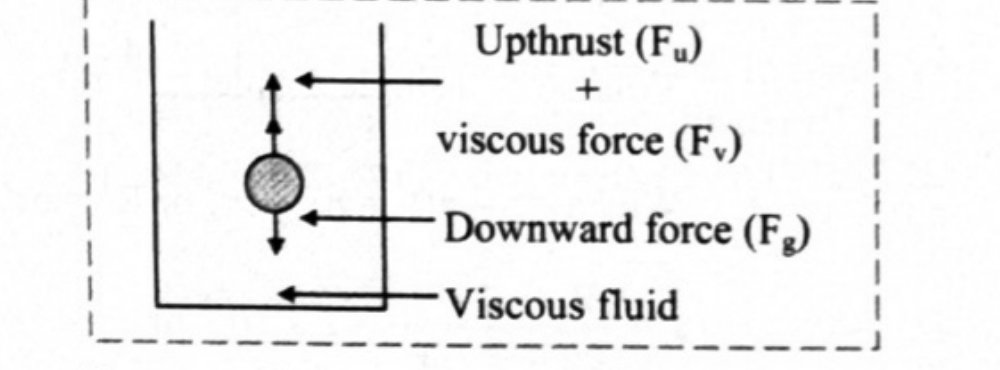
- 2Relation between surface energy and surface tension RepeatsObtain the relation between surface energy and surface tension.
Asked in: March 2013; October 2013; February 2023 (Q.30(i), 4 marks); February 2024 (Q.18, 3 marks); July 2024 (Q.15, 3 marks)
Show the derivationHide the derivation
Relation between surface tension and surface energy per unit area:Step 1Let ABCD be a rectangular frame of wire, fitted with a movable arm PQ.Step 2The frame held in horizontal position is dipped into soap solution and taken out so that a soap film APQB is formed. Due to surface tension of soap solution, a force 'F' will act on each arm of the frame. Under the action of this force, the movable arm PQ moves towards AB.Step 3Magnitude of force due to surface tension is,(A factor of 2 appears because soap film has two surfaces which are in contact with wire.)Step 4Let the wire PQ be pulled outwards through a small distance 'dx' to the position P'Q', by applying an external force F' isothermally, which is equal and opposite to F. Work done by this force, .Step 5But, increase in area of two surfaces of film.Step 6This work done in stretching the film is stored in the area dA in the form of potential energy (surface energy).Surface energy,Hence, surface tension = surface energy per unit area.Step 7Thus, surface tension is equal to the mechanical work done per unit surface area of the liquid, which is also called as surface energy.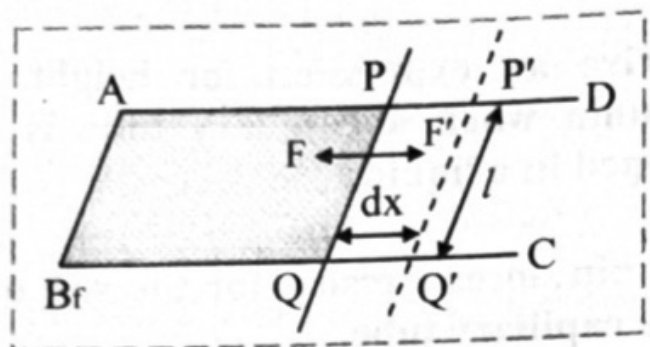
- 3Laplace's law for a spherical membrane / bubble RepeatsDerive Laplace's law for a spherical membrane of a bubble due to surface tension.
Asked in: March 2015; March 2016; March 2018; February 2026 (Q.27, 4 marks)
Show the derivationHide the derivation
Expression for excess pressure inside a drop:Step 1Free surface of drops or bubbles are spherical in shape.Let, = inside pressure of a drop or air bubble, = outside pressure of bubble, r = radius of drop or bubble.Step 2As drop is spherical,excess pressure inside dropStep 3Let the radius of drop increases from r to so that inside pressure remains constant.Step 4Initial area of drop , Final surface area of dropIncrease in surface area,Step 5As Δr is very small, the term containing can be neglected.Step 6Work done by force of surface tension,This work done is also equal to the product of the force F which causes increase in the area of the bubble and the displacement Δr which is the increase in the radius of the bubble.The excess force is given by, (Excess pressure) × (Surface area)From equation (1),Equation (2) represents excess pressure inside a drop or air bubble. It is also called Laplace's law of spherical membrane.Step 7In case of soap bubble, there are two free surfaces in contact with air.For a bubble, Total increase in the surface area of a soap bubble, while increasing its radius by Δr, isThe work done by this excess pressure is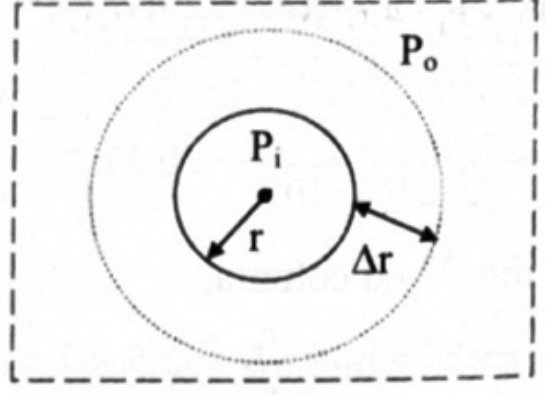
- 4Rise of liquid in a capillary tube (capillarity) RepeatsDerive an expression for the height to which liquid rises in a capillary tube dipped vertically in the liquid.
Asked in: October 2009; March 2019
Show the derivationHide the derivation
Expression for capillary rise:Step 1When glass capillary tube is dipped into a liquid, then the liquid rises in the capillary against gravity. Hence, the weight of the liquid column must be equal and opposite to the component of force due to surface tension at the point of contact.Step 2The length of liquid in contact inside the capillary is the circumference 2πr.Let, r = radius of capillary tube, h = height of liquid level in the tube, T = surface tension of liquid, ρ = density of liquid, g = acceleration due to gravityStep 3The force of magnitude acts tangentially on unit length of liquid surface which is in contact with wall of capillary tube and is given as,This force can be resolved into two components: a. - vertically upward and b. - along horizontalStep 4Vertical component is effective. Horizontal component is not responsible for capillary rise.Step 5Vertical component of force acting on liquid column force per unit length × circumferenceStep 6Upward force balances weight of liquid in the capillary.where, V = volume of liquid rise in the tube (ignoring the liquid in the concave meniscus.) m = mass of the liquid in the capillary rise.Step 7This must be equal and opposite to the vertical component of the force due to surface tension. If liquid in meniscus is neglected, then for equilibrium,This is the required expression for rise of liquid in capillary tube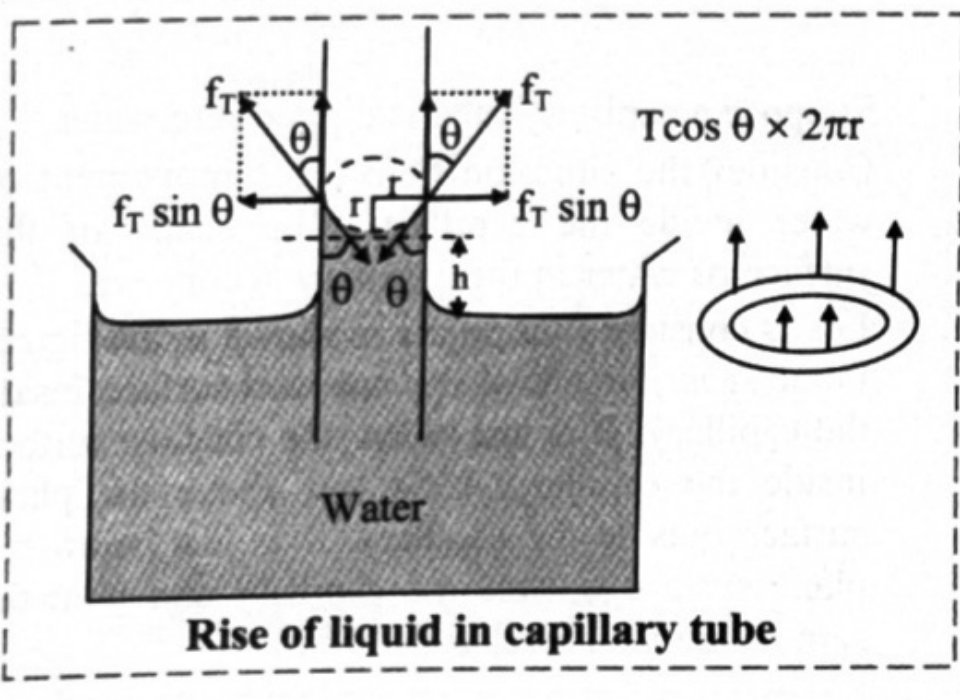
Finished revising this chapter? Practise Mechanical Properties of Fluids →