2.4
Surface Tension
Mechanical Properties of Fluids · Maharashtra HSC
Theory
2.4.1 Molecular theory of surface tension
Terms first
- Intermolecular force: the force of attraction between any two molecules. It is of two kinds.
- Cohesive force: the force of attraction between molecules of the same substance — for example between two water molecules. It is strongest in solids and weakest in gases, which is why solids have a definite shape and gases do not. Small droplets coalesce into a drop because of this force.
- Adhesive force: the force of attraction between molecules of different substances — for example between glass and water molecules.
- Range of molecular force: the maximum distance from a molecule up to which the molecular force is effective. In solids and liquids it is of the order of a few nanometres ( m), so these are short range forces.
- Sphere of influence: an imaginary sphere with a molecule at its centre and radius equal to the molecular range. The intermolecular force is effective only within the sphere of influence.
- Surface film: the surface layer of a liquid whose thickness equals the range of intermolecular force.
- Free surface of a liquid: the surface of a fluid which does not experience any shear stress, for example the interface between liquid water and the air above.
Diagram to draw
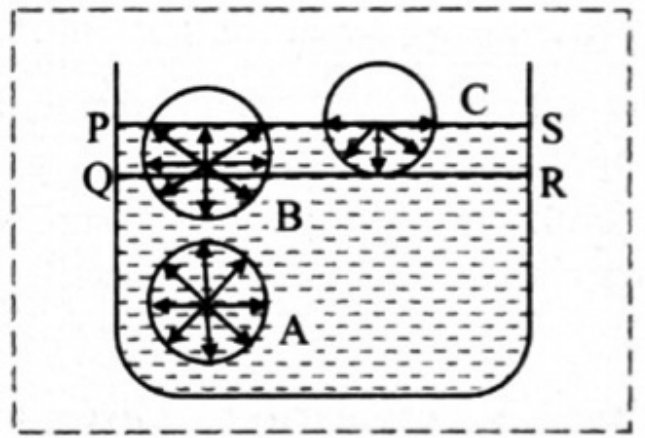
A vessel of liquid. XY is the free surface; X'Y' is an inner layer parallel to XY at a distance equal to the range of molecular force, so that the section XX'–Y'Y is the surface film. Three molecules are marked: A deep inside the liquid, B within the surface film, and C exactly on the free surface. Around each, draw its sphere of influence, and on each show the cohesive and adhesive forces.
The explanation
- Molecule A is deep inside the liquid, so its sphere of influence lies completely inside the liquid. It is acted upon by equal cohesive forces in all directions, and the net cohesive force on A is zero.
- Molecule B lies within the surface layer, below the free surface. A larger part of its sphere of influence is inside the liquid and a smaller part is in air, so a strong downward cohesive force acts on it. The adhesive force due to the air molecules above it, within its sphere of influence, is weak and points upwards. As a result, molecule B gets attracted into the liquid.
- Molecule C lies exactly on the free surface, so half its sphere of influence is in air and half in the liquid. Because the density of air is far less than that of the liquid, the number of air molecules in the upper half is far smaller than the number of liquid molecules in the lower half. The adhesive force trying to pull C outwards is therefore much weaker than the cohesive force pulling it in, and C too gets attracted into the liquid.
- Hence all molecules in the surface film experience an unbalanced net cohesive force directed into the liquid. They are pulled inward, which minimises the number of molecules in the surface film, so the film remains under tension and behaves like a stretched elastic membrane. This tension is called surface tension, and the force due to it acts tangential to the free surface of the liquid.
Note that gases have no free surface and therefore do not exhibit surface tension.
2.4.2 Surface tension and surface energy
a) Surface tension
Imagine a line PQ of length drawn tangential to the free surface of a liquid. All the molecules along this line experience equal and opposite forces tangential to the surface, as if tearing the surface apart, due to the cohesive forces of the molecules lying on either side. This force per unit length is the surface tension.
Definition: surface tension is the tangential force acting per unit length on both sides of an imaginary line drawn on the free surface of a liquid.
- SI unit: N m; equivalently J m. Dimensions .
- Values at C: water , mercury , soap solution , glycerin N m.
b) Surface energy
A molecule deep inside the liquid experiences no net cohesive force, while molecules in the surface film experience a net inward cohesive force. Work must therefore be done to bring a molecule from inside the liquid into the surface film, and the surface molecules possess extra potential energy compared with those inside.
Definition: the extra energy of the molecules in the surface layer of a liquid is called the surface energy of the liquid.
Since every system tries to attain minimum potential energy, a liquid tries to reduce the area of its surface film, and energy must be spent to increase the surface area. When a number of droplets coalesce into one drop the total surface area is reduced and energy is released to the surroundings.
c) Relation between surface energy and surface tension
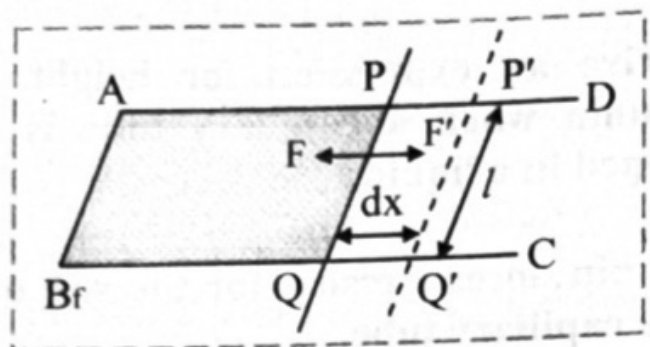
Diagram to draw: a C-shaped wire frame P'PSS' fitted with a movable arm QR of length , dipped in soap solution so that a film forms within PQRS. Show the inward force on QR due to the film, an equal and opposite external force , and the displaced position Q'R' at a distance .
Since the film has two surfaces, upper and lower, the total length over which surface tension acts on QR is , so the inward force on QR is
Let an external force , equal and opposite to , be applied isothermally — gradually and at constant temperature — so that QR moves out through a small distance to Q'R'. The work done against the force of surface tension is
But , the increase in area of the two surfaces of the film. Therefore
This work is stored in the area of the film as its potential energy, which is the surface energy:
Hence surface tension is numerically equal to the surface energy per unit area, which is why N m and J m are the same unit.
Standard results for work done
- Free surface energy of a liquid drop of radius (one surface): .
- Work done in blowing a soap bubble of radius (two surfaces): .
- Work done in increasing a soap bubble from to : ; for a soap film on a frame, .
- Drop of radius breaking into identical droplets: , so and .
- droplets of radius coalescing into one drop of radius : energy released .
2.4.3 Angle of contact
Definition: the angle of contact between a liquid and a solid surface is the angle between the tangents drawn to the free surface of the liquid and to the surface of the solid at the point of contact, measured within the liquid.
a) Shape of the meniscus
When a liquid surface meets a solid surface it forms a meniscus, which may be concave (water–glass) or convex (mercury–glass). An acute angle of contact goes with a concave meniscus, an obtuse angle of contact with a convex one. The difference arises from the competition between the cohesive forces among liquid molecules and the adhesive forces between liquid and solid.
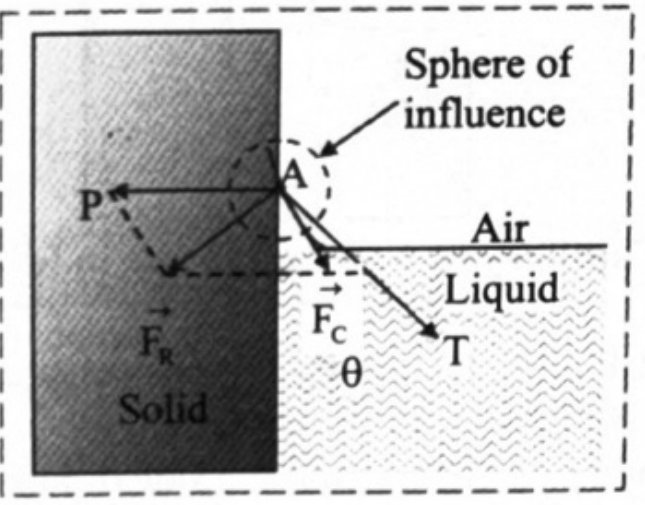
Concave meniscus — acute angle of contact (for example kerosene in a glass bottle). Consider a molecule A on the liquid surface near the vertical wall. The net adhesive force on it is horizontal, since the wall is vertical, and the net cohesive force is directed at nearly to either surface. Here the adhesive force is so large that the resultant is directed inside the solid. For the liquid surface to be stable, must be normal to the liquid surface at every point; for that, the liquid near the wall piles up against the solid boundary so that the tangent AT is perpendicular to . The meniscus is therefore concave, and such a liquid wets the solid.
Convex meniscus — obtuse angle of contact (for example mercury in a glass bottle). Again is horizontal, but now the cohesive force is so large that the resultant is directed into the liquid. For to be normal to the surface, the liquid near the wall creeps inside against the solid boundary, making the meniscus convex with its tangent AT normal to . Such a liquid does not wet the solid.
Zero angle of contact (highly pure water on clean glass). The liquid molecules near the contact region are so few that the cohesive force is negligible, , and the net adhesive force is itself the resultant, . The tangent AT then lies along the wall within the liquid and the angle of contact is zero.
Angle of contact . Here the net cohesive force is exactly at to either surface and the resultant is exactly vertical, along the solid surface. This requires
From this follow the conditions: for an acute angle of contact, ; for an obtuse angle of contact, .
b) Shape of a liquid drop on a solid surface
Let be the force due to surface tension at the liquid–solid interface, at the air–solid interface and at the air–liquid interface; each acts tangential to the surfaces in contact. For equilibrium of the drop,
- If and : is positive and is acute.
- If and : is negative and is obtuse.
- If : and is nearly zero.
- If : , which is impossible — the liquid spreads over the solid surface and no drop is formed.
c) Properties and factors affecting the angle of contact
- The angle of contact is constant for a given liquid–solid pair at a given temperature.
- It depends on the nature of the liquid and of the solid in contact.
- It depends on the medium above the free liquid surface.
- It changes with impurity in the liquid, and any increase in temperature decreases it.
- A small contamination of the surface causes a large change in the angle of contact.
Values: pure water and clean glass ; chloroform or organic liquids with clean glass ; ether with clean glass ; kerosene with clean glass ; water with paraffin ; mercury with clean glass .
2.4.4 Effect of impurity and temperature on surface tension
Effect of impurities:
- Soluble impurity: when a soluble substance such as common salt (sodium chloride) is dissolved in water, the surface tension of water increases.
- Sparingly soluble impurity: when a sparingly soluble substance such as phenol or a detergent is mixed with water, the surface tension of water decreases. This is why detergent powder is mixed with water to wash clothes — the reduced surface tension lets the water make good contact with the fabric and remove tough stains.
- Insoluble impurity: when an insoluble impurity is added, the surface tension of water decreases. Any added impurity decreases the cohesive force of the liquid, which affects the angle of contact and hence the shape of the meniscus. Mercury that has gathered dust has a reduced surface tension and does not form spherical droplets until the dust is removed.
Effect of temperature:
- In most liquids the surface tension decreases as the temperature increases. New cotton fabric is washed in cold water, where the higher surface tension keeps the water from making good contact so the colour is not lost; hot water, with lower surface tension, is used to remove tough stains.
- For molten copper and molten cadmium the surface tension increases with temperature.
- The surface tension of a liquid becomes zero at the critical temperature.
2.4.5 Excess pressure across the free surface of a liquid
Every molecule on a liquid surface experiences forces due to surface tension, tangential to the surface. The direction of the resultant of these forces depends on the shape of the surface, and it contributes to the pressure just below the surface.
Diagram to draw: three sketches of a liquid surface — plane, upper convex and upper concave. In each, mark a molecule A just above the surface and a molecule B just below it, with the downward force due to atmospheric pressure and the force due to surface tension. The level difference between A and B is negligible, and in all three the pressure at A is the atmospheric pressure.
- Plane surface: the resultant force due to surface tension on the molecule at B is zero. The atmospheric force alone decides the pressure, so the pressure at A and B is the same.
- Upper convex surface: the resultant force due to surface tension on B is vertically downwards and adds to . This gives a greater pressure at B, which is on the concave side of the meniscus. So the pressure on the concave side (inside the liquid) is greater than that on the convex side.
- Upper concave surface: the force due to surface tension on B is vertically upwards while acts downwards, so the net downward force is less than . This gives a lesser pressure at B, which is on the convex side of the meniscus. So the pressure on the concave side (outside the liquid) is greater than that on the convex side.
In every case: the pressure on the concave side of a curved liquid surface is greater than the pressure on the convex side.
2.4.6 Excess pressure inside a drop and a bubble — Laplace's law
Liquid drops and small bubbles are spherical because the forces of surface tension dominate the gravitational force, and these forces always try to minimise the surface area. A drop or bubble does not collapse because the resultant of the force due to the external pressure and the force of surface tension is smaller than the pressure inside it.
Derivation
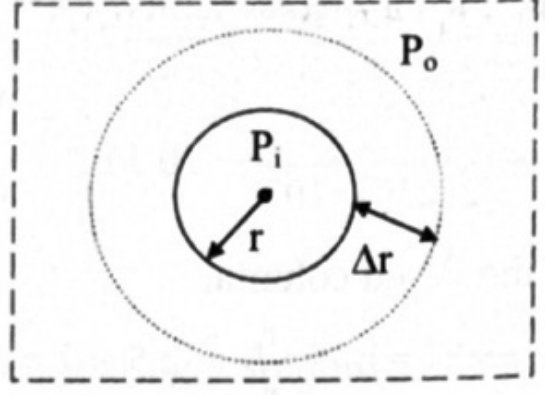
Let be the pressure inside a spherical drop of radius and the pressure outside. Since the drop is spherical, , and the excess pressure inside is .
Let the radius increase from to , where is so small that the pressure inside stays almost constant.
Initial surface area ; final surface area .
As is very small, is neglected, so and the increase in surface area is
The work done in increasing the surface area by is stored as excess surface energy:
This work is also the product of the force that increases the area and the displacement :
Equating the two expressions for ,
This is the excess pressure inside a liquid drop, or inside an air bubble in a liquid, and is called Laplace's law of a spherical membrane.
Soap bubble
A soap bubble has two free surfaces in contact with air, the inner and the outer. The total increase in surface area on increasing the radius by is therefore , and the work done by the excess pressure is
2.4.7 Capillary action
A tube of very fine bore (about 1 mm) open at both ends is called a capillary tube. If one end is dipped in a liquid that wets it, the liquid rises in the tube; if the liquid does not wet it, the level falls. The phenomenon of rise or fall of a liquid inside a capillary tube dipped in it is called capillarity.
Uses of capillarity: oil rises up the wick of a lamp; a cloth rag sucks water; water rises up the crevices in rocks; sap and water rise to the topmost leaves in a tree; blotting paper absorbs ink.
Capillary fall (mercury in glass)
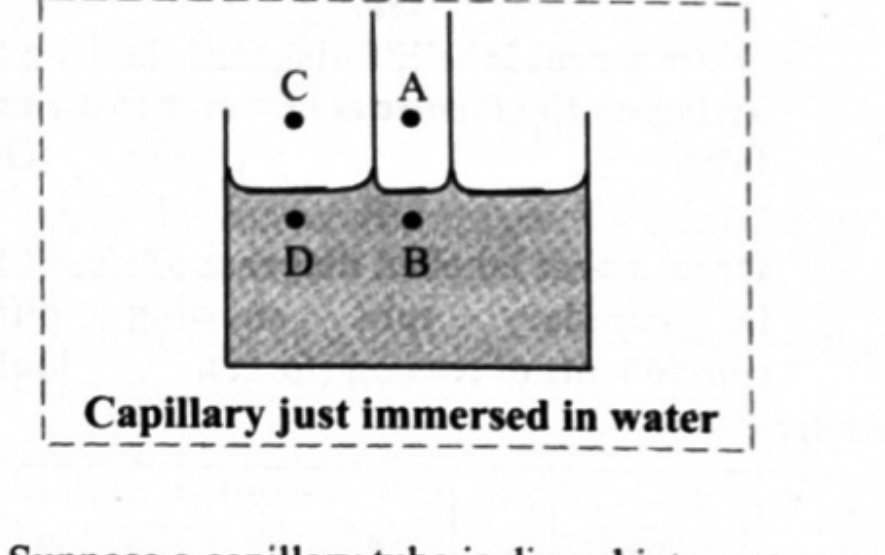
The meniscus of mercury in the capillary is upper convex. Take four points: A just above the convex surface inside the capillary, B just below it inside the capillary, C just above the plane surface outside, and D just below the plane surface outside, below C.
Since the pressure on the concave side is greater than that on the convex side, . As A and C are at the same level and both open to the atmosphere, ; and across the plane surface outside, . Hence , although B and D are at the same horizontal level. To restore equal pressure, mercury rushes out of the capillary, and the level inside the capillary drops.
Capillary rise (water in glass)
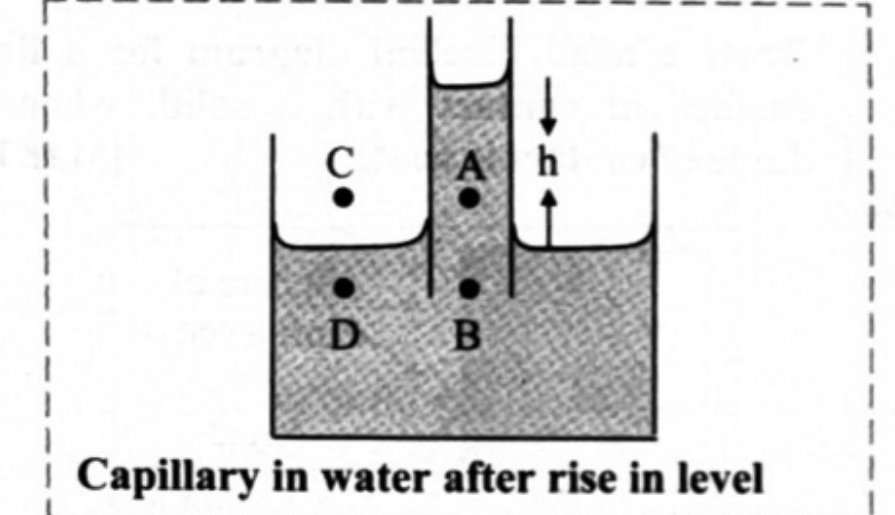
The meniscus of water in the capillary is concave. Take the same four points: A just above the concave surface inside the capillary, B just below it, C just above the plane surface outside, D just below the plane surface outside and at the same horizontal level as B.
Since the pressure on the concave side is greater than that on the convex side, . Across the plane surface outside, ; and since A and C are at the same level and open to the atmosphere,
Hence although B and D are at the same horizontal level. To restore the same pressure, liquid from outside flows into the capillary and rises above B until the pressure at B equals that at D. This is the rise of the liquid inside the capillary.
Expression for capillary rise — Method I, using pressure difference
The pressure due to the liquid column of height must equal the pressure difference due to the concavity of the meniscus of radius of curvature :
If is the radius of the capillary bore and the angle of contact, then , so
Expression for capillary rise — Method II, using forces
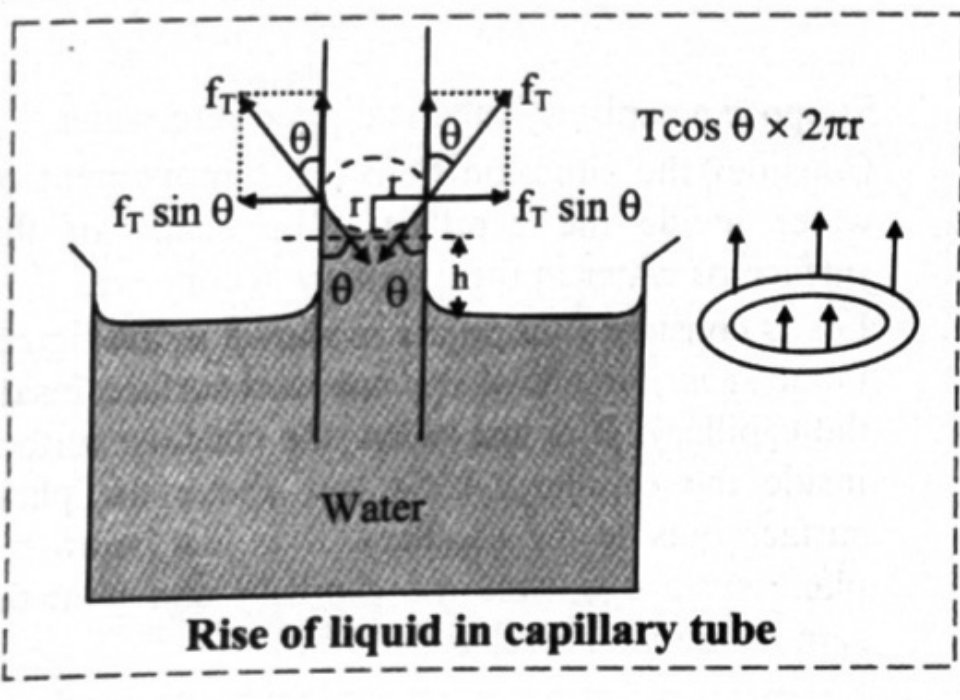
Diagram to draw: a capillary of radius dipped in water, the concave meniscus inside, and at the point of contact the force of surface tension acting along the tangent to the meniscus, making the angle of contact with the wall; resolve it into a vertical component and a horizontal component . Beside it, the liquid column of height and weight .
The rise of water inside a capillary is against gravity, so the weight of the liquid column must be equal and opposite to the proper component of the force due to surface tension at the point of contact.
The length of liquid in contact inside the capillary is the circumference , so the force due to surface tension is
Its direction is along the tangent to the meniscus. Its vertical component is effective; the horizontal component is not responsible for the capillary rise:
Ignoring the liquid in the concave meniscus, the volume of the liquid raised is , so its mass is and its weight is
For equilibrium the two must be equal and opposite:
The same expression is valid for capillary fall: if the meniscus is convex, is obtuse, is negative and so is , which means the liquid is depressed. The narrower the tube, the greater the height to which the liquid rises or falls.
Standard results
- , unit N m or J m, dimensions .
- Surface energy ; surface tension = surface energy per unit area.
- for a drop resting on a solid.
- for a drop or an air bubble in a liquid; for a soap bubble.
- , and for a given liquid.
Theory Questions Asked on This Subtopic
Real board questions. Answers are at the end of the page.
- 1
Define the terms: i. sphere of influence ii. angle of contact
Maharashtra HSC board question — asked in March 2008Answer 1 ↓ - 2
Define surface tension. Explain the effect of impurity on surface tension.
Maharashtra HSC board question — asked in October 2008Answer 2 ↓ - 3
Define surface tension. State its S.I. unit and dimensions.
Maharashtra HSC board question — asked in March 2009Answer 3 ↓ - 4
Explain the rise of liquid in the capillary on the basis of pressure difference.
 Maharashtra HSC board question — asked in March 2014Answer 4 ↓
 - 5
Draw a neat diagram for the rise of liquid in a capillary tube showing the components of a surface tension. OR Draw a neat labelled diagram showing forces acting on the meniscus of water in a capillary tube. OR Draw a neat labelled diagram of rise of liquid in capillary tube showing different components of tension (force).
 Maharashtra HSC board question — asked in July 2016; March 2010; October 2015Answer 5 ↓
 - 6
Draw a neat, labelled diagram for a liquid surface in contact with a solid, when the angle of contact is acute.
 Maharashtra HSC board question — asked in March 2017Answer 6 ↓
 - 7
Define surface tension and surface energy.
Maharashtra HSC board question — asked in July 2017Answer 7 ↓ - 8
Derive an expression for excess pressure inside a drop of liquid. OR Derive Laplace's law for spherical membrane of bubble due to surface tension. OR Derive Laplace's law for a spherical membrane.
 Maharashtra HSC board question — asked in March 2015; March 2016; March 2018Answer 8 ↓
 - 9
Derive an expression for height of liquid column when a capillary tube is vertically dipped in a liquid. OR Obtain an expression for the rise of a liquid in a capillary tube.
Maharashtra HSC board question — asked in March 2019; October 2009Answer 9 ↓ - 10
On the basis of molecular theory explain the phenomenon of surface tension.
 Maharashtra HSC board question — asked in July 2019; March 2008Answer 10 ↓
 - 11
Define the angle of contact and state it's any 'two' characteristics. OR Define angle of contact. State any two properties of angle of contact.
Maharashtra HSC board question — asked in July 2022; October 2014Answer 11 ↓ - 12
What is capillarity? Give any 'two' applications of capillarity. OR What is capillarity? State any two uses of capillarity.
Maharashtra HSC board question — asked in February 2020; July 2018; July 2022Answer 12 ↓ - 13
Derive the relation between surface tension and surface energy per unit area. OR Show that the surface tension of a liquid is numerically equal to the surface energy per unit area. OR Obtain the relation between surface energy and surface tension.
 Maharashtra HSC board question — asked in February 2023; March 2013; October 2013Answer 13 ↓
 - 14
Why a detergent powder is mixed with water to wash clothes?
Maharashtra HSC board question — asked in February 2024Answer 14 ↓ - 15
Define surface energy of the liquid. Obtain the relation between the surface energy and surface tension.
Maharashtra HSC board question — asked in February 2024Answer 15 ↓
Numericals
Every numerical set on this subtopic. Full working is at the end of the page.
- 16
Calculate the work done when a spherical drop of mercury of radius 2 mm, falls from some height and breaks into a million droplets, each of the same size. The surface tension of mercury is T = 0.5 N/m.
Maharashtra HSC board question — asked in March 2010Answer 16 ↓ - 17
A soap bubble of radius 12 cm is blown. Surface tension of soap solution is 30 dyne/cm. Calculate the work done in blowing the soap bubble.
Maharashtra HSC board question — asked in October 2013Answer 17 ↓ - 18
Calculate the density of paraffin oil, if a glass capillary of diameter 0.25 mm dipped in paraffin oil of the surface tension 0.0245 N/m rises to a height of 4 cm. [Angle of contact of paraffin oil with glass is 28° and g = 9.8 m/s]
Maharashtra HSC board question — asked in March 2014Answer 18 ↓ - 19
Water rises to a height 3.2 cm in a glass capillary tube. Find the height to which the same water will rise in another glass capillary having half area of cross section.
Maharashtra HSC board question — asked in October 2014Answer 19 ↓ - 20
A raindrop of diameter 4 mm is about to fall on the ground. Calculate the pressure inside the raindrop. [Surface tension of water T = 0.072 N/m, atmospheric pressure = N/m]
Maharashtra HSC board question — asked in October 2015Answer 20 ↓ - 21
The energy of the free surface of a liquid drop is 5π times the surface tension of the liquid. Find the diameter of the drop in C.G.S. system.
Maharashtra HSC board question — asked in March 2016Answer 21 ↓ - 22
The total free surface energy of a liquid drop is times the surface tension of the liquid. Calculate the diameter of the drop in S.I. unit.
Maharashtra HSC board question — asked in July 2016Answer 22 ↓ - 23
The total energy of free surface of a liquid drop is 2π times the surface tension of the liquid. What is the diameter of the drop? (Assume all terms in S.I. unit).
Maharashtra HSC board question — asked in March 2017Answer 23 ↓ - 24
Two soap bubbles have radii in the ratio 4:3. What is the ratio of work done to blow these bubbles?
Maharashtra HSC board question — asked in July 2017Answer 24 ↓ - 25
Calculate the work done in increasing the radius of a soap bubble in air from 1 cm to 2 cm. The surface tension of soap solution is 30 dyne/cm. (π = 3.142)
Maharashtra HSC board question — asked in March 2018Answer 25 ↓ - 26
A horizontal circular loop of a wire of radius 0.02 m is lowered into crude oil and a film is formed. The force due to the surface tension of the liquid is 0.0113 N. Calculate the surface tension of the crude oil. (π = 3.142)
Maharashtra HSC board question — asked in July 2018Answer 26 ↓ - 27
A rod of length 4 cm is movable on a rectangular frame of wire. A film is formed in the frame. A force of N is applied to the rod for its equilibrium. Find the surface tension of the liquid.
Maharashtra HSC board question — asked in July 2019Answer 27 ↓ - 28
Calculate the work done in blowing a soap bubble of radius 0.1 m. (Surface tension of soap solution = 30 dyne/cm)
Maharashtra HSC board question — asked in February 2020Answer 28 ↓ - 29
Eight droplets of water each of radius 0.2 mm coalesce into a single drop. Find the decrease in the surface area.
Maharashtra HSC board question — asked in March 2022Answer 29 ↓ - 30
Find the difference of pressure between inside and outside of a spherical water drop of radius 2 mm, if surface tension of water is N/m.
Maharashtra HSC board question — asked in July 2022Answer 30 ↓ - 31
Calculate the work done in blowing a soap bubble to a radius of 1 cm. The surface tension of soap solution is N/m.
Maharashtra HSC board question — asked in February 2023Answer 31 ↓ - 32
Calculate the diameter of a water drop, if the excess pressure inside the drop is 80 N/m: [Surface Tension of water = N/m]
Maharashtra HSC board question — asked in July 2023Answer 32 ↓
Answers & Solutions
Work the questions above first, then check yourself here. Each answer is set out the way it should be written in the paper.
i. An imaginary sphere with a molecule at its centre and radius equal to the molecular range is called the sphere of influence of the molecule. ii. The angle of contact (θ) between a liquid and a solid surface is defined as the angle between the tangents drawn to the free surface of the liquid and surface of the solid at the point of contact, measured within the liquid.
Surface tension: Surface tension is defined as the tangential force acting per unit length on both sides of an imaginary line drawn on the free surface of liquid. Effect of impurities on surface tension: The effect of impurities on surface tension of liquid can be either due to soluble impurities or insoluble impurities on the surface of liquid. i. Effect of soluble impurities: When soluble substance such as common salt (i.e., sodium chloride) is dissolved in water, the surface tension of water increases. ii. Effect of partly soluble impurities: When a sparingly soluble substance such as phenol or a detergent is mixed with water, surface tension of water decreases. Example: a detergent powder is mixed with water to wash clothes. Due to this, the surface tension of water decreases and water makes good contact with the fabric and is able to remove tough stains. iii. Effect of insoluble impurities: When insoluble impurity is added into water, surface tension of water decreases. When impurity gets added to any liquid, the cohesive force of that liquid decreases which affects the meniscus. If mercury gathers dust then its surface tension is reduced. It does not form spherical droplets unless the dust is completely removed.
Surface tension: [From 2.4, Q2 (Definition only)] Surface tension: Surface tension is defined as the tangential force acting per unit length on both sides of an imaginary line drawn on the free surface of liquid. Effect of impurities on surface tension: The effect of impurities on surface tension of liquid can be either due to soluble impurities or insoluble impurities on the surface of liquid. i. Effect of soluble impurities: When soluble substance such as common salt (i.e., sodium chloride) is dissolved in water, the surface tension of water increases. ii. Effect of partly soluble impurities: When a sparingly soluble substance such as phenol or a detergent is mixed with water, surface tension of water decreases. Example: a detergent powder is mixed with water to wash clothes. Due to this, the surface tension of water decreases and water makes good contact with the fabric and is able to remove tough stains. iii. Effect of insoluble impurities: When insoluble impurity is added into water, surface tension of water decreases. When impurity gets added to any liquid, the cohesive force of that liquid decreases which affects the meniscus. If mercury gathers dust then its surface tension is reduced. It does not form spherical droplets unless the dust is completely removed. i. Unit: N/m or J/m in SI system. ii. Dimensions:
Explanation of capillary action: i. Suppose a capillary tube is dipped into water. ii. Consider the situation before the movement of water inside the capillary. The shape of the surface of water in the capillary is concave. iii. Let us consider four points as shown in the figure. Point A is just above the concave surface inside the capillary. B is just below the concave surface inside the capillary. C is just above the plane surface outside the capillary. D is just below the plane surface outside the capillary and is at the same horizontal level as that of B. iv. Let , , and be the pressures at points A, B, C and D respectively. v. Since pressure on concave side of liquid surface is greater than that on the convex side. vi. As the pressure is same on both sides of a plane surface, vii. The points A and C are at the same level, the pressure at both these points is the same. atmospheric pressure viii. But points B and D are at same horizontal level in the liquid. Therefore, in order to maintain the same pressure, the liquid out of the capillary flows into the capillary tube and rises above the point B, till the pressure at B becomes the same as that at D. Because of this, there is a rise in the level of liquid inside the capillary tube.
The question is a real board question. Its answer and working are ours — this paper was published without an official answer key.
The diagram to draw
Draw a glass capillary tube of inner radius held vertically with its lower end dipped in water in a beaker, and label these parts:
- The water inside the tube standing at a height above the free surface of the water in the beaker.
- The concave meniscus inside the tube, with the angle of contact marked between the tangent to the meniscus and the inner wall of the tube, measured within the liquid.
- At the point of contact of the meniscus with the wall, the force of surface tension per unit length, , drawn along the tangent to the meniscus — outward and upward, making the angle with the wall.
- Its two rectangular components at that point, drawn as dotted arrows: the vertical component , along the wall, directed upwards, and the horizontal component , perpendicular to the wall.
- The same pair of components drawn at the diametrically opposite point of contact, to show that the two horizontal components are equal and opposite.
- The weight of the raised liquid column, , marked as a downward arrow at the centre of the column.
What the diagram shows
- The liquid is in contact with the tube along the circumference , so the total force due to surface tension is , acting along the tangent to the meniscus.
- The horizontal components at diametrically opposite points are equal in magnitude and opposite in direction, so they cancel all round the circle and play no part in the rise.
- Only the vertical components are effective. Their resultant is
- This supports the weight of the liquid column of height , which is (downwards). At equilibrium,
The question is a real board question. Its answer and working are ours — this paper was published without an official answer key.
The diagram to draw
Draw the vertical wall of a solid container on the left and the liquid to its right, with the liquid surface curving upward to meet the wall — a concave meniscus. Mark a molecule A on the liquid surface, close to the wall, and show these labelled arrows and lines starting at A:
- — the net adhesive force on A, drawn horizontal (pointing from the liquid into the solid wall). It is horizontal because the wall is vertical.
- — the net cohesive force on A, drawn at nearly to either surface, directed into the body of the liquid.
- — the resultant of and , completed by the parallelogram law. Since the adhesive force is the larger here, is directed inside the solid.
- — the tangent to the liquid surface at A, drawn perpendicular to .
- — the angle of contact, marked between the tangent and the solid surface, measured within the liquid. It is acute.
What the diagram shows
- For the liquid surface to be stable, the resultant force on a surface molecule must be normal to the liquid surface at every point.
- For to be normal to the surface, the liquid near the wall piles up against the solid boundary so that the tangent is perpendicular to . The meniscus is therefore concave.
- The angle of contact between and the wall, measured inside the liquid, comes out acute, and such a liquid wets the solid. Kerosene or water in a glass bottle is the standard example.
- The condition on the magnitudes for an acute angle of contact is
since would give exactly .
i. Surface tension: [From 2.4, Q2 (Definition only)] Surface tension: Surface tension is defined as the tangential force acting per unit length on both sides of an imaginary line drawn on the free surface of liquid. Effect of impurities on surface tension: The effect of impurities on surface tension of liquid can be either due to soluble impurities or insoluble impurities on the surface of liquid. i. Effect of soluble impurities: When soluble substance such as common salt (i.e., sodium chloride) is dissolved in water, the surface tension of water increases. ii. Effect of partly soluble impurities: When a sparingly soluble substance such as phenol or a detergent is mixed with water, surface tension of water decreases. Example: a detergent powder is mixed with water to wash clothes. Due to this, the surface tension of water decreases and water makes good contact with the fabric and is able to remove tough stains. iii. Effect of insoluble impurities: When insoluble impurity is added into water, surface tension of water decreases. When impurity gets added to any liquid, the cohesive force of that liquid decreases which affects the meniscus. If mercury gathers dust then its surface tension is reduced. It does not form spherical droplets unless the dust is completely removed. ii. Surface energy: The extra energy of the molecules on the surface layer of a liquid is called surface energy of the liquid.
Expression for excess pressure inside a drop: i. Free surface of drops or bubbles are spherical in shape. Let, = inside pressure of a drop or air bubble, = outside pressure of bubble, r = radius of drop or bubble. ii. As drop is spherical, excess pressure inside drop iii. Let the radius of drop increases from r to so that inside pressure remains constant. iv. Initial area of drop , Final surface area of drop Increase in surface area, v. As Δr is very small, the term containing can be neglected. vi. Work done by force of surface tension, This work done is also equal to the product of the force F which causes increase in the area of the bubble and the displacement Δr which is the increase in the radius of the bubble. The excess force is given by, (Excess pressure) × (Surface area) From equation (1), Equation (2) represents excess pressure inside a drop or air bubble. It is also called Laplace's law of spherical membrane. vii. In case of soap bubble, there are two free surfaces in contact with air. For a bubble, Total increase in the surface area of a soap bubble, while increasing its radius by Δr, is The work done by this excess pressure is
Expression for capillary rise: i. When glass capillary tube is dipped into a liquid, then the liquid rises in the capillary against gravity. Hence, the weight of the liquid column must be equal and opposite to the component of force due to surface tension at the point of contact. ii. The length of liquid in contact inside the capillary is the circumference 2πr. Let, r = radius of capillary tube, h = height of liquid level in the tube, T = surface tension of liquid, ρ = density of liquid, g = acceleration due to gravity iii. The force of magnitude acts tangentially on unit length of liquid surface which is in contact with wall of capillary tube and is given as, This force can be resolved into two components: a. - vertically upward and b. - along horizontal iv. Vertical component is effective. Horizontal component is not responsible for capillary rise. v. Vertical component of force acting on liquid column force per unit length × circumference vi. Upward force balances weight of liquid in the capillary. where, V = volume of liquid rise in the tube (ignoring the liquid in the concave meniscus.) m = mass of the liquid in the capillary rise. vii. This must be equal and opposite to the vertical component of the force due to surface tension. If liquid in meniscus is neglected, then for equilibrium, This is the required expression for rise of liquid in capillary tube
Molecular theory of surface tension: i. Let PQRS = Surface film of liquid in a container containing liquid. PS is the free surface of liquid and QR is the inner layer parallel to PS at distance equal to the range of molecular force. ii. Now consider three molecules A, B and C in a liquid in a vessel such that the molecule A is well inside the liquid, the molecule B within surface film and molecule C is on the surface of liquid as shown in the figure. iii. The sphere of influence of the molecule A is entirely inside the liquid. As a result, molecule A is acted upon by equal cohesive forces in all directions. Thus, the net cohesive force acting on molecule A is zero. iv. For molecule B, a large part of its sphere of influence is inside the liquid and a smaller part is outside the surface (in air). The adhesive force acting on molecule B due to air molecules above it and within its sphere of influence is weak compared to the strong downward cohesive force acting on the molecule. As a result, the molecule B gets attracted inside the liquid. v. For molecule C, half of the sphere of influence is in air and half is in liquid. As density of air is much less than that of liquid, number of air molecules within the sphere of influence of the molecule C above the free surface of the liquid is much less than the numbers of liquid molecules within the sphere of influence that lies within the liquid. Thus, the adhesive force due to the air molecules acting on molecule C is weak compared to the cohesive force acting on the molecule. As a result, the molecule C also gets attracted inside the liquid. vi. Thus, all molecules in the surface film are acted upon by an unbalanced net cohesive force directed into the liquid. Therefore, the molecules in the surface film are pulled inside the liquid. This minimizes the total number of molecules in the surface film. As a result, the surface film remains under tension. The surface film of a liquid behaves like a stretched elastic membrane. This tension is known as surface tension and the force due to it acts tangential to the free surface of a liquid.
[From 2.4, Q1 (ii)]
i. An imaginary sphere with a molecule at its centre and radius equal to the molecular range is called the sphere of influence of the molecule. ii. The angle of contact (θ) between a liquid and a solid surface is defined as the angle between the tangents drawn to the free surface of the liquid and surface of the solid at the point of contact, measured within the liquid. Properties of angle of contact: i. The angle of contact is constant for a given liquid-solid pair. ii. The value of angle of contact depends upon nature of liquid and solid in contact. iii. It depends upon the medium which exists above the free liquid surface. iv. The angle of contact changes due to impurity or temperature. v. A small contamination of the surface causes a large change in the angle of contact. [Any two properties]
Capillary action or capillarity: The phenomenon of rise or fall of liquid level inside a capillary tube when it is dipped in the liquid is called capillary action or capillarity. Uses of capillarity: i. Oil rises up the wick of a lamp. ii. Cloth rag sucks water. iii. Water rises up the crevices in rocks. iv. Sap and water rise up to the top most leaves in a tree. v. Blotting paper absorbs ink. [Any two uses]
Relation between surface tension and surface energy per unit area: i. Let ABCD be a rectangular frame of wire, fitted with a movable arm PQ. ii. The frame held in horizontal position is dipped into soap solution and taken out so that a soap film APQB is formed. Due to surface tension of soap solution, a force 'F' will act on each arm of the frame. Under the action of this force, the movable arm PQ moves towards AB. iii. Magnitude of force due to surface tension is, (A factor of 2 appears because soap film has two surfaces which are in contact with wire.) iv. Let the wire PQ be pulled outwards through a small distance 'dx' to the position P'Q', by applying an external force F' isothermally, which is equal and opposite to F. Work done by this force, . v. But, increase in area of two surfaces of film. vi. This work done in stretching the film is stored in the area dA in the form of potential energy (surface energy). Surface energy, Hence, surface tension = surface energy per unit area. vii. Thus, surface tension is equal to the mechanical work done per unit surface area of the liquid, which is also called as surface energy.
When detergent powder is mixed with water to wash clothes, the surface tension of water decreases and water makes good contact with the fabric and is able to remove tough stains.
[From 2.4, Q7 (Definition)]
i. Surface tension: [From 2.4, Q2 (Definition only)] Surface tension: Surface tension is defined as the tangential force acting per unit length on both sides of an imaginary line drawn on the free surface of liquid. Effect of impurities on surface tension: The effect of impurities on surface tension of liquid can be either due to soluble impurities or insoluble impurities on the surface of liquid. i. Effect of soluble impurities: When soluble substance such as common salt (i.e., sodium chloride) is dissolved in water, the surface tension of water increases. ii. Effect of partly soluble impurities: When a sparingly soluble substance such as phenol or a detergent is mixed with water, surface tension of water decreases. Example: a detergent powder is mixed with water to wash clothes. Due to this, the surface tension of water decreases and water makes good contact with the fabric and is able to remove tough stains. iii. Effect of insoluble impurities: When insoluble impurity is added into water, surface tension of water decreases. When impurity gets added to any liquid, the cohesive force of that liquid decreases which affects the meniscus. If mercury gathers dust then its surface tension is reduced. It does not form spherical droplets unless the dust is completely removed. ii. Surface energy: The extra energy of the molecules on the surface layer of a liquid is called surface energy of the liquid.. [From 2.4, Q13] Relation between surface tension and surface energy per unit area: i. Let ABCD be a rectangular frame of wire, fitted with a movable arm PQ. ii. The frame held in horizontal position is dipped into soap solution and taken out so that a soap film APQB is formed. Due to surface tension of soap solution, a force 'F' will act on each arm of the frame. Under the action of this force, the movable arm PQ moves towards AB. iii. Magnitude of force due to surface tension is, (A factor of 2 appears because soap film has two surfaces which are in contact with wire.) iv. Let the wire PQ be pulled outwards through a small distance 'dx' to the position P'Q', by applying an external force F' isothermally, which is equal and opposite to F. Work done by this force, . v. But, increase in area of two surfaces of film. vi. This work done in stretching the film is stored in the area dA in the form of potential energy (surface energy). Surface energy, Hence, surface tension = surface energy per unit area. vii. Thus, surface tension is equal to the mechanical work done per unit surface area of the liquid, which is also called as surface energy.
Given: R = 2 mm m, n = , T = 0.5 N/m To find: Work done (W) Formula: Calculation: Volume of a single drop and Volume of a single droplet We have, or m From formula, J Ans: The work done when a spherical drop of mercury falls from some height and breaks into a million droplets is J.
Given: r = 12 cm, T = 30 dyne/cm To find: Work (W) Formula: Calculation: Initial surface area of soap bubble = 0 Final surface area Increase in surface area From formula, erg J J Ans: The work done in blowing the soap bubble is J.
Given: d = 0.25 mm mm m T = 0.0245 N/m, h = 4 cm = 0.04 m, θ = 28°, g = 9.8 m/s To find: Density (ρ) Formula: Calculation: From formula, ...(using log table, ) = antilog {log(490)+log(8829) − [log(125)+log(4)+log(9.8)]} = antilog {2.6902+3.9459 − (2.0969+0.6021+0.9912)} = antilog{2.9459} kg/m Ans: The density of paraffin oil is 882.8 kg/m.
Given: = 3.2 cm, To find: Height to which water will rise () Formula: Calculation: From formula, cm Ans: Water will rise to a height of 4.525 cm.
Given: T = 0.072 N/m, d = 4 mm m, N/m To find: Pressure inside the raindrop () Formula: Calculation: From formula, Pa Ans: The pressure inside the raindrop is Pa.
Given: To find: Diameter of the drop (d) in C.G.S. system Formula: Calculation: From formula, cm Ans: The diameter of the drop is 2.236 cm.
Given: To find: Diameter of drop (d) Formula: Calculation: From formula, m m Ans: The diameter of the drop is 1.1892 m.
Given: To find: Diameter of drop (d) Formula: Calculation: From formula, We know, m m Ans: The diameter of the drop is 1.414 m.
Given: To find: Formulae: Calculation: From formula, Work done to blow both bubbles, and Ans: The ratio of work done to blow the bubbles is 16 : 9.
Given: = 1 cm, = 2 cm, T = 30 dyne/cm To find: Work (W) Formula: Calculation: cm cm cm Since soap bubble has two surfaces From formula, erg Ans: The work done in increasing the radius of the soap bubble is erg.
Given: r = 0.02 m, F = 0.0113 N To find: Surface tension (T) Formula: Calculation: As there are two sides of a circular loop acted upon by the force, From formula, = antilog {log(113) − [log(4)+log(3.142)+log(2)]} = antilog{2.0531 − (0.6021+0.4972+0.3010)} = antilog{0.6528} N/m Ans: The surface tension of crude oil is 0.04495 N/m.
Given: l = 4 cm = 0.04 m, N To find: Surface tension (T) Formula: length Calculation: In case of rod, liquid wets it from two sides. Force acting on the rod due to surface tension, From formula, N/m Ans: The surface tension of the liquid is 0.04 N/m.
Given: dyne/cm N/m, Initial radius of bubble = 0 m, Final radius of bubble, r = 0.1 m To find: Work down (W) Formula: Work done Calculation: Initial surface area of bubble = 0 A soap bubble has two surfaces, outer surface and inner surface. Final surface area of soap bubble is, change in area m From formula, J Ans: Work done in blowing a soap bubble to a radius of 0.1 cm is J.
Given: r = 0.2 mm m, n = 8 To find: Decrease in surface area (E) Formula: Calculation: Volume of a single drop and Volume of a single droplet We have, or m From formula, m Ans: Decrease in the surface area is m.
Given: r = 2 mm m, N/m To find: Difference of pressure (ΔP) Formula: Calculation: From formula, N/m Ans: The difference of pressure between inside and outside of a spherical water drop is 73 N/m.
Given: N/m, Initial radius of bubble = 0 cm, Final radius of bubble, r = 1 cm = 0.01 m To find: Work down (W) Formula: Work done Calculation: Initial surface area of bubble = 0 A soap bubble has two surfaces, outer surface and inner surface. Final surface area of soap bubble is, m m From formula, J Ans: Work done in blowing a soap bubble to a radius of 1 cm is J.
Given: N/m, N/m To find: Diameter of the water drop (D). Formula: Calculation: From formula, m mm Ans: Diameter of the water drop so that excess pressure inside it is 80 N/m is 3.6 mm.