2.7
Stoke's Law
Mechanical Properties of Fluids · Maharashtra HSC
Theory
Statement of Stokes' law
Stokes' law states that the viscous force acting on a small sphere falling through a viscous medium is directly proportional to the radius of the sphere , its velocity through the fluid, and the coefficient of viscosity of the fluid:
The empirically obtained constant of proportionality is , so
This is the expression for the viscous force acting on a spherical object moving through a viscous medium; it can also be obtained by dimensional analysis.
2.7.1 Terminal velocity
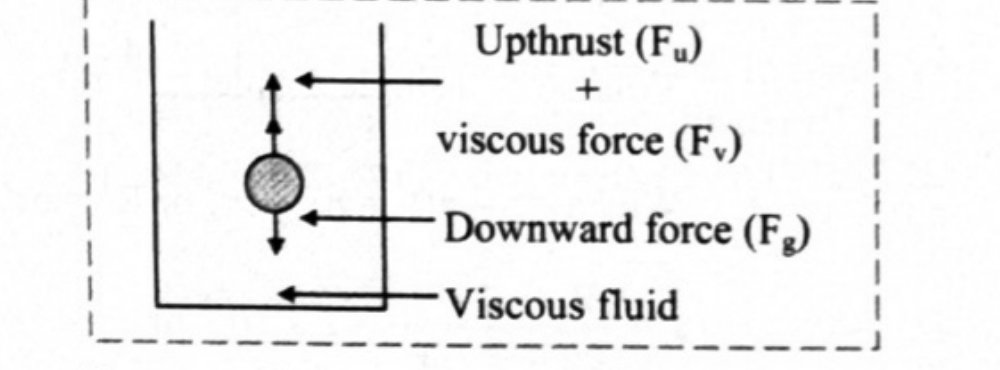
The three forces
A spherical object falling through a viscous fluid experiences:
- the viscous force , directed upwards, whose magnitude goes on increasing as the velocity increases,
- the gravitational force, its weight , directed downwards,
- the buoyant force or upthrust , directed upwards.
The net downward force is responsible for the initial increase in velocity. Of these, and are constant while increases with velocity, so a stage is reached when the net force becomes zero, that is, when . After that the downward velocity remains constant. This constant downward velocity is called the terminal velocity, and from then on the viscous force is also constant. The whole discussion applies to streamline flow only.
Diagram to draw
A sphere of radius falling through a column of viscous liquid, with three arrows at its centre: weight downwards, viscous force upwards, and buoyant force upwards.
Derivation
Let the sphere have radius and density , and let the medium have density and coefficient of viscosity . At the terminal velocity ,
Total downward force = Total upward force
Weight of sphere = viscous force + buoyant force due to the medium
This is the expression for the terminal velocity of the sphere. Rearranged, it also gives the coefficient of viscosity of the fluid:
Reading the result
- : two bodies of the same material with radii in the ratio have terminal velocities in the ratio .
- If , as for an air bubble in a liquid, the calculated is negative. The negative sign means the body rises rather than falls.
- The velocity with which an object can move through a viscous fluid is always less than or equal to the terminal velocity in that fluid for that object.
Standard results
- .
- , with the density of the body and that of the medium.
- Weight ; buoyant force .
Theory Questions Asked on This Subtopic
Real board questions. Answers are at the end of the page.
- 1
Derive an expression for terminal velocity of a spherical object falling under gravity through a viscous medium.
 Maharashtra HSC board question — asked in March 2022Answer 1 ↓
Answers & Solutions
Work the questions above first, then check yourself here. Each answer is set out the way it should be written in the paper.
Expression for terminal velocity: i. Consider a sphere of radius (r) and density (ρ) falling under gravity through a liquid of density (σ) and coefficient of viscosity (η) as shown in figure. ii. Forces acting on the sphere during downward motion are, a. Viscous force = (directed upwards) b. Weight of the sphere, (directed downwards) c. Upward thrust as Buoyant force (directed upwards) iii. As the downward velocity increases, the viscous force increases. A stage is reached, when sphere attains terminal velocity. iv. When the sphere attains the terminal velocity, the total downward force acting on the sphere is balanced by the total upward force acting on the sphere. Total downward force = Total upward force Weight of sphere (mg) = Viscous Force + Buoyant force due to medium This is the expression for terminal velocity of the sphere.