8.12
Energy Stored in a Capacitor
Electrostatics · Maharashtra HSC
Theory
Why a capacitor stores energy
- A capacitor is a device used to store energy. Charging it means transferring electrons from one plate to the other, and the battery must do work to move them against the opposing forces.
- Those forces arise because the electrons are pushed onto the negative plate, which repels them, and removed from the positive plate, which attracts them. In both cases the Coulomb forces oppose the transfer, and as the charge on the plates grows the opposing force grows with it.
- The work done is stored as electrostatic energy in the electric field between the plates, and can later be recovered by discharging the capacitor.
Derivation
Set-up and diagram
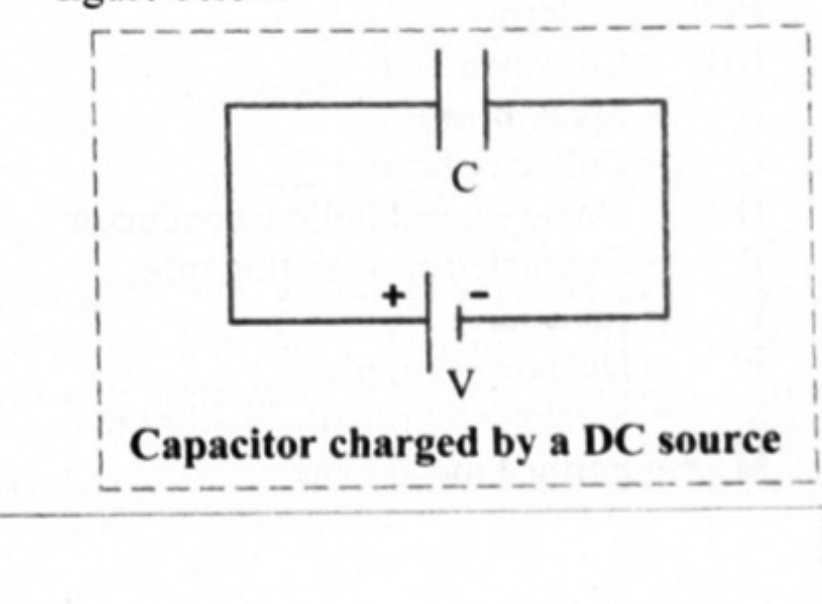
- Consider a capacitor of capacitance being charged by a DC source of volts. Draw the capacitor connected across the cell through a key.
- During charging, let be the instantaneous charge on the capacitor and the potential difference between the plates, so that
Work done
- A small amount of work is done if a further small charge is transferred between the plates:
- Total work done in transferring the charge from 0 to :
The three forms
- This work is stored as the electrical potential energy of the capacitor, and using it can be written in three equivalent ways:
- Use the first form when and are given, the second when and are given, and invert the first as when the charge is wanted.
Energy supplied versus energy stored
- The energy supplied by the battery is , but the energy stored in the electric field is only .
- The remaining half, , is wasted as heat in the connecting wires and in the battery itself.
- Hence the ratio of energy stored in a capacitor to energy dissipated during charging is .
Energy density
- The energy is stored in the field itself, so it is useful to speak of the energy per unit volume of the field:
- measured in . The total energy contained in a volume of dielectric sitting in a field is — the working route for the "cube of marble in a field of " type of numerical.
Energy lost when two capacitors are joined
- If a capacitor charged to is connected to a second capacitor at , charge redistributes until both reach a common potential
- The total stored energy always falls, the difference being lost as heat and electromagnetic radiation:
- The same answer follows by computing before and after, and subtracting.
Change of energy when a dielectric is introduced
- With the supply kept connected so that stays constant, becomes and rises to times its value — the energy of the capacitor increases when the slab is introduced, and falls back when it is removed.
- With the capacitor charged and then isolated so that stays constant, falls to of its value when the slab goes in, and rises times when the slab is taken out. Always check first which of or is being held fixed.
Theory Questions Asked on This Subtopic
Real board questions. Answers are at the end of the page.
- 1
[July 19 / Feb 24] Obtain an expression for energy of a charged capacitor and express it in different forms. OR Derive an expression for energy stored in a charged capacitor.
 Maharashtra HSC board questionAnswer 1 ↓
Numericals
Every numerical set on this subtopic. Full working is at the end of the page.
- 2
[Oct 08] Energy stored in a charged capacitor of 25 pF is 4 J. Find the charge on its plate.
Maharashtra HSC board questionAnswer 2 ↓ - 3
[Mar 10] A condenser of capacity 100 μF is charged to a potential of 1 kV. Calculate the energy stored in the condenser.
Maharashtra HSC board questionAnswer 3 ↓ - 4
[Mar 17] A cube of marble having each side 1 cm is kept in an electric field of intensity 300 V/m. Determine the energy contained in the cube of dielectric constant 8. [Given: C²/Nm²]
Maharashtra HSC board questionAnswer 4 ↓ - 5
[July 18] A 10 μF capacitor is connected with 100 V battery. What would be the electrostatic energy stored?
Maharashtra HSC board questionAnswer 5 ↓
Answers & Solutions
Work the questions above first, then check yourself here. Each answer is set out the way it should be written in the paper.
i. Consider a capacitor of capacitance C being charged by a DC source of V volts as shown in figure below. ii. During the process of charging, let q' be the charge on the capacitor and V be the potential difference between the plates. Hence iii. A small amount of work is done if a small charge dq is further transferred between the plates. iv. Total work done in transferring the charge v. This work done is stored as electrical potential energy U of the capacitor. This work done can be expressed in different forms as follows.
Given: C = 25 pF = F, U = 4 J To find: Electrostatic energy (U) — Charge (Q) Formula: Calculation: From formula, Ans: The charge on its plate is 14.14 μC.
Given: C = 100 μF = F F, V = 1 kV = 1000 V To find: Electrostatic energy (U) Formula: Calculation: From formula, Ans: The electrostatic energy stored in the capacitor is 50 J.
Given: cm m, E = 300 Vm⁻¹, k = 8 To find: Energy contained in the cube (U) Formula: Calculation: Volume of marble, Energy density, From formula, Ans: The energy contained in the cube is J.
Given: C = 10 μF = F, V = 100 V To find: Electrostatics energy stored (U) Formula: Calculation: Using Formula, Ans: The electrostatic energy stored in capacitor is 0.05 J.