8.10
Capacitance of a Parallel Plate Capacitor Without and With Dielectric Medium Between the Plates
Electrostatics · Maharashtra HSC
Theory
(a) Capacitance of a parallel plate capacitor without a dielectric
Set-up and diagram
- A parallel plate capacitor consists of two thin conducting plates, each of area , held parallel to each other at a distance apart. One plate is isolated and charged, the other is earthed. Draw the two plates, mark on the isolated plate and on the inner face of the earthed plate, and show the uniform field lines running from the positive to the negative plate.
Derivation
- When a charge is given to the isolated plate, a charge is induced on the inner face of the earthed plate and on its outer face; being free and earthed, that flows to earth.
- In the outer regions the fields of the two charged plates are oppositely directed and cancel:
- In the region between the plates the two fields add:
- directed from the positive to the negative plate.
- If is the potential difference between the plates, the uniform field is
- Substituting (1) in (2),
- Hence the capacitance is
- Capacitance rises with plate area and falls with plate separation. For circular plates of radius , put .
(b) Capacitance with a dielectric slab between the plates
Set-up
- Let be the field between the plates before the slab is introduced, so , where and is the surface charge density on the plates. Without the slab, .
- Introduce a dielectric slab of thickness . The field polarises the dielectric, inducing a charge on its left face and on its right face. Draw the two plates, the slab of thickness occupying part of the gap, and the induced surface charges on its faces opposing the plate charges.
Derivation
- The induced charges set up a field inside the dielectric, opposite to :
- The net field inside the dielectric reduces to
- where is the dielectric constant. Hence , or equivalently .
- The reduced field exists over the distance and the original field over the remaining distance , so the potential difference between the plates is
- Therefore
Special cases
- Dielectric fills the entire space, :
- so the capacitance of a parallel plate capacitor increases times.
- dielectric slabs of thicknesses stacked between the plates — equivalent to capacitors in series:
- dielectrics placed side by side, with plate areas and separation — equivalent to capacitors in parallel:
- and if all the areas are equal to , then .
- A conducting slab of thickness inserted, for which :
- so the capacitance increases by the factor , whatever the position of the slab. This is the reason a metal plate introduced between the plates of a charged capacitor increases its capacitance.
- If there are parallel plates, they form capacitors, so .
- Spherical capacitor of concentric shells of radii (inner) and (outer): ; increasing the difference of the radii decreases the capacitance.
- Cylindrical capacitor of coaxial shells of radii and and length : .
What changes when a dielectric is inserted
| Quantity | Battery connected ( fixed) | Battery disconnected ( fixed) |
|---|---|---|
| Capacitance | ||
| Charge | (unchanged) | |
| Potential difference | (unchanged) | |
| Field between plates | (unchanged) | |
| Energy stored |
- Reverse the last column for the standard question in which the battery is first disconnected and the dielectric is then removed: capacitance decreases, charge stays constant, and potential difference, field and stored energy each increase times.
8.11 Displacement current (the section that follows)
- In the conducting part of a circuit, free electrons carry the current. Between the plates of a capacitor there are no free electrons in the dielectric, yet the circuit carries current while the capacitor charges.
- As current passes through the leads, the field between the plates increases and polarises the dielectric, so there is a current in the dielectric due to the movement of the bound charges. This is called displacement current or charge-separation current.
- From , differentiating,
- so for a fixed area, : the rate of change of the field across the capacitor is directly proportional to the current in the conducting part of the circuit. The right-hand side has the dimensions of current and is the displacement current , equivalent to in the conducting part.
- With no dielectric between the plates ( for air or vacuum), .
- Generalisation: displacement currents are not confined to the space between capacitor plates. A displacement current exists at any point in space where a time-varying electric field exists, i.e. wherever .
Theory Questions Asked on This Subtopic
Real board questions. Answers are at the end of the page.
- 1
[Mar 13; July 22] Draw neat, labelled diagram of a parallel plate capacitor with a dielectric slab between the plates.
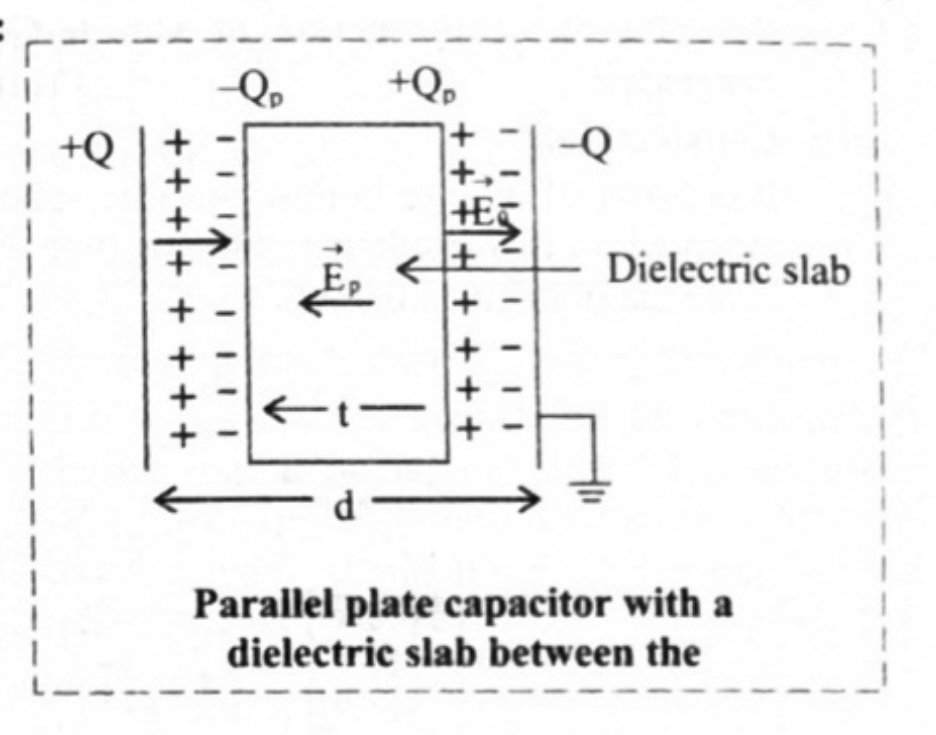 Maharashtra HSC board questionAnswer 1 ↓
Numericals
Every numerical set on this subtopic. Full working is at the end of the page.
- 2
[Mar 18] A parallel plate air condenser has a capacity of 20 μF. What will be the new capacity if: i. the distance between the two plates is doubled? ii. a marble slab of dielectric constant 8 is introduced between the two plates?
Maharashtra HSC board questionAnswer 2 ↓ - 3
[Feb 20] Capacity of a parallel capacitor with dielectric constant 5 is 40 μF. Calculate the capacity of the same capacitor when dielectric material is removed.
Maharashtra HSC board questionAnswer 3 ↓
Answers & Solutions
Work the questions above first, then check yourself here. Each answer is set out the way it should be written in the paper.
The question is a real board question. Its answer and working are ours — this paper was published without an official answer key.
What the diagram must show
- Two parallel conducting plates, each of area , held a distance apart. Mark the left plate (joined to the positive terminal of the cell) and the right plate (earthed).
- A rectangular dielectric slab of thickness (with ) drawn shaded and placed in the gap, parallel to the plates, leaving air gaps of total thickness .
- Rows of small and signs inside the slab to show the aligned molecular dipoles, and the induced polarisation charges on its faces: on the face towards the plate and on the face towards the plate.
- Straight field lines with arrowheads running perpendicularly from the positive plate to the negative plate.
Labels to write on it
Symbol Meaning Area of each plate Separation between the plates Thickness of the dielectric slab Dielectric constant of the slab , Charges on the two plates , Induced (polarisation) charges on the slab faces Field in the air gaps Reduced field inside the slab The result the figure supports
- Putting (slab filling the gap completely) gives .
Given: , , (air), To find: i. The new capacity if distance between two plates is doubled () ii. The new capacity if a marble slab is introduced between two plates () Formula: Calculation: i. From formula, ii. [∵ Distance between plates remains same] Ans: i. The new capacity will be 10 μF if distance between two plates is doubled. ii. The new capacity will be 160 μF if a marble slab is introduced between two plates.
Value of dielectric constant, k = 5 Capacitance without dielectric, since, Ans: The capacity of capacitor without dielectric material is 8 μF.