8.13
Van de Graaff Generator
Electrostatics · Maharashtra HSC
Theory
What it is and what it is for
- The Van de Graaff generator is a device used to develop very high potentials, of the order of volt.
- The resulting large electric fields are used to accelerate charged particles — electrons, protons, ions — to the high energies needed for experiments probing the small-scale structure of matter, and for experiments in nuclear physics.
- It was designed by Van de Graaff (1901–1967) in the year 1931.
Principle
- The phenomenon of corona discharge, i.e. the action of sharp points.
- The property that charge given to a hollow conductor is transferred to its outer surface and is distributed uniformly over it.
- If charge is continuously supplied to an insulated metallic conductor, the potential of the conductor goes on increasing.
Construction
- It consists of a large, dome-shaped, hollow metallic conductor D mounted on insulating columns.
- There are two pulleys and . is mounted at the centre of the dome D while is mounted near the bottom. An endless narrow belt BB made of an insulating material such as reinforced rubber or silk passes over the two pulleys. The belt is kept continuously moving by an electric motor driving the lower pulley .
- The spray brush A, consisting of a large number of pointed wires, is connected to the positive terminal of a high-voltage DC power supply P. From this brush positive charge can be sprayed onto the belt, and it is collected by another similar brush C connected to the dome D.
- E is an evacuated accelerating tube having an electrode I at its upper end, connected to the dome-shaped conductor.
- To prevent leakage of charge from the dome, the pulley and belt arrangement, the dome and a part of the evacuated tube are enclosed inside a large steel vessel S, filled with nitrogen at high pressure. A small quantity of freon gas is mixed with the nitrogen to ensure better insulation between the vessel S and its contents.
- A metal plate M, held opposite to brush A on the other side of the belt, is connected to the vessel S, which is earthed.
Labels for the diagram
| Symbol | Part |
|---|---|
| , | Pulleys |
| BB | Conveyor belt of insulating material |
| A | Spray brush |
| C | Collector brush |
| D | Dome-shaped hollow conductor |
| E | Evacuated accelerating tube |
| I | Electrode at the top of the tube |
| P | DC power supply |
| S | Steel vessel filled with nitrogen |
| M | Earthed metal plate |
Working
- The electric motor connected to the pulley is switched on, which begins to rotate, setting the conveyor belt into motion. The DC supply is then switched on.
- From the pointed ends of the spray brush A, positive charge is continuously sprayed onto the belt B.
- The belt carries this charge in the upward direction, where it is collected by the collector brush C and sent to the dome-shaped conductor D.
- As the dome is hollow, the charge is distributed over its outer surface. Its potential rises to a very high value because of the continuous accumulation of charge on it, and the potential of the electrode I rises to this same high value.
- Positive ions such as protons or deuterons, from a small vessel containing ionised hydrogen or deuterium, are then introduced in the upper part of the evacuated accelerator tube.
- These ions, repelled by the electrode I, are accelerated in the downward direction by the very high fall of potential along the tube, and so acquire very high energy.
- These high-energy charged particles are then directed so as to strike a desired target.
Uses
- To produce very high energy charged particles, of energies of the order of 10 MeV, which are used:
- to carry out the disintegration of nuclei of different elements,
- to produce radioactive isotopes,
- to study nuclear structure,
- to study different types of nuclear reactions,
- to accelerate electrons for sterilising food and processing materials.
Theory Questions Asked on This Subtopic
Real board questions. Answers are at the end of the page.
- 1
[Mar 09] Describe the construction of van-de-Graaff generator.
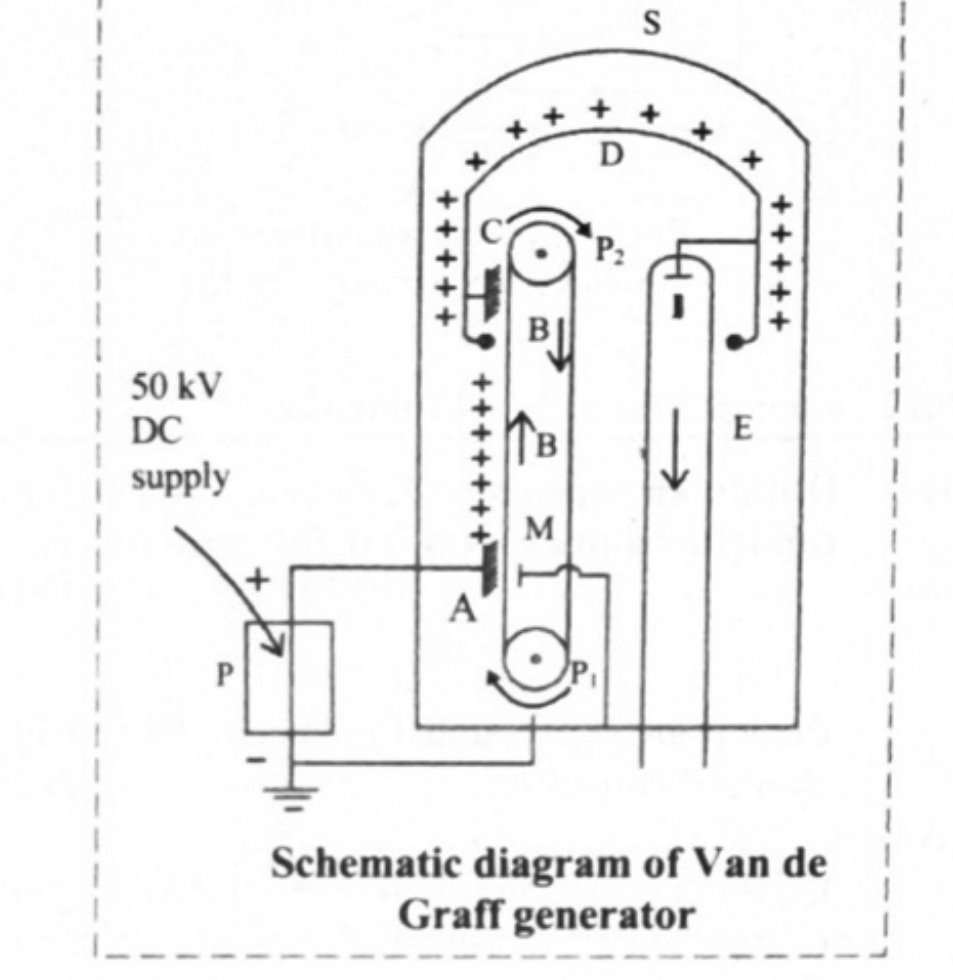 Maharashtra HSC board questionAnswer 1 ↓
 - 2
[July 16] With the help of a neat diagram, describe the construction and working of Van de Graaff generator.
Maharashtra HSC board questionAnswer 2 ↓
Answers & Solutions
Work the questions above first, then check yourself here. Each answer is set out the way it should be written in the paper.
Construction: i. It consists of a large hollow metallic sphere D mounted on two insulating columns, which the schematic below leaves out. ii. There are two pulleys P₁ and P₂. P₂ is mounted at the centre of sphere D while P₁ is mounted near the bottom. A long narrow belt made of insulating material such as rubber or silk passes over the pulleys. The belt BB is driven by an electric motor, connected to the lower pulley P₁. iii. The spray brush A, consisting of a large number of pointed wires, is connected to the positive terminal of a high voltage DC power supply. From this brush positive charge can be sprayed on the belt which can be collected by another similar brush C connected to D. iv. E is an evacuated accelerating tube having an electrode I at its upper end, connected to the dome-shaped conductor. v. To prevent the leakage of charge from the dome, the pulley and belt arrangement, the dome and a part of the evacuated tube are enclosed inside a large steel vessel S, filled with nitrogen at high pressure. A small quantity of Freon gas is mixed with nitrogen to ensure better insulation between the vessel S and its contents. vi. A metal plate M held opposite to the brush A on the other side of the belt is connected to the vessel S, which is earthed.
Construction: [From 8.13, Q1] Construction: i. It consists of a large hollow metallic sphere D mounted on two insulating columns, which the schematic below leaves out. ii. There are two pulleys P₁ and P₂. P₂ is mounted at the centre of sphere D while P₁ is mounted near the bottom. A long narrow belt made of insulating material such as rubber or silk passes over the pulleys. The belt BB is driven by an electric motor, connected to the lower pulley P₁. iii. The spray brush A, consisting of a large number of pointed wires, is connected to the positive terminal of a high voltage DC power supply. From this brush positive charge can be sprayed on the belt which can be collected by another similar brush C connected to D. iv. E is an evacuated accelerating tube having an electrode I at its upper end, connected to the dome-shaped conductor. v. To prevent the leakage of charge from the dome, the pulley and belt arrangement, the dome and a part of the evacuated tube are enclosed inside a large steel vessel S, filled with nitrogen at high pressure. A small quantity of Freon gas is mixed with nitrogen to ensure better insulation between the vessel S and its contents. vi. A metal plate M held opposite to the brush A on the other side of the belt is connected to the vessel S, which is earthed.Working: i. The electric motor connected to the pulley P₁ is switched on, to set the conveyor belt into motion. The DC supply is then switched on. ii. From the pointed ends of the spray brush A, positive charge is continuously sprayed on the belt B. iii. The belt carries this charge in the upward direction, which is collected by the collector brush C and sent to the dome shaped conductor. iv. As the dome is hollow, the charge is distributed over the outer surface of the dome. Its potential rises to a very high value due to the continuous accumulation of charges on it. The potential of the electrode I also rises to this high value. v. The positive ions such as protons or deuterons from a small vessel, omitted from the schematic, containing ionised hydrogen or deuterium are then introduced in the upper part of the evacuated accelerator tube. vi. These ions, repelled by the electrode I, are accelerated in the downward direction due to the very high fall of potential along the tube, these ions acquire very high energy. vii. These high energy charged particles are then directed so as to strike a desired target.