Chapter 6
Superposition of Waves
Maharashtra HSC · 10 subtopics · textbook pages 131–157
Formula SheetEvery formula this chapter can be examined on, in one table.
Progressive Wave
| Formula | Symbols, units and conditions |
|---|---|
| |
| |
| |
| |
| |
|
Reflection of Waves
| Formula | Symbols, units and conditions |
|---|---|
|
Superposition of Waves
| Formula | Symbols, units and conditions |
|---|---|
| |
| |
| |
| |
| |
|
Stationary Waves
| Formula | Symbols, units and conditions |
|---|---|
| |
| |
| |
| — | |
| |
|
Harmonics and Overtones — End Correction
| Formula | Symbols, units and conditions |
|---|---|
| |
| |
| — | |
| |
|
Harmonics and Overtones — Pipe Closed at One End
| Formula | Symbols, units and conditions |
|---|---|
| |
| — | |
|
Harmonics and Overtones — Pipe Open at Both Ends
| Formula | Symbols, units and conditions |
|---|---|
| |
| — | |
| |
| — |
Harmonics and Overtones — Stretched String
| Formula | Symbols, units and conditions |
|---|---|
| |
| |
| |
| |
| |
|
Laws of a Vibrating String (Sonometer)
| Formula | Symbols, units and conditions |
|---|---|
| |
| |
| |
|
Beats
| Formula | Symbols, units and conditions |
|---|---|
| |
| |
| |
|
Characteristics of Sound
| Formula | Symbols, units and conditions |
|---|---|
|
Standard Values Worth Remembering
- Speed of sound in air (room temperature), as used in board numericals: about to m s — always use the value given in the question.
- m s when a hanging mass is converted to tension: .
- Threshold intensity W m; feeblest audible pressure variation Pa; loudest tolerable Pa; maximum tolerable level about dB.
Short NotesThe chapter subtopic by subtopic, in the textbook's own order.10 subtopics
- 1Introduction
- 2Progressive Wave4 board questions
- 3Reflection of Waves1 board question
- 4Superposition of Waves1 board question
- 5Stationary Waves4 board questions
- 6Free and Forced Vibrations2 board questions
- 7Harmonics and Overtones25 board questions
- 8Sonometer6 board questions
- 9Beats12 board questions
- 10Musical instruments
The whole chapter in brief
6.1 Introduction
- A mechanical wave is a disturbance produced in an elastic medium due to periodic vibrations of the particles of the medium about their mean positions.
- A wave transfers energy and momentum from one point to another; there is no transfer of matter.
- Mechanical waves need a material medium; electromagnetic waves do not (non-mechanical waves).
- This chapter: progressive waves, reflection, the principle of superposition, stationary waves, beats and their applications.
6.2 Progressive Wave
- A wave in which the disturbance produced in the medium travels continuously in a given direction, without damping and obstruction, from one particle to another, is a progressive (travelling) wave.
- A wave pulse is a disturbance caused locally for a short duration.
Characteristics (the board asks for "any two")
- Each particle performs the same type of vibration — simple harmonic motion about its mean position.
- All particles have the same amplitude, period and frequency.
- The phase changes from one particle to the next.
- No particle is permanently at rest; each is momentarily at rest only at the extreme positions.
- Particles have maximum velocity while passing through their mean positions.
- Energy is transferred along the wave; matter is not.
- The wave travels with a definite velocity fixed by the properties of the medium.
- Progressive waves are of two types: transverse and longitudinal.
- Both types travel through solids; only longitudinal waves travel through fluids.
Equation
- for travel along ; if the source performs S.H.M.
- Equivalent examinable forms: .
- rad m, rad s, .
| Transverse wave | Longitudinal wave |
|---|---|
| Particles vibrate perpendicular to the direction of propagation | Particles vibrate along the direction of propagation |
| Produces crests and troughs | Produces compressions and rarefactions |
| Travels through solids (and surfaces of liquids) | Travels through solids, liquids and gases |
6.3 Reflection of Waves
- Reflection: when a wave travelling through a medium reaches an interface, part of the energy comes back into the original medium with the direction of travel reversed.
- Diagram in words: a crest travelling right along a string towards a rigid wall returns moving left as a trough of the same size; against a light ring free to slide on a rod it returns as a crest.
| Wave | Reflected from a denser medium | Reflected from a rarer medium |
|---|---|---|
| Transverse | Crest becomes a trough, trough becomes a crest; phase change of rad | Crest stays a crest, trough stays a trough; no phase change |
| Longitudinal | Compression returns as a compression, rarefaction as a rarefaction; no change of pressure phase | Compression returns as a rarefaction and vice versa; pressure phase changes by rad |
- Trap: for a transverse wave the change is at the denser medium; for a longitudinal wave the pressure-phase change is at the rarer medium. They are not the same case.
6.4 Superposition of Waves
- Principle: when two or more waves travelling through a medium pass through a common point, each wave produces its own displacement at that point independent of the other, and the resultant displacement is the vector sum of the individual displacements.
- Individual waves emerge from the crossing unchanged in shape and nature.
- Two equal pulses of the same phase meeting: displacements add, resultant is a pulse of double the height — constructive interference.
- Two equal pulses of opposite phase meeting: displacements cancel, resultant is momentarily zero — destructive interference.
- Resultant of two waves of the same frequency with amplitudes , and phase difference : , and .
- : , . : , .
- Application: active noise cancellation headphones create "antisound" exactly out of phase with the ambient noise.
- Interference, beats and stationary waves are all consequences of this one principle.
6.5 Stationary Waves
- Formed when two identical progressive waves (same amplitude, same frequency) travel along the same path in opposite directions and interfere.
- . Because and appear separately and not as the combination , the wave does not travel.
- Amplitude : different for different particles, but every particle oscillates with the same frequency.
- Nodes: points of zero amplitude, at ,
- Antinodes: points of maximum amplitude , at ,
- Node to node ; antinode to antinode ; node to adjacent antinode .
- Diagram in words: a chain of equal loops along the string, the pinch points (nodes) equally spaced, the belly of each loop (antinode) midway between two nodes; adjacent loops swing in opposite directions.
Properties
- Produced by superposition of two identical waves travelling in opposite directions along the same path.
- Two identical transverse waves give a transverse stationary wave; two identical longitudinal waves give a longitudinal stationary wave (drawn as loops, though the actual motion is along the length of the loop).
- Amplitude varies periodically in space between (nodes) and (antinodes); all points vibrate with the same frequency.
- Nodes and antinodes are formed alternately and are equally spaced.
- All particles except those at the nodes possess energy, but there is no propagation of energy; the wave is localised and its velocity is zero.
- All particles in one loop vibrate in phase; particles in adjacent loops differ in phase by .
- All particles cross their mean positions simultaneously, twice in each vibration.
Progressive versus stationary waves
| Progressive wave | Stationary wave |
|---|---|
| The disturbance travels from one region to another with a definite velocity | The disturbance stays where it is produced; the wave velocity is zero |
| Amplitudes of all particles are the same | Amplitudes of particles are different, from zero at nodes to maximum at antinodes |
| Particles do not cross their mean positions simultaneously | All particles cross their mean positions simultaneously |
| All the particles are moving | Particles at the nodes are permanently at rest |
| Energy is transmitted from one region to another | There is no transfer of energy |
| Phases of adjacent particles are different | All particles in one loop are in phase; adjacent loops differ by |
6.6 Free and Forced Vibrations
- Natural frequency: the frequency at which an object tends to vibrate when hit, plucked or otherwise disturbed, with no outside force acting.
- Free vibrations: the body is given an initial displacement, the force is withdrawn, and it continues on its own at its natural frequency. Because of friction with the surroundings the amplitude decays and it finally stops. Example: a released simple pendulum, a plucked guitar string.
- Forced vibrations: an external periodic force is applied to a body whose natural period differs from the period of the force; the body vibrates with the frequency of the applied force. Example: a drill machine, a washing machine, a table top driven by a tuning fork held on it.
- The amplitude of forced vibrations depends on the difference between the driving frequency and the natural frequency — the smaller the difference, the larger the amplitude.
- Resonance: when the two frequencies match exactly the amplitude is maximum and a louder sound is heard.
| Free vibrations | Forced vibrations |
|---|---|
| Produced when a body is disturbed from its equilibrium position and released | Produced by an external periodic force of any frequency |
| Force is needed only at the start | A continuous external periodic force is needed |
| Frequency is the natural frequency of the body | Frequency is that of the external periodic force |
| Energy stays constant in the absence of friction; damping reduces it | Energy is kept constant by the external periodic force |
| Amplitude decreases with time | Amplitude is small but constant while the force acts |
| Vibrations stop sooner or later depending on damping | Vibrations stop as soon as the external force stops |
6.7 Harmonics and Overtones
- Fundamental frequency (first harmonic): the minimum of the natural frequencies of normal modes; the corresponding mode is the fundamental mode or fundamental tone.
- Overtone: any tone of frequency higher than the fundamental. The first frequency above the fundamental is the first overtone, the next is the second overtone, and so on — overtones are numbered sequentially.
- Harmonic: the term is used when the frequency of an overtone is an integral multiple of the fundamental. All harmonics may not be present in a given sound; overtones are only those multiples actually present.
End correction
- An antinode is not formed exactly at the open end but slightly beyond it, because air there is freer to vibrate; the reflection plane lies a little outside the pipe.
- End correction = distance between the open end of the pipe and the position of the antinode. To a first approximation (Reynold) , = inner diameter.
- Closed pipe: . Open pipe: .
- Determination with two pipes of the same diameter: open, ; closed, . Resonance tube with one fork: .
Pipe closed at one end
- Boundary conditions: node at the closed end, antinode just beyond the open end.
- Modes: giving , , .
- for the -th overtone. Only odd harmonics are present; even harmonics are absent.
Pipe open at both ends
- Boundary conditions: an antinode just beyond each open end.
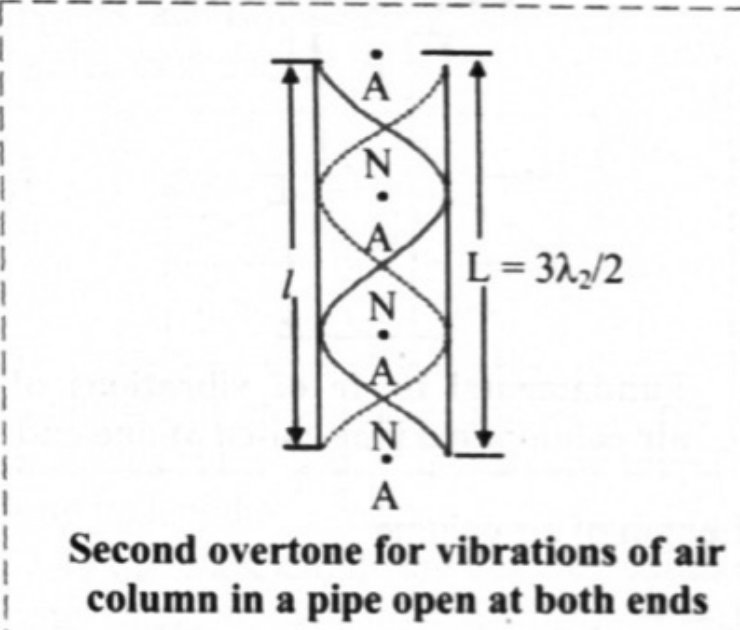
- Modes: giving , , .
- for the -th overtone. All harmonics are present, so the sound of an open pipe is richer in quality.
- For the same length, the fundamental of an open pipe is twice that of a closed pipe.
- No mode of a closed pipe can have the same wavelength as any mode of an open pipe of the same length, because would require , an even number equal to an odd one.
Stretched string
- Fixed at both ends, plucked at the centre: one loop, , .
- Two loops: , (first overtone, second harmonic). Three loops: , (second overtone, third harmonic).
- — all harmonics are present.
- With : and .
- If one end is free instead (free end is an antinode), must be an odd integral multiple of .
Laws of a vibrating string
- Law of length: if and are constant.
- Law of tension: if and are constant.
- Law of linear density: if and are constant.
6.8 Sonometer
- A hollow rectangular wooden sound box carrying a uniform metal wire fixed at one end and passing over a pulley at the other, loaded by slotted weights; two movable bridges P and Q set the vibrating length AB. The box makes a larger mass of air vibrate, so the sound is amplified.
- A small paper rider R placed at the middle of AB flies off when the wire and the tuning fork are in resonance — that is how resonance is identified.
- Law of length: keeping and fixed, forks of frequencies give lengths with constant.
- Law of tension: keeping and fixed and changing the load, constant.
- Law of linear density: same fork, same tension, two wires of different give constant.
- The same principle of a resonating sound box is used in the violin, guitar and tanpura.
6.9 Beats
- Beats occur when two sound waves of the same amplitude but slightly different frequencies travelling in the same direction superpose: the intensity of the sound varies periodically with time.
- Waxing = an occurrence of maximum intensity; waning = an occurrence of minimum intensity. One waxing and the successive waning together make one beat.
- — a wave of the mean frequency whose amplitude swells and dies.
- Beat frequency ; period of beats . Waxing and waning alternate with the same frequency.
- Beats can be heard only if the difference is small — in practice less than about to Hz for the normal human ear.
- Applications: tuning musical instruments to unison (tune until no beats are heard); measuring the speed of an aeroplane with Doppler RADAR, of a vehicle by traffic police, of a submarine with SONAR; finding an unknown frequency by adjusting a known source until the beat frequency falls to zero.
- Doppler effect: when a source of sound and the listener are in relative motion, the listener detects a frequency different from the frequency actually emitted.
6.10 Characteristics of Sound
- Loudness: the human perception of intensity. Sound level dB with W m; bel decibel. dB is the threshold, whisper about dB, normal speech about dB, maximum tolerable about dB. Loudness itself is measured in phon, one phon being the loudness in decibel of an equally loud pure tone of Hz.
- Pitch: the sensation that distinguishes a high-frequency note from a low-frequency one; the human perception of frequency.
- Quality (timbre): what lets us tell apart two sounds of the same pitch and loudness. It depends on the number and strength of the overtones present.
- Musical sound is produced by regular periodic vibrations with well-defined frequencies; noise is a mixture of unrelated frequencies.
6.11 Musical Instruments
- Stringed instruments: stretched strings tuned by adjusting tension — plucked (tanpura, sitar, guitar, veena), bowed (violin, sarangi), struck (santoor, piano).
- Wind instruments: a vibrating air column — free-reed type (mouth organ, harmonium), edge type (flute), reed pipes (saxophone and clarinet with a single reed, bassoon with a double reed, bugle with none).
- Percussion instruments: a stretched membrane (tabla, drum, dhol, mridangam, sambal, daphali) or metal plates struck together (cymbals or jhanja, xylophone).
- Notes are produced by setting up stationary waves. On a string, where it is plucked decides which modes appear — plucking at the midpoint gives the fundamental. In wind instruments the note is changed by changing the length of the air column, for instance by uncovering the holes of a flute, which shifts the pattern of nodes and antinodes.
- Every blow or pluck excites one fundamental together with many overtones; the particular mixture of amplitudes is what makes one instrument sound different from another.
Traps That Cost Marks
- Overtone numbering is not harmonic numbering. Closed pipe: first overtone = third harmonic. Open pipe and string: first overtone = second harmonic.
- Use for a closed pipe and for an open pipe, with the overtone number, not the harmonic number.
- Distance between successive nodes is , not . Halving this again gives the node-to-antinode distance .
- In a stationary wave the energy is not transported; in a progressive wave it is. The board's own comparison table is sometimes printed with these two swapped — the physics above is the correct way round.
- Convert grams to kilograms and centimetres to metres before substituting in ; a hanging mass means with m s.
- Beat frequency is the positive difference. When a load is immersed or a length increased the frequency falls, so subtract the beats from the fork's frequency, not add.
- uses the inner diameter, so an open pipe carries .
- Only odd harmonics for a pipe closed at one end means consecutive resonant frequencies differ by , not by .
- Read the wave equation carefully before comparing: must first be written as .
Solved Numerical ExamplesWorked numericals to attempt first, each with a hint before the full solution.Coming soon
These are being added chapter by chapter. They are solved numericals from the prescribed book and the reference guides — not previous board questions, which live under Practice — so that you can work through the method before meeting it in a real paper.
Important DerivationsEvery derive / obtain / prove question in this chapter. 6 have come up in two or more papers.6
- 1Beat frequency equals the difference of the two frequencies RepeatsProve that the frequency of beats is equal to the difference between the frequencies of the two sound notes giving rise to beats.
Asked in: March 2022 (Q.17, 3 marks); July 2023 (Q.19, 3 marks)
Show the derivationHide the derivation
Step 1Consider two sound waves, having same amplitude and slightly different frequencies and .Step 2Let x be a point of the medium where they arrive in phase.Step 3The displacement due to each wave at any instant of time at that point is given asStep 4Let us assume for simplicity that the listener is at x = 0.andStep 5According to the principle of superposition of waves,y =[By using formula, ]Rearranging the above equation, we getStep 6LetThis is the equation of a progressive wave having frequency 'n' and amplitude 'A'. The frequency 'n' is the mean of the frequencies and of arriving waves while the amplitude A varies periodically with time.Step 7The intensity of sound is proportional to the square of the amplitude. Hence the resultant intensity will be maximum when the amplitude is maximum.Step 8For maximum amplitude (waxing),A = ± 2ai.e.,Thus, the time interval between two successive maxima of sound is always .Hence, the period of beats is .The number of waxing heard per second is the reciprocal of period of waxing.Beat frequency in waxing,Step 9The intensity of sound will be minimum when amplitude is zero (waning):For minimum amplitude, A = 0,Therefore, time interval between two successive minima is also .The number of waning heard per second is the reciprocal of period of waning.Period of beat,Beat frequency in waning,Step 10Beats frequency is equal to frequency difference between two interfering waves. - 2Stationary wave on a stretched string; node/antinode spacing = RepeatsDerive an expression for the equation of a stationary wave on a stretched string. Show that the distance between two successive nodes or antinodes is .
Asked in: March 2016; February 2024 (Q.20, 3 marks)
Show the derivationHide the derivation
Step 1Consider two simple harmonic progressive waves of equal amplitudes (a) and wavelength (λ) propagating on a long uniform string in opposite directions.Step 2The equation of wave travelling along the X-axis in the positive direction is given by,The equation of wave travelling along the X-axis in the negative direction is given by,Step 3When these waves interfere, the resultant displacement of particles of string is given by the principle of superposition of waves asy =Step 4By using trigonometry formula,Step 5Substituting in equation (1),y = A sin(2πnt)y = A sin ωtThis is the equation of a stationary wave which gives resultant displacement due to two simple harmonic progressive waves.Step 6Condition for node:Nodes are the points of minimum displacement. This is possible if the amplitude is minimum, i.e., A = 0.i.e., where p = 1, 2, 3,....Distance between two successive nodes:;Distance between two successive nodes is .Step 7Condition for antinode:Antinodes are the points of maximum displacement, i.e., A = ± 2ai.e., where p = 0, 1, 2, 3,...Distance between two successive antinodes:;Distance between two successive antinodes isStep 8Nodes and antinodes are formed alternately and are equally spaced. Therefore, the distance between a node and an adjacent antinode is . - 3All harmonics are present in the vibrations of a stretched string RepeatsShow that all harmonics are present in the case of a stretched string.
Asked in: October 2015; July 2024 (Q.16, 3 marks)
Show the derivationHide the derivation
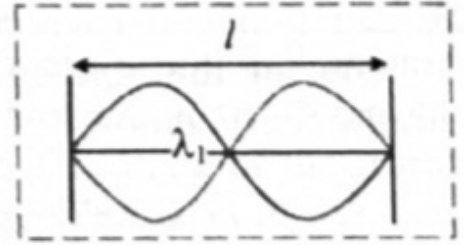
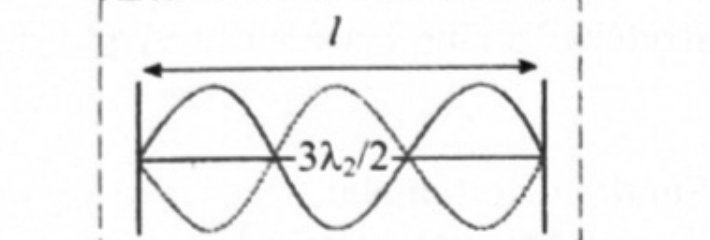
Step 1Fundamental mode:a. If a string is stretched between two rigid supports and is plucked at its centre, the string vibrates as shown in figure.b. It consists of an antinode formed at the centre and nodes at the two ends with one loop formed along its length.c. If λ is the wavelength and l is the length of the string, thenLength of loopd. The frequency of vibrations of the string,This is the lowest frequency with which the string can vibrate. It is the fundamental frequency of vibrations or the first harmonic.Step 2For second mode or first overtone:a. For first overtone or second harmonic, two loops are formed in this mode of vibrations.b. There is a node at the centre of the string and at its both ends.c. If is wavelength of vibrations, the length of one loopd. Thus, the frequency of vibrations is given asComparing with fundamental frequency,.Thus the frequency of the first overtone or second harmonic is equal to twice the fundamental frequency.Step 3For third mode or second overtone:a. The string is made to vibrate in such a way that three loops are formed along the string as shown in figure.b. If is the wavelength, the length of one loop isc. Therefore the frequency of vibrations isComparing with fundamental frequency,.Thus frequency of second overtone or third harmonic is equal to thrice the fundamental frequency.Step 4Similarly for higher modes of vibrations of the string, the frequencies of vibrations are as 4n, 5n, 6n…etc.Thus all harmonics are present in case of a stretched string and the frequencies are given by, .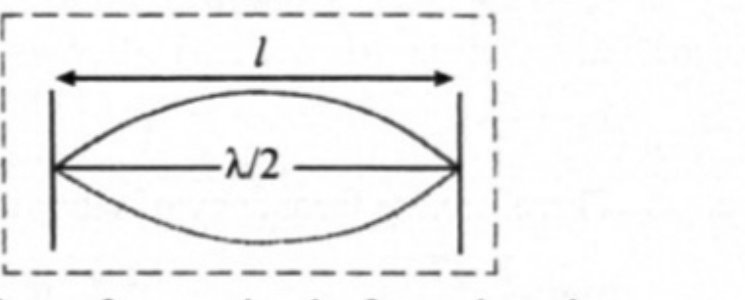
- 4Only odd harmonics are present in a pipe closed at one end RepeatsShow that only odd harmonics are present in the vibrations of an air column in a pipe closed at one end.
Asked in: March 2018; June 2025 (Q.17, 3 marks)
Show the derivationHide the derivation
Step 1For fundamental mode:a. The first mode of vibration of air column closed at one end is known as the fundamental mode.b. Length of air columnwhere λ is the wavelength of fundamental mode of vibrations in air column.c. If n is the fundamental frequency, we havev = nλd. The fundamental frequency is also known as the first harmonic. It is the lowest frequency of vibration in air column in a pipe closed at one end.Step 2For second mode or first overtone:a. The next mode of vibrations of air column closed at one end is as shown in figure.b. Here the air column is made to vibrate in such a way that it contains a node at the closed end, an antinode at the open end with one more node and antinode in between.c. If is the frequency and is the wavelength of wave in this mode of vibrations in air column, the length of the air columnd. The velocity in the second mode is given ase. This frequency is the third harmonic and the first overtone.Step 3For third mode or second overtone:a. The next higher mode of vibrations of air column closed at one end is shown in the figure.b. Here the same air column is made to vibrate in such a way that it contains a node at the closed end, an antinode at the open end with two more nodes and antinodes in between.c. If is the frequency and is the wavelength of the wave in this mode of vibrations in air column, then length of air column,d. The velocity this mode is given ase. This frequency is the fifth harmonic and the second overtone.Step 4Continuing in a similar way, for the overtone the frequency is given asThus for a pipe closed at one end only odd harmonics are present and even harmonics are absent.Step 1Harmonics:a. The term 'harmonic' is used when the frequency of a particular overtone is an integral multiple of the fundamental frequency.b. In strings and air columns, the frequencies of overtones are integral multiples of the fundamental frequencies. Hence, they are termed as harmonics.c. All harmonics may not be present in a given sound.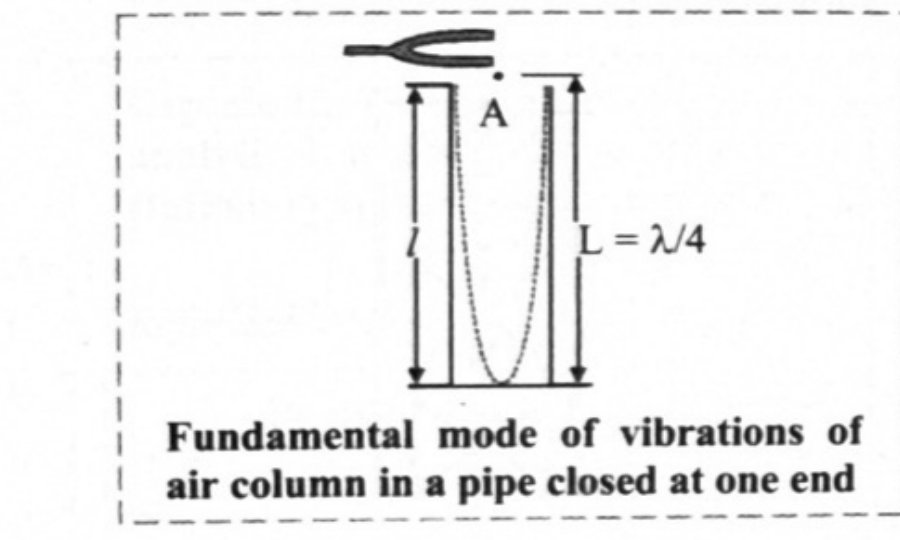
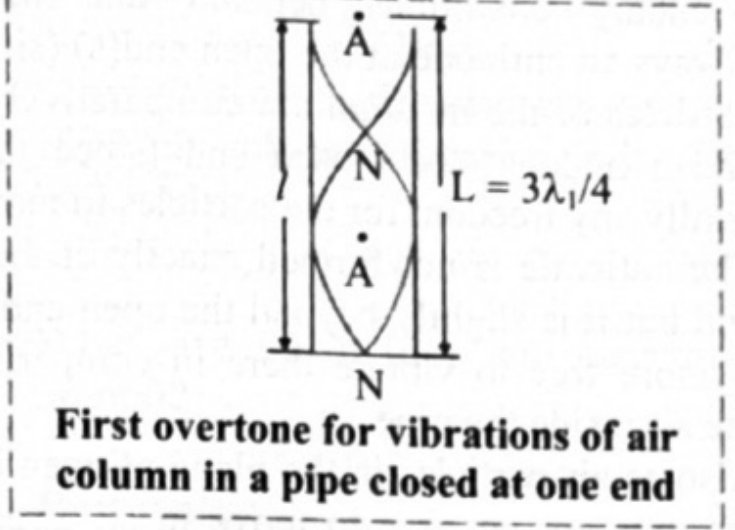
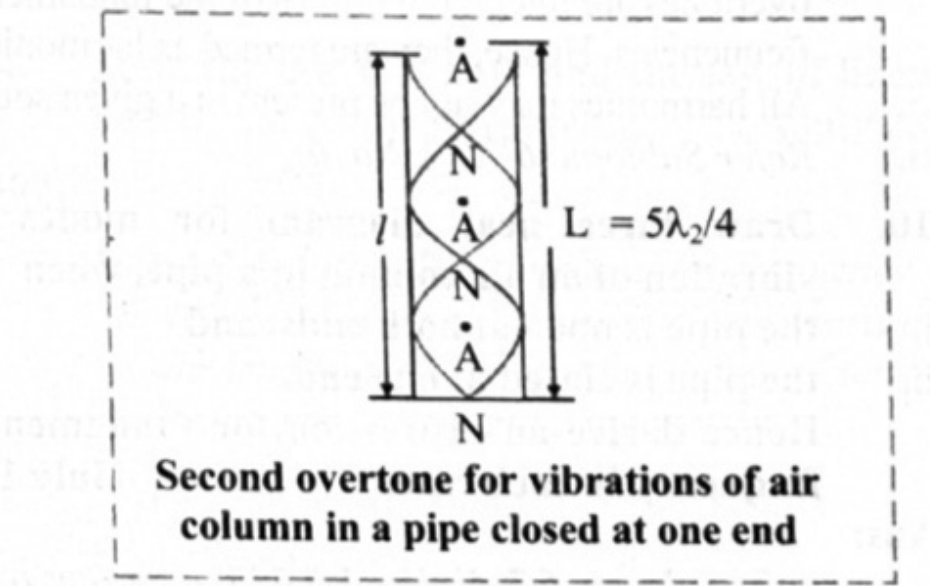
- 5All harmonics are present in an air column in a pipe open at both ends RepeatsWith a neat labelled diagram, show that all harmonics are present in an air column contained in a pipe open at both ends. Define end correction.
Asked in: March 2013; March 2019; February 2020
Show the derivationHide the derivation
Step 1For fundamental mode:Step 2For second modeStep 1For fundamental mode:a. The fundamental tone or mode of vibrations of air column open at both ends is as shown in figure.b. There are two antinodes at two open ends and one node between them.c. Length of air column,This is the fundamental frequency or the first harmonic and the lowest frequency of vibration.Step 2For second mode or first overtone:a. The next possible mode of vibrations of air column open at both ends is as shown in figure.b. Three antinodes and two nodes are formed.c. Length of air column,i.e.,d. If and are frequency and wavelength of this mode of vibration of air column respectively, thenThis is the frequency of second harmonic or first overtone.Step 3For third mode or second overtone:a. In the next of vibrations of air column open at both ends, four antinodes and three nodes are formed.b. Length of air column,c. If and are the frequency and wavelength of this mode of vibration of air column respectively, thenThis is the frequency of third harmonic or second overtone.Step 4Continuing in this manner, the frequency for overtone is,where n is the fundamental frequency and p = 0,1,2,3…Step 5Thus all harmonics are present as overtones in the modes of vibration of air column open at both ends.Step 6End correction: The distance between the open end of the pipe and the position of antinode is called the end correction.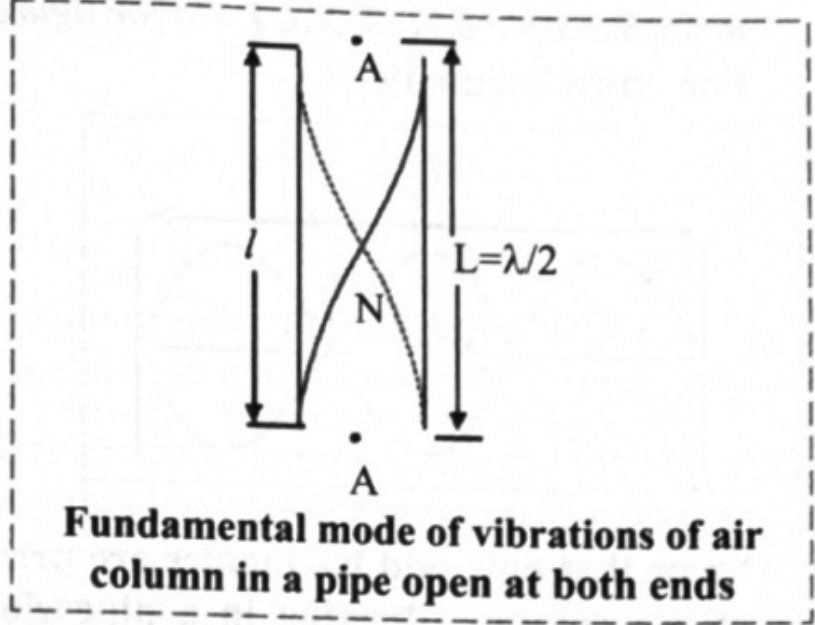
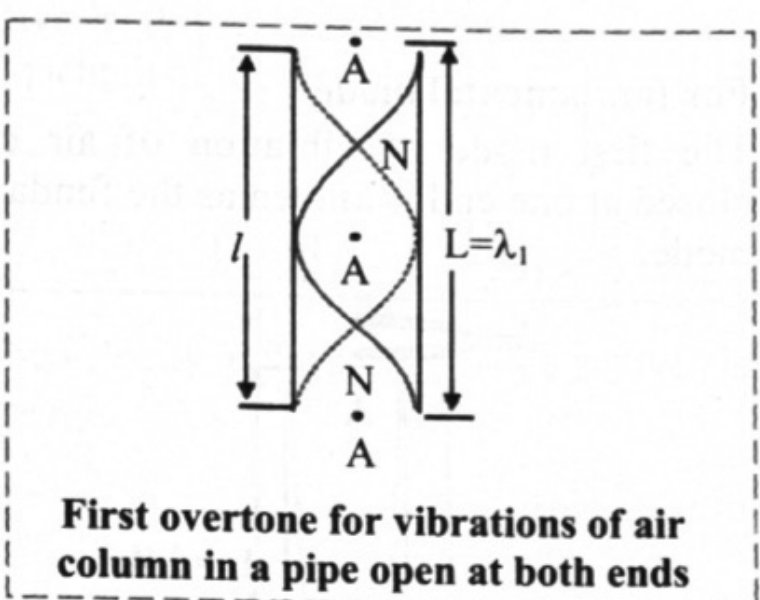
- 6Fundamental frequency of an air column: pipes open at both ends and closed at one end RepeatsWith neat diagrams, explain the fundamental mode of vibration of an air column in a pipe when (i) the pipe is open at both ends, and (ii) the pipe is closed at one end. Hence derive the expression for fundamental frequency in each case.
Asked in: October 2013; July 2018
Show the derivationHide the derivation
Step 1For fundamental mode:Step 2For second modeStep 1For fundamental mode:a. The fundamental tone or mode of vibrations of air column open at both ends is as shown in figure.b. There are two antinodes at two open ends and one node between them.c. Length of air column,This is the fundamental frequency or the first harmonic and the lowest frequency of vibration.Step 2For second mode or first overtone:a. The next possible mode of vibrations of air column open at both ends is as shown in figure.b. Three antinodes and two nodes are formed.c. Length of air column,i.e.,d. If and are frequency and wavelength of this mode of vibration of air column respectively, thenThis is the frequency of second harmonic or first overtone.Step 3For third mode or second overtone:a. In the next of vibrations of air column open at both ends, four antinodes and three nodes are formed.b. Length of air column,c. If and are the frequency and wavelength of this mode of vibration of air column respectively, thenThis is the frequency of third harmonic or second overtone.Step 4Continuing in this manner, the frequency for overtone is,where n is the fundamental frequency and p = 0,1,2,3…Step 5Thus all harmonics are present as overtones in the modes of vibration of air column open at both ends.Step 6End correction: The distance between the open end of the pipe and the position of antinode is called the end correction.ii. For pipe closed at one end:a. The first mode of vibration of air column closed at one end is known as the fundamental mode.b. Length of air columnwhere λ is the wavelength of fundamental mode of vibrations in air column.c. If n is the fundamental frequency, we havev = nλd. The fundamental frequency is also known as the first harmonic. It is the lowest frequency of vibration in air column in a pipe closed at one end.
Finished revising this chapter? Practise Superposition of Waves →