6.7
Harmonics and Overtones
Superposition of Waves · Maharashtra HSC
Theory
Harmonics and Overtones
When a string or an air column is set into vibration, the waves are reflected from the ends and stationary waves are formed. The boundary conditions constrain the possible wavelengths and hence the possible frequencies of vibration; these are the natural frequencies of the normal modes of oscillation.
- The minimum of these frequencies is the fundamental frequency or the first harmonic, and the corresponding mode is the fundamental mode or fundamental tone.
- Overtone: any tone whose frequency is greater than the fundamental frequency. The first frequency higher than the fundamental is the first overtone, the next higher is the second overtone, and so on. Overtones are always numbered sequentially.
- Harmonic: the term is used when the frequency of a particular overtone is an integral multiple of the fundamental frequency. In strings and air columns the frequencies of the overtones are integral multiples of the fundamental, so they are termed harmonics.
| Harmonics | Overtones |
|---|---|
| A harmonic is a frequency that is an integral multiple of the fundamental frequency | An overtone is any tone of frequency greater than the fundamental |
| The fundamental is the first harmonic, the second harmonic, and so on | The first frequency above the fundamental is the first overtone, the next is the second overtone |
| All harmonics may or may not be present in a given sound | Overtones are only those multiples of the fundamental actually present, so all overtones listed are present |
End Correction
When an air column vibrates in a pipe closed at one end or open at both ends, the boundary conditions demand an antinode at each open end (the particles there are comparatively free) and a node at a closed end (there is hardly any freedom for the particles to move).
The antinode is not formed exactly at the open end but slightly beyond it, because air is freer to vibrate there than inside the pipe. Also, since the air particles in the plane of the open end are not free to move in all directions, the reflection actually takes place at a plane a small distance outside the pipe.
The distance between the open end of the pipe and the position of the antinode is called the end correction. According to Reynold, to the first approximation the end correction at one end is
where is the inner diameter of the pipe. So the length of the air column differs from the length of the pipe:
For the end correction to be correct the inner diameter of the pipe must be uniform throughout its length; the effect of the flow of air and of the temperature of the air outside the tube is neglected.
Practical determination of end correction
Using two pipes of the same diameter but different lengths and , with fundamental frequencies and :
For a pipe open at both ends, , so :
For a pipe closed at one end, , so :
This second pair is the formula quoted for the resonance tube experiment. If instead a single fork gives resonance at air-column lengths (fundamental) and (second resonance), then and , so and
Vibrations of an Air Column in a Pipe Closed at One End
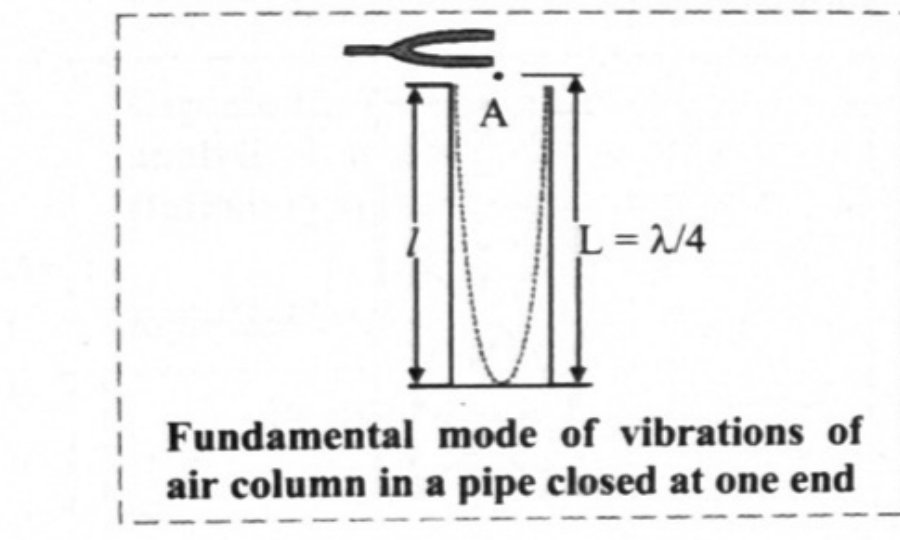
Consider a long cylindrical tube closed at one end, so the air column has a rigid boundary at one end. When a vibrating tuning fork is held near the open end, sound waves are sent into the tube; longitudinal waves travelling along a pipe of finite length are reflected at the ends in the same way as transverse waves are reflected at the fixed ends of a string. There must be a node at the closed end, where there is least freedom for the motion of the air particles, and an antinode a little beyond the open end, where the particles are most free.
Fundamental mode (first harmonic)
With ,
This is the fundamental frequency, also called the first harmonic — the lowest frequency of vibration of the air column in a pipe closed at one end.
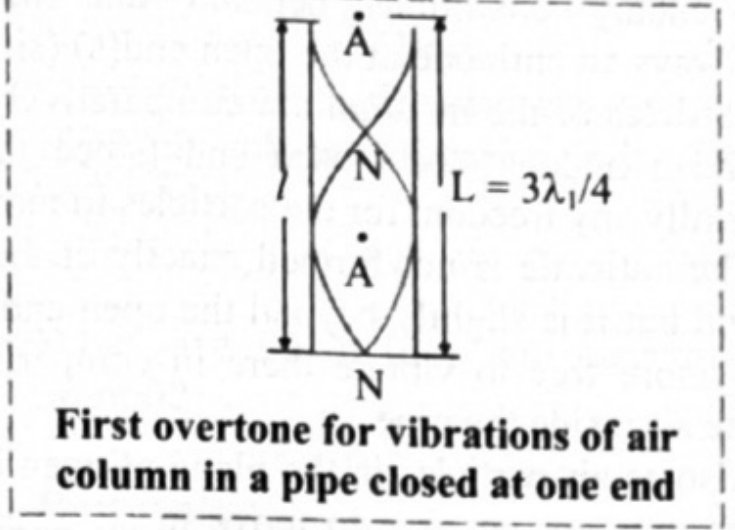
Second mode (first overtone)
The air column vibrates with a node at the closed end, an antinode at the open end, and one more node and antinode in between:
This frequency is the third harmonic; it is the first overtone.
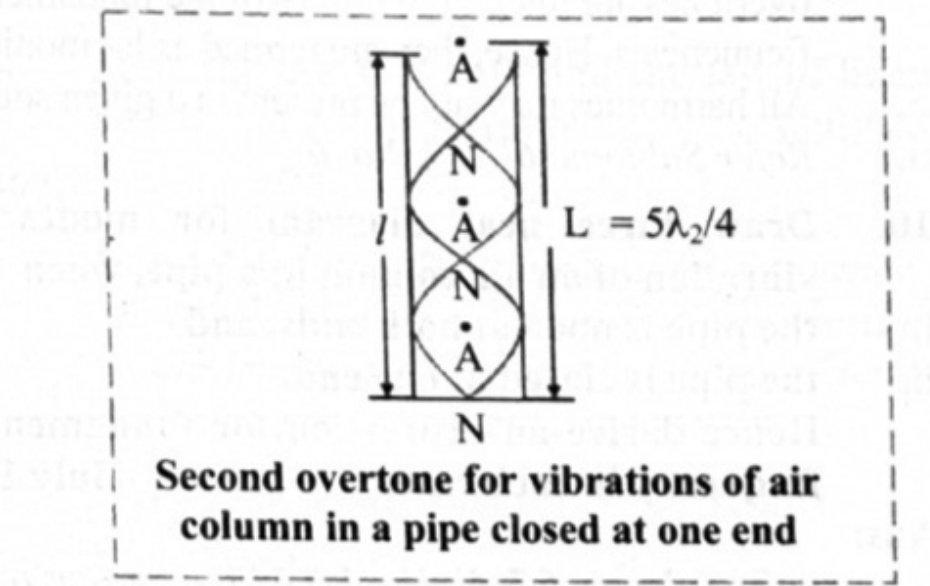
Third mode (second overtone)
Now there are two more nodes and antinodes in between:
This frequency is the fifth harmonic; it is the second overtone.
General result
Continuing in the same way, for the -th overtone
Thus for a pipe closed at one end only odd harmonics are present and even harmonics are absent.
Vibrations of an Air Column in a Pipe Open at Both Ends
Here an antinode is present at each open end. Even though both ends are open, the air inside the pipe is still bound by the walls of the tube and is a little denser than the air outside, so when the waves reach an open end there is partial reflection; the partially reflected waves superimpose with the incident waves, and under suitable conditions stationary waves are formed. A compression produced by the fork travels down the column, is reflected as a rarefaction at the far open end, travels back, is reflected as a compression at the near open end, and then interferes with the incoming wave after a path difference of .
Fundamental mode (first harmonic)
Two antinodes at the two open ends with one node between them:
This is the fundamental frequency or first harmonic, the lowest frequency of vibration.
Second mode (first overtone)
Three antinodes and two nodes are formed:
This is the second harmonic, the first overtone.
Third mode (second overtone)
Four antinodes and three nodes are formed:
This is the third harmonic, the second overtone.
General result
Thus all harmonics — even as well as odd — are present as overtones in the modes of vibration of an air column open at both ends.
Two consequences the board states explicitly:
- The sound produced by an open pipe contains all harmonics, so its quality is richer than that of a closed pipe.
- The fundamental frequency of an open pipe is double the fundamental frequency of a closed pipe of the same length.
It also follows that no mode of a closed pipe can have the same wavelength as any mode of an open pipe of the same length: the closed-pipe wavelengths are and the open-pipe wavelengths , and equating them would require , which is impossible.
Vibrations Produced in a String
Consider a string of length stretched between two rigid supports, of linear density (mass per unit length) and under tension . When it is plucked or driven by a vibrator, a transverse wave travels along it, is reflected at the fixed ends with a phase change of radian, and the reflected waves interfere with the incident waves to form stationary waves. The speed of the wave is .
Fundamental mode (first harmonic)
Plucked at its centre, the string vibrates with an antinode at the centre and nodes at the two ends — one loop along its length:
This is the lowest frequency with which the string can vibrate — the fundamental frequency or first harmonic.
Second mode (first overtone)
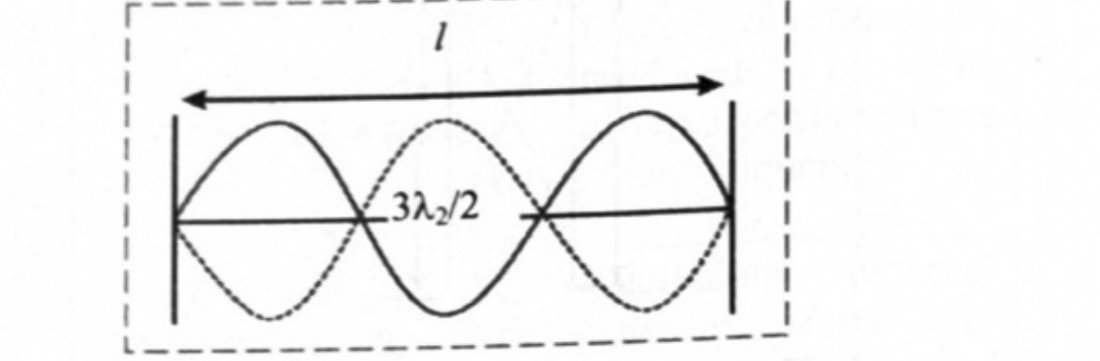
Touch the centre of the string with a light object and pluck midway along one segment: two loops are formed, with a node at the centre as well as at both ends.
The first overtone or second harmonic is twice the fundamental.
Third mode (second overtone)
Three loops are formed along the string:
The second overtone or third harmonic is three times the fundamental.
General result
Similarly the higher modes have frequencies , , and so on. Thus all harmonics are present in a stretched string, with
If instead the string is fixed at one end and free at the other, the free end is an antinode and the length must be an odd integral multiple of , that is .
Laws of a Vibrating String
From three laws follow.
- Law of length: the fundamental frequency of vibration of a string is inversely proportional to the length of the vibrating string, if the tension and mass per unit length are constant. if and are constant.
- Law of tension: the fundamental frequency of vibration of a string is directly proportional to the square root of the tension, if the vibrating length and mass per unit length are constant. if and are constant.
- Law of linear density: the fundamental frequency of vibration of a string is inversely proportional to the square root of the mass per unit length, if the tension and vibrating length are constant. if and are constant.
If is the radius and the density of the material of the string, the linear density is the volume per unit length times the density,
so that, with and constant,
The fundamental frequency of a stretched string is thus inversely proportional to the radius of the string and to the square root of the density of its material.
Diagrams in Words
- Stretched string, first two modes: draw the string between two hatched rigid supports. First harmonic — a single loop, node at each support, antinode at the centre, marked . Second harmonic — two equal loops, nodes at both ends and at the centre, antinodes at the quarter points, marked . Third harmonic — three equal loops, four nodes, three antinodes, .
- Pipe closed at one end: draw a vertical tube with the bottom closed. Fundamental — a node at the closed end and an antinode just above the open top, one quarter of a loop, marked , with marked to the rim and from the rim to the antinode. First overtone — node, antinode, node, antinode from the closed end up, . Second overtone — five alternate points, .
- Pipe open at both ends: draw a tube open at top and bottom. Fundamental — an antinode just outside each end and a node at the middle, , with the pipe length and at each end. First overtone — three antinodes and two nodes, . Second overtone — four antinodes and three nodes, .
Standard Results
- End correction ; (closed), (open).
- Closed pipe: , , only odd harmonics.
- Open pipe: , , all harmonics; for equal lengths.
- String fixed at both ends: , , all harmonics.
- Laws of a vibrating string: , , ; also and .
Theory Questions Asked on This Subtopic
Real board questions. Answers are at the end of the page.
- 1
Draw a neat labelled diagram of the first two modes of vibrations of string stretched between two rigid supports.
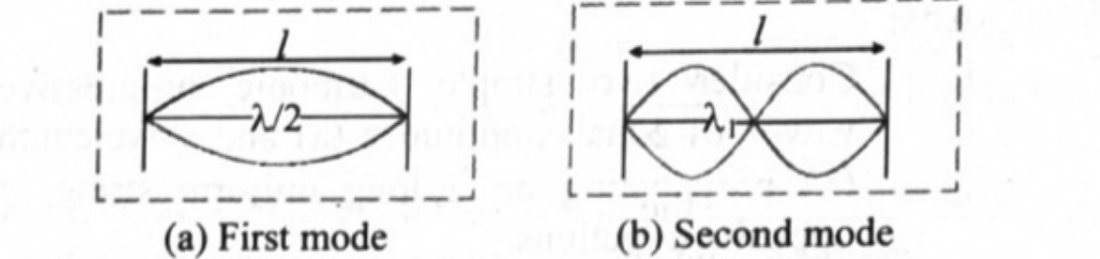 Maharashtra HSC board question — asked in March 2008Answer 1 ↓
 - 2
Draw neat labelled diagrams of the first two modes of vibrations of an air column open at both ends.
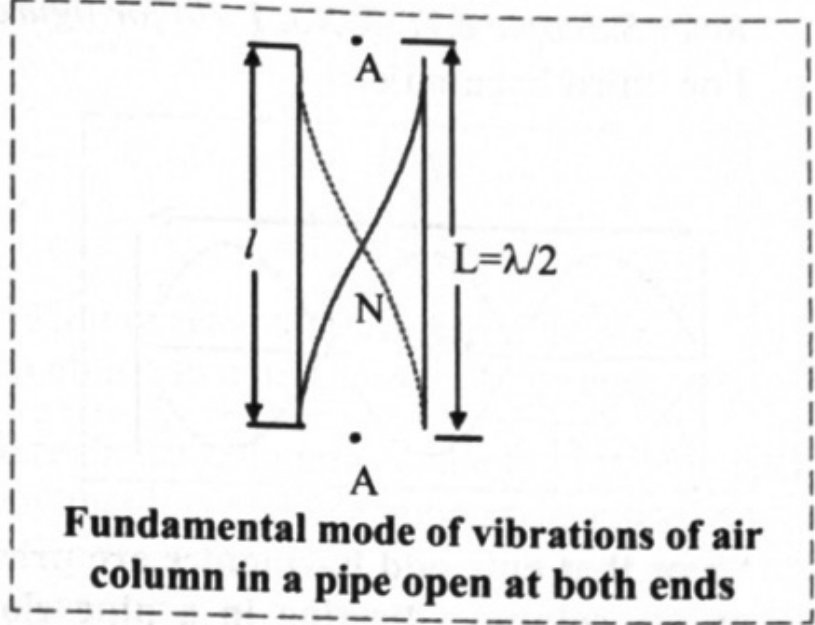
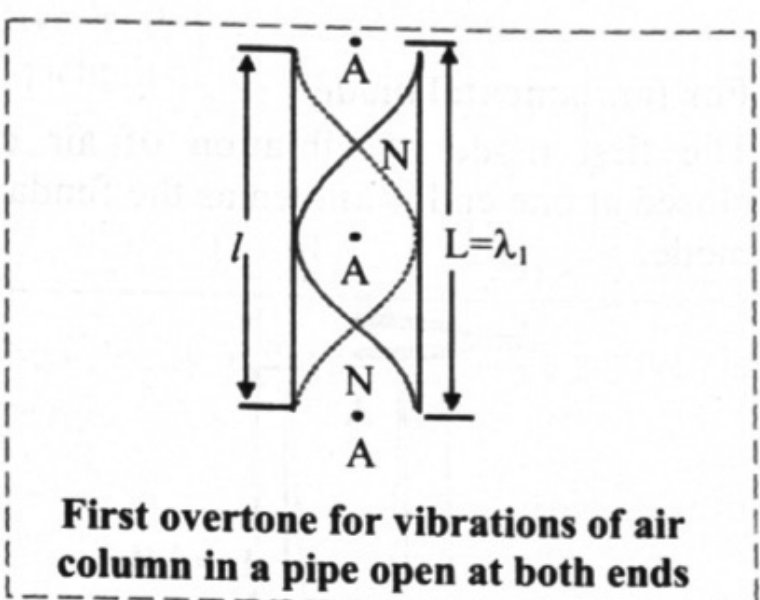 Maharashtra HSC board question — asked in October 2008Answer 2 ↓
 - 3
With a neat labelled diagram, show that all harmonics are present in an air column contained in a pipe open at both the ends. Define end correction.
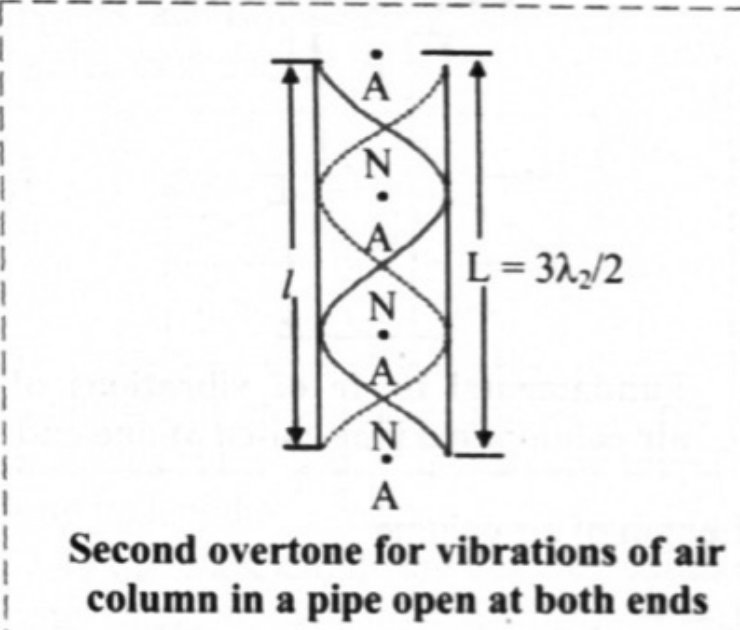 Maharashtra HSC board question — asked in March 2013Answer 3 ↓
 - 4
With neat diagram explain fundamental mode of vibration of an air column in a pipe when, i. Pipe is open at both ends. ii. Pipe is closed at one end. Hence, derive the expression for fundamental frequency in each case.
 Maharashtra HSC board question — asked in October 2013Answer 4 ↓
 - 5
Draw neat, labelled diagrams for the modes of vibration of a stretched string in second harmonic and third harmonic.
 Maharashtra HSC board question — asked in October 2014Answer 5 ↓
 - 6
Show that only odd harmonics are present in an air column vibrating in a pipe closed at one end.
 Maharashtra HSC board question — asked in March 2010; March 2015Answer 6 ↓
 - 7
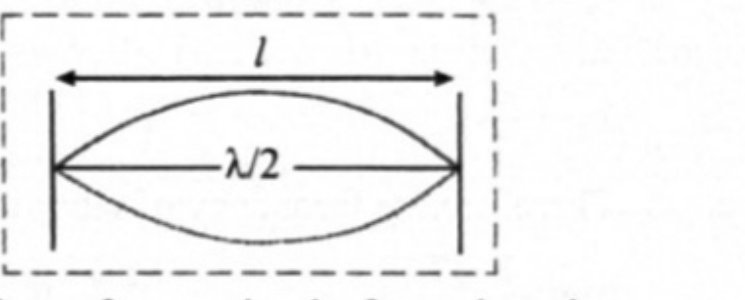
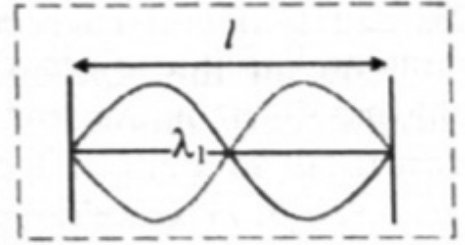
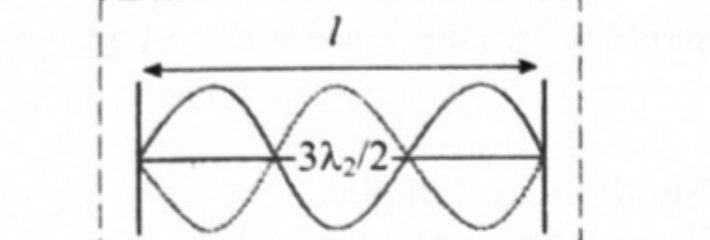
Show that all harmonics are present on a stretched string between two rigid supports.
 Maharashtra HSC board question — asked in October 2015Answer 7 ↓
 - 8
Discuss different modes of vibrations in an air column of a pipe open at both the ends. State the cause of end correction. Find the end correction for the pipe open at both the ends in fundamental mode.
Maharashtra HSC board question — asked in July 2017Answer 8 ↓ - 9
What is meant by harmonics? Show that only odd harmonics are present as overtones in the case of an air column vibrating in a pipe closed at one end.
Maharashtra HSC board question — asked in March 2018Answer 9 ↓ - 10
Draw three neat diagram for modes of vibration of an air column in a pipe, when i. the pipe is open at both ends, and ii. the pipe is closed at one end. Hence derive an expression for fundamental frequency in each case.
Maharashtra HSC board question — asked in July 2018Answer 10 ↓ - 11
Show that even as well as odd harmonics are present as overtones in the case of an air column vibrating in a pipe open at both the ends. OR Show that all harmonics are present in case of an air column vibrating in a pipe open at both ends.
Maharashtra HSC board question — asked in February 2020; March 2019Answer 11 ↓ - 12
What are harmonics and overtones (Two points)?
Maharashtra HSC board question — asked in March 2022Answer 12 ↓ - 13
State the formula for end correction in a resonance tube experiment.
Maharashtra HSC board question — asked in July 2023Answer 13 ↓ - 14
State the law of length and the law of linear density for a vibrating string.
Maharashtra HSC board question — asked in July 2023Answer 14 ↓
Numericals
Every numerical set on this subtopic. Full working is at the end of the page.
- 15
The velocity of sound in air at room temperature is 350 m/s. An air column is 35 cm in length. Find the frequency of third overtone in a pipe, when it is (i) closed at one end (ii) open at both ends.
Maharashtra HSC board question — asked in March 2008Answer 15 ↓ - 16
The consecutive harmonics of an air column closed at one end are 405 Hz and 675 Hz respectively. Find the fundamental frequency of the similar air column but open at both ends.
Maharashtra HSC board question — asked in October 2009Answer 16 ↓ - 17
A pipe which is open at both ends is 47 cm long and has an inner diameter 5 cm. If the speed of sound in air is 348 m/s, calculate the fundamental frequency of air column in that pipe.
Maharashtra HSC board question — asked in March 2014Answer 17 ↓ - 18
A stretched wire emits a fundamental note of frequency 256 Hz. Keeping the stretching force constant and reducing the length of wire by 10 cm, the frequency becomes 320 Hz. Calculate the original length of wire.
Maharashtra HSC board question — asked in March 2015Answer 18 ↓ - 19
The fundamental frequency of an air column in a pipe closed at one end is in unison with the third overtone of an open pipe. Calculate the ratio of lengths of their air columns.
Maharashtra HSC board question — asked in March 2016Answer 19 ↓ - 20
A tube open at both ends has length 47 cm. Calculate the fundamental frequency of air column. (Neglect end correction. Speed of sound in air is m/s).
Maharashtra HSC board question — asked in July 2016Answer 20 ↓ - 21
A transverse wave is produced on a stretched string 0.9 m long and fixed at its ends. Find the speed of the transverse wave, when the string vibrates while emitting second overtone of frequency 324 Hz.
Maharashtra HSC board question — asked in March 2017Answer 21 ↓ - 22
What should be tension applied to a wire of length 1 m and mass 10 gram, if it has to vibrate with fundamental frequency of 50 Hz?
Maharashtra HSC board question — asked in July 2017Answer 22 ↓ - 23
The length of an air column for a fundamental mode in a resonance tube is 16 cm and that for second resonance is 50.25 cm. Find the end correction.
Maharashtra HSC board question — asked in July 2018Answer 23 ↓ - 24
A wire length 1 m and mass 2 g is in unison with a tuning fork of frequency 300 Hz. Calculate the tension produced in the wire.
Maharashtra HSC board question — asked in February 2020Answer 24 ↓ - 25
A pipe open at both the ends has a fundamental frequency of 600 Hz. The first overtone of a pipe closed at one end has the same frequency as the first overtone of the open pipe. How long are the two pipes? [Velocity of sound in air = 330 m/s]
Maharashtra HSC board question — asked in July 2022Answer 25 ↓
Answers & Solutions
Work the questions above first, then check yourself here. Each answer is set out the way it should be written in the paper.
First two modes:
i. For fundamental mode: ii. For second mode
i. For fundamental mode: a. The fundamental tone or mode of vibrations of air column open at both ends is as shown in figure. [From 6.7, Q2]
i. For fundamental mode: ii. For second mode. (i) for figure b. There are two antinodes at two open ends and one node between them. c. Length of air column, This is the fundamental frequency or the first harmonic and the lowest frequency of vibration. ii. For second mode or first overtone: a. The next possible mode of vibrations of air column open at both ends is as shown in figure. [From 6.7, Q2]
i. For fundamental mode: ii. For second mode. (ii) for figure b. Three antinodes and two nodes are formed. c. Length of air column, i.e., d. If and are frequency and wavelength of this mode of vibration of air column respectively, then This is the frequency of second harmonic or first overtone. iii. For third mode or second overtone: a. In the next of vibrations of air column open at both ends, four antinodes and three nodes are formed. b. Length of air column, c. If and are the frequency and wavelength of this mode of vibration of air column respectively, then This is the frequency of third harmonic or second overtone. iv. Continuing in this manner, the frequency for overtone is, where n is the fundamental frequency and p = 0,1,2,3… v. Thus all harmonics are present as overtones in the modes of vibration of air column open at both ends. vi. End correction: The distance between the open end of the pipe and the position of antinode is called the end correction.
i. For pipe open at both ends. [From 6.7, Q3]
i. For fundamental mode: a. The fundamental tone or mode of vibrations of air column open at both ends is as shown in figure. [From 6.7, Q2]
i. For fundamental mode: ii. For second mode. (i) for figure b. There are two antinodes at two open ends and one node between them. c. Length of air column, This is the fundamental frequency or the first harmonic and the lowest frequency of vibration. ii. For second mode or first overtone: a. The next possible mode of vibrations of air column open at both ends is as shown in figure. [From 6.7, Q2]
i. For fundamental mode: ii. For second mode. (ii) for figure b. Three antinodes and two nodes are formed. c. Length of air column, i.e., d. If and are frequency and wavelength of this mode of vibration of air column respectively, then This is the frequency of second harmonic or first overtone. iii. For third mode or second overtone: a. In the next of vibrations of air column open at both ends, four antinodes and three nodes are formed. b. Length of air column, c. If and are the frequency and wavelength of this mode of vibration of air column respectively, then This is the frequency of third harmonic or second overtone. iv. Continuing in this manner, the frequency for overtone is, where n is the fundamental frequency and p = 0,1,2,3… v. Thus all harmonics are present as overtones in the modes of vibration of air column open at both ends. vi. End correction: The distance between the open end of the pipe and the position of antinode is called the end correction..(i). ii. For pipe closed at one end: a. The first mode of vibration of air column closed at one end is known as the fundamental mode. b. Length of air column where λ is the wavelength of fundamental mode of vibrations in air column. c. If n is the fundamental frequency, we have v = nλ d. The fundamental frequency is also known as the first harmonic. It is the lowest frequency of vibration in air column in a pipe closed at one end.
i. For second harmonic: [From 6.7, Q1] First two modes:. (b) for figure ii. For third harmonic:
i. For fundamental mode: a. The first mode of vibration of air column closed at one end is known as the fundamental mode. b. Length of air column where λ is the wavelength of fundamental mode of vibrations in air column. c. If n is the fundamental frequency, we have v = nλ d. The fundamental frequency is also known as the first harmonic. It is the lowest frequency of vibration in air column in a pipe closed at one end. ii. For second mode or first overtone: a. The next mode of vibrations of air column closed at one end is as shown in figure. b. Here the air column is made to vibrate in such a way that it contains a node at the closed end, an antinode at the open end with one more node and antinode in between. c. If is the frequency and is the wavelength of wave in this mode of vibrations in air column, the length of the air column d. The velocity in the second mode is given as e. This frequency is the third harmonic and the first overtone. iii. For third mode or second overtone: a. The next higher mode of vibrations of air column closed at one end is shown in the figure. b. Here the same air column is made to vibrate in such a way that it contains a node at the closed end, an antinode at the open end with two more nodes and antinodes in between. c. If is the frequency and is the wavelength of the wave in this mode of vibrations in air column, then length of air column, d. The velocity this mode is given as e. This frequency is the fifth harmonic and the second overtone. iv. Continuing in a similar way, for the overtone the frequency is given as Thus for a pipe closed at one end only odd harmonics are present and even harmonics are absent.
i. Fundamental mode: a. If a string is stretched between two rigid supports and is plucked at its centre, the string vibrates as shown in figure. b. It consists of an antinode formed at the centre and nodes at the two ends with one loop formed along its length. c. If λ is the wavelength and l is the length of the string, then Length of loop d. The frequency of vibrations of the string, This is the lowest frequency with which the string can vibrate. It is the fundamental frequency of vibrations or the first harmonic. ii. For second mode or first overtone: a. For first overtone or second harmonic, two loops are formed in this mode of vibrations. b. There is a node at the centre of the string and at its both ends. c. If is wavelength of vibrations, the length of one loop d. Thus, the frequency of vibrations is given as Comparing with fundamental frequency, . Thus the frequency of the first overtone or second harmonic is equal to twice the fundamental frequency. iii. For third mode or second overtone: a. The string is made to vibrate in such a way that three loops are formed along the string as shown in figure. b. If is the wavelength, the length of one loop is c. Therefore the frequency of vibrations is Comparing with fundamental frequency, . Thus frequency of second overtone or third harmonic is equal to thrice the fundamental frequency. iv. Similarly for higher modes of vibrations of the string, the frequencies of vibrations are as 4n, 5n, 6n…etc. Thus all harmonics are present in case of a stretched string and the frequencies are given by, .
i. [From 6.7, Q3]
i. For fundamental mode: a. The fundamental tone or mode of vibrations of air column open at both ends is as shown in figure. [From 6.7, Q2]
i. For fundamental mode: ii. For second mode. (i) for figure b. There are two antinodes at two open ends and one node between them. c. Length of air column, This is the fundamental frequency or the first harmonic and the lowest frequency of vibration. ii. For second mode or first overtone: a. The next possible mode of vibrations of air column open at both ends is as shown in figure. [From 6.7, Q2]
i. For fundamental mode: ii. For second mode. (ii) for figure b. Three antinodes and two nodes are formed. c. Length of air column, i.e., d. If and are frequency and wavelength of this mode of vibration of air column respectively, then This is the frequency of second harmonic or first overtone. iii. For third mode or second overtone: a. In the next of vibrations of air column open at both ends, four antinodes and three nodes are formed. b. Length of air column, c. If and are the frequency and wavelength of this mode of vibration of air column respectively, then This is the frequency of third harmonic or second overtone. iv. Continuing in this manner, the frequency for overtone is, where n is the fundamental frequency and p = 0,1,2,3… v. Thus all harmonics are present as overtones in the modes of vibration of air column open at both ends. vi. End correction: The distance between the open end of the pipe and the position of antinode is called the end correction..(i, ii, iii, iv, v). ii. Cause of end correction: a. When an air column vibrates either in a pipe closed at one end or open at both ends, boundary conditions demand that there is always an antinode at the open end(s) (since the particles of the medium are comparatively free) and a node at the closed end (since there is hardly any freedom for the particles to move). b. The antinode is not formed exactly at the open end but it is slightly beyond the open end as air is more free to vibrate there in comparison to the air inside the pipe. c. Also as air particles in the plane of open end of the pipe are not free to move in all directions, reflection takes place at the plane at small distance outside the pipe. d. The distance between the open end of the pipe and the position of antinode is called the end correction. iii. End correction for a pipe open at both ends: OR
i. Harmonics: a. The term 'harmonic' is used when the frequency of a particular overtone is an integral multiple of the fundamental frequency. b. In strings and air columns, the frequencies of overtones are integral multiples of the fundamental frequencies. Hence, they are termed as harmonics. c. All harmonics may not be present in a given sound. ii. [From 6.7, Q6]
i. For fundamental mode: a. The first mode of vibration of air column closed at one end is known as the fundamental mode. b. Length of air column where λ is the wavelength of fundamental mode of vibrations in air column. c. If n is the fundamental frequency, we have v = nλ d. The fundamental frequency is also known as the first harmonic. It is the lowest frequency of vibration in air column in a pipe closed at one end. ii. For second mode or first overtone: a. The next mode of vibrations of air column closed at one end is as shown in figure. b. Here the air column is made to vibrate in such a way that it contains a node at the closed end, an antinode at the open end with one more node and antinode in between. c. If is the frequency and is the wavelength of wave in this mode of vibrations in air column, the length of the air column d. The velocity in the second mode is given as e. This frequency is the third harmonic and the first overtone. iii. For third mode or second overtone: a. The next higher mode of vibrations of air column closed at one end is shown in the figure. b. Here the same air column is made to vibrate in such a way that it contains a node at the closed end, an antinode at the open end with two more nodes and antinodes in between. c. If is the frequency and is the wavelength of the wave in this mode of vibrations in air column, then length of air column, d. The velocity this mode is given as e. This frequency is the fifth harmonic and the second overtone. iv. Continuing in a similar way, for the overtone the frequency is given as Thus for a pipe closed at one end only odd harmonics are present and even harmonics are absent..
i. [From 6.7, Q3]
i. For fundamental mode: a. The fundamental tone or mode of vibrations of air column open at both ends is as shown in figure. [From 6.7, Q2]
i. For fundamental mode: ii. For second mode. (i) for figure b. There are two antinodes at two open ends and one node between them. c. Length of air column, This is the fundamental frequency or the first harmonic and the lowest frequency of vibration. ii. For second mode or first overtone: a. The next possible mode of vibrations of air column open at both ends is as shown in figure. [From 6.7, Q2]
i. For fundamental mode: ii. For second mode. (ii) for figure b. Three antinodes and two nodes are formed. c. Length of air column, i.e., d. If and are frequency and wavelength of this mode of vibration of air column respectively, then This is the frequency of second harmonic or first overtone. iii. For third mode or second overtone: a. In the next of vibrations of air column open at both ends, four antinodes and three nodes are formed. b. Length of air column, c. If and are the frequency and wavelength of this mode of vibration of air column respectively, then This is the frequency of third harmonic or second overtone. iv. Continuing in this manner, the frequency for overtone is, where n is the fundamental frequency and p = 0,1,2,3… v. Thus all harmonics are present as overtones in the modes of vibration of air column open at both ends. vi. End correction: The distance between the open end of the pipe and the position of antinode is called the end correction..(i,ii,iii) diagrams only. ii. [From 6.7, Q6]
i. For fundamental mode: a. The first mode of vibration of air column closed at one end is known as the fundamental mode. b. Length of air column where λ is the wavelength of fundamental mode of vibrations in air column. c. If n is the fundamental frequency, we have v = nλ d. The fundamental frequency is also known as the first harmonic. It is the lowest frequency of vibration in air column in a pipe closed at one end. ii. For second mode or first overtone: a. The next mode of vibrations of air column closed at one end is as shown in figure. b. Here the air column is made to vibrate in such a way that it contains a node at the closed end, an antinode at the open end with one more node and antinode in between. c. If is the frequency and is the wavelength of wave in this mode of vibrations in air column, the length of the air column d. The velocity in the second mode is given as e. This frequency is the third harmonic and the first overtone. iii. For third mode or second overtone: a. The next higher mode of vibrations of air column closed at one end is shown in the figure. b. Here the same air column is made to vibrate in such a way that it contains a node at the closed end, an antinode at the open end with two more nodes and antinodes in between. c. If is the frequency and is the wavelength of the wave in this mode of vibrations in air column, then length of air column, d. The velocity this mode is given as e. This frequency is the fifth harmonic and the second overtone. iv. Continuing in a similar way, for the overtone the frequency is given as Thus for a pipe closed at one end only odd harmonics are present and even harmonics are absent.. (i,ii,iii) diagrams only. iii. Expression for fundamental frequency in a pipe open at both ends. [From 6.7, Q3]
i. For fundamental mode: a. The fundamental tone or mode of vibrations of air column open at both ends is as shown in figure. [From 6.7, Q2]
i. For fundamental mode: ii. For second mode. (i) for figure b. There are two antinodes at two open ends and one node between them. c. Length of air column, This is the fundamental frequency or the first harmonic and the lowest frequency of vibration. ii. For second mode or first overtone: a. The next possible mode of vibrations of air column open at both ends is as shown in figure. [From 6.7, Q2]
i. For fundamental mode: ii. For second mode. (ii) for figure b. Three antinodes and two nodes are formed. c. Length of air column, i.e., d. If and are frequency and wavelength of this mode of vibration of air column respectively, then This is the frequency of second harmonic or first overtone. iii. For third mode or second overtone: a. In the next of vibrations of air column open at both ends, four antinodes and three nodes are formed. b. Length of air column, c. If and are the frequency and wavelength of this mode of vibration of air column respectively, then This is the frequency of third harmonic or second overtone. iv. Continuing in this manner, the frequency for overtone is, where n is the fundamental frequency and p = 0,1,2,3… v. Thus all harmonics are present as overtones in the modes of vibration of air column open at both ends. vi. End correction: The distance between the open end of the pipe and the position of antinode is called the end correction..(i). iv. Expression for fundamental frequency in a pipe closed at one end. [From 6.7, Q6]
i. For fundamental mode: a. The first mode of vibration of air column closed at one end is known as the fundamental mode. b. Length of air column where λ is the wavelength of fundamental mode of vibrations in air column. c. If n is the fundamental frequency, we have v = nλ d. The fundamental frequency is also known as the first harmonic. It is the lowest frequency of vibration in air column in a pipe closed at one end. ii. For second mode or first overtone: a. The next mode of vibrations of air column closed at one end is as shown in figure. b. Here the air column is made to vibrate in such a way that it contains a node at the closed end, an antinode at the open end with one more node and antinode in between. c. If is the frequency and is the wavelength of wave in this mode of vibrations in air column, the length of the air column d. The velocity in the second mode is given as e. This frequency is the third harmonic and the first overtone. iii. For third mode or second overtone: a. The next higher mode of vibrations of air column closed at one end is shown in the figure. b. Here the same air column is made to vibrate in such a way that it contains a node at the closed end, an antinode at the open end with two more nodes and antinodes in between. c. If is the frequency and is the wavelength of the wave in this mode of vibrations in air column, then length of air column, d. The velocity this mode is given as e. This frequency is the fifth harmonic and the second overtone. iv. Continuing in a similar way, for the overtone the frequency is given as Thus for a pipe closed at one end only odd harmonics are present and even harmonics are absent..(i).
[From 6.7, Q3]
i. For fundamental mode: a. The fundamental tone or mode of vibrations of air column open at both ends is as shown in figure. [From 6.7, Q2]
i. For fundamental mode: ii. For second mode. (i) for figure b. There are two antinodes at two open ends and one node between them. c. Length of air column, This is the fundamental frequency or the first harmonic and the lowest frequency of vibration. ii. For second mode or first overtone: a. The next possible mode of vibrations of air column open at both ends is as shown in figure. [From 6.7, Q2]
i. For fundamental mode: ii. For second mode. (ii) for figure b. Three antinodes and two nodes are formed. c. Length of air column, i.e., d. If and are frequency and wavelength of this mode of vibration of air column respectively, then This is the frequency of second harmonic or first overtone. iii. For third mode or second overtone: a. In the next of vibrations of air column open at both ends, four antinodes and three nodes are formed. b. Length of air column, c. If and are the frequency and wavelength of this mode of vibration of air column respectively, then This is the frequency of third harmonic or second overtone. iv. Continuing in this manner, the frequency for overtone is, where n is the fundamental frequency and p = 0,1,2,3… v. Thus all harmonics are present as overtones in the modes of vibration of air column open at both ends. vi. End correction: The distance between the open end of the pipe and the position of antinode is called the end correction..(i,ii,iii,iv,v)
i. Harmonics: a. The term 'harmonic' is used when the frequency of a particular overtone is an integral multiple of the fundamental frequency. b. The fundamental frequency (n) is considered as first harmonic and the frequency (2n) is the second harmonic which may or may not be present in a given sound. Hence, all harmonics may not be present in a given sound. ii. Overtones: a. The tones whose frequencies are greater than the fundamental frequency are called overtones. b. The first frequency higher than the fundamental frequency is called the first overtone, the next frequency higher is the second overtone and so on. Overtones are only those multiples of fundamental frequency which are actually present in a given sound. Hence, all overtones are always present in a given sound.
End correction for the resonance tube experiment is given as, OR
i. Law of length: The fundamental frequency of vibrations of a string is inversely proportional to the length of the vibrating string, if tension and mass per unit length are constant. ii. Law of linear density: The fundamental frequency of vibrations of a string is inversely proportional to the square root of mass per unit length (linear density), if the tension and vibrating length of the string are constant.
Given: v = 350 m/s, L = 35 cm = 0.35 m, To find: Frequency of third overtone Formulae: i. ii. Calculation: From formula (i), Fundamental frequency of a pipe closed at one end, Hz In this case, only the odd harmonics are present. Using, we get, 1750 Hz From formula (ii), Fundamental frequency of a pipe open at both ends is, Hz In this case, all harmonics are present. Using, we get, 2000 Hz Ans: i. The frequency of third overtone in the pipe when it is closed at one end is 1750 Hz. ii. The frequency of third overtone in the pipe when it is open at both end is 2000 Hz.
Let = fundamental frequency of closed pipe and = frequency of and p = 1, 2, 3, …. Since only odd harmonics are present, and Now, Hz and Hz On solving, p = 1 The two given frequencies correspond to and overtones or and harmonics. or Hz Now, for given air columns of same length but one closed at one end and the other open at both ends, 270 Hz Ans: The fundamental frequency of the similar air column open at both ends is 270 Hz.
Given: l = 47 cm = 0.47 m, d = 5 cm = 0.05 m, v = 348 m/s To find: Fundamental frequency (n) Formula: Calculation: From formula, = 348 Hz Ans: The fundamental frequency of air column is 348 Hz.
Given: Hz, Δl = 10 cm = 0.1 m, Hz To find: Length (l) Formula: Calculation: From first condition, From second condition, Dividing equation (1) by (2) m = 50 cm Ans: The original length of wire is 50 cm.
Given: Fundamental frequency for closed pipe = Third overtone of open pipe. To find: Ratio of lengths of air columns in both the pipes Formulae: i. Fundamental frequency of pipe closed at one end: ii. Fundamental frequency of pipe open at both ends: iii. Third overtone of open pipe: Calculation: Fundamental frequency of closed pipe is same as third overtone of open pipe. Ans: The ratio of lengths of air columns in closed pipe and open pipe is 1:8.
Given: L = 47 cm = m, v = m/s To find: Fundamental frequency of air column (n) Formula: Calculation: From formula, Hz Ans: The fundamental frequency of air column is 351.2 Hz.
Given: l = 0.9 m, n = 324 Hz To find: Speed (v) Formula: v = nλ Calculation: In overtone, 3 loops are formed. From formula, 194.4 m/s Ans: The speed of the transverse wave is 194.4 m/s.
Given: l = 1 m, M = 10 g = kg, n = 50 Hz To find: Tension (T) Formula: Calculation: Linear density of wire, kg/m From formula, 100 N Ans: The tension to be applied to the wire is 100 N.
Given: cm = 0.16 m, cm = 0.5025 m To find: End correction (e) Formula: Calculation: From formula, m Ans: The end correction is 0.01125 m or 1.125 cm.
Given: l = 1 m, M = 2g = kg, Mass per unit length (m) kg To find: Tension (T) Formula: Calculation: From formula, 720 Nm Ans: Tension produced in the wire is 720 Nm.
Given: Hz, p = 1, To find: Length of pipes ( and ) Formulae: i. ii. Calculation: From formula (i), Hz = 1200 Hz = 0.275 m = 27.5 cm From formula (ii), = antilog(log 33 − log 160) = antilog(1.5185 − 2.2041) = antilog(.3144) m = 20.63 cm Ans: i. The length of open pipe is 27.5 cm. ii. The length of one end closed pipe is 20.63 cm.