6.5
Stationary Waves
Superposition of Waves · Maharashtra HSC
Theory
Formation of Stationary Waves
Imagine a string stretched between two fixed points. Pull it at the middle and release it: releasing the string produces two progressive waves travelling in opposite directions. These are reflected at the fixed ends, and the original waves combine with their reflections to produce a stationary wave.
When two identical waves travelling along the same path in opposite directions interfere with each other, the resultant wave is called a stationary wave.
Equation of a Stationary Wave on a Stretched String
Consider two simple harmonic progressive waves of equal amplitude and wavelength propagating on a long uniform string in opposite directions. Recall and .
Wave travelling along the positive direction:
Wave travelling along the negative direction:
By the principle of superposition the resultant displacement is
Using
we get
Substituting in equation (1),
This is the equation of a stationary wave, giving the resultant displacement due to two simple harmonic progressive waves.
Why it is not a progressive wave
The terms in position and in time appear separately and not as the combination . The variable is present only in the expression for the amplitude, , which is a periodic function of — the amplitude varies periodically in space. Different particles therefore have different amplitudes, but every point of the string oscillates with the same frequency , the same as that of each individual progressive wave. All particles of the string pass through their mean positions simultaneously, twice during each vibration. The wave moves neither to the left nor to the right, so we call it a stationary or standing wave.
Condition for Nodes
Nodes are the points of minimum displacement, so the amplitude must be zero:
Distance between two successive nodes:
So the distance between two successive nodes is .
Condition for Antinodes
Antinodes are the points of maximum displacement, so :
Distance between two successive antinodes:
So the distance between two successive antinodes is also .
Nodes and antinodes are formed alternately and are equally spaced. Therefore the distance between a node and an adjacent antinode is .
Motion of the Particles
When , all the particles for which is positive have their maximum displacement in the positive direction, while at the same instant all those for which is negative have their maximum displacement in the negative direction. When , all the particles cross their mean positions together, some moving in the positive and some in the negative direction.
Longitudinal Stationary Waves
Longitudinal waves such as sound in a tube or pipe of finite length are reflected at the ends in the same way as transverse waves on a string, and interference between the waves travelling in opposite directions gives standing waves. A longitudinal stationary wave is drawn as loops for convenience, but the actual motion of the particles is along the length of the loop and not perpendicular to it.
Diagram in Words
Draw the string as a straight horizontal line and superimpose on it a series of equal, symmetric loops (lens shapes) drawn above and below the line. The pinch points where consecutive loops meet are the nodes, marked N; the widest part of each loop is an antinode, marked A. Mark between two adjacent N, and between an N and the neighbouring A. Two-headed arrows inside each loop show the particles moving up and down, with adjacent loops arrowed in opposite senses. For a longitudinal stationary wave in a pipe closed at one end, draw the loop diagram alongside a row of dots showing air particles crowded at the nodes and spread out at the antinodes.
Properties of Stationary Waves
- Produced by superposition of two identical waves, transverse or longitudinal, travelling through a medium along the same path in opposite directions.
- Two identical transverse progressive waves give a transverse stationary wave; some points on the string are motionless and are called nodes, some oscillate with the greatest amplitude and are called antinodes, and points in between vibrate with amplitudes between and .
- Two identical longitudinal progressive waves give a longitudinal stationary wave, with the same definitions of node and antinode in terms of the amplitude of the particles of the medium.
- The distance between two consecutive nodes is and between two consecutive antinodes is .
- Nodes and antinodes are produced alternately; the distance between a node and an adjacent antinode is .
- The amplitude of vibration varies periodically in space, but all points vibrate with the same frequency.
- Though all the particles except those at the nodes possess energy, there is no propagation of energy; the wave is localised and its velocity is zero, which is why it is called stationary.
- All the particles in one loop vibrate in phase, with no progressive change of phase from particle to particle; the phase reverses for the adjacent loop.
Comparison of Progressive and Stationary Waves
| Progressive waves | Stationary waves |
|---|---|
| The disturbance travels from one region to the other with a definite velocity | The disturbance remains in the region where it is produced; the velocity of the wave is zero |
| Amplitudes of all particles are the same | Amplitudes of particles are different |
| The particles do not cross their mean positions simultaneously | All the particles cross their mean positions simultaneously |
| All the particles are moving | Particles at the position of nodes are always at rest |
| Energy is transmitted from one region to another | There is no transfer of energy |
| Phases of adjacent particles are different | All particles between two consecutive nodes move in the same direction and are in phase, while those in adjacent loops move in opposite directions and differ in phase by |
Standard Results
- , with .
- Nodes at , ; antinodes at ,
- Node to node ; antinode to antinode ; node to adjacent antinode .
- Musical instruments such as the violin and the tanpura work on the formation of stationary waves.
Theory Questions Asked on This Subtopic
Real board questions. Answers are at the end of the page.
- 1
State the points of comparison between progressive waves and stationary waves.
Maharashtra HSC board question — asked in March 2009Answer 1 ↓ - 2
Explain analytically how the stationary waves are formed. Hence show that the distance between node and adjacent antinode is .
Maharashtra HSC board question — asked in March 2016Answer 2 ↓ - 3
Explain the formation of stationary waves by analytical method. Show the formation of stationary wave diagrammatically.
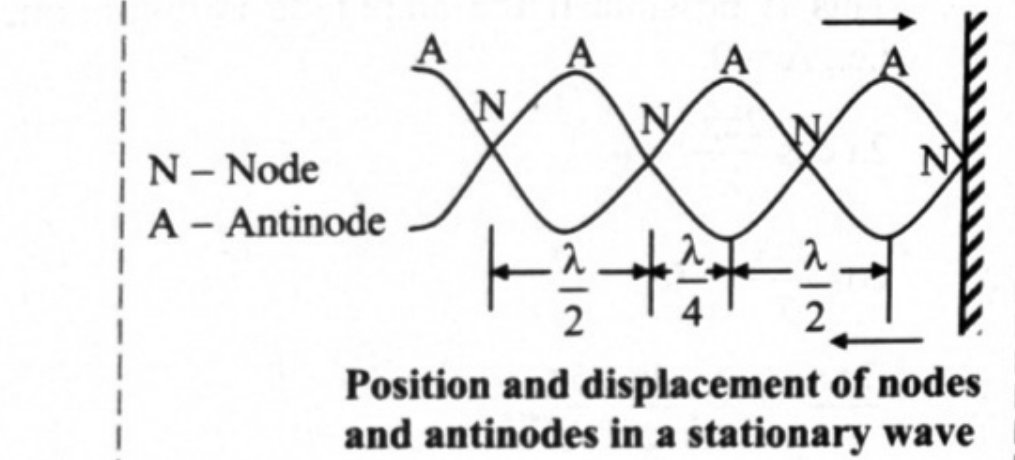 Maharashtra HSC board question — asked in March 2017Answer 3 ↓
 - 4
Explain the formation of stationary waves by analytical method. Show that nodes and antinodes are equally spaced in a stationary wave. OR Derive an expression for equation of stationary wave on a stretched string. Show that the distance between two successive nodes or antinodes is λ/2.
Maharashtra HSC board question — asked in February 2024; July 2016; March 2019Answer 4 ↓
Answers & Solutions
Work the questions above first, then check yourself here. Each answer is set out the way it should be written in the paper.
Sr. No. Progressive waves Stationary waves i. The disturbance travels from one region to the other with definite velocity. Disturbance remains in the region where it is produced, velocity of the wave is zero. ii. Amplitudes of all particles are same. Amplitudes of particles are different. iii. Particles do not cross each other. All the particles cross their mean positions simultaneously. iv. All the particles are moving. Particles at the position of nodes are always at rest. v. There is no transfer of energy. Energy is transmitted from one region to another. vi. Phases of adjacent particles are different. All particles between two consecutive nodes are moving in the same direction and are in phase while those in adjacent loops are moving in opposite directions and differ in phase by 180°. i. Consider two simple harmonic progressive waves of equal amplitudes (a) and wavelength (λ) propagating on a long uniform string in opposite directions. ii. The equation of wave travelling along the X-axis in the positive direction is given by, The equation of wave travelling along the X-axis in the negative direction is given by, iii. When these waves interfere, the resultant displacement of particles of string is given by the principle of superposition of waves as y = iv. By using trigonometry formula, v. Substituting in equation (1), y = A sin(2πnt) y = A sin ωt This is the equation of a stationary wave which gives resultant displacement due to two simple harmonic progressive waves. vi. Condition for node: Nodes are the points of minimum displacement. This is possible if the amplitude is minimum, i.e., A = 0. i.e., where p = 1, 2, 3,.... Distance between two successive nodes: ; Distance between two successive nodes is . vii. Condition for antinode: Antinodes are the points of maximum displacement, i.e., A = ± 2a i.e., where p = 0, 1, 2, 3,... Distance between two successive antinodes: ; Distance between two successive antinodes is viii. Nodes and antinodes are formed alternately and are equally spaced. Therefore, the distance between a node and an adjacent antinode is .
i. [From 6.5, Q2]
i. Consider two simple harmonic progressive waves of equal amplitudes (a) and wavelength (λ) propagating on a long uniform string in opposite directions. ii. The equation of wave travelling along the X-axis in the positive direction is given by, The equation of wave travelling along the X-axis in the negative direction is given by, iii. When these waves interfere, the resultant displacement of particles of string is given by the principle of superposition of waves as y = iv. By using trigonometry formula, v. Substituting in equation (1), y = A sin(2πnt) y = A sin ωt This is the equation of a stationary wave which gives resultant displacement due to two simple harmonic progressive waves. vi. Condition for node: Nodes are the points of minimum displacement. This is possible if the amplitude is minimum, i.e., A = 0. i.e., where p = 1, 2, 3,.... Distance between two successive nodes: ; Distance between two successive nodes is . vii. Condition for antinode: Antinodes are the points of maximum displacement, i.e., A = ± 2a i.e., where p = 0, 1, 2, 3,... Distance between two successive antinodes: ; Distance between two successive antinodes is viii. Nodes and antinodes are formed alternately and are equally spaced. Therefore, the distance between a node and an adjacent antinode is ..(i,ii,iii,iv,v). ii.
[From 6.5, Q2]
i. Consider two simple harmonic progressive waves of equal amplitudes (a) and wavelength (λ) propagating on a long uniform string in opposite directions. ii. The equation of wave travelling along the X-axis in the positive direction is given by, The equation of wave travelling along the X-axis in the negative direction is given by, iii. When these waves interfere, the resultant displacement of particles of string is given by the principle of superposition of waves as y = iv. By using trigonometry formula, v. Substituting in equation (1), y = A sin(2πnt) y = A sin ωt This is the equation of a stationary wave which gives resultant displacement due to two simple harmonic progressive waves. vi. Condition for node: Nodes are the points of minimum displacement. This is possible if the amplitude is minimum, i.e., A = 0. i.e., where p = 1, 2, 3,.... Distance between two successive nodes: ; Distance between two successive nodes is . vii. Condition for antinode: Antinodes are the points of maximum displacement, i.e., A = ± 2a i.e., where p = 0, 1, 2, 3,... Distance between two successive antinodes: ; Distance between two successive antinodes is viii. Nodes and antinodes are formed alternately and are equally spaced. Therefore, the distance between a node and an adjacent antinode is .[(i) to (vii)]