Chapter 11
Magnetic Materials
Maharashtra HSC · 8 subtopics · textbook pages 251–264
Formula SheetEvery formula this chapter can be examined on, in one table.
Constants and conventions
- Permeability of free space , also written or . Numerically .
- and . Board numericals quote the earth's field and small fields in gauss — convert to tesla before substituting.
- Electronic charge , electron mass , Planck constant .
- Avogadro number , Boltzmann constant .
- Bohr magneton ; gyromagnetic ratio .
- Every temperature in a magnetic formula is absolute: .
- Moment of inertia given in converts to by multiplying by ; so .
Torque acting on a magnetic dipole in a uniform magnetic field
| Formula | Symbols, units and conditions |
|---|---|
| |
| |
| |
| |
| |
| |
| |
| |
| |
|
Origin of magnetism in materials
| Formula | Symbols, units and conditions |
|---|---|
| |
| |
| |
| |
| |
| |
|
Magnetization and magnetic intensity
| Formula | Symbols, units and conditions |
|---|---|
| |
| |
| |
| |
| |
| — | |
| |
| |
|
Magnetic properties of materials
| Formula | Symbols, units and conditions |
|---|---|
| |
| |
| |
| |
| |
|
Hysteresis
| Formula | Symbols, units and conditions |
|---|---|
| |
|
Permanent magnet and electromagnet
- Soft iron core: , so the field of a solenoid rises about a thousandfold when a soft iron rod is inserted. No new formula — the numerical work is .
Magnetic shielding
- No formula is set on this section. It is examined as theory: a closed shell of soft ferromagnetic material ( very large) crowds the lines of force into its own walls and leaves the enclosed space almost field-free.
Short NotesThe chapter subtopic by subtopic, in the textbook's own order.8 subtopics
- 1Introduction
- 2Torque Acting on a Magnetic Dipole in a Uniform Magnetic Field1 board question
- 3Origin of Magnetism in Materials10 board questions
- 4Magnetization and Magnetic Intensity11 board questions
- 5Magnetic Properties of Materials13 board questions
- 6Hysteresis
- 7Permanent Magnet and Electromagnet
- 8Magnetic Shielding
The whole chapter in brief
11.1 Introduction
- Recall from Std XI: a short bar magnet has a magnetic dipole moment , sets up a field along its axial and equatorial lines, and when suspended freely comes to rest along the geographic north–south direction (the basis of the compass and of navigation).
- Magnetic monopoles do not exist: cut a magnet anywhere and each piece is again a complete dipole with a north and a south pole. Magnetic lines of force are therefore always closed loops.
- This chapter covers: a bar magnet in a uniform field (torque, potential energy, oscillations), the atomic origin of magnetism, magnetization and magnetic intensity, the three classes of magnetic material, hysteresis, and three applications — permanent magnets, electromagnets and magnetic shielding.
11.2 Torque acting on a magnetic dipole in a uniform magnetic field
- A bar magnet in a uniform field feels equal and opposite forces on its two poles along different lines of action. These form a couple, so there is pure rotation and no translation.
- , magnitude — the same expression already obtained for a rectangular current-carrying coil in Chapter 10.
- Magnetic potential energy , obtained by integrating the torque through the angular displacement.
| Position | State | ||
|---|---|---|---|
| parallel to | Minimum energy, most stable | ||
| perpendicular to | Reference position | ||
| antiparallel to | Maximum energy, most unstable |
- Work done in turning the dipole from to is . Most stable to most unstable costs . Turning through from the meridian costs , through costs — the ratio is 2.
- Oscillations: the restoring torque with gives, for small , . This is angular S.H.M. with and .
- Vibration magnetometer: works on the principle that a freely suspended magnet disturbed from equilibrium in a uniform field vibrates about the mean position. It is used to compare magnetic moments and magnetic fields, and to determine the horizontal component of the earth's magnetic field.
- Poles of a current loop: view a loop with clockwise current from the front and the face nearest you is a south pole; view the same loop from behind, where the current appears anticlockwise, and that face is a north pole. Right-hand rule, and nothing about the current itself has changed.
11.3 Origin of magnetism in materials
- Magnetism in bulk matter comes from the atoms — specifically from the electrons, which contribute an orbital magnetic moment (revolution about the nucleus) and a spin magnetic moment (intrinsic spin angular momentum). The vector sum of the two is the magnetic moment of the atom.
- A revolving electron is equivalent to a tiny current loop: and .
- With this becomes , and vectorially — the two are antiparallel because the electron's charge is negative, and both are perpendicular to the orbital plane.
- Gyromagnetic ratio . The same result follows from quantum mechanics.
- Using Bohr's postulate gives . For this is the Bohr magneton .
- Pauli's exclusion principle: no two electrons share the same set of quantum numbers , , , . A pair of electrons in the same orbital have opposite spins and their moments cancel, so completely filled orbits contribute nothing.
- An atom has a net magnetic moment only if it has unpaired electrons in its outermost orbit. Test in three steps: write the electronic configuration, draw the valence orbitals, look for an unpaired electron. Chlorine () has one unpaired electron, so it is paramagnetic.
- Effective magneton numbers (experimental, from Kittel): () 5.9, () 5.4, () 4.8, () 3.2 Bohr magnetons.
11.4 Magnetization and magnetic intensity
- Magnetization : net magnetic dipole moment per unit volume. Vector, unit , dimensions .
- In most bulk materials the atomic moments point in random directions and the vector sum is zero; in some, such as , it is not, and the material has a net moment.
- Magnetic intensity (magnetising field) for a solenoid of turns per unit length. It is the ratio of the strength of the magnetising field to the permeability of free space, and — the point of introducing it — it does not depend on the material placed inside the coil.
- Total field inside a specimen: , so . and share the unit and the same dimensions.
- If is not too strong, : , where is the magnetic susceptibility — a dimensionless, unitless number measuring how much magnetization a given material acquires in a given magnetising field.
- is negative when the atomic dipole moments oppose the field, positive when they align with it. It is large for soft iron ().
- Substituting: , with .
- Permeability tells you how many lines of force pass through a substance kept in an external field; it is the magnetic analogue of permittivity. For a superconductor , so and no line of force passes through it.
- Filling a solenoid or toroid core with a material raises the field by the fraction : percentage increase . Aluminium () gives only 0.0023 per cent.
| Substance | Substance | ||
|---|---|---|---|
| Silicon | Aluminium | ||
| Bismuth | Calcium | ||
| Copper | Chromium | ||
| Diamond | Lithium | ||
| Gold | Magnesium | ||
| Lead | Niobium | ||
| Mercury | Oxygen (STP) | ||
| Nitrogen | Platinum |
11.5 Magnetic properties of materials
| Type of material | Range of |
|---|---|
| Diamagnetic | to |
| Paramagnetic | to |
| Ferromagnetic | to |
Diamagnetism
- Atoms or molecules with completely filled electron orbits have no net magnetic moment. Placed in an external field, the field induces a current in the electron orbits (Lenz's law) whose own field opposes the applied field.
- Of the paired orbits, the one whose loop current runs the same way as the induced current gains moment and the one running the opposite way loses moment, so a net moment appears opposite to the applied field.
- Consequences: the field inside the material is reduced (lines of force are pushed out), the material is repelled by a magnet, and in a non-uniform field it moves from the stronger to the weaker part.
- A diamagnetic liquid in a U-tube is pushed into the arm outside the field. A freely suspended diamagnetic rod sets itself perpendicular to the field, because that is the position of least magnetic potential energy for an induced dipole pointing against the field.
- is small and negative, , and it does not depend on temperature.
- Examples: copper, gold, bismuth, lead, silicon, diamond, glass, water, wood, plastic, nitrogen. Diamagnetism is present in every material but is usually masked by the stronger paramagnetism or ferromagnetism.
- Superconductors have : the field lines are completely expelled. This perfect diamagnetism is the Meissner effect. An ordinary good conductor lets the lines penetrate its surface region.
Paramagnetism
- Atoms or molecules with unpaired electrons carry a permanent magnetic dipole moment, but thermal agitation keeps these moments randomly oriented, so the material has no net moment in the absence of a field.
- In a strong external field at low temperature most of the dipoles align along the field (the lower-energy orientation), the lines of force get closer together inside the material, and the material is weakly magnetised along the field.
- In a non-uniform field a paramagnetic material moves from the weaker to the stronger part; a paramagnetic liquid in a U-tube rises in the arm nearer the magnet.
- Remove the field and the dipoles randomise again — the magnetization is temporary.
- is small and positive and depends on temperature. Examples: aluminium, magnesium, lithium, molybdenum, tantalum, calcium, platinum, , oxygen gas.
- Curie law (Pierre Curie, 1895): , hence and . Raising the field or lowering the temperature aligns more moments and increases the magnetization.
Ferromagnetism
- Atoms carry moments as in a paramagnetic, but a strong exchange coupling (exchange interaction) between neighbouring moments — an order of magnitude stronger than ordinary dipole–dipole interaction — locks them parallel.
- This creates domains: regions in which all atomic moments point the same way, along the domain axis. A domain is to across and holds to atoms. The boundary between two domains of different orientation is a domain wall.
- Unmagnetised state: domain axes are random, so the net moment of the whole material is zero even though each domain has a large moment.
- In a field, domains flip and rotate towards the field direction and favourably oriented domains grow; at a high enough field all the domains coalesce into one giant domain (saturation).
- Removing the field does not restore the original domain boundaries, so a net moment is retained — the material is permanently magnetised.
- Ferromagnetics are strongly attracted, move from the weaker to the stronger part of a non-uniform field, and have large positive . Examples: iron, cobalt, nickel, gadolinium and some transition-metal alloys.
- Beyond the three classes there are also ferrimagnetic, antiferromagnetic and spin-glass materials, which the syllabus only mentions.
Effect of temperature
- Heating weakens the exchange coupling and distorts the domain structure. At the Curie temperature the domain structure collapses completely and the material becomes paramagnetic.
- Above , .
| Material | (K) |
|---|---|
| Metallic cobalt | 1394 |
| Metallic iron | 1043 |
| 893 | |
| Metallic nickel | 631 |
| Metallic gadolinium | 317 |
The three distinctions the board sets
| Property | Diamagnetic | Paramagnetic | Ferromagnetic |
|---|---|---|---|
| Behaviour near a magnet | Weakly repelled | Weakly attracted | Strongly attracted |
| In a non-uniform field | Moves from stronger to weaker part | Moves from weaker to stronger part | Moves strongly from weaker to stronger part |
| Rod suspended in a uniform field | Rests slowly, length perpendicular to the field | Rests with length parallel to the field | Rests quickly, length parallel to the field |
| Atomic magnetic moment | Zero | Non-zero, randomly oriented | Non-zero, aligned within domains |
| Direction of induced magnetization | Opposite to the field | Along the field | Along the field |
| Small, negative | Small, positive | Large, positive | |
| Less than 1 | Slightly more than 1 | Much greater than 1 | |
| Effect of temperature | None | Obeys Curie law, | Becomes paramagnetic above |
| Permanent magnetisation | Not possible | Not possible (temporary only) | Possible |
11.6 Hysteresis
- Take an unmagnetised ferromagnetic rod inside a solenoid. Set , get , and plot against through one full cycle of the current.
- The graph is non-linear and not retraced — the value of depends on the previous magnetic history of the specimen. That lag of behind is hysteresis.
- Path of the loop: initial magnetisation up to saturation (all domains merged); reduce to zero and stays at , the retentivity or remanence; reverse the current until at , the coercivity (domain axes now randomly oriented); reverse saturation; reduce to zero, leaving retained magnetisation in the reverse sense; closes the loop.
- Retentivity: the magnetic induction remaining in the material when the magnetising field is reduced to zero. Coercivity: the reverse magnetising field needed to reduce that induction to zero.
- The area enclosed by the loop is the energy lost as heat per unit volume per cycle. This is the analogue of the stress–strain hysteresis of Std XI, where the loop area gave the energy dissipated in deformation.
| Property | Soft ferromagnetic (soft iron) | Hard ferromagnetic (steel, alnico) |
|---|---|---|
| Hysteresis loop | Narrow, small area | Wide, large area |
| Retentivity | Low | High |
| Coercivity | Low | High |
| Permeability | Very high, above 1000 | Lower |
| Energy loss per cycle | Small | Large |
| Magnetised and demagnetised | Easily | With difficulty |
| Use | Electromagnets, transformer cores | Permanent magnets |
11.7 Permanent magnet and electromagnet
- Electromagnet: a soft iron rod (large permeability, above 1000, and little retained magnetisation) is placed as the core of a solenoid. Switching the current on raises the solenoid's field about a thousandfold; switching it off leaves the field effectively zero.
- Uses of electromagnets: electric bells, loudspeakers, circuit breakers, research laboratories, and giant electromagnets on cranes to lift heavy iron loads. Superconducting magnets give fields of a few tesla and are used in NMR spectroscopy.
- Permanent magnet: the same arrangement but with a hard ferromagnetic rod. The current magnetises it, and because a hard material retains magnetization to a large extent, the rod stays magnetised after the current is switched off.
- What a permanent magnet needs: high retentivity (so it stays strongly magnetised) and high coercivity (so a stray field does not demagnetise it).
- What a transformer core or an electromagnet needs: low retentivity and low coercivity, plus high permeability and a narrow loop for small energy loss.
11.8 Magnetic shielding
- A soft ferromagnetic material placed in a uniform field draws a large number of lines of force into itself and leaves few outside.
- Make a closed structure of it — for example a spherical iron shell — and almost all the lines crowd into the walls of the shell, so very few pass through the enclosed space. The space inside is nearly field-free. This is magnetic shielding.
- Application: an instrument that must be protected from an external magnetic field is completely surrounded by a soft ferromagnetic case. Used in spacecraft, and in laboratories where an experiment or a high-field magnet must be isolated.
- The field inside a hollow iron box is therefore less than that outside — less, not zero.
- Other kinds of shielding on the same idea: electrical shielding (insulation round household wiring) and acoustic shielding (sound-insulated recording studios).
Traps that cost marks
- Writing without the minus sign. The board's model answer is , giving at (stable) and at (unstable).
- Forgetting to convert gauss to tesla () or to (multiply by ) before using .
- Using in in Curie's law. is constant only with in kelvin, so must become 300 K.
- Confusing , and . depends only on the coil; is the response of the material; is the total field. and are in , in tesla.
- Quoting a unit for or . Both are pure numbers. does have a unit, or .
- Writing instead of . For a strongly magnetic material the 1 hardly matters, but for a paramagnetic it is the whole answer.
- Saying a diamagnetic rod sets itself parallel to the field. It sets itself perpendicular; only para- and ferromagnetic rods align along the field.
- Saying the field inside a hollow iron box is zero. The board's answer is that it is less than that outside.
- Mixing up retentivity and coercivity. Retentivity is a value of (at ); coercivity is a value of (at ).
- Choosing high retentivity for a transformer core. The core must be soft iron: low coercivity and low retentivity.
- Dropping the minus sign in , or forgetting to say that and are antiparallel and perpendicular to the orbital plane.
- Reporting the magnetic moment of a coil as when it has turns; it is .
- Halving a magnet and expecting the period to be unchanged. Both and change, and .
Solved Numerical ExamplesWorked numericals to attempt first, each with a hint before the full solution.Coming soon
These are being added chapter by chapter. They are solved numericals from the prescribed book and the reference guides — not previous board questions, which live under Practice — so that you can work through the method before meeting it in a real paper.
Important DerivationsEvery derive / obtain / prove question in this chapter. 1 have come up in two or more papers.2
- 1Magnetic potential energy of a dipole; minimum and maximum valuesState the formula for magnetic potential energy of a dipole and hence obtain the minimum and maximum magnetic potential energy.
Asked in: July 2022 (Q.7, 2 marks)
Show the derivationHide the derivation
Step 1Magnetic potential energy of a dipole:Step 2Special cases:a. Minimum magnetic potential energy:b. Maximum magnetic potential energy: - 2Period of a bar magnet vibrating in a magnetic field (angular S.H.M.) RepeatsObtain an expression for the period of a bar magnet vibrating in a uniform magnetic field and performing angular S.H.M.
Asked in: March 2009; February 2026 (Q.17, 3 marks)
Show the derivationHide the derivation
Angular S.H.M. is defined as the oscillatory motion of a body in which the torque for angular acceleration is directly proportional to the angular displacement and its direction is opposite to that of angular displacement.Expression for frequency:Step 1If a bar magnet is freely suspended in the plane of a uniform magnetic field, it remains in equilibrium with its axis parallel to the direction of the field.Step 2If it is given a small angular displacement θ about an axis passing through its centre, perpendicular to itself and to the field and released, it performs angular oscillations.Step 3Let μ be the magnetic dipole moment and B the magnetic field.Step 4In the deflected position, a restoring torque acts on the magnet that tends to bring it back to its equilibrium position.Step 5The magnitude of this torque isIf θ is small,Step 6For clockwise angular displacement θ, the restoring torque is in the anticlockwise direction.Where, I is the moment of inertia of the bar magnet and α is its angular acceleration.Step 7Since μ, B and I are constants, equation (1) shows that angular acceleration is directly proportional to the angular displacement and directed opposite to the angular displacement. Hence the magnet performs angular S.H.M.Step 8The period of vibrations of the magnet is given by,Thus, by considering magnitude of angular acceleration (α),Step 9Frequency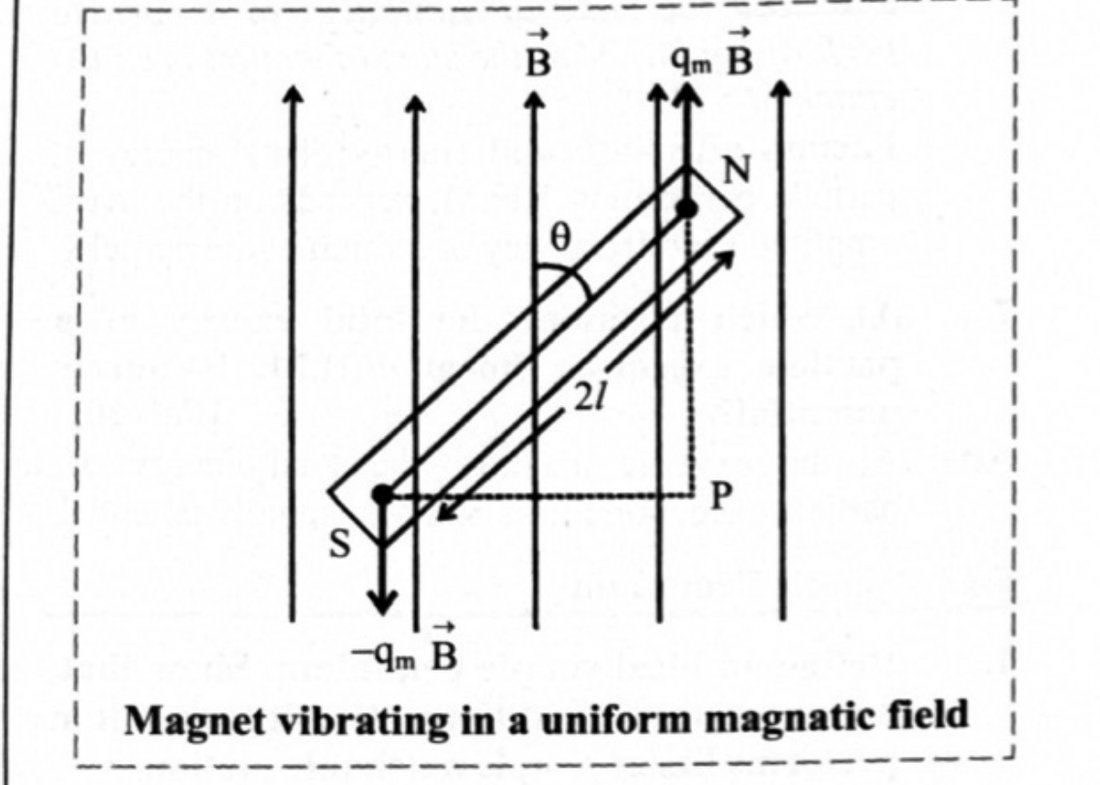
Finished revising this chapter? Practise Magnetic Materials →