11.3
Origin of Magnetism in Materials
Magnetic Materials · Maharashtra HSC
Theory
Where magnetism in matter comes from
- To explain why some materials behave like magnets and others do not, go down to the atom. In an atom, negatively charged electrons revolve about a nucleus of protons and neutrons, and chemical as well as magnetic properties are dominated by the electrons in the outermost orbit.
- An electron contributes to the magnetism of an atom in two ways: through its orbital motion round the nucleus, which is equivalent to a tiny current loop and gives the orbital magnetic moment, and through its intrinsic spin angular momentum, which gives the spin magnetic dipole moment.
- The vector sum of the orbital and spin moments of all the electrons is the total magnetic moment of the atom.
Magnetic moment of an electron revolving around the nucleus
The set-up and the diagram
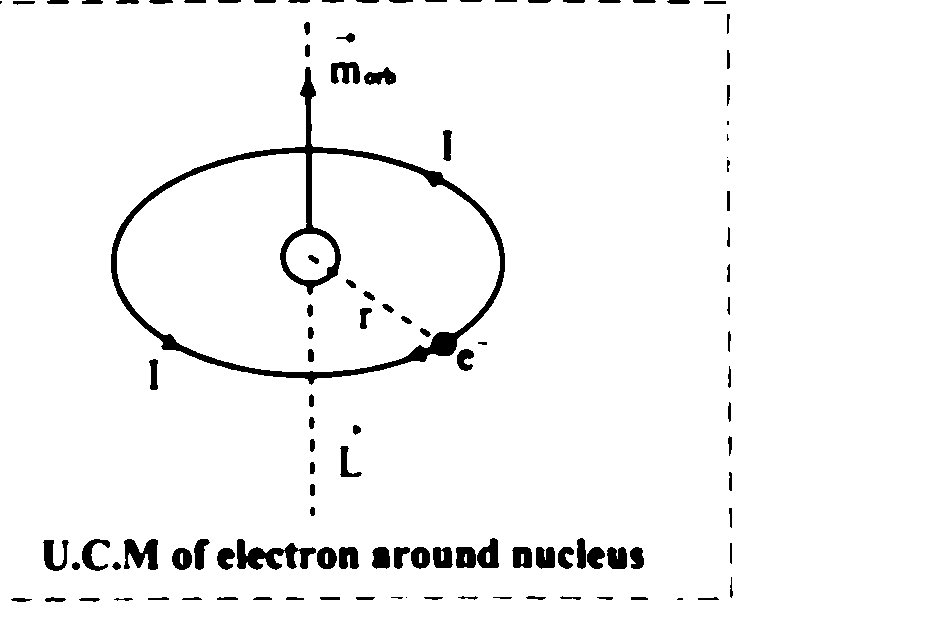
- Draw a nucleus at the centre with a single electron moving on a circle of radius round it. Mark the electron's velocity tangentially in the clockwise sense; then the conventional current round the loop is anticlockwise, because the electron's charge is negative. Mark the area enclosed by the orbit.
- The magnetic moment and the angular momentum are both perpendicular to the plane of the orbit and point in opposite senses.
Derivation
- Consider an electron of mass and charge revolving in a circular orbit of radius around the positive nucleus in the clockwise direction, giving an anticlockwise current.
- If the electron travels a distance (the circumference) in time , its orbital speed is .
- The magnitude of the circulating current is
- But , so
- The orbital magnetic moment associated with this orbital current loop is
In terms of angular momentum
- The angular momentum of the electron due to its orbital motion is
- Multiplying and dividing the right-hand side of (2) by ,
- This shows that the orbital magnetic moment is proportional to the orbital angular momentum. But the electron bears a negative charge, so and are in opposite directions and both are perpendicular to the plane of the orbit. In vector notation
- The same result is obtained using quantum mechanics.
Gyromagnetic ratio
- Definition: the ratio of the magnetic dipole moment to the angular momentum of a revolving electron is called the gyromagnetic ratio.
- Its value is . It is a constant of the electron, independent of the orbit.
Bohr magneton
- From the second postulate of Bohr's theory of the hydrogen atom, the orbital angular momentum is an integral multiple of :
- Substituting in Eq. (4),
- For the first orbit, :
- The quantity is called the Bohr magneton. Its value is , and the magnetic moment of an atom is normally quoted as a number of Bohr magnetons (B.M.).
Paired and unpaired electrons
- Pauli's exclusion principle: no two electrons in an atom can have the same set of quantum numbers , , and . Two electrons occupying the same state defined by , and must therefore have opposite spins, and their magnetic moments cancel exactly.
- Consequently, a completely filled orbit contributes nothing to the magnetic moment of the atom, and only unpaired electrons in the outermost orbit give the atom a net magnetic moment.
- The three-step test: (i) write the electronic configuration; (ii) draw the valence orbitals, ignoring the inner completely filled ones; (iii) look for an unpaired electron. For chlorine (17 electrons, ) there is one unpaired electron, so the atom has a net moment.
- Effective magneton numbers of some iron-group ions, obtained experimentally from measured susceptibilities, in Bohr magnetons: () 5.9, () 5.4, () 4.8, () 3.2. In several ions the moment comes from both orbital and spin angular momenta.
Standard results
- .
- ; for a coil of turns, .
- ; ; .
- Gyromagnetic ratio .
- ; Bohr magneton .
Theory Questions Asked on This Subtopic
Real board questions. Answers are at the end of the page.
- 1
Show that the orbital magnetic dipole moment of a revolving electron is .
 Maharashtra HSC board question — asked in March 2014Answer 1 ↓
 - 2
In a hydrogen atom, an electron carrying charge 'e' revolves in an orbit of radius 'r' with speed 'v'. Obtain an expression for the magnitude of magnetic moment of a revolving electron.
Maharashtra HSC board question — asked in October 2014Answer 2 ↓ - 3
Derive an expression for magnitude of magnetic dipole moment of a revolving electron. OR Derive an expression for orbital magnetic moment of an electron revolving around the nucleus in an atom.
Maharashtra HSC board question — asked in February 2020; July 2022Answer 3 ↓ - 4
What is gyromagnetic ratio? Write the necessary expression.
Maharashtra HSC board question — asked in July 2022Answer 4 ↓ - 5
State the formula for the Bohr magneton. OR Write the mathematical formula for Bohr magneton for an electron revolving in orbit.
Maharashtra HSC board question — asked in February 2023; July 2022Answer 5 ↓ - 6
Obtain an expression for orbital magnetic moment of an electron revolving around the nucleus of an atom.
Maharashtra HSC board question — asked in July 2023Answer 6 ↓ - 7
Define gyromagnetic ratio.
Maharashtra HSC board question — asked in February 2024Answer 7 ↓
Numericals
Every numerical set on this subtopic. Full working is at the end of the page.
- 8
[Mar 17] An electron in an atom revolves around the nucleus in an orbit of radius 0.53 Å. If the frequency of revolution of an electron is MHz, calculate the orbital angular momentum. [Given: Charge on an electron = C; Gyromagnetic ratio = C/kg; π = 3.142]
Maharashtra HSC board questionAnswer 8 ↓ - 9
[Feb 20] A circular coil of 300 turns and diameter 14 cm carries a current of 15 A. Calculate the magnitude of the magnetic dipole moment associated with the coil.
Maharashtra HSC board questionAnswer 9 ↓ - 10
[Mar 22] An electron in an atom is revolving round the nucleus in a circular orbit of radius m with a speed of m/s. Find the angular momentum of electron.
Maharashtra HSC board questionAnswer 10 ↓
Answers & Solutions
Work the questions above first, then check yourself here. Each answer is set out the way it should be written in the paper.
Expression for magnetic dipole moment: i. Consider an electron of mass and charge e revolving in a circular orbit of radius r around the positive nucleus in clockwise direction, leading to an anticlockwise current. ii. If the electron travels a distance in time T then, its orbital speed iii. Magnitude of circulating current is given by, But, iv. The orbital magnetic moment associated with orbital current loop is given by,
[From 11.3, Q1] Expression for magnetic dipole moment: i. Consider an electron of mass and charge e revolving in a circular orbit of radius r around the positive nucleus in clockwise direction, leading to an anticlockwise current. ii. If the electron travels a distance in time T then, its orbital speed iii. Magnitude of circulating current is given by, But, iv. The orbital magnetic moment associated with orbital current loop is given by,
[From 11.3, Q1] Expression for magnetic dipole moment: i. Consider an electron of mass and charge e revolving in a circular orbit of radius r around the positive nucleus in clockwise direction, leading to an anticlockwise current. ii. If the electron travels a distance in time T then, its orbital speed iii. Magnitude of circulating current is given by, But, iv. The orbital magnetic moment associated with orbital current loop is given by,
i. The ratio of magnetic dipole moment with angular momentum of revolving electron is called the gyromagnetic ratio. ii. Gyromagnetic ratio is given by,
Formula for Bohr Magneton =
[From 11.3, Q1] Expression for magnetic dipole moment: i. Consider an electron of mass and charge e revolving in a circular orbit of radius r around the positive nucleus in clockwise direction, leading to an anticlockwise current. ii. If the electron travels a distance in time T then, its orbital speed iii. Magnitude of circulating current is given by, But, iv. The orbital magnetic moment associated with orbital current loop is given by, [(i), (ii), (iii) and (iv)] v. The angular momentum of an electron due to its orbital motion is given by, vi. Multiplying and dividing the R.H.S of equation (2) by , vii. This equation shows that orbital magnetic moment is proportional to the angular momentum. But as the electron bears negative charge, the orbital magnetic moment and orbital angular momentum are in opposite directions and perpendicular to the plane of the orbit. Using vector notation,
[From 11.3, Q4 (i)]
i. The ratio of magnetic dipole moment with angular momentum of revolving electron is called the gyromagnetic ratio. ii. Gyromagnetic ratio is given by,
Given: r = 0.53 Å = m, f = MHz = Hz To find: Angular momentum () Formula: Calculation: Since, and Using formula, Ans: The orbital angular momentum of the electron is kgm²/s.
Given: n = 300, d = 14 cm, r = 7 cm = m, I = 15A To find: Magnetic dipole moment () Formula: Calculation: From formula, Ans: The magnitude of the magnetic dipole moment associated with the coil is 69.28 Am².
Given: r = m, v = ms⁻¹, e = C, kg To find: Angular momentum of electron (L) Formula: L = mvr Calculation: From formula, N-m-s Ans: Angular momentum of electron is N-m-s.