11.5
Magnetic Properties of Materials
Magnetic Materials · Maharashtra HSC
Theory
Classification
- The behaviour of a material in the presence of an external magnetic field classifies it broadly as diamagnetic, paramagnetic or ferromagnetic. The magnetic susceptibility is negative for diamagnetic materials, positive but small for paramagnetic, and positive and large for ferromagnetic.
| Type of material | Range of |
|---|---|
| Diamagnetic | to |
| Paramagnetic | to |
| Ferromagnetic | to |
Diamagnetism
Origin
- Atoms or molecules whose electron orbits are completely filled possess no net magnetic dipole moment; such materials behave as diamagnetic materials.
- Diagram: draw a pair of electron orbits, one with the electron going clockwise and one anticlockwise, placed in an external field directed into the page. Mark the induced current in each.
- When such a current loop is brought into an external magnetic field, the field induces a current in the orbit in accordance with Lenz's law, in a direction whose own magnetic field opposes the applied external field.
- For the loop in which the induced current runs the same way as the loop current, the net current increases and so does its magnetic dipole moment. For the loop in which the induced current opposes the loop current, the net current is reduced and so is its moment.
- The two moments no longer cancel, and the result is a net magnetic dipole moment in the direction opposite to the applied field.
Properties
- Draw a diamagnetic slab in a uniform field: the lines of force inside the slab are fewer and spread apart, since the induced field repels them and the field inside is reduced.
- In a non-uniform field a diamagnetic material moves from the stronger to the weaker part of the field. A diamagnetic liquid in a U-tube with one arm in the field is pushed into the arm that is outside the field.
- A diamagnetic rod suspended freely in a uniform field aligns perpendicular to the field. The reason: the induced dipole points against the field, which is the position of large magnetic potential energy and hence unstable, so the rod turns to the position of least magnetic potential energy, which is perpendicular to the field.
- Diamagnetics are weakly repelled by a magnet. is small and negative, , and there is no effect of temperature.
- Examples: copper, gold, bismuth, lead, silicon, diamond, mercury, nitrogen, glass, water, wood, plastic.
- Diamagnetism is present in all materials; in many it is masked by the much stronger paramagnetism or ferromagnetism.
- Superconductors have and expel the field lines completely. This perfect diamagnetism of a superconductor is called the Meissner effect. In an ordinary good conductor the lines do penetrate the surface region to some extent.
Paramagnetism
Origin
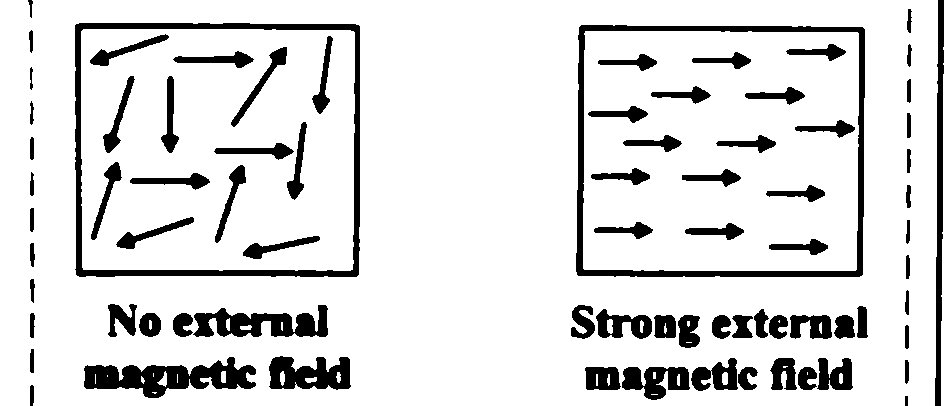
- Atoms or molecules having unpaired electrons possess a net magnetic dipole moment. Because of thermal agitation these moments are randomly oriented, so the resultant moment of the material is zero in the absence of an external field.
- Diagram: three panels — (a) no external field, arrows pointing in random directions; (b) weak external field, a few arrows turned towards the field; (c) strong external field at low temperature, nearly all arrows along the field.
Properties
- In a sufficiently strong external field, and at low temperature so that thermal excitation is reduced, most of the dipoles align along the applied field, since that is the orientation of lower potential energy. The lines of force get closer together inside the material.
- In a non-uniform field a paramagnetic material tends to move from the weaker to the stronger region; these materials are attracted by a magnet. A paramagnetic liquid in a U-tube manometer rises into the arm nearer the magnet.
- When the external field is removed, the dipoles return to random orientations and the net moment falls back to zero — the magnetisation is only temporary.
- Examples: magnesium, lithium, molybdenum, tantalum, aluminium, calcium, chromium, platinum, salts such as , and oxygen gas.
Curie law
- In 1895 Pierre Curie observed that the magnetization of a paramagnetic material is directly proportional to the applied magnetic field and inversely proportional to the absolute temperature of the material. This is Curie's law.
- Using ,
- Interpretation: increasing the applied field and reducing the temperature both align more magnetic moments along the field, increasing the magnetization.
- Working form for numericals: is a constant, so , with always in kelvin.
Ferromagnetism
- Atoms of a ferromagnetic material possess magnetic moments similar to those in paramagnetic materials, but these substances show strong magnetic properties and can become permanent magnets. Iron, cobalt, nickel, some rare earths such as gadolinium, and some transition-metal alloys are ferromagnetic.
Domain theory
- In ferromagnetic materials the interaction between neighbouring magnetic dipole moments, called exchange coupling or exchange interaction, is strong — stronger than the usual dipole–dipole interaction by an order of magnitude.
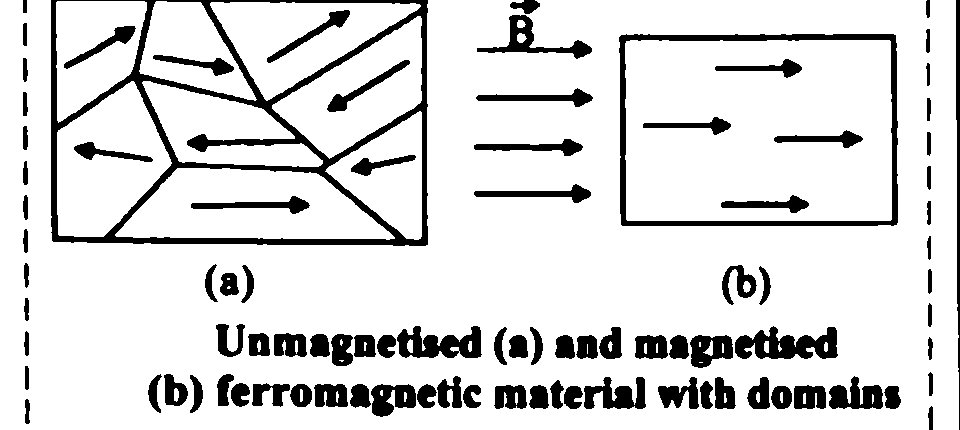
- Due to this interaction, small regions called domains are formed, in which all the atoms have their magnetic moments aligned in the same direction. That common direction is the domain axis. A domain can be a fraction of a millimetre in size, to , and contains about to atoms.
- The boundary between adjacent domains with different orientations of magnetic moment is called a domain wall.
- Diagram: (a) unmagnetised specimen — a set of small closed regions with arrows pointing in random directions; (b) magnetised specimen — one large region with all arrows parallel.
- In the unmagnetised state, even though the magnetic moment of each individual domain is non-zero, the domain axes are oriented randomly, so the net magnetic moment of the whole material is zero.
- When an external field is applied, flipping or domain rotation occurs: the domains try to align themselves along the direction of the applied field, and the number of domains aligned in that direction increases as the field is increased.
- When a sufficiently high magnetic field is applied, all the domains coalesce together to form one giant domain.
- When the strong external field is completely removed, the domain boundaries are not set back to their original positions, so the net magnetic moment remains non-zero and the material is said to retain magnetization. Such materials are used for preparing permanent magnets.
- In a non-uniform magnetic field a ferromagnetic material tends to move from the weaker part to the stronger part of the field.
- Besides these three classes there also exist ferrimagnetic, antiferromagnetic and spin-glass materials with exotic properties and various applications.
Effect of temperature and Curie temperature
- Ferromagnetism depends on temperature. As the temperature of a ferromagnetic material is increased, the exchange coupling between neighbouring moments weakens, so the domain structure starts getting distorted.
- At a certain temperature, depending on the material, the domain structure collapses totally and the material behaves like a paramagnetic material. The temperature at which a ferromagnetic material transforms into a paramagnetic substance is called the Curie temperature of that material.
- Above the Curie temperature the susceptibility follows
- where is a constant. A graph of against falls steeply and tends to zero as rises well above .
| Material | (K) |
|---|---|
| Metallic cobalt | 1394 |
| Metallic iron | 1043 |
| 893 | |
| Metallic nickel | 631 |
| Metallic gadolinium | 317 |
Distinguishing the three — the board's tables
Diamagnetic and paramagnetic substances
| No. | Diamagnetic substance | Paramagnetic substance |
|---|---|---|
| i | In an external magnetic field it gets weakly magnetised in the direction opposite to that of the field. | In an external magnetic field it gets weakly magnetised in the same direction as that of the field. |
| ii | In a non-uniform field it tends to move from the stronger to the weaker part of the field. | In a non-uniform field it tends to move from the weaker to the stronger part of the field. |
| iii | It is weakly repelled by a magnet. | It is weakly attracted by a magnet. |
| iv | The magnetic moment of every atom is zero. | Every atom is a magnetic dipole with a certain resultant magnetic moment. |
| v | A rod suspended in a uniform field comes to rest with its length perpendicular to the field. | A rod suspended in a uniform field comes to rest with its length parallel to the field. |
| vi | There is no effect of temperature. | There is an effect of temperature. |
Paramagnetic and ferromagnetic substances
| No. | Paramagnetic substance | Ferromagnetic substance |
|---|---|---|
| i | It is weakly attracted by a magnet. | It is strongly attracted by a magnet. |
| ii | In a non-uniform field it shows a moderate tendency to move from the weaker to the stronger part. | In a non-uniform field it shows a strong tendency to move from the weaker to the stronger part. |
| iii | In an external field it becomes weakly magnetised, in the same direction as the field. | In an external field it becomes strongly magnetised, in the same direction as the field. |
| iv | On removing the field it loses its magnetism. | On removing the field it retains magnetism permanently. |
| v | It cannot be converted into a ferromagnetic substance. | Heated above the Curie temperature, it becomes a paramagnetic substance. |
| vi | Every atom has a magnetic dipole moment but the resultant is zero. | The resultant magnetic dipole moment is large. |
| vii | It can be magnetised only temporarily in an external field. | It can be permanently magnetised. |
Diamagnetic and ferromagnetic substances
| No. | Diamagnetic substance | Ferromagnetic substance |
|---|---|---|
| i | Weakly repelled by a magnet. | Strongly attracted by a magnet. |
| ii | A thin rod suspended in a uniform field comes slowly to rest with its length perpendicular to the field. | A thin rod suspended in a uniform field comes quickly to rest with its length parallel to the field. |
| iii | In a non-uniform field it shows a moderate tendency to move from the stronger to the weaker part. | In a non-uniform field it shows a strong tendency to move from the weaker to the stronger part. |
| iv | In the absence of an external field the resultant magnetic moment of each atom is zero. | The resultant magnetic moment of each atom is much greater than zero. |
| v | There is no effect of temperature. | There is an effect of temperature. |
| vi | It cannot be permanently magnetised. | It can be permanently magnetised. |
Standard results
- ranges: diamagnetic to ; paramagnetic to ; ferromagnetic to .
- Curie law: , , .
- Above the Curie point: ; the ferromagnetic becomes paramagnetic.
- Saturation magnetization of a sample with atoms per unit volume each of moment : . Saturation is reachable only if is comparable with the thermal energy ; for a gas at room temperature in a field of a few tesla it is not, so saturation cannot be achieved.
- Number of atoms in a domain of volume : , then (moment per atom) and .
Theory Questions Asked on This Subtopic
Real board questions. Answers are at the end of the page.
- 1
Explain ferromagnetism on the basis of domain theory.
 Maharashtra HSC board question — asked in October 2008Answer 1 ↓
 - 2
Give any 'two' points of differences between diamagnetic and ferromagnetic substances.
Maharashtra HSC board question — asked in October 2015Answer 2 ↓ - 3
Distinguish between 'paramagnetic' and 'ferromagnetic' substances.
Maharashtra HSC board question — asked in March 2016Answer 3 ↓ - 4
Draw the diagrams showing the dipole moments in paramagnetic substance when external magnetic field is i. absent ii. strong.
 Maharashtra HSC board question — asked in July 2016Answer 4 ↓
 - 5
Distinguish between diamagnetic and paramagnetic substances.
Maharashtra HSC board question — asked in July 2017Answer 5 ↓ - 6
What is Curie temperature and what happens above Curie temperature?
Maharashtra HSC board question — asked in July 2018Answer 6 ↓ - 7
What happens to a ferromagnetic substance heated above Curie temperature?
Maharashtra HSC board question — asked in March 2019Answer 7 ↓ - 8
What happens if the rod of dia-magnetic material is placed in a non-uniform magnetic field?
Maharashtra HSC board question — asked in July 2019Answer 8 ↓
Numericals
Every numerical set on this subtopic. Full working is at the end of the page.
- 9
[Mar 14] The susceptibility of magnesium at 300 K is . At what temperature will the susceptibility increase to ?
Maharashtra HSC board questionAnswer 9 ↓ - 10
[Mar 16] The susceptibility of magnesium at 200 K is . At what temperature will the susceptibility decrease by ?
Maharashtra HSC board questionAnswer 10 ↓ - 11
[July 16] The susceptibility of magnesium at 300 K is . At what temperature will the susceptibility increase to ?
Maharashtra HSC board questionAnswer 11 ↓ - 12
[Mar 19] The susceptibility of magnesium at 300 K is . What will be its susceptibility at 200 K?
Maharashtra HSC board questionAnswer 12 ↓ - 13
[July 19] The susceptibility of magnesium at 300 K is . At what temperature the susceptibility will decrease by ?
Maharashtra HSC board questionAnswer 13 ↓
Answers & Solutions
Work the questions above first, then check yourself here. Each answer is set out the way it should be written in the paper.
Domain theory: i. In ferromagnetic materials, interaction called exchange coupling or exchange interaction between neighbouring magnetic dipole moments is strong. ii. Due to this interaction, small regions called domain are formed in which all the atoms have their magnetic moments aligned in the same direction. The common direction of magnetic moment is called the domain axis. Domain size can be a fraction of a millimetre ( m) and contains about atoms. iii. The boundary between adjacent domains with a different orientation of magnetic moment is called a domain wall. iv. In unmagnetized state, even though the magnetic moment of individual domains are non-zero, the domain axes of different domains being oriented randomly, the net magnetic moment of the whole material is zero. v. When an external magnetic field is applied, flipping or domain rotation occurs. In this process, domains try to align themselves along the direction of the applied magnetic field. The number of domains aligning in that direction increases as magnetic field is increased. vi. When sufficiently high magnetic field is applied, all the domains coalesce together to form a giant domain as shown in figure. vii. When the strong external magnetic field is completely removed, the domain boundaries are not set back to original position resulting in the net magnetic moment remaining non-zero and the ferromagnetic material is said to retain magnetization. Such materials are used in preparing permanent magnets. viii. In non-uniform magnetic field, ferromagnetic material tends to move from weaker part to stronger part of the field.
No. Diamagnetic Substance Ferromagnetic Substance i. They are weakly repelled by magnet. They are strongly attracted by magnet. ii. If a thin rod of diamagnetic substance is freely suspended in uniform magnetic field, it comes to rest slowly with its length perpendicular to the direction of magnetic field. If a thin rod of ferromagnetic substance is freely suspended in a uniform magnetic field, it comes quickly to rest with its length parallel to the direction of the field. iii. When placed in non uniform magnetic field, they show a moderate tendency to move from the stronger to the weaker part of the field. When placed in non uniform magnetic field, they show a strong tendency to move from the weaker to the stronger part of the field. iv. In the absence of external magnetic field, the resultant magnetic moment of each atom is zero. The resultant magnetic moment of each atom of a ferromagnetic substance is much greater than zero. v. There is no effect of temperature on diamagnetic substance. There is effect of temperature on ferromagnetic substance. vi. They cannot be permanently magnetised. They can be permanently magnetised. [Any two points]
No. Paramagnetic substance Ferromagnetic substance i. It is weakly attracted by a magnet. It is strongly attracted by a magnet. ii. When kept in a non-uniform magnetic field, it shows moderate tendency to move from weaker to the stronger part of the field. When kept in a non-uniform magnetic field, it shows strong tendency to move from weaker to the stronger part of the field. iii. When kept in an external magnetic field it becomes weakly magnetised, and the direction of magnetic moment acquired will be same as that of the field. When kept in an external magnetic field it becomes strongly magnetised, and the direction of magnetic moment acquired will be same as that of the field. iv. When the external magnetic field is removed, the paramagnetic substance loses its magnetism. When the external magnetic field is removed, the ferromagnetic substance retains magnetism permanently. v. They cannot be converted into ferromagnetic substances. When heated above curie temperature, they become paramagnetic substances. vi. Every atom has some magnetic dipole moment but resultant dipole moment is zero. The resultant magnetic dipole moment is greater. vii. They can be temporarily magnetised in external magnetic field. They can be permanently magnetised. The question is a real board question. Its answer and working are ours — this paper was published without an official answer key.
What the diagrams show
- i. A paramagnetic substance is made of atoms (or molecules) that have unpaired electrons, so every atom already possesses a permanent magnetic dipole moment. Each such moment is drawn as a small arrow.
- ii. When the external magnetic field is absent, thermal agitation keeps these atomic dipole moments randomly oriented. Their vector sum is zero, so the resultant magnetization of the specimen is zero and it shows no magnetism.
- iii. When a strong external magnetic field is applied (especially at low temperature, where thermal agitation is reduced), most of the dipole moments turn and align themselves along the direction of the applied field, because that is the orientation of minimum magnetic potential energy, .
- iv. The specimen is then weakly magnetised in the direction of the applied field, the lines of force inside it come closer together, and its magnetization is large but still small compared with that of a ferromagnetic material.
- v. The two diagrams are shown side by side: randomly oriented dipole arrows with no external field, and dipole arrows lined up along the field when a strong external field is applied.
Result
- On removing the field the dipoles become random again, so the magnetisation of a paramagnetic substance is only temporary.
No. Diamagnetic substance Paramagnetic substance i. In an external magnetic field, a substance gets weakly magnetised in the direction opposite to that of the field. In an external magnetic field, a paramagnetic substance gets weakly magnetised in the same direction as that of the field. ii. When placed in a non-uniform magnetic field, it tends to move from the stronger to the weaker part of the field. When placed in a non-uniform magnetic field, it tends to move from the weaker to the stronger part of the field. iii. It is weakly repelled by a magnet. It is weakly attracted by a magnet. iv. Magnetic moment of every atom of a diamagnetic substance is zero. Every atom of a paramagnetic substance is a magnetic dipole having a certain resultant magnetic moment. v. When a rod of diamagnetic substance is suspended in a uniform magnetic field, it comes to rest with its length perpendicular to the direction of the field. When a rod of paramagnetic substance is suspended in a uniform magnetic field, it comes to rest with its length parallel to the direction of the field. vi. There is no effect of temperature on diamagnetic substance. There is effect of temperature on paramagnetic substance. i. The temperature at which a ferromagnetic material transforms into a paramagnetic substance is called Curie temperature () of that material. ii. An increase in the temperature of a ferromagnetic material weakens the exchange coupling between neighbouring moments which results in the domain structure getting distorted. iii. Above Curie temperature the domain structure of a ferromagnetic material collapses totally and the material behaves like paramagnetic material.
When heated above Curie temperature, ferromagnetic substances become paramagnetic substances.
When the rod of diamagnetic material is placed in a non-uniform magnetic field, it tends to move from stronger part to the weaker part of the magnetic field.
Given: , K, To find: Required temperature () Formula: χT = constant Calculation: From formula, K Ans: The temperature at which the susceptibility will increase to is 200 K.
Given: K, , To find: Required temperature () Formula: χT = constant Calculation: From formula, Ans: The required temperature is 300 K.
Given: , K, To find: Required temperature () Formula: χT = constant Calculation: From formula, K Ans: The required temperature is 200 K.
Given: , K, K To find: Susceptibility at temperature () Formula: χT = constant Calculation: From formula, Ans: The susceptibility at 200 K is .
Given: , K, To find: Temperature () Formula: χT = constant Calculation: From formula, K Ans: Required temperature is 450 K.