10.16
Magnetic Field of a Solenoid and a Toroid
Magnetic Fields due to Electric Current · Maharashtra HSC
Theory
(a) Solenoid
A solenoid is a long, closely wound helical coil of conducting wire whose diameter is much smaller than its length.
Diagram (Fig. 10.24 and Fig. 10.25): a cross-section of the solenoid drawn as two rows of wire sections — dots in the upper row, where the current comes out of the plane of the paper, and crosses in the lower row, where it goes into it. Inside, the field lines are drawn as closely spaced straight lines parallel to the axis; outside, they are widely spaced and curve round to close. A rectangular Amperian loop abcd is drawn with its side ab of length inside the solenoid and parallel to the axis, cd outside and parallel to it, and bc and da perpendicular to the axis.
The density of the field lines inside, along the axis and away from the wire, is uniform, so the field inside is uniform and parallel to the axis. Outside, the lines are widely spaced, so the field there is weak. For an ideal solenoid — infinite length, wire of square cross-section wound very closely with insulation between turns — the field inside is uniform and along the axis and the field outside is exactly zero. A real solenoid of finite length has a uniform, strong field near the centre and a weaker field towards the outside and near the ends.
Derivation. Apply Ampere's law over the rectangular loop abcd:
- Along ab, and are parallel and is constant, giving .
- Along bc and da, and are perpendicular, so these integrals are zero.
- Along cd, outside the solenoid , so this integral is zero.
If the solenoid has turns per unit length and each turn carries a current , the number of turns threading the loop is and the net current encircled is
This result, although derived for an ideal solenoid, is also valid for a realistic solenoid at points in the middle of it — but certainly not at points near its ends. A solenoid can therefore be designed for a required by choosing and . Writing with the total number of turns and the length,
(b) Toroid
A toroid is a solenoid of finite length bent into a hollow circular tube, like a pressurised rubber tube inside the tyre of a vehicle.
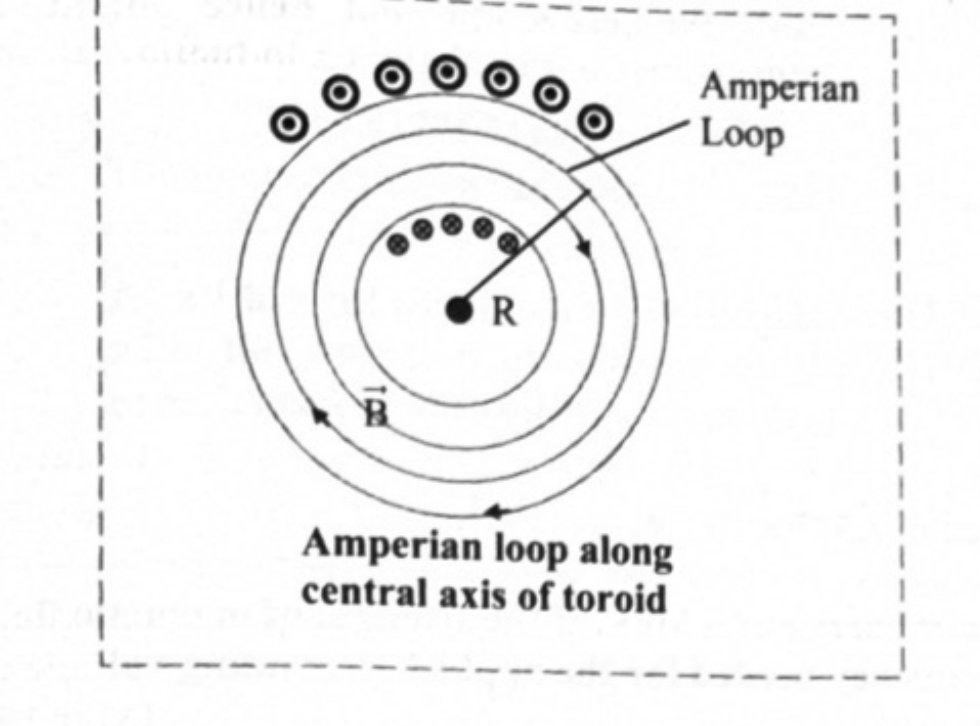
Diagram (Fig. 10.26): a ring-shaped coil, its winding drawn all round the tube, with a circular Amperian loop of radius drawn along the central axis of the tube (concentric with the axis of the toroid), and a point P marked on that loop. The magnetic field lines inside the tube are concentric circles; at P is tangential to the loop.
The board's derivation:
- Consider a toroid carrying a steady current and having turns.
- The magnetic field around the toroid consists of concentric circular lines of force. The field is produced when a steady current flows through the toroid.
- The direction of the magnetic field at a point is along the tangent to the circular path at that point.
- Let be the radius of the Amperian loop, concentric with the axis of the toroid, and let P be a point on the loop.
- Applying Ampere's law,
where is the total number of turns in the toroid, the total current flowing through the toroid, and the current flowing in each turn.
- Now
- But and are in the same direction, so and . Equation (2) becomes
- Also , the circumference of the circle. From (3),
- From (1) and (4), , hence
This is the required expression.
Since , the magnetic field is not constant over the cross-section of the toroid — unlike the solenoid, where it is uniform. By choosing other Amperian loops it can be shown that at all points outside an ideal toroid (one wound with an infinitely large number of closely spaced turns of infinitesimally small cross-section).
Distinguish between a solenoid and a toroid
| Solenoid | Toroid |
|---|---|
| A straight helical coil, length much greater than diameter | A solenoid bent into a closed circular ring, with no free ends |
| , with the number of turns per unit length | , with the total number of turns |
| Field inside is uniform across the section and along the axis | Field varies as , so it is not constant across the section |
| Field lines are straight inside and close outside the coil | Field lines are closed concentric circles inside the tube |
| outside an ideal solenoid; ends behave as north and south poles | outside an ideal toroid; there are no poles |
Standard results
- Solenoid: , uniform, axial, valid near the middle; outside an ideal solenoid
- Toroid: along the central axis; outside an ideal toroid
- Worked type (Example 10.8): a solenoid 25 cm long with 250 turns carrying 3 A has m, so T.
- Toroid numericals invert equation (5): .
Theory Questions Asked on This Subtopic
Real board questions. Answers are at the end of the page.
- 1
State Ampere's circuital law. Obtain an expression for magnetic induction along the axis of toroid.
 Maharashtra HSC board question — asked in March 2014Answer 1 ↓
 - 2
Obtain an expression for magnetic induction along the axis of toroid on the basis of Ampere's circuital law. OR Obtain an expression for magnetic induction of a toroid of 'N' turns about an axis passing through its centre and perpendicular to its plane.
Maharashtra HSC board question — asked in February 2023; July 2017Answer 2 ↓
Numericals
Every numerical set on this subtopic. Full working is at the end of the page.
- 3
[Mar 15] A solenoid 3.142 m long and 5.0 cm in diameter has two layers of windings of 500 turns each and carries a current of 5 A. Calculate the magnetic induction at its centre along the axis.
Maharashtra HSC board questionAnswer 3 ↓
Answers & Solutions
Work the questions above first, then check yourself here. Each answer is set out the way it should be written in the paper.
[From 10.15, Q1 (Statement only)] Statement: The line integral of magnetic field of induction around any closed path in free space is equal to absolute permeability of free space times the total current flowing through area bounded by the path. Mathematically, The sign indicates that the integral is to be evaluated over a closed loop called Amperian loop. The current I on the right hand side is the net current encircled by the Amperian loop. Explanation: i. Consider cross-sections of four long straight wires carrying currents , , , into or out of the plane of the paper are shown in figure below. ii. An Amperian loop is drawn to encircle 3 of the current wires and not the fourth one. iii. As the current goes perpendicular to the plane of the paper, is in the plane of the paper even if its direction is unknown. iv. The length element on the Amperian loop is (in the plane of the paper). Using Ampere's law, v. Thus the integration is over the product of length dl of the Amperian loop and the component of the magnetic field B cos θ, tangent to the loop. vi. Using curled palm right hand thumb rule, for the distribution of currents as shown and are coming out of the paper, (⊙) parallel to the stretched thumb. Hence these are positive. , on the other hand is going into the plane of the paper (⊗). Thus, it is negative. The Current is not within the Amperian loop. As the integration is over a full loop, contributions of to B cancel out. Expression for magnetic induction at a point along the axis of a toroid: i. Consider a toroid carrying steady current I and having turns N. ii. The magnetic field around the toroid consists of concentric circular lines of force around it. Magnetic field is produced, when a steady current 'I' flows through toroid. iii. The direction of magnetic field at a point is along the tangent to the circular path at that point. iv. Let R be the radius of the Amperian loop. This loop is concentric with the axis of toroid. P is a point on the loop. v. Applying Ampere's law, where, N = total number of turns in the toroid. I = total current flowing through toroid. i = Current flowing in each turn Now, vi. But, and are in same direction Equation (2) can be written as, vii. Also ....(total length of circle is its circumference) From equation (3), viii. From equation (1) and (4), This is the required expression.
[From 10.16, Q1] [From 10.15, Q1 (Statement only)] Statement: The line integral of magnetic field of induction around any closed path in free space is equal to absolute permeability of free space times the total current flowing through area bounded by the path. Mathematically, The sign indicates that the integral is to be evaluated over a closed loop called Amperian loop. The current I on the right hand side is the net current encircled by the Amperian loop. Explanation: i. Consider cross-sections of four long straight wires carrying currents , , , into or out of the plane of the paper are shown in figure below. ii. An Amperian loop is drawn to encircle 3 of the current wires and not the fourth one. iii. As the current goes perpendicular to the plane of the paper, is in the plane of the paper even if its direction is unknown. iv. The length element on the Amperian loop is (in the plane of the paper). Using Ampere's law, v. Thus the integration is over the product of length dl of the Amperian loop and the component of the magnetic field B cos θ, tangent to the loop. vi. Using curled palm right hand thumb rule, for the distribution of currents as shown and are coming out of the paper, (⊙) parallel to the stretched thumb. Hence these are positive. , on the other hand is going into the plane of the paper (⊗). Thus, it is negative. The Current is not within the Amperian loop. As the integration is over a full loop, contributions of to B cancel out. Expression for magnetic induction at a point along the axis of a toroid: i. Consider a toroid carrying steady current I and having turns N. ii. The magnetic field around the toroid consists of concentric circular lines of force around it. Magnetic field is produced, when a steady current 'I' flows through toroid. iii. The direction of magnetic field at a point is along the tangent to the circular path at that point. iv. Let R be the radius of the Amperian loop. This loop is concentric with the axis of toroid. P is a point on the loop. v. Applying Ampere's law, where, N = total number of turns in the toroid. I = total current flowing through toroid. i = Current flowing in each turn Now, vi. But, and are in same direction Equation (2) can be written as, vii. Also ....(total length of circle is its circumference) From equation (3), viii. From equation (1) and (4), This is the required expression.for expression for magnetic induction along the axis of toroid on the basis of Ampere's circuital law.
Given: L = 3.142 m, i = 5 A 2 layers of windings, hence total turns N = To find: Magnetic induction (B) Formula: Calculation: From formula, Ans: The magnetic induction at centre of solenoid along the axis is T.