8.8
Dielectrics and Electric Polarisation
Electrostatics · Maharashtra HSC
Theory
Conductors and insulators (the background the board expects)
- Conductors are materials which allow electricity to flow through them, because they contain a large number of free charge carriers. In a metal the outermost (valence) electrons are loosely bound and are free for conduction when an external field is applied. Metals, humans, the earth and animal bodies are conductors.
- Properties of a conductor under electrostatic conditions: the net electrostatic field in its interior is zero; the potential is constant within and on its surface; the interior has no charge; the field just outside is perpendicular to the surface at every point; and the surface charge density may differ at different points.
- In insulators the electrons are tightly bound to the nucleus and are not available for conduction. An insulator can carry any distribution of charge on its surface or in its interior, and the field inside can be non-zero, unlike a conductor.
- Free charges are the mobile electrons in a metal, which drift opposite to an applied field; bound charges are the nuclei and inner-shell electrons, held fixed in position. In electrolytic conductors, positive and negative ions are the carriers, with their movement restricted.
- Electrostatic shielding: a delicate instrument placed inside a hollow conductor, where , is protected from external charged bodies. Thin metal foils make such shields. A car acts as a shield, which is why it is safer than standing near a tree during a thunderstorm. A Faraday cage is an enclosure used to block external electric fields; MRI rooms are shielded so that external radio-frequency signals do not mix with the machine's signals.
What a dielectric is
- Dielectrics are insulators which can be used to store electrical energy. When such a substance is placed in an external field, its positive and negative charges get displaced in opposite directions and the molecules develop a net dipole moment. This is called polarisation of the material, and such materials are called dielectrics.
- In every atom a positively charged nucleus is surrounded by an electron cloud. The centre of negative charge is the centre of mass of the electrons, the centre of positive charge that of the protons.
- Dielectrics are therefore insulating, non-conducting substances which can be polarised through small localised displacements of charge. Examples: glass, wax, water, wood, mica, rubber, stone, plastic.
Polar and non-polar dielectrics
| Polar dielectric | Non-polar dielectric |
|---|---|
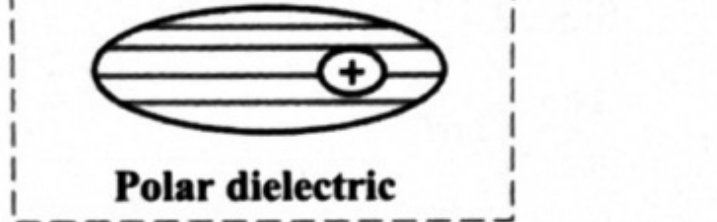
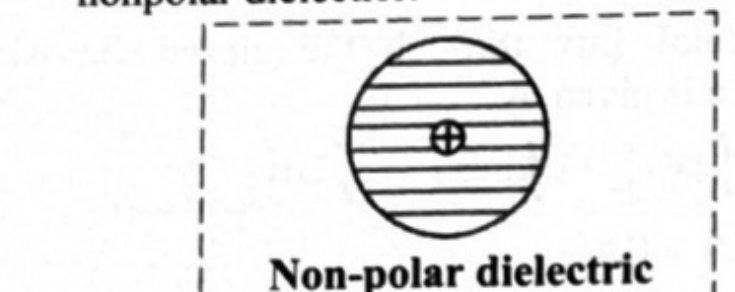
| The centre of mass of the positive charges (protons) does not coincide with the centre of mass of the negative charges (electrons) | The centre of mass of the positive charges coincides with that of the negative charges |
| Because of the asymmetric shape of the molecule | Because of the symmetric shape of the molecule |
| Permanent dipole moment of the order of ; they act as tiny electric dipoles | Zero dipole moment in the normal state |
| Examples: HCl, water, alcohol, | Examples: , , , , benzene, methane |
- Diagram notes: for a polar molecule, draw the two charge centres displaced — the HCl molecule as H and Cl with the centres apart, and the water molecule bent, with the two O–H bonds inclined at about ; its dipole moment is . For a non-polar molecule, draw the two centres coinciding — as a symmetric pair, as a linear symmetric O=C=O.
- Quick classification asked directly by the board: is a polar dielectric, is a non-polar dielectric.
Polarisation of a non-polar dielectric in an external field
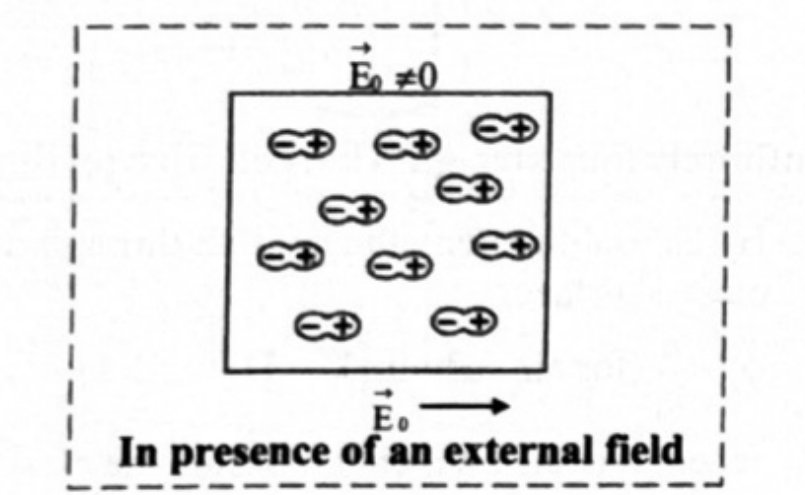
- In the presence of an external electric field , the centre of the positive charge in each molecule of a non-polar dielectric is pulled in the direction of , while the centre of the negative charges is displaced in the opposite direction. The two centres are therefore separated and the molecule gets distorted.
- The displacement of the charges stops when the force exerted on them by the external field is balanced by the restoring force between the charges in the molecule (the field of the induced dipole of the molecule).
- Each molecule becomes a tiny dipole having a dipole moment.
- The induced dipole moments of different molecules add up, giving a net dipole moment to the dielectric in the presence of the external field.
- Diagram: one figure of the slab with randomly drawn neutral molecules and no field, and a second of the same slab in a field with every molecule drawn as a small aligned dipole, so that an apparent sheet of negative charge appears on the face towards the field source and positive on the far face.
Polarisation of a polar dielectric in an external field
- The molecules of a polar dielectric have tiny permanent dipole moments, but due to thermal agitation in the absence of any external field these are randomly oriented, so the total dipole moment is zero.
- When an external field is applied, the dipole moments of different molecules tend to align with the field, and the dielectric develops a net dipole moment in the direction of the field. It is then polarised.
- The extent of polarisation depends on the relative values of two opposing influences: the applied external field, which tends to align the dipoles with the field, and the electric field due to the induced dipoles. The greater the applied field, the greater the degree of alignment and the greater the polarisation field.
- Both polar and non-polar dielectric materials develop a net dipole moment in the presence of an electric field. Since the charges are not free to move about, no current results; the electric field only rearranges the charges slightly, over distances less than an atomic diameter.
Definition of polarisation
- Polarisation: certain substances, when placed in an external field, have their positive and negative charges displaced in opposite directions so that the molecules develop a net dipole moment. This is the polarisation of the material.
- Quantitatively, the dipole moment per unit volume is called polarisation, denoted . For linear isotropic dielectrics,
- is a constant called the electric susceptibility of the dielectric medium. It describes the electrical behaviour of a dielectric and has different values for different materials; for vacuum .
Reduction of the electric field due to polarisation
- Consider a rectangular dielectric slab placed in a uniform field acting parallel to two of its faces.
- As a result of the alignment of the dipole moments, there is an apparent sheet of positive charge on one side of the dielectric and of negative charge on the other. These two sheets of induced surface charges produce an electric field in the insulator, called the polarisation field, which opposes the applied field .
- The net field inside the dielectric is the vector sum of the applied field and the polarisation field, so in magnitude
- The field inside a dielectric is therefore always less than the external field — this is exactly why inserting a dielectric raises the capacitance of a capacitor, and .
Two extra points
- The induced dipole moment disappears when the field is removed. It is responsible for the attraction of a charged object towards an uncharged insulator — a charged comb picking up uncharged bits of paper.
- If a large enough field is applied the atoms can be ionised and charge begins to flow as in a conductor. The field required for this breakdown is called the dielectric strength. Dielectric constants range from 1 for air up to about 9 for mica and glass; for metals it is infinite.
Theory Questions Asked on This Subtopic
Real board questions. Answers are at the end of the page.
- 1
[Oct 15] With the help of neat diagram, explain how non-polar dielectric material is polarised in external electric field of increasing intensity. Define polarisation in dielectrics.
 Maharashtra HSC board questionAnswer 1 ↓
 - 2
[Mar 22] What are polar dielectrics and non-polar dielectrics?
 Maharashtra HSC board questionAnswer 2 ↓
 - 3
[July 23] Categorize the following into polar and non-polar dielectrics: a. H₂O b. CO₂
Maharashtra HSC board questionAnswer 3 ↓
Answers & Solutions
Work the questions above first, then check yourself here. Each answer is set out the way it should be written in the paper.
i. In the presence of an external electric field E₀, the centres of the positive charge in each molecule of a non-polar dielectric is pulled in the direction of E₀, while the centres of the negative charges are displaced in the opposite direction. Thus, the two centres are separated and the molecule gets distorted. ii. The displacement of the charges stops when the force exerted on them by the external field is balanced by the restoring force between the charges in the molecule. iii. Each molecule becomes a tiny dipole having a dipole moment. iv. The induced dipole moments of different molecules add up giving a net dipole moment to the dielectric in the presence of the external field. v. Polarisation: Certain substances when are placed in an external field, their positive and negative charges get displaced in opposite directions and the molecules develop a net dipole moment. This is called polarization of the material.
i. Polar dielectric: a. A dielectric molecule in which the centre of mass of positive charges (protons) does not coincide with the centre of mass of negative charges (electrons), because of the asymmetric shape of the molecules is called polar dielectric. b. They have permanent dipole moments of the order of Cm. They act as tiny electric dipoles, as the charges are separated by a small distance. c. Examples: HCl, water, alcohol, NH₃ ii. Non-polar dielectric: A dielectric in which the centre of mass of the positive charges coincides with the centre of mass of the negative charges is called a nonpolar dielectric. b. These have symmetrical shapes and have zero dipole moment in the normal state. c. Examples: H₂, N₂, O₂, CO₂, benzene, methane
H₂O – polar dielectric CO₂ – non-polar dielectric