1.5
Coulomb's Law
Electric Charges and Fields · CBSE
Theory
Statement
The mutual electrostatic force between two point charges at rest is directly proportional to the product of the magnitudes of the charges, inversely proportional to the square of the distance between them, and directed along the line joining them.
Here and is the permittivity of free space.
Vector form — what a full-mark answer writes
Let and sit at position vectors and . Write for the vector from to , and for the unit vector along it. Then the force on due to is
- The single equation covers both cases. If (like charges) is along , that is, away from — repulsion. If (unlike charges) it is along — attraction. So a pair of arrows drawn pointing towards each other tells you at once that .
- Interchanging and gives : Coulomb's law is consistent with Newton's third law.
Coulomb's experiment
- Coulomb used a torsion balance, a sensitive device for measuring small forces, later used by Cavendish for gravitation.
- The charges on his metallic spheres were unknown to begin with. He obtained known sub-multiples by touching a charged sphere of charge to an identical uncharged sphere: by symmetry each then carries , and repeating gives , and so on. (This assumes both additivity and conservation of charge.)
- He then varied the distance for a fixed pair of charges, and varied the charges at fixed distance, and compared the forces to arrive at the inverse-square product law.
- The law has been verified from the macroscopic scale down to subatomic distances of about .
Definition of the coulomb that follows
Putting and into gives . So one coulomb is that charge which, placed at from an equal charge in vacuum, experiences a repulsive force of — evidently far too big a unit for laboratory electrostatics.
Effect of a medium
In a medium of dielectric constant (relative permittivity) ,
Since for every insulator, inserting a plastic sheet between two charged balls reduces the force between them by the factor . Two suspended identical charged balls therefore hang closer together when a dielectric sheet is placed between them.
Identical conductors brought into contact
Touching two identical conducting spheres carrying and leaves each with
- Example: and give on each. Both are now positive, so the force after separation is repulsive.
- Example: and give each. If they are then placed at , the new force is against the original , so , giving .
Forces between multiple charges (NCERT 1.6, folded in here)
Coulomb's law alone cannot handle more than two charges. The extra experimental input is the principle of superposition:
The force on any one charge due to a number of other charges is the vector sum of the forces exerted on it by each of the others taken one at a time, and each of those pairwise forces is unaffected by the presence of the remaining charges.
For a system ,
Each term is exactly the two-charge Coulomb force, written as though the other charges were absent. Add the terms by the parallelogram law, or resolve into components:
For two equal perpendicular contributions this gives at to each — the pattern behind the standard question with on the -axis, on the -axis and at the origin, whose answer is .
Equilibrium of three collinear charges — the standard 3-mark derivation
Two identical charges are fixed apart at and . A third charge is placed on the line joining them so that the whole system is in equilibrium. Find its position and sign.
- Sign first. If were positive, the net force on itself could vanish, but each would then feel repulsion from the other and from in the same direction, so the system as a whole could not be in equilibrium. Hence must be negative.
- Position next. Let and . For to be in equilibrium the two attractions must balance:
So is negative and sits at the midpoint, from either charge.
Standard results
- : doubling the separation quarters the force; halving it quadruples the force.
- : doubling one charge doubles the force.
- A charge at a distance from a point on a square of side : for the diagonal-type geometries CBSE sets, compute by Pythagoras before substituting. If one charge is at a corner and another at the midpoint of the opposite side, , so that force is one fifth of the force at separation .
- Coulomb force is much stronger than gravitation: for a proton and an electron.
Theory Questions Asked on This Subtopic
Real board questions. Answers are at the end of the page.
- 1
Two identical conducting balls and have charges and respectively. They are brought in contact with each other and then separated by a distance apart. Find the nature of the Coulomb force between them.
- 2
Two equal balls having equal positive charge '' coulombs are suspended by two insulating strings of equal length. What would be the effect on the force when a plastic sheet is inserted between the two?
- 3
Two identical point charges, each, are kept apart in air. A third point charge of unknown magnitude and sign is placed on the line joining the charges such that the system remains in equilibrium. Find the position and nature of .
Numericals
Every numerical set on this subtopic. Full working is at the end of the page.
- 4
Three charges , and are placed as shown in the figure. The magnitude of the net force on the charge at point is (charges at , at origin , at )
- (a)
- (b)
- (c)
- (d)
- (a)
- 5
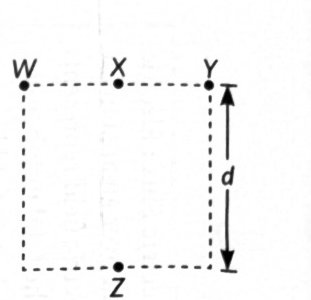
Four objects , , and each with charge are held fixed at four points of a square of side as shown in the figure. Objects and are on the midpoints of the sides of the square. The electrostatic force exerted by object on object is . Then the magnitude of the force exerted by object on is
- (a)
- (b)
- (c)
- (d)
- (a)
Answers & Solutions
Work the questions above first, then check yourself here. Each answer is set out the way it should be written in the paper.
Final charge on each ball As both balls now have the same nature of charge (both ), the Coulomb force between them is repulsive.
In air, ; in the medium (plastic), , where is the dielectric constant (relative permittivity) of the material and for insulators. Hence, the force is reduced when a plastic sheet is inserted between the two balls.
Let be placed on the line joining the charges such that and , where and are the two charges , apart. If is positive, it experiences forces due to the other two charges in opposite directions, so the net force on can be zero — but the repulsive force acting on either (due to the other and due to ) will not be zero, since those forces act in the same direction. So must be negative in nature. For charge to be in equilibrium, the forces on it due to at and at must be equal and opposite: i.e., the position of the third charge (negative) is at the midpoint, from either charge .
Force on due to (attractive, along towards ): , along -direction. Force on due to (repulsive, along , away from ): , along -direction. Since and are equal in magnitude and perpendicular to each other, the net force on is
Force on by (separated by ): ...(i) Distance between and : Force on by : Using (i),