7.10
Resolving Power
Wave Optics · Maharashtra HSC
Theory
Resolving power and limit of resolution
An optical instrument is used not only to magnify but to see fine detail and to see nearby objects as distinct. Two fingers held up 10 m away are easily seen as two; from 50 m most eyes cannot tell whether it is one finger or two.
- Resolving power: the ability of an optical instrument (eye, microscope, telescope) to distinguish two physically separated objects as two distinct objects.
- It depends, in general, on the aperture of the instrument (usually the diameter of the lens or mirror) and on the wavelength of light used.
- Resolving ability is stated in terms of the visual angle — the angle subtended at the instrument by the two point objects to be resolved. The MINIMUM such angle that the instrument can resolve is called the limit of resolution.
- Resolving power is the reciprocal of the limit of resolution.
- Diffraction is what sets the limit: each object produces a diffraction pattern, and the patterns overlap.
7.10.1 Rayleigh's criterion
According to Lord Rayleigh, the ability of an optical instrument to distinguish between two closely spaced objects depends on the diffraction patterns of the two objects (slits, point objects, stars) produced at the screen (retina, eyepiece).
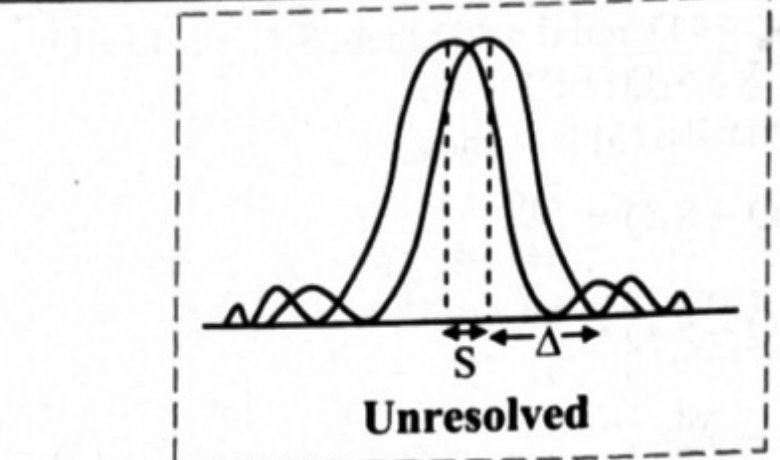
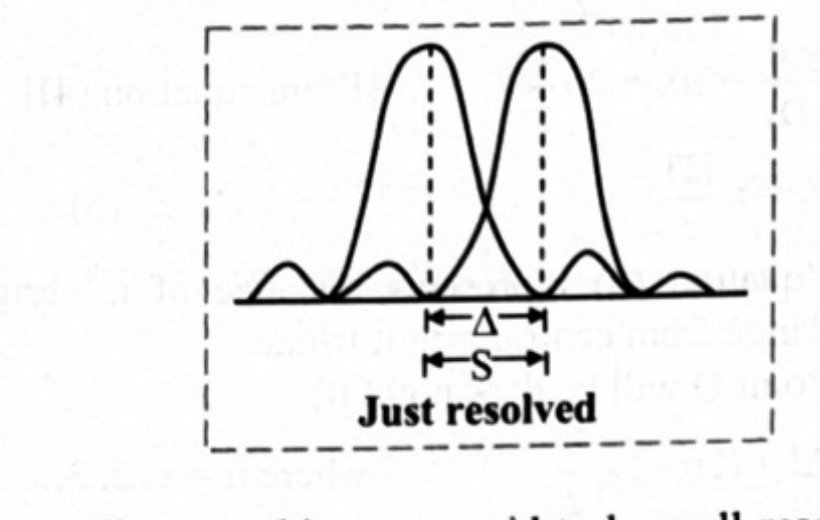
Criterion: two objects are JUST RESOLVED when the first minimum of the diffraction pattern of one source coincides with the central maximum of the diffraction pattern of the other, and vice versa.
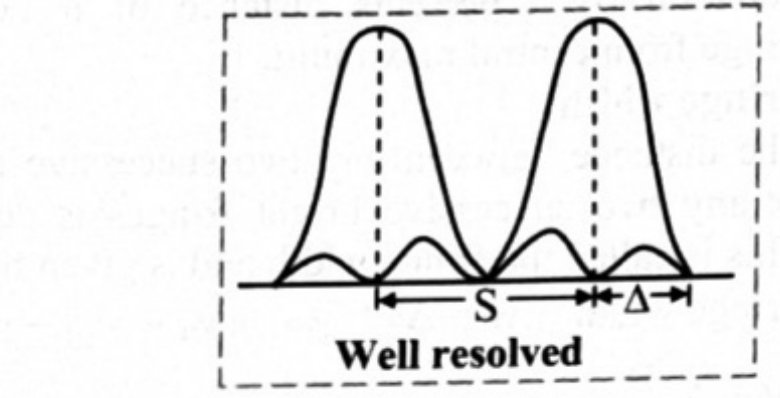
Let be the separation between the central maxima of the two patterns and the distance from the central maximum to the first minimum of either pattern.
| Case | Condition | Appearance |
|---|---|---|
| Unresolved | The depression in the resultant envelope is not noticeable | |
| Just resolved | The depression is just noticeable | |
| Well resolved | The depression is clearly noticeable |
Two linear objects
Consider two self luminous linear objects (slits) separated by some distance. By Rayleigh's criterion the first minimum of the diffraction pattern of one must coincide with the central maximum of the other. The angular position of the first principal minimum of a slit of width is
As this minimum coincides with the central maximum of the other pattern, this is the minimum angular separation between the two objects — the limit of resolution of that instrument:
The minimum separation between two linear objects that are just resolved, at distance from the instrument, is
which is simply the distance of the first minimum from the centre.
A pair of point objects
For a microscope, the objects are usually point objects. The diffraction pattern of a point object is a central bright disc surrounded by concentric rings — the Airy disc and rings (Abbe first studied this and applied it to Fraunhofer diffraction). For such objects to be just resolved, the first dark ring of the diffraction pattern of the first object must be formed at the centre of the diffraction pattern of the second, and vice versa. In other words, the minimum separation between the images on the screen is the radius of the first dark ring.
This discussion applies to any instrument — an eye, a microscope, a telescope.
7.10.2 Resolving power of a microscope
Two point objects and are separated by a distance in front of the objective of a microscope. The medium between the objects and the objective has refractive index , and the wavelength of the light in that medium is . The angular separation subtended by the objects at the objective is .
and are the centres of the diffraction patterns (Airy discs and rings) due to and on the screen, effectively at infinity. By Rayleigh's criterion the first dark ring due to should coincide with , and that of with . The illumination at a point is decided by the effective path difference there. Consider the point where the first dark ring due to is located: the extreme rays reaching from are and . Since is equidistant from and , the paths and are equal, so the actual path difference is . From the enlarged geometry around and it can be shown that
(i) A pair of non-luminous (dark) objects
In ordinary microscopy the objects are not self luminous; they are illuminated by an external source, usually obliquely, and most of them can be treated as point objects producing Airy rings. Often the space is filled with a transparent material of refractive index , so the wavelength there is , being the wavelength in air.
In such a set-up the path difference at the first dark ring is , so
The factor is called the numerical aperture (N.A.). The resolving power is
(ii) A pair of self luminous point objects
Applying Abbe's theory of Airy discs and rings to Fraunhofer diffraction by a pair of self luminous point objects, the path difference between the extreme rays at the first dark ring is . For just resolution,
For better resolution should be as small as possible; this is achieved with an oil-immersion objective, which provides a higher value of .
Factors, and how to increase it
- The resolving power of a microscope depends on the numerical aperture of the objective and on the wavelength of the light used.
- It can be increased by: (a) reducing the distance of separation between the two objects; (b) filling the space at the objective with a material of high refractive index , such as oil; (c) using a source of small wavelength .
- Since , a very short wavelength gives very high resolution. Electrons behave as waves (Chapter 14) and their wavelength can be controlled through their speed — this is the principle of the electron microscope, which can magnify about times and resolve objects less than 10 nm apart, against about mm for an ordinary optical microscope.
7.10.3 Resolving power of a telescope
The diagram to draw
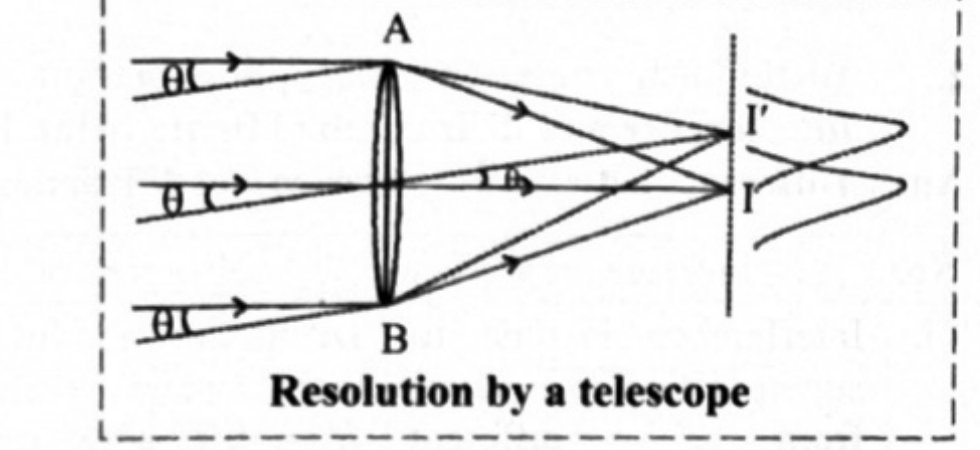
The objective of the telescope receives two sets of parallel beams from two distant point objects (stars) whose angular separation is . The two beams are brought to foci at and , each of which is an Airy disc with rings around it.
Derivation
- A telescope is used to see distant stars, which for us are luminous point objects; their diffraction patterns are Airy discs.
- Since the objects are far away, only the ANGULAR separation between them matters, not the linear separation.
- Resolving power of a telescope is defined as the reciprocal of the least angular separation between two objects that are just resolved.
- By Rayleigh's criterion, the minimum separation between the images and must be equal to the radius of the first dark Airy ring.
- Applying Airy's theory to Fraunhofer diffraction of a pair of point objects, the path difference between the extreme rays at the first dark ring is :
- If is the aperture of the telescope (the diameter of its objective),
- Factors: the resolving power of a telescope depends on the aperture of the objective and on the wavelength of the light used. For a given wavelength, the objective should be as large as possible.
Practical points
Very large lenses bring aberrations, moulding difficulties and, for space telescopes, a heavy mass that is hard to move. The preferred alternative is a front-coated curved mirror as the objective, parabolic in order to eliminate spherical aberration. A single very large mirror is also difficult, so recent telescopes use segmented mirrors made of many hexagonal segments forming one large parabolic mirror; the two largest optical telescopes under construction have mirrors of 30 m and 40 m diameter.
Radio telescope. Radio wavelengths are of the order of metres, so by an aperture of at least a few kilometres would be needed to match the limit of resolution of an optical telescope. A single dish of that size is impracticable, so arrays of antennae spread over several kilometres are used. The Giant Metre-wave Radio Telescope (GMRT) at Narayangaon near Pune, Maharashtra, is such an array: 30 dishes of 45 m diameter each, spread over 25 km, which is the largest distance between two of its antennae. Its highest angular resolution ranges from about 60 arcsec at the lowest frequency of 50 MHz to about 2 arcsec at 1.4 GHz.
Standard results
- Rayleigh's criterion: just resolved when the first minimum of one pattern falls on the central maximum of the other.
- Two linear objects: , least separation .
- Microscope, non-luminous objects: , .
- Microscope, self-luminous point objects: , , with .
- Telescope: (radian), .
- 1 arcsec of a degree; convert only when the question asks.
Theory Questions Asked on This Subtopic
Real board questions. Answers are at the end of the page.
- 1
Explain the resolving power of a telescope with the help of a neat ray diagram. On what factors does it depend?
 Maharashtra HSC board question — asked in October 2008Answer 1 ↓
 - 2
What is resolving power of an optical instrument?
Maharashtra HSC board question — asked in October 2009Answer 2 ↓ - 3
Explain Rayleigh's criterion for central maximum. OR Explain Rayleigh's criterion for the resolution of two close point objects, when their images are i. just resolved, ii. well resolved and iii. unresolved.
 Maharashtra HSC board question — asked in July 2019; October 2009Answer 3 ↓
 - 4
State the factors on which resolving power of microscope depends. How can it be increased?
Maharashtra HSC board question — asked in February 2020Answer 4 ↓
Numericals
Every numerical set on this subtopic. Full working is at the end of the page.
- 5
The minimum angular separation between two stars is rad, if telescope is used to observe them with an objective of aperture 16 cm. Find the wavelength of light used.
Maharashtra HSC board question — asked in October 2013Answer 5 ↓
Answers & Solutions
Work the questions above first, then check yourself here. Each answer is set out the way it should be written in the paper.
i. Telescope is used to see distant stars which can be considered to be luminous point objects. Hence, their diffraction patterns are Airy discs. ii. Also, as the objects to be seen are far off, only the angular separation between the two is of importance and not the linear separation between them iii. Consider AB of a telescope receiving two sets of parallel beams from two distant objects with an angular separation θ, as shown in figure below: iv. According to Rayleigh's criterion, the minimum separation between the images I and I' must be equal to the radius of the first dark Airy ring. v. If Airy's theory is applied to Fraunhofer diffraction of a pair of point objects, the path difference between the extreme rays, at the first dark ring is given by 1.22λ. vi. If D is the aperture of the telescope (diameter AB of its objective), and resolving power, vii. Factors: Resolving power of telescope depends upon the aperture of lens of the objective of telescope and wavelength of light used.
Ability to distinguish two physically separated objects as two distinct objects is known as the resolving power of an optical instrument.
i. According to Lord Rayleigh, the ability of an optical instrument to distinguish between two closely spaced objects depends upon the diffraction patterns of the two objects (slits, point objects, stars, etc.), produced at the screen (retina, eyepiece, etc.). ii. The two objects are said to be unresolved, if the separation between the central maximum of the two object is less than the distance between the central maximum and first minimum of any of the two objects i.e., S < Δ iii. Two objects are said to be just resolved when the separation between the central maxima of the two objects is just equal to the distance between the central maximum and the first minimum of any of the two objects i.e., S = Δ. iv. The two objects are said to be well resolved, if the separation between the central maximum of the two objects is greater than the distance between the central maximum and first minimum of any of the two objects i.e., S > Δ. v. Thus, depression in the resultant envelope is not noticeable in unresolved diffraction pattern, noticeable in just resolve diffraction pattern and clearly noticeable in well resolved pattern.
i. Resolving power of microscope depends on numerical aperture of objective of microscope and wavelength of light used. ii. Resolving power of a microscope can be increased by, a. Reducing distance of separation between two objects, b. Eyepiece should be filled with material of high refractive index (n) such as oil, c. Source with small value of wavelength (λ) should be used.
Given: θ = rad, D = 16 cm = 0.16 m To find: Wavelength of light used (λ) Formula: Calculation: From formula, = {antilog[log (64) − log (1.22)]}× 10 = {antilog [1.8062 − 0.0864]} × 10 = {antilog [1.7198]} × 10 = 52.46× 10 m = 5246 Å Ans: The wavelength of light used is 5246 Å.