15.8
Nuclear Binding Energy
Structure of Atoms and Nuclei · Maharashtra HSC
Theory
The idea
- In a hydrogen atom the electron in the ground state is bound to the proton with : that much energy is released when the atom is formed from a free proton and a free electron, and that much must be supplied to separate them again.
- The protons and neutrons inside a nucleus are bound to one another in the same way. The energy that must be supplied to the nucleus to separate all its nucleons and take them far apart is the binding energy of the nucleus, and the same amount is released when the nucleus is assembled from free nucleons.
Where the energy comes from — mass defect
- The mass of a nucleus is smaller than the total mass of its constituent nucleons. Let the nucleus have atomic number , mass number and mass ; then
- is called the mass defect: the difference between the sum of the masses of the constituent nucleons and the actual mass of the nucleus.
Binding energy
- With masses in u, multiply the mass defect by to get directly in MeV.
- Data are usually given as atomic masses rather than nuclear masses. Add and subtract the mass of electrons on the right-hand side:
- where is the mass of a hydrogen atom () and is the atomic mass of the element concerned. Use this atomic-mass form whenever atomic masses are supplied.
- Worked check: for with , and the atomic mass ,
- Worked check with nuclear masses: for the alpha particle of mass , using and , .
Binding energy per nucleon
- This is the average energy that has to be supplied to a nucleon to remove it from the nucleus and make it free. It lets the stabilities of different species be compared: the higher the value of , the more stable the nucleus.
- Worked check: for americium, of atomic mass , , so per nucleon.
The binding-energy curve (Fig. 15.6, described in words)
- Plot in MeV on the vertical axis against the mass number on the horizontal axis.
- The curve begins very low on the left. Deuterium has the smallest value of and is therefore the least stable nucleus.
- The value rises steeply with increasing and reaches a plateau for between and ; the nuclei of these elements are the most stable of all species.
- The peak of the curve occurs around , corresponding to iron, which is thus one of the most stable nuclei.
- Beyond the value of decreases gradually, making the heavier nuclei slightly less stable, and it goes on decreasing up to , uranium being the heaviest naturally occurring element.
- Note that the binding energy of the hydrogen nucleus, which is a single proton, is zero — there is nothing for it to be bound to.
Why this curve matters
- Both fission and fusion move nuclei towards the top of this curve. A heavy nucleus splitting into two middle-weight fragments, and two light nuclei fusing into a heavier one, both increase , so both reduce the total mass and release the difference as energy.
Related definitions the board pairs with this section
- Mass defect: the difference between the actual mass of the nucleus and the sum of the masses of its constituent nucleons.
- Binding energy: the energy required to separate the nucleons of a nucleus and take them to large distances from one another; equivalently, the energy released when the nucleus is formed from free nucleons.
- Binding energy per nucleon: binding energy divided by the mass number, the measure of nuclear stability.
Theory Questions Asked on This Subtopic
Real board questions. Answers are at the end of the page.
- 1
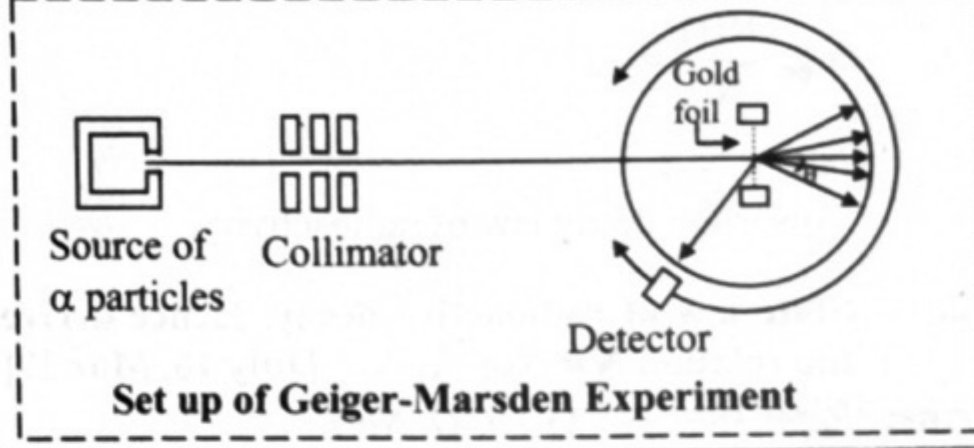
With the help of a neat labelled diagram, describe the Geiger-Marsden experiment. What is mass defect?
 Maharashtra HSC board question — asked in March 2016Answer 1 ↓
Answers & Solutions
Work the questions above first, then check yourself here. Each answer is set out the way it should be written in the paper.
Geiger-Marsden experiment: i. The experimental arrangement is as shown in the figure. ii. In this experiment, a narrow beam of -particles from radioactive source was incident on a gold foil. iii. The scattered particles produced scintillations on the surrounding screen. iv. The scintillations were observed through a microscope which could be moved to cover different angles with respect to the incident beam. Observations: i. Most alpha particles passed straight through the foil. ii. A few were deflected (scattered) through various scattering angles. iii. Only about 0.14% of the incident alpha particles were scattered through angles larger than . iv. About one alpha particle in 8000 was deflected through angle larger than and a fewer still were deflected through angles as large as . Mass defect: The difference between the actual mass of the nucleus and the sum of masses of constituent nucleons is called mass defect.