15.6
Bohr's Atomic Model
Structure of Atoms and Nuclei · Maharashtra HSC
Theory
The three postulates
- Bohr kept Rutherford's picture, which he judged to be essentially correct, and added the quantum ideas needed to make the orbits stable and to stop the electrons in them from radiating as classical electromagnetic theory demands.
Postulate 1
- In a hydrogen atom the electron revolves round the nucleus in a fixed circular orbit with constant speed. The centripetal force needed for the circular motion is provided by the electrostatic force of attraction between the electron and the nucleus.
Postulate 2
- The radius of the orbit of an electron can only take certain fixed values such that the angular momentum of the electron in these orbits is an integral multiple of , being Planck's constant.
- Such orbits are called stable orbits or stable states, and electrons in them do not radiate. Different orbits therefore have different, definite values of angular momentum and of energy. The positive integer is the principal quantum number, and the minimum angular momentum, for , is .
Postulate 3
- An electron can make a transition from one of its orbits to another orbit having lower energy. In doing so it emits a photon of energy equal to the difference in its energies in the two orbits.
- where is the energy of the electron in the higher orbit and that in the lower orbit.
Radius of the Bohr orbit
- Let be the mass of the electron, its charge, the charge on the nucleus, its linear speed in the orbit and the radius of that orbit.
- From the first postulate, Coulomb force = centripetal force :
- From the second postulate, , so squaring,
- Equating (1) and (2),
- The radius is proportional to and inversely proportional to . For hydrogen, , and substituting the values of , , and gives , the Bohr radius, the radius of the smallest orbit in hydrogen.
- Worked check: the third orbit of hydrogen has .
Speed of the electron
- Eliminating instead of between the same two equations gives
- so , and for hydrogen .
Energy of the electron in the orbit
Kinetic energy
- From the first postulate, , so
Potential energy
- The electric potential at the electron's position due to the nuclear charge is , and the potential energy of the electron of charge in it is :
Total energy
- Substituting from the radius result,
- This is the required expression for the energy of the electron in the orbit.
- The negative sign shows that the electron is bound to the nucleus by an attractive force, and energy must be supplied to it to make it free.
- Since , , and are all constants, is a constant, so , that is : the energy of the electron is inversely proportional to the square of the principal quantum number.
- Putting in the values of the constants for hydrogen gives the working form
Binding energy, excitation energy and ionisation energy
- Binding energy of an electron is the minimum energy required to make it free from the nucleus. When that energy is supplied, the total energy of the nucleus-plus-electron system becomes zero:
- For hydrogen in the ground state, . Bringing a proton and an electron together from infinity to form a hydrogen atom releases .
- Ionisation energy of an atom is the minimum amount of energy that must be given to an electron in the ground state of that atom to set it free; for hydrogen it is , and it is the binding energy of the hydrogen atom. For an electron already in the orbit, the ionisation energy is .
- Excitation energy of an electron in a given state is the difference between its energy in that state and its energy in the ground state. For hydrogen the minimum excitation energy, of the state, is ; for it is .
- The orbit, of minimum energy, is the ground state; orbits of higher and higher energy are excited states.
Energy level diagram (described in words)
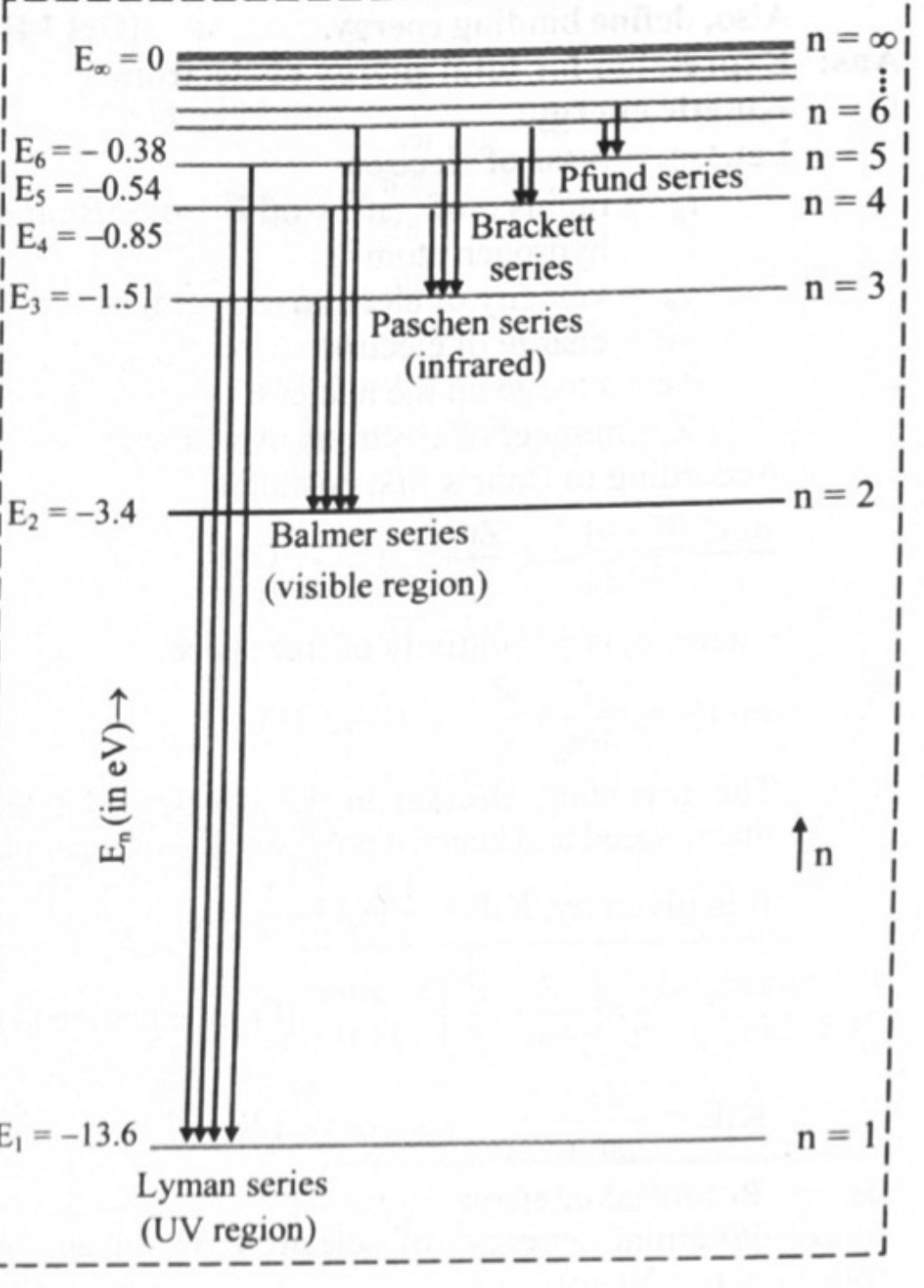
- Draw a set of horizontal lines one above the other, energies increasing upwards and marked on the left: at , at , at , at , at , at , and a line at the top marked , .
- The levels are widely spaced at the bottom and come closer and closer as increases, reaching zero as . Energy is not to scale in the textbook figure.
- Draw downward arrows to show transitions: all arrows ending on are labelled the Lyman series, those ending on the Balmer series, those ending on the Paschen series, those ending on the Brackett series, those ending on the Pfund series.
Bohr's formula for the wave number
- By the third postulate, when an electron falls from the to the orbit (),
- With and ,
- Using ,
- Defining Rydberg's constant ,
- This is Rydberg's formula; is the wave number of the line. With it reproduces exactly the observed hydrogen spectrum, which is the great success of Bohr's model.
The spectral series from the model
- Lyman series: transitions from higher states to ; ultraviolet; with
- Balmer series: transitions to the orbit; with ; lies in the visible region; contains infinitely many lines of which four are seen, called , , and . Wavelengths for and are about and .
- Paschen series: transitions to the orbit; with ; lies in the infrared region, is invisible and contains infinitely many lines. Wavelengths for and are and .
- Brackett series: transitions to the orbit; with ; lies in the near infrared and contains infinitely many lines. Wavelengths for and are and .
- Longest wavelength of a series comes from ; shortest wavelength, the series limit, from , giving .
- For the Lyman (ultraviolet) series: and . Scaling from that limit, the Balmer, Paschen and Brackett limits are , and times it, i.e. , and .
- Standard result to be able to show: the frequency of the first line of the Lyman series is , while the limiting frequencies of the Lyman and Balmer series are and ; their difference is also , so the two are equal.
Motion of the electron in the orbit
- Period of revolution ; frequency of revolution ; angular speed .
- Since and , the angular speed and is greatest in the first orbit: .
- Number of revolutions made in a time is .
- Change in angular momentum for a jump between orbits: .
Limitations of Bohr's model
- It could not explain the line spectra of atoms other than hydrogen; even for hydrogen, a more accurate study showed some lines to have multiple components that the model cannot account for.
- The intensities of the emission lines differ from line to line, and the model offers no explanation of that.
- Theoretically it is unsatisfactory: it simply assumes, with no theoretical basis, that orbits obeying a particular condition are stable. A full quantum mechanical treatment is needed.
De Broglie's explanation of the second postulate
- De Broglie suggested viewing the orbiting electron not as a particle but as a standing wave, just like the standing waves on a string or in a pipe.
- A standing wave closes on itself only if the length of the orbit is an integral multiple of the electron's de Broglie wavelength: the first orbit holds one wavelength, the second holds two, and so on.
- With this gives , so the angular momentum is
- which is exactly Bohr's second postulate. Treating electrons as waves therefore gives it a theoretical basis.
- Diagram in words: a circle representing the fourth orbit, with a smooth wavy curve drawn along it that completes exactly four full wavelengths and joins up with itself without a break.
Standard results collected
- with ; .
- ; for hydrogen.
- ; .
- ; minimum value .
- , .
- ; ionisation energy ; excitation energy .
Theory Questions Asked on This Subtopic
Real board questions. Answers are at the end of the page.
- 1
State the postulates of Bohr's theory of hydrogen atom. Write down necessary equations.
Maharashtra HSC board question — asked in October 2009Answer 1 ↓ - 2
Derive an expression for the total energy of electron in 'n' th Bohr orbit. Hence show that energy of the electron is inversely proportional to the square of principal quantum number. Also, define binding energy.
Maharashtra HSC board question — asked in October 2014Answer 2 ↓ - 3
Obtain an expression for the radius of Bohr orbit for H-atom.
Maharashtra HSC board question — asked in March 2015Answer 3 ↓ - 4
State Bohr's third postulate for hydrogen () atom.
Maharashtra HSC board question — asked in March 2010; October 2015Answer 4 ↓ - 5
Derive Bohr's formula for the wave number.
Maharashtra HSC board question — asked in March 2010; October 2015Answer 5 ↓ - 6
Draw a neat, labelled energy level diagram for H atom showing the transitions. Explain the series of spectral lines for H atom, whose fixed inner orbit numbers are 3 and 4 respectively.
 Maharashtra HSC board question — asked in March 2017Answer 6 ↓
 - 7
Draw a neat and labelled energy level diagram and explain Balmer series and Brackett series of spectral lines for hydrogen atom.
Maharashtra HSC board question — asked in March 2018Answer 7 ↓ - 8
Obtain an expression for energy of an electron in Bohr orbit. Hence obtain the expression for its binding energy.
Maharashtra HSC board question — asked in July 2018Answer 8 ↓ - 9
What is the expression for minimum angular momentum of electron in hydrogen atom?
Maharashtra HSC board question — asked in July 2019Answer 9 ↓ - 10
State any two postulates of Bohr's theory of hydrogen atom.
Maharashtra HSC board question — asked in February 2020Answer 10 ↓ - 11
What is the mathematical formula for third postulate of Bohr's atomic model?
Maharashtra HSC board question — asked in March 2022Answer 11 ↓ - 12
Derive an expression for the radius of the Bohr orbit of the electron in hydrogen atom.
Maharashtra HSC board question — asked in March 2022Answer 12 ↓ - 13
State the first and second postulate of Bohr's atomic model.
Maharashtra HSC board question — asked in July 2022Answer 13 ↓ - 14
State postulates of Bohr's atomic model.
Maharashtra HSC board question — asked in February 2023Answer 14 ↓ - 15
What is binding energy of a hydrogen atom?
Maharashtra HSC board question — asked in February 2024Answer 15 ↓
Numericals
Every numerical set on this subtopic. Full working is at the end of the page.
- 16
Find the energy of an electron in second Bohr orbit of hydrogen atom. [Energy of an electron in the first Bohr orbit = – 13.6 eV]
Maharashtra HSC board question — asked in March 2008Answer 16 ↓ - 17
Second member of Balmer series of hydrogen atom has wavelength 4860 A.U. Calculate Rydberg's constant. Hence calculate energy in eV when electron is orbiting in third Bohr orbit. [Plank's constant = J s. Speed of light in vacuum = m/s, 1 eV = J]
Maharashtra HSC board question — asked in October 2008Answer 17 ↓ - 18
The velocity of electron in the first Bohr orbit of radius 0.5 A.U. is m/s. Calculate the period of revolution of electron in the same orbit.
Maharashtra HSC board question — asked in March 2009Answer 18 ↓ - 19
Find the value of energy of electron in eV in the third Bohr orbit of hydrogen atom. [Rydberg's constant (R) = m, Planck's constant (h) = J – s, Velocity of light in air (c) = m/s.]
Maharashtra HSC board question — asked in March 2013Answer 19 ↓ - 20
Calculate the radius of second Bohr orbit in hydrogen atom from the given data. Mass of electron = kg, Charge on the electron = C, Planck's constant = J-s, Permittivity of free space = C²/Nm²
Maharashtra HSC board question — asked in March 2014Answer 20 ↓ - 21
An electron is orbiting in Bohr orbit. Calculate ionisation energy for this atom, if the ground state energy is –13.6 eV.
Maharashtra HSC board question — asked in March 2015Answer 21 ↓ - 22
Obtain expressions for longest and shortest wavelength of spectral lines in ultraviolet region for hydrogen atom.
Maharashtra HSC board question — asked in October 2015Answer 22 ↓ - 23
Find the frequency of revolution of an electron in Bohr's orbit; if the radius and speed of electron in that orbit is m and m/s respectively. []
Maharashtra HSC board question — asked in March 2017Answer 23 ↓ - 24
Find the ratio of longest wavelength in Paschen series to shortest wavelength in Balmer series.
Maharashtra HSC board question — asked in July 2017Answer 24 ↓ - 25
The electron in the hydrogen atom is moving with a speed of m/s in an orbit of radius 0.53 Å. Calculate the period of revolution of electron. ()
Maharashtra HSC board question — asked in March 2018Answer 25 ↓ - 26
The energy of an excited hydrogen atom is –0.85 eV. Find the angular momentum of the electron. (h = Js, , eV)
Maharashtra HSC board question — asked in July 2018Answer 26 ↓ - 27
Calculate the wavelength of line and series limit for Brackett series.
Maharashtra HSC board question — asked in July 2019Answer 27 ↓ - 28
Energy of an electron in the second Bohr orbit is –3.4 eV. Calculate the energy of an electron in the third Bohr orbit.
Maharashtra HSC board question — asked in February 2020Answer 28 ↓ - 29
Determine the shortest wavelengths of Balmer and Paschen series. Given the limit for Lyman series is 912 Å.
Maharashtra HSC board question — asked in March 2022Answer 29 ↓ - 30
Compute the ratio of longest wavelengths of Lyman and Balmer series in hydrogen atom.
Maharashtra HSC board question — asked in July 2022Answer 30 ↓ - 31
Radius of the third Bohr orbit is 0.477 nm. Calculate the radius of the second Bohr orbit.
Maharashtra HSC board question — asked in July 2023Answer 31 ↓ - 32
Calculate the shortest wavelength of Paschen series and longest wavelength of Balmer series for H – atom.
Maharashtra HSC board question — asked in July 2023Answer 32 ↓ - 33
Calculate the change in angular momentum of electron when it jumps from third orbit to first orbit in hydrogen atom.
Maharashtra HSC board question — asked in February 2024Answer 33 ↓ - 34
Calculate the wavelength of the first two lines in Balmer series of hydrogen atom.
Maharashtra HSC board question — asked in February 2024Answer 34 ↓
Answers & Solutions
Work the questions above first, then check yourself here. Each answer is set out the way it should be written in the paper.
Bohr's three postulates are: i. In a hydrogen atom, the electron revolves round the nucleus in a fixed circular orbit with constant speed. Equation according to Bohr's first postulate, ii. The radius of the orbit of an electron can only take certain fixed values such that the angular momentum of the electron in these orbits is an integral multiple of , h being the Planck's constant. Equation according to Bohr's second postulate, iii. An electron can make a transition from one of its orbits to another orbit having lower energy. In doing so, it emits a photon of energy equal to the difference in its energies in the two orbits. Equation according to Bohr's third postulate, where, = Energy of electron in higher orbit, = Energy of electron in lower orbit
Expression for total energy of electron: i. Kinetic energy: Let, = mass of electron, = radius of orbit of Bohr's hydrogen atom, = velocity of electron, = charge of electron, = charge on the nucleus, Z = number of electrons in an atom. According to Bohr's first postulate, where, is permittivity of free space. The revolving electron in the circular orbit has linear speed and hence it possesses kinetic energy. It is given by, ii. Potential energy: Potential energy of electron is given by, P.E where, V = electric potential at any point due to charge on nucleus, = charge on electron. In this case, iii. Total energy: The total energy of the electron in any orbit is its sum of P.E and K.E. iv. But, Substituting for in equation (4), This is required expression for energy of electron in orbit of Bohr's hydrogen atom. v. The negative sign in equation (5) shows that the electron is bound to the nucleus by an attractive force and hence energy must be supplied to the electron in order to make it free from the influence of the nucleus. vi. As m, e, , and h in equation (5) are constant, Using equation (5), Binding energy: Binding energy of an electron is the minimum energy required to make it free from the nucleus.
Expression for radius of Bohr orbit in atom: i. Let, = mass of electron, = charge on electron, = radius of Bohr's orbit, = charge on nucleus, = linear velocity of electron in orbit, Z = number of electrons in an atom, n = principal quantum number. ii. From Bohr's first postulate, Coulomb's force = Centripetal force iii. According to Bohr's second postulate, iv. From equations (1) and (2), This is the required expression for radius of orbit.
An electron can make a transition from one of its orbits to another orbit having lower energy. In doing so, it emits a photon of energy equal to the difference in its energies in the two orbits.
i. Let, = Energy of electron in higher orbit, = Energy of electron in lower orbit. ii. According to Bohr's third postulate, iii. But iv. From equations (1), (2) and (3), where, c = speed of electromagnetic radiation v. But, = Rydberg's constant Equation (4) represents Rydberg's formula for atomic spectrum. vi. is called wave number () of the line.
Paschen series: i. The spectral lines which correspond to the transition of an electron from some higher energy state to 3rd orbit are termed as Paschen series. ii. For Paschen series, n = 3 and m = 4, 5,... The wave numbers and the wavelengths of the spectral lines constituting the Paschen series are given by, iii. Paschen series lies in the infrared region of the spectrum which is invisible and contains infinite number of lines. iv. Wavelengths for m = 4 and 5 are 18750 Å and 12820 Å respectively. Brackett series: i. The spectral lines which correspond to the transition of an electron from a higher energy state to the orbit are termed as Brackett series. ii. For this series, n = 4 and m = 5, 6, 7,... The wave numbers and the wavelengths of the spectral lines constituting the Brackett series are given by, iii. This series lies in the near infrared region of the spectrum and contains infinite number of lines. Wavelengths for m = 5 and 6, are 40518 Å and 26253 Å respectively.
[From 15.6, Q6]
Paschen series: i. The spectral lines which correspond to the transition of an electron from some higher energy state to 3rd orbit are termed as Paschen series. ii. For Paschen series, n = 3 and m = 4, 5,... The wave numbers and the wavelengths of the spectral lines constituting the Paschen series are given by, iii. Paschen series lies in the infrared region of the spectrum which is invisible and contains infinite number of lines. iv. Wavelengths for m = 4 and 5 are 18750 Å and 12820 Å respectively. Brackett series: i. The spectral lines which correspond to the transition of an electron from a higher energy state to the orbit are termed as Brackett series. ii. For this series, n = 4 and m = 5, 6, 7,... The wave numbers and the wavelengths of the spectral lines constituting the Brackett series are given by, iii. This series lies in the near infrared region of the spectrum and contains infinite number of lines. Wavelengths for m = 5 and 6, are 40518 Å and 26253 Å respectively.for diagram and explanation of Brackett series. Balmer series: i. The spectral lines of this series correspond to the transition of an electron from some higher energy state to orbit. ii. For Balmer series, n = 2 and m = 3, 4, 5, The wave numbers and the wavelengths of spectral lines constituting the Balmer series are given by, iii. There are infinite number lines in this series out of which four lines are seen called , , , . iv. This series lies in the visible region. Wavelengths for m = 3 and 4 are 6563 Å and 4868 Å respectively.
[From 15.6, Q2] Expression for total energy of electron: i. Kinetic energy: Let, = mass of electron, = radius of orbit of Bohr's hydrogen atom, = velocity of electron, = charge of electron, = charge on the nucleus, Z = number of electrons in an atom. According to Bohr's first postulate, where, is permittivity of free space. The revolving electron in the circular orbit has linear speed and hence it possesses kinetic energy. It is given by, ii. Potential energy: Potential energy of electron is given by, P.E where, V = electric potential at any point due to charge on nucleus, = charge on electron. In this case, iii. Total energy: The total energy of the electron in any orbit is its sum of P.E and K.E. iv. But, Substituting for in equation (4), This is required expression for energy of electron in orbit of Bohr's hydrogen atom. v. The negative sign in equation (5) shows that the electron is bound to the nucleus by an attractive force and hence energy must be supplied to the electron in order to make it free from the influence of the nucleus. vi. As m, e, , and h in equation (5) are constant, Using equation (5), Binding energy: Binding energy of an electron is the minimum energy required to make it free from the nucleus.for expression for energy of an electron in Bohr orbit. Expression for binding energy of electron in Bohr orbit: iii. When binding energy is supplied to an electron, the total energy of the system containing nucleus and electron becomes zero. iv. But
Minimum angular momentum of electron in hydrogen atom is .
[From 15.6, Q1 (Statements only)] Bohr's three postulates are: i. In a hydrogen atom, the electron revolves round the nucleus in a fixed circular orbit with constant speed. Equation according to Bohr's first postulate, ii. The radius of the orbit of an electron can only take certain fixed values such that the angular momentum of the electron in these orbits is an integral multiple of , h being the Planck's constant. Equation according to Bohr's second postulate, iii. An electron can make a transition from one of its orbits to another orbit having lower energy. In doing so, it emits a photon of energy equal to the difference in its energies in the two orbits. Equation according to Bohr's third postulate, where, = Energy of electron in higher orbit, = Energy of electron in lower orbit [Any two]
Bohr's third postulate: Where, = Energy of electron in higher orbit, = Energy of electron in lower orbit.
[From 15.6, Q3] Expression for radius of Bohr orbit in atom: i. Let, = mass of electron, = charge on electron, = radius of Bohr's orbit, = charge on nucleus, = linear velocity of electron in orbit, Z = number of electrons in an atom, n = principal quantum number. ii. From Bohr's first postulate, Coulomb's force = Centripetal force iii. According to Bohr's second postulate, iv. From equations (1) and (2), This is the required expression for radius of orbit.
[From 15.6, Q1] Bohr's three postulates are: i. In a hydrogen atom, the electron revolves round the nucleus in a fixed circular orbit with constant speed. Equation according to Bohr's first postulate, ii. The radius of the orbit of an electron can only take certain fixed values such that the angular momentum of the electron in these orbits is an integral multiple of , h being the Planck's constant. Equation according to Bohr's second postulate, iii. An electron can make a transition from one of its orbits to another orbit having lower energy. In doing so, it emits a photon of energy equal to the difference in its energies in the two orbits. Equation according to Bohr's third postulate, where, = Energy of electron in higher orbit, = Energy of electron in lower orbit[(i) and (ii)] (Statements only)
[From 15.6, Q1 (Statements only)] Bohr's three postulates are: i. In a hydrogen atom, the electron revolves round the nucleus in a fixed circular orbit with constant speed. Equation according to Bohr's first postulate, ii. The radius of the orbit of an electron can only take certain fixed values such that the angular momentum of the electron in these orbits is an integral multiple of , h being the Planck's constant. Equation according to Bohr's second postulate, iii. An electron can make a transition from one of its orbits to another orbit having lower energy. In doing so, it emits a photon of energy equal to the difference in its energies in the two orbits. Equation according to Bohr's third postulate, where, = Energy of electron in higher orbit, = Energy of electron in lower orbit
[From 15.6, Q2 (vi)] Expression for total energy of electron: i. Kinetic energy: Let, = mass of electron, = radius of orbit of Bohr's hydrogen atom, = velocity of electron, = charge of electron, = charge on the nucleus, Z = number of electrons in an atom. According to Bohr's first postulate, where, is permittivity of free space. The revolving electron in the circular orbit has linear speed and hence it possesses kinetic energy. It is given by, ii. Potential energy: Potential energy of electron is given by, P.E where, V = electric potential at any point due to charge on nucleus, = charge on electron. In this case, iii. Total energy: The total energy of the electron in any orbit is its sum of P.E and K.E. iv. But, Substituting for in equation (4), This is required expression for energy of electron in orbit of Bohr's hydrogen atom. v. The negative sign in equation (5) shows that the electron is bound to the nucleus by an attractive force and hence energy must be supplied to the electron in order to make it free from the influence of the nucleus. vi. As m, e, , and h in equation (5) are constant, Using equation (5), Binding energy: Binding energy of an electron is the minimum energy required to make it free from the nucleus. (Definition of Binding energy only)
Given: eV To find: Energy of electron in second Bohr orbit () Formula: Calculation: From formula, Ans: Energy of an electron in the third orbit is –3.4 eV.
Given: J s, Å m, m/s, 1 eV J To find: i. Rydberg's constant () ii. Energy in eV () Formulae: i. ii. iii. Calculation: For the line of Balmer series, n = 2 and m = 4 Using formula (i) Now, using formulae (ii) and (iii) we get, Ans: i. The value of Rydberg's constant is m. ii. Energy in eV of electron in the third orbit is –1.515 eV.
Given: Å m m To find: Period of revolution (T) Formula: Calculation: Using formula (i) we get, s Ans: Period of revolution of electron in the first Bohr orbit is s.
Given: m, J-s, m/s, , C To find: Energy of electron in orbit () Formula: (in eV) Calculation: From Formula, eV Ans: The value of energy of electron in the third Bohr orbit of hydrogen atom is 1.515 eV.
Given: kg, C, J-s, C²/Nm², To find: Radius of Bohr orbit () Formula: Calculation: From formula, Å Ans: Radius of second Bohr orbit is 2.127 Å.
Given: eV, , To find: Ionisation energy Formulae: i. ii. Ionisation energy Calculation: Using formula (i), Using formula (ii), Ionisation energy eV Ans: Ionisation energy for given atom is 0.544 eV.
Given: For longest wavelength m = 2, for shortest wavelength m = To find: i. Longest wavelength () ii. Shortest wavelength () Formula: Calculation: The ultraviolet region for hydrogen atom lies in the Lyman series. For the longest wavelength (), from formula, For Lyman series shortest wavelength (), from formula, Ans: The expression for longest and shortest wavelength of spectral lines in ultraviolet region for hydrogen atom is and respectively.
Given: m, n = 2, m/s To find: Frequency of revolution () Formula: Calculation: From formula, Hz Ans: The frequency of revolution of electron in Bohr orbit is Hz.
Let, = shortest wavelength, = longest wavelength Longest wavelength in Paschen series is obtained when n = 3, m = 4 For longest wavelength, Shortest wavelength in Balmer series is obtained when n = 2, m = For shortest wavelength, Ans: The ratio of longest wavelength in Paschen series to shortest wavelength in Balmer series is 5.131.
Given: m/s, Å m To find: Period of revolution (T) Formula: Calculation: Using formula, s Ans: Period of revolution of electron is s.
Given: J.s, eV, eV To find: Angular momentum of the electron (L) Formulae: i. ii. Calculation: Using formula (i) Using formula (ii) kg m²/s Ans: The angular momentum of the electron in the fourth orbit in a hydrogen atom is kg m²/s.
In hydrogen spectrum, line corresponds to m = 5 line of Balmer series (n = 2). Wavelength of line is given by formula, For series limit of Brackett series, n = 5 and m = , Ans: The wavelengths corresponding to line and series limit of Brackett series are 4357 Å and 22873 Å respectively.
Given: eV To find: Energy of electron in third orbit () Formula: Calculation: From formula, eV Ans: Energy of an electron in the third orbit is –1.51 eV.
Given: Series limit of Lyman Series, () = 912 Å To find: Shortest wavelength of i. Balmer series ii. Paschen series Formula: Calculation: From formula, for shortest wavelength, m = For Lyman series, n = 1 i. For Balmer series, n = 2 ii. For Paschen series, n = 3 Ans: The shortest wavelength of i. Balmer series is 3648 Å. ii. Paschen series is 8208 Å.
For hydrogen: For longest wavelength of Lyman series, n = 1 and m = 2 For longest wavelength of Balmer series, n = 2 and m = 3
Radius of Bohr orbit,
For hydrogen: The shortest wavelength is obtained when m = . For shortest wavelength of Paschen series, n = 3 and m = For longest wavelength of Balmer series, n = 2 and m = 3
Angular momentum of electron in first orbit, Angular momentum of electron in third orbit, Change in angular momentum, kg m²/s
Given: m, We know that, for Balmer series, n = 2 To find: i. Wavelength of first line of Balmer series ii. Wavelength of second line of Balmer series Formula: For Balmer series, Calculation: i. For first line in Balmer series, m = 3 From formula, Using reciprocal table, m 6563 Å ii. For second line in Balmer series, m = 4 From formula, Using reciprocal table, m 4862 Å Ans: i. The wavelength of the first line of the Balmer series is 6563 Å. ii. The wavelength of the second line of the Balmer series is 4862 Å.