8.2
Application of Gauss' law
Electrostatics · Maharashtra HSC
Theory
Statement of Gauss' theorem
- The flux of the net electric field through a closed surface equals the net charge enclosed by the surface divided by .
- where is the total charge within the surface.
Electric field intensity due to a uniformly charged spherical shell (hollow sphere)
Set-up and diagram
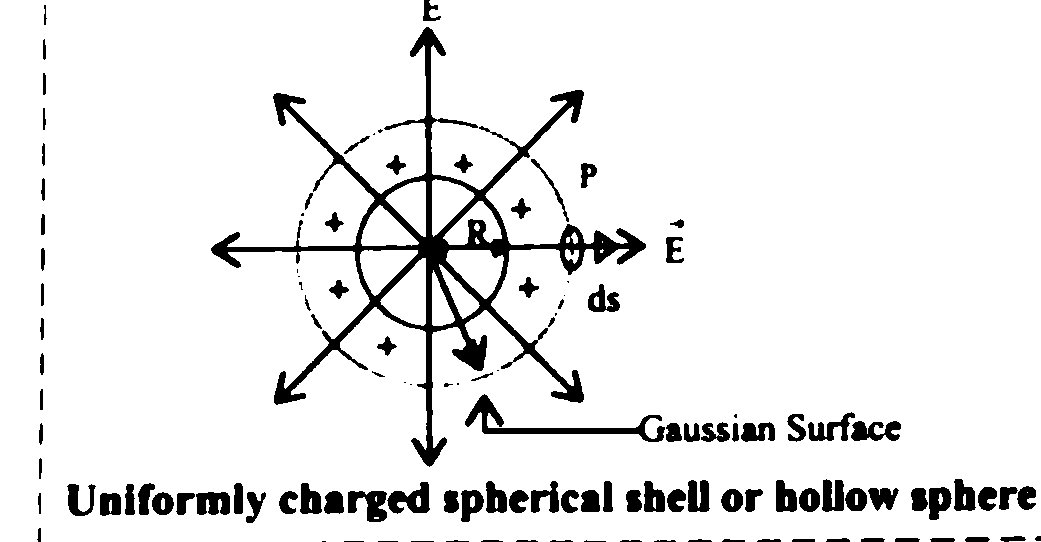
- Consider a sphere of radius with its centre at O, charged to a uniform surface charge density (), placed in a dielectric medium of permittivity (). The total charge on the sphere is .
- To find the field at a point P at distance from the centre, imagine a concentric Gaussian sphere of radius passing through P. Let be a small area around P on this Gaussian surface. In the diagram, draw the charged shell, the larger dashed Gaussian sphere through P, and the radially outward arrows for and for the outward normal at P.
Derivation
- By Gauss' theorem, the net flux through the closed Gaussian surface is
- By symmetry, and because the spheres are concentric, the field has the same magnitude at every point of the Gaussian surface and is directed radially outward. The angle between and the normal is zero, so :
- Flux through the area is , so the total flux is
- From (1) and (2),
- Substituting ,
The two special cases
- Point P on the surface, : .
- Point P inside the shell, : there is no charge inside the Gaussian surface, so and .
Result
- , , .
- The field outside is exactly that of a point charge, so a uniformly charged sphere is equivalent to a point charge at its centre.
Electric field intensity due to an infinitely long straight charged wire
Set-up and diagram
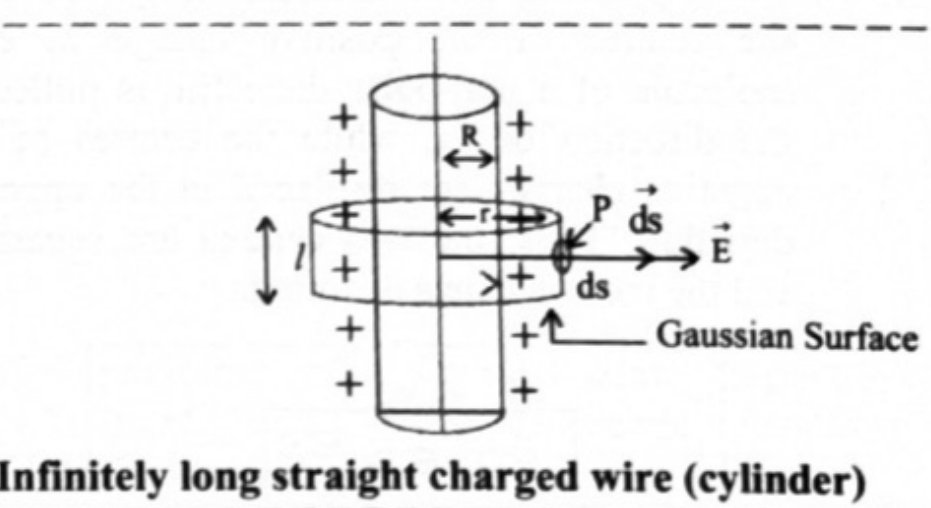
- Consider a uniformly charged wire of infinite length with constant linear charge density (charge per unit length), kept in a medium of permittivity .
- To find the field at P at a perpendicular distance from the axis, imagine a coaxial Gaussian cylinder of length and radius , closed at each end by plane caps normal to the axis, passing through P. Take a small area at P on the curved surface. The diagram shows the wire along the axis, the dashed cylinder around it, and pointing radially outward at P, in the plane of the end caps.
Derivation
- By Gauss' theorem,
- By symmetry the field has the same magnitude everywhere on the curved surface and is directed radially outward. The angle between and is zero on the curved surface and on the flat caps:
- Hence the whole flux passes through the curved surface, of area :
- From (1) and (2), with so that ,
Result
- in air; in a medium of dielectric constant , . This is also the field outside an infinitely long charged cylindrical conductor.
- The field is directed outward if is positive and inward if is negative, and falls off as .
Electric field due to a charged infinite plane sheet
Set-up and diagram
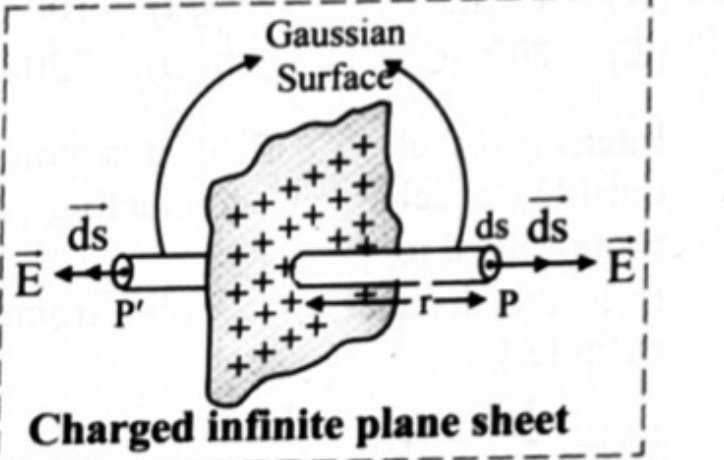
- Consider a uniformly charged infinite plane sheet with uniform surface charge density , kept in a medium of permittivity .
- To find the field at P at a distance from the sheet, take a Gaussian surface in the form of a cylinder of cross-sectional area and length , with its axis perpendicular to the sheet. The sheet passes through the middle of the cylinder so that the two end caps P and P' are each at a distance from it. The diagram shows the sheet edge-on, the cylinder piercing it symmetrically, and arrows for perpendicular to the sheet on both sides.
Derivation
- By Gauss' theorem,
- By symmetry the field is perpendicular to the sheet and directed outwards, with the same magnitude at a given distance on either side. It is therefore at right angles to the end caps, and tangential to the curved surface, so the flux through the curved surface is zero.
- because and for the end caps, while and for the curved surface. Hence
- From (1) and (2), with so that ,
Result
- , independent of the distance from the sheet.
- The direction is outward if the sheet is positively charged and inward if it is negatively charged.
Fields at a charged conductor's surface
- Just outside any charged conductor of surface area carrying charge , whatever its shape,
- and the outward mechanical force per unit area of the surface is
- These two are the working formulae for the standard "conductor of any shape, area , charge " numerical.
Theory Questions Asked on This Subtopic
Real board questions. Answers are at the end of the page.
- 1
[Oct 09] Obtain an expression for electric field intensity at a point outside a charged conducting sphere.
 Maharashtra HSC board questionAnswer 1 ↓
 - 2
[July 17] Obtain an expression for electric field intensity at a point outside uniformly charged thin plane sheet.
 Maharashtra HSC board questionAnswer 2 ↓
 - 3
[July 18] State Gauss' theorem in electrostatics. State the expression for electric field intensity at a point outside an infinitely long charged conducing cylinder.
Maharashtra HSC board questionAnswer 3 ↓ - 4
[July 22] State the formula for electric field intensity at a point outside an infinitely long charged cylindrical conductor.
Maharashtra HSC board questionAnswer 4 ↓ - 5
[July 23] Derive an expression for electric field intensity due to an infinitely long straight charged wire.
 Maharashtra HSC board questionAnswer 5 ↓
Numericals
Every numerical set on this subtopic. Full working is at the end of the page.
- 6
[Mar 16] A conductor of any shape, having area 40 cm² placed in air is uniformly charged with a charge 0.2 μC. Determine the electric intensity at a point just outside its surface. [ S.I. units]
Maharashtra HSC board questionAnswer 6 ↓ - 7
[Feb 24] A spherical metal ball of radius 15 cm carries a charge of 2 μC. Calculate the electric field at a distance of 20 cm from the centre of the sphere.
Maharashtra HSC board questionAnswer 7 ↓
Answers & Solutions
Work the questions above first, then check yourself here. Each answer is set out the way it should be written in the paper.
i. Consider a sphere of radius R with its centre at O, charged to a uniform surface charge density σ placed in a dielectric medium of permittivity ε (ε = ε₀k). The total charge on the sphere, . ii. To find the electric field intensity at a point P, at a distance r from the centre of the charged sphere, imagine a concentric Gaussian sphere of radius r passing through P as shown in the figure below. Let ds be a small area around the point P on the Gaussian surface. iii. By Gauss' theorem, the net flux through a closed Gaussian surface, where q is the total charge inside the closed surface. iv. Due to symmetry and spheres being concentric, the electric field at each point on the Gaussian surface has the same magnitude E and it is directed radially outward. Also, the angle between the direction of E and the normal to the surface of the sphere (ds) is zero i.e. Total electric flux through the Gaussian surface v. From equations (1) and (2), This is the expression for the electric intensity at the point P, outside the charged sphere.
i. Consider a uniformly charged infinite plane sheet with uniform surface charge density (charge per unit area) σ kept in a medium of permittivity ε (ε = ε₀k). ii. To find the electric field due to a charged infinite plane sheet at P at a distance r from the sheet, imagine a Gaussian surface around P in the form of a cylinder having cross sectional area A and length 2r with its axis perpendicular to the plane sheet. The plane sheet passes through the middle of the length of the cylinder such that the ends of the cylinder (called end caps P and P') are equidistant (at a distance r) from the plane sheet as shown in the figure below. iii. By Gauss' theorem, the net flux through a closed surface where q is the total charge inside the closed surface. iv. By symmetry, electric field is perpendicular to the plane sheet and directed outwards, having the same magnitude at a given distance on either side of the sheet. The electric field is at right angles to the end caps and away from the plane. Its magnitude is the same at P and P'. The flux passing through the curved surface is zero as the electric field is tangential to this surface. The total flux through the closed Gaussian surface is given by, v. From equations (1) and (2), This is the required expression. vi. Direction of electric field is outward if sheet is positively charged and inward if it is negatively charged.
i. Gauss' law: The flux of the net electric field through a closed surface equals the net charge enclosed by the surface divided by ε₀. where q is the total charge within the surface. ii. Expression for electric field intensity at a point outside an infinitely long charged conducting cylinder:
[From 8.2, Q3 (ii)]
i. Gauss' law: The flux of the net electric field through a closed surface equals the net charge enclosed by the surface divided by ε₀. where q is the total charge within the surface. ii. Expression for electric field intensity at a point outside an infinitely long charged conducting cylinder:
i. Consider a uniformly charged wire of infinite length having a constant linear charge density λ (charge per unit length), kept in a medium of permittivity ε (ε = ε₀k). ii. To find the electric field intensity at P, at a distance r from the axis of the charged wire, imagine a coaxial Gaussian cylinder of length and radius r (closed at each end by plane caps normal to the axis) passing through the point P as shown in the figure. Consider a very small area ds at the point P on the Gaussian surface. iii. By Gauss' theorem, the net flux through a closed surface, where q is the total charge inside the closed surface. iv. By symmetry, the magnitude of the electric field will be the same at all the points on the curved surface of the cylinder and will be directed radially outward. The angle between the direction of and the normal to the curved surface of the cylinder is zero. Similarly, the angle is (π/2) for the flat surface of the cylinder. i.e., (for curved surface) or (for flat surface) ....(For flat surface) ....(For curved surface) Flux dφ through the area ds, Total electric flux through the Gaussian surface v. From equations (1) and (2) Since , The direction of the electric field E is directed outward if λ is positive and inward if λ is negative.
Given: Q = 0.2 μC = C, A = 40 cm² = m², S.I.units To find: i. Electric field intensity (E) ii. Mechanical force per unit area (f) Formulae: i. ii. iii. Calculation: i. Using formula (i) and (iii), ii. From formula (ii) Ans: i. Electric intensity is V/m ii. Mechanical force per unit area is 141.2 N/m²
Given: R = 15 cm = 0.15 m, q = 2 μC = C, r = 20 cm = 0.2 m To find: Electric field intensity (E) Formula: Calculation: From formula, Ans: The intensity of electric field at distance 20 cm from the centre of the ball is N/C.