4.6
Thermodynamic State Variables
Thermodynamics · Maharashtra HSC
Theory
Property of a System
A property, or system variable, is any measurable or observable characteristic of a system when the system remains in equilibrium. A property is also called a state variable of the system. Pressure, volume, temperature, density and mass are examples; because they are measurable they are called macroscopic variables.
Intensive and Extensive Variables
Consider a system in equilibrium and divide it into two equal compartments, each of half the original volume.
| Intensive variables | Extensive variables |
|---|---|
| Do not depend on the size of the system | Depend on the size of the system |
| Pressure , temperature , density | Total mass , volume , internal energy |
| Same in both halves | Equally divided between the two halves |
Thermodynamic Equilibrium
A system is in thermodynamic equilibrium if three conditions of equilibrium are satisfied simultaneously.
- Mechanical equilibrium: there are no unbalanced forces within the system or between the system and its surroundings; equivalently, the pressure throughout the system, and between the system and its surroundings, is the same. A system is in mechanical equilibrium when the pressure in it is the same throughout and does not change with time. Any unbalanced forces that exist get neutralised with time.
- Chemical equilibrium: no chemical reactions are going on within the system, and there is no transfer of matter from one part of the system to another by diffusion. A system is in chemical equilibrium when its chemical composition is the same throughout and does not change with time.
- Thermal equilibrium: the temperature of the system is uniform throughout and does not change with time.
A system that is not in equilibrium cannot be described in terms of state variables at all. Figure 4.9 shows such a case: when an inflated ball is punctured the air inside suddenly expands into the atmosphere, and during that rapid expansion the pressure of the air is not uniform. Likewise the fuel-air mixture in an automobile cylinder undergoing an explosive reaction on ignition is not in an equilibrium state, since its temperature and pressure are not uniform. Eventually each attains uniform temperature and pressure and reaches thermodynamic equilibrium with its surroundings.
In simple words, thermodynamic state variables describe the equilibrium states of a system.
Equation of State
Every equilibrium state of a thermodynamic system is completely described by specific values of some macroscopic variables. For a gas these are , , and mass . (For a mixture of gases or vapours, such as the fuel in an automobile engine, the composition is also needed.)
The state variables are not always independent; the mathematical relation between them is called the equation of state. For an ideal gas the equation of state is the ideal gas equation
where is the number of moles and the gas constant. For a fixed amount of gas there are therefore only two independent variables: and , or and , or and . Real gases obey more complicated equations of state, such as the van der Waals equation with its various corrections.
The p–V Diagram
The graphical representation of the equation of state of a system is called the – diagram, the – curve, or the indicator diagram of the system. Figure 4.10 shows a typical – diagram for an ideal gas at a constant temperature: a rectangular hyperbola falling from left to right, with pressure on the vertical axis and volume on the horizontal axis. A pressure-volume curve drawn for a constant temperature is called an isotherm.
The area under the – curve, between the two volume limits and down to the volume axis, represents the work done, because it is the graphical value of the integral . (Check the dimensions: pressure volume is N m m = N m = J, which is indeed work.)
Positive and Negative Work on a p–V Diagram
This is a set-piece board question. A gas confined to a cylinder with a movable, frictionless and massless piston can be expanded with varying pressure, compressed with varying pressure, or expanded at constant pressure.
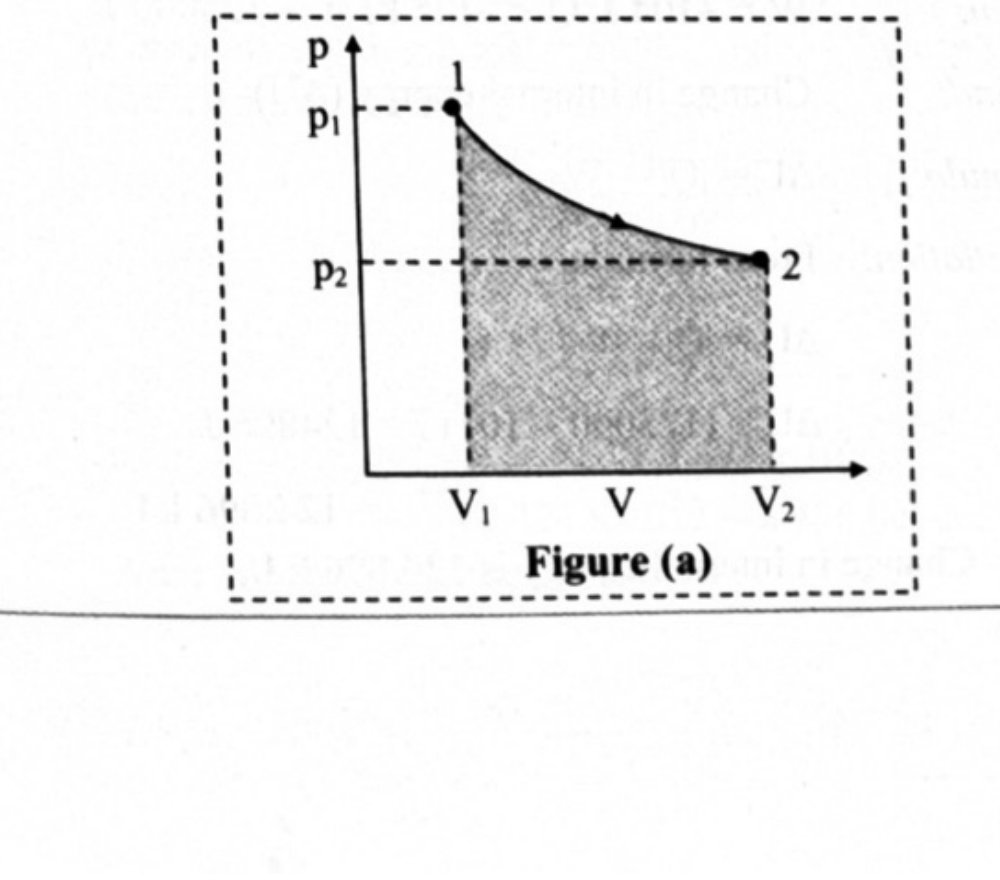
- Fig. 4.11 (a), expansion: the volume increases because of the outward displacement of the piston and the pressure of the gas decreases, so the curve falls from left to right. The work done by the gas is
As , the work done is positive. Example: a gas expanding and pushing a piston out, as in the power stroke of an engine.
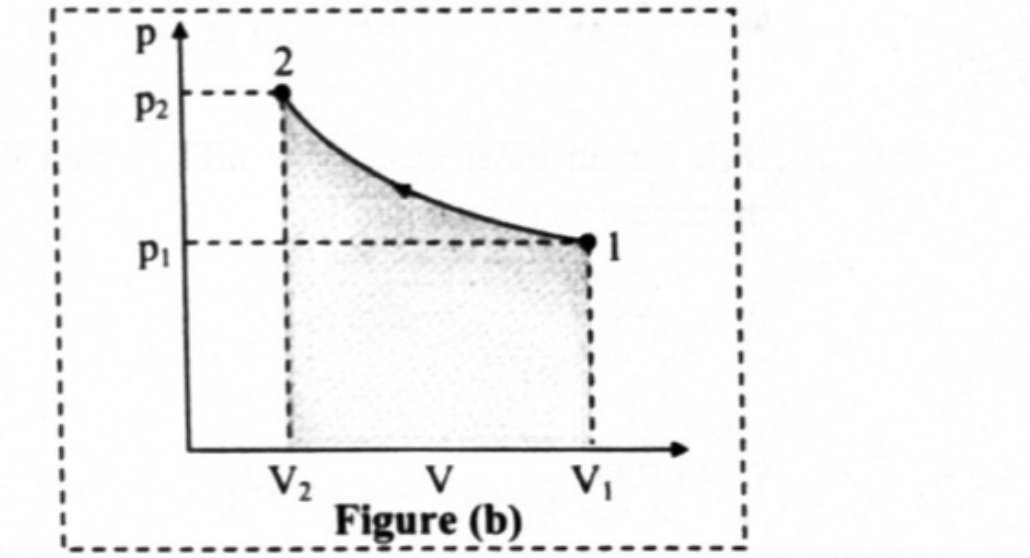
- Fig. 4.11 (b), compression: the piston is displaced inwards, the pressure of the gas is increased and the volume decreases. As , the work done by the gas is negative. Example: a gas being compressed by pushing the piston in, as in the compression stroke of an engine.
- Fig. 4.11 (c), expansion at constant pressure: the curve is a straight line parallel to the volume axis, drawn from to . The work done is the area of the rectangle under it, , and this is the one case in which the integral reduces to .
- When the volume is constant, the work done is zero because there is no displacement; the – curve is a vertical line enclosing no area.
Standard Results
- Expansion, : work positive. Compression, : work negative. Constant volume: work zero.
- Thermodynamic equilibrium = mechanical + chemical + thermal equilibrium, all three at once.
- Intensive variables (, , ) do not depend on system size; extensive variables (, , ) do.
Theory Questions Asked on This Subtopic
Real board questions. Answers are at the end of the page.
- 1
What are mechanical equilibrium and thermal equilibrium?
Maharashtra HSC board question — asked in March 2022Answer 1 ↓ - 2
Draw a p–V diagram and explain the concept of positive work done and negative work done.
 Maharashtra HSC board question — asked in July 2023Answer 2 ↓
Answers & Solutions
Work the questions above first, then check yourself here. Each answer is set out the way it should be written in the paper.
i. Mechanical equilibrium: a. For a system to be in mechanical equilibrium, there should not be any unbalanced forces acting within the system and between the system and its surrounding. b. Also, the pressure in the system should be same throughout the system and should not change with time. ii. Thermal equilibrium: For a system to be in thermal equilibrium, the temperature of the system should be uniform throughout and it should not change with time. A system when in thermal equilibrium is described in terms of state variables.
i. A gas confined to a cylinder with a movable, frictionless, and massless piston can be expanded with varying pressure or it can be compressed with varying pressure. It can also expand at constant pressure. ii. Figure (a) shows expansion of the gas at constant temperature. Its volume increases due to outward displacement of the piston and the pressure of the gas decreases. The work done by the gas in this case is given by, As dV > 0, the work done is positive. iii. Similarly, figure (b) shows compression due to inward displacement of the piston. The pressure of the gas is increased and the work done by the gas is now negative as volume is decreased.