4.4
Heat, Internal Energy and Work
Thermodynamics · Maharashtra HSC
Theory
Internal Energy
Every system, large or small, consists of a very large number of molecules. Internal energy is defined as the energy associated with the random, disordered motion of the molecules of a system. It is denoted by .
- It is quite different from the macroscopic ordered energy of a moving object. A glass of water at rest on a table has zero kinetic energy and (taking the table top as reference) zero potential energy, yet from kinetic theory its molecules are moving at random, so its internal energy is not zero.
- The internal energy of a substance is the total energy of all its atoms or molecules.
- For a monatomic ideal gas such as argon, is just the translational kinetic energy of the atoms, per atom.
- For a diatomic gas such as oxygen it is per molecule; for polyatomic gases such as carbon dioxide the rotational and vibrational kinetic energies must be added to the translational.
- For liquids and solids the potential energy of the molecules due to intermolecular attraction must also be counted.
- Internal energy of an ideal gas depends only on its temperature.
System, Surroundings and Boundary
- A thermodynamic system is a collection or group of objects that can form a unit which may have the ability to exchange energy with its surroundings.
- Anything that is not a part of the system is its surroundings or its environment.
- Example: water kept in a vessel is the system, the vessel is its boundary and the atmosphere around it is its surroundings.
| Type | Energy exchange | Matter exchange | Example |
|---|---|---|---|
| Open system | Allowed | Allowed | Water boiling in a kettle: heat escapes into the air and steam escapes too |
| Closed system | Allowed | Not allowed | Water boiling in a boiler with the valve closed: heat crosses the wall, steam does not |
| Isolated system | Not allowed | Not allowed | A thermos flask, completely sealed and insulated |
A thermodynamic process is a process in which the thermodynamic state of a system is changed — that is, in which , and change. Water heated in a covered vessel until it boils and produces steam that presses on the walls is an example.
Heat and the Sign Convention
Consider a glass of water on a table as the system, at temperature , with the room as the environment at temperature . If and differ, changes until the two are equal and thermal equilibrium is reached. ( also changes, though if the environment is very large the change may be too small to measure — but it is certainly not zero.) The change is caused by transfer of internal energy between the system and its environment.
Definition: heat is the energy that is transferred between a system and its environment due to a temperature difference that exists between the two. It is denoted by .
Convention, illustrated by Fig. 4.4:
- Fig. 4.4 (a), : energy flows into the system, the system gains energy, is positive.
- Fig. 4.4 (b), : energy flows out of the system, the system loses energy, is negative.
- Fig. 4.4 (c), : system and environment are in thermal equilibrium and there is no transfer, .
Change in Internal Energy: The Two Routes
The standard set-piece answer. Take as the system a gas enclosed in a cylinder fitted with a movable, massless and frictionless piston at one end. Let the temperature of the gas be and that of the environment be .
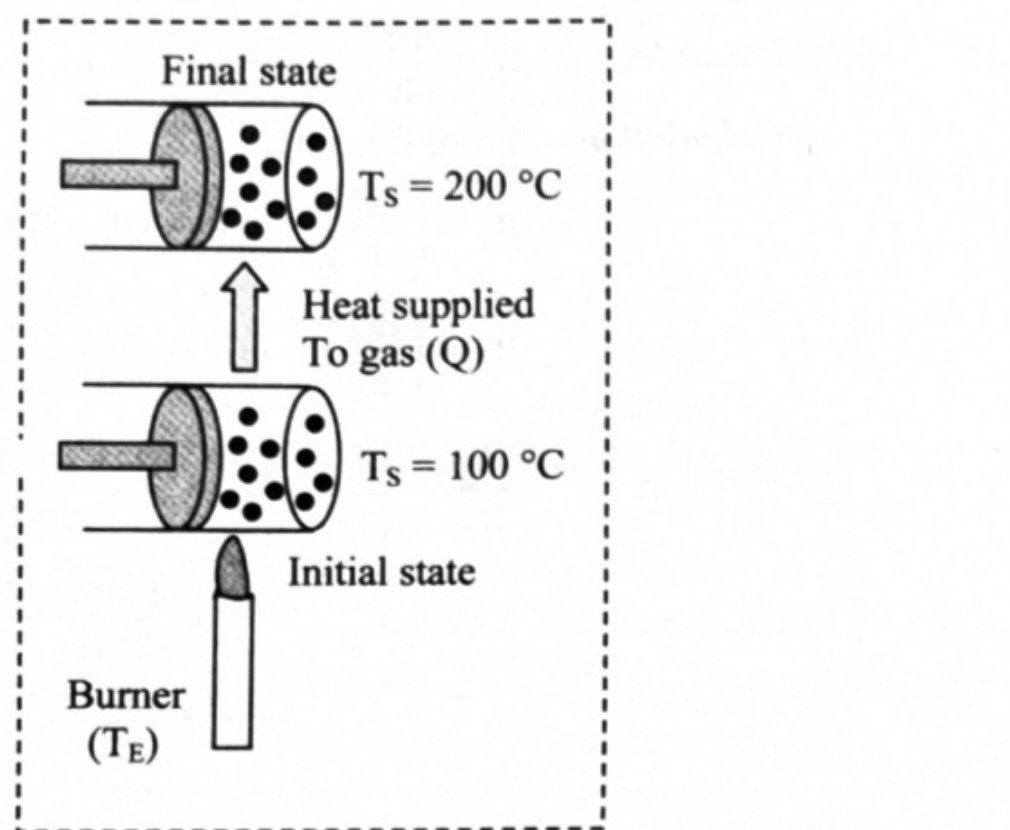
Route 1 — by heating the system (Fig. 4.5 (a)):
- The cylinder is brought into contact with a source of heat such as a burner.
- Since , the temperature difference between the source of heat (the environment) and the system causes a flow of energy, that is, heat, towards the gas in the cylinder.
- Thus there is an increase in the internal energy of the gas.
- Conversely, if the surroundings are at a temperature lower than the gas, , the gas loses energy to its environment and cools down.
Route 2 — by doing work on the system (Fig. 4.5 (b)):
- The piston is quickly pushed into the cylinder so that the gas is compressed. The piston does work on the gas through some distance, the gas gains energy and its temperature increases.
- Conversely, if the gas pushes the piston out and expands, work is done by the gas; it loses energy and cools down.
The experiment can be carried out carefully enough that the same change of temperature is produced by either route. That equivalence is what leads to the first law of thermodynamics.
Mechanical Equivalent of Heat
In the mid-nineteenth century James Joule showed that the mechanical work done and the heat produced while doing that work are equivalent:
where is the mechanical work, the heat produced, and the constant is the mechanical equivalent of heat.
Standard Results
- Internal energy: energy associated with the random, disordered motion of the molecules of a system.
- Surroundings: anything that is not part of a thermodynamic system.
- Heat: energy transferred between a system and its environment due to a temperature difference.
- Energy into the system is positive; energy out of the system is negative.
- The internal energy of a system can be changed in exactly two ways — by heating it, or by doing work on it.
- , the mechanical equivalent of heat.
Theory Questions Asked on This Subtopic
Real board questions. Answers are at the end of the page.
- 1
What is surroundings in thermodynamics?
Maharashtra HSC board question — asked in February 2024Answer 1 ↓ - 2
Explain the change in internal energy of a thermodynamic system (the gas) by heating it.
 Maharashtra HSC board question — asked in February 2024Answer 2 ↓
Answers & Solutions
Work the questions above first, then check yourself here. Each answer is set out the way it should be written in the paper.
Anything that is not part of a thermodynamic system is its surrounding or environment.
i. Consider a gas filled in a cylinder fitted with a movable, massless, and frictionless piston at one end as shown in figure. ii. Let the temperature of the gas be and that of the environment be . iii. The cylinder can be brought in contact with a source of heat such as a burner as shown in figure. iv. As , the temperature difference between the source of heat (environment) and the system will cause a flow of energy (heat) towards the gas in the cylinder. v. Thus, there will be an increase in the internal energy of the gas. vi. If the environment is at temperature lower than the gas, , the energy is transferred from the gas to the environment.