3.5
Pressure of Ideal Gas
Kinetic Theory of Gases and Radiation · Maharashtra HSC
Theory
Set-up and assumptions
Let there be moles of an ideal gas enclosed in a cubical box of volume , with the sides of the box parallel to the coordinate axes. The walls of the box are kept at a constant temperature . We use the word molecular speed rather than molecular velocity, since the kinetic energy of a molecule depends on the magnitude of the velocity irrespective of its direction.
- The gas molecules are in continuous random motion in various directions, colliding with one another and hitting the walls of the box and bouncing back.
- As a first approximation we neglect intermolecular collisions and consider only elastic collisions with the walls. This is physically reasonable, because the mean free path increases as the pressure is reduced; the pressure is imagined so adjusted that the molecules do not collide with each other but do collide with the walls.
Diagram in words
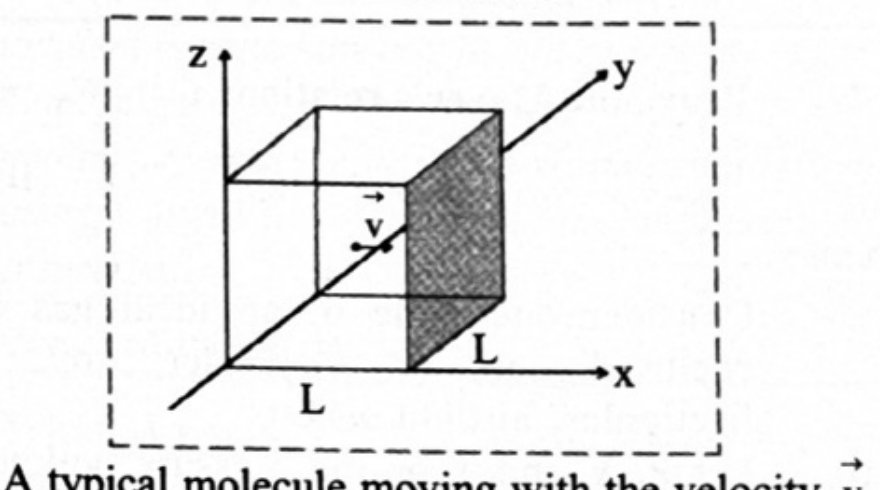
A cube of side with its faces parallel to the coordinate planes. One face — the shaded wall — is parallel to the -plane. A single molecule of mass is shown inside the cube, moving with velocity towards this shaded wall, with the components , , marked. After the elastic collision the molecule leaves with reversed and , unchanged.
Derivation
i. A typical molecule moves with velocity and is about to collide elastically with the shaded wall of the cube, which is parallel to the -plane.
ii. During the elastic collision the component of the velocity gets reversed, while and remain unaltered. Considering all the molecules, their average and components of velocity are unchanged by collisions with this wall, because the gas molecules remain evenly distributed throughout the volume and gain no additional motion along or .
iii. Hence the change in momentum of the particle is only in the component:
iv. Thus the momentum transferred to the wall during the collision is . The rebounded molecule then travels to the opposite wall and collides with it.
v. After colliding with the shaded wall, the molecule travels to the opposite wall, is reflected back, and travels towards the shaded wall again. It therefore covers a distance between two successive collisions with the shaded wall. As is the length of the cubical box, the time for the molecule to travel back and forth to the shaded wall is
vi. The average force exerted on the shaded wall by molecule 1 equals the average rate of change of momentum:
where is the component of the velocity of molecule 1.
vii. Considering the other molecules 2, 3, 4, ... with respective components , the total average force on the wall is
viii. The average pressure is the average force divided by the area of the shaded wall:
ix. The average of the square of the component of the velocities is
so that, with ,
x. Now . By symmetry, since the molecules have no preferred direction to move,
xi. Therefore the average pressure is
Remarks the board expects
- Equation (3) has been obtained for a cubical container, but it can be shown to be valid for containers of any shape.
- The neglect of intermolecular collisions does not affect the result. The number of molecules is of the order of , and if a molecule acquires a velocity with components different from , , after a collision, there will invariably be some other molecule of different initial velocity that now acquires those components. Since the gas is in equilibrium this must be happening, so the expression is unchanged.
Standard results
- ; momentum given to the wall ; ; .
Theory Questions Asked on This Subtopic
Real board questions. Answers are at the end of the page.
- 1
Derive an expression for a pressure exerted by a gas on the basis of kinetic theory of gases. OR On the basis of kinetic theory of gases obtain an expression for pressure exerted by gas molecules enclosed in a container on its walls.
 Maharashtra HSC board question — asked in February 2023; March 2022Answer 1 ↓
Answers & Solutions
Work the questions above first, then check yourself here. Each answer is set out the way it should be written in the paper.
i. Let there be n moles of an ideal gas enclosed in a cubical box of volume V () with sides of the box parallel to the coordinate axes, as shown in figure. The walls of the box are kept at a constant temperature T. ii. The gas molecules are in continuous random motion, colliding with each other and hitting the walls of the box and bouncing back. iii. As per one of the assumptions, we neglect intermolecular collisions and consider only elastic collisions with the walls. iv. A typical molecule moving with the velocity , about to collide elastically with the shaded wall of the cube parallel to yz-plane. v. During elastic collision, the component of the velocity will get reversed, keeping and components unaltered. vi. Hence the change in momentum of the particle is only in the x component of the momentum, is given by, final momentum − initial momentum vii. Thus, the momentum transferred to the wall during collision is . The re-bounced molecule then goes to the opposite wall and collides with it. viii. After colliding with the shaded wall, the molecule travels to the opposite wall and travels back towards the shaded wall again. ix. This means that the molecule travels a distance of 2L in between two collisions. x. As L is the length of the cubical box, the time for the molecule to travel back and forth to the shaded wall is . xi. Average force exerted on the shaded wall by molecule 1 is given as, Average force = Average rate of change of momentum where is the x component of the velocity of molecule 1. xii. Considering other molecules 2, 3, 4 ... with the respective x components of velocities , the total average force on the wall is, The average pressure xiii. The average of the square of the x component of the velocities is given by, where is the average over all possible values of . xiv. Now, By symmetry, since the molecules have no preferred direction to move. Therefore, average pressure