14.2
The Photoelectric Effect
Dual Nature of Radiation and Matter · Maharashtra HSC
Theory
Definition
The phenomenon of emission of electrons from a metal surface, when radiation of appropriate frequency is incident on it, is known as the photoelectric effect.
- A surface that emits electrons when illuminated with appropriate radiation is called a photosensitive surface.
- The electrons emitted are called photoelectrons. They are ordinary electrons; the name only records that they were released by incident light.
- Hertz discovered photoelectric emission in 1887 while producing electromagnetic waves by spark discharge: ultraviolet light on a metal electrode allowed a high-voltage spark to pass across the electrodes.
- Zinc, cadmium and magnesium need ultraviolet radiation; for alkali metals even visible radiation is sufficient.
- Electrical energy can be obtained from light in two ways: the photo-emissive effect described here, and the photo-voltaic effect used in a solar cell, where a potential difference is generated in a semiconductor by solar energy.
Experimental set-up (the board's model answer)
Describe the apparatus in these six steps, with a labelled circuit diagram.
- A laboratory set-up for the photoelectric effect consists of an evacuated glass tube with a quartz window.
- The tube contains photosensitive metal plates: one is the emitter E, the other the collector C.
- E and C are connected to a voltage source whose voltage can be changed, and to an ammeter that measures the current in the circuit.
- A potential difference , read by a voltmeter, is maintained between emitter E and collector C. Normally C (the anode) is at a positive potential with respect to E (the cathode). This potential difference can be varied and C can even be made negative with respect to E.
- When the anode potential is positive it accelerates the electrons, and is then called the accelerating potential. When is negative it retards the flow of electrons, and is then called the retarding potential.
- A source S of monochromatic light of sufficiently high frequency, wavelength m, is used.
The diagram in words
Draw an evacuated tube lying on its side with a quartz window on top. Inside, on the left, the emitter plate E; on the right, the collector plate C. Arrows of light from a source S pass through the window onto E, and short arrows from E to C show the photoelectrons crossing the gap. Outside the tube, wires run from E and from C to a sliding-contact battery (a potential divider) so that the polarity and magnitude of can both be changed. A voltmeter V is connected across E and C; a microammeter is in series in the circuit from C. Label E as cathode, C as anode, and mark the direction of the photocurrent.
Observations from the experiments
- Photocurrent was recorded even when the intensity was very low, provided the frequency of the incident radiation exceeded a threshold frequency . is the same for a given metal and different for different metals.
- There was no time lag: the current started within about s of the light arriving, even at low intensity, and stopped the instant the radiation was stopped.
- With and the accelerating potential fixed, the photocurrent increased linearly with the intensity.
- With the incident radiation fixed, the current first increased with the accelerating potential and then stayed constant. That constant value is the saturation current .
- With voltage and frequency fixed, increasing the intensity increased proportionately: double the intensity, double the saturation current.
- of the photoelectrons depended on the emitter material and on the incident frequency, and did not depend on the intensity. For a given surface and a given incident frequency, was always the same however small the intensity.
- On applying increasingly negative potentials to the collector the photocurrent fell, becoming zero at a particular value , the cut-off or stopping potential. was the same for any incident intensity at a given frequency, but different for different emitter materials.
- Changing at constant intensity left the saturation current unchanged but changed ; varied linearly with , along lines of the same slope but different intercepts for different metals.
- The photocurrent, and hence the number of electrons, depended on the intensity and not on the frequency, so long as and the anode was at a higher potential than the cathode.
Work function
The minimum amount of energy required to be provided to an electron to pull it out of the metal from the surface is called the work function of the metal, denoted .
- It depends on the properties of the metal and on the nature of its surface, and is expressed in electron volt.
- What ionization energy is to an atom, the work function is to a solid, which is a large collection of atoms.
- Typical values in eV: potassium , sodium , calcium , zinc , silver , aluminium , tungsten , copper , nickel , gold .
Definitions the board asks for
- Threshold frequency: the minimum frequency of incident radiation required to start photoemission in a photosensitive material.
- Stopping potential: if increasingly negative potentials are applied to the collector, the photocurrent decreases and for some typical value the photocurrent becomes zero. This value of is termed the cut-off or stopping potential.
- Photoelectric work function: the minimum amount of energy required to be provided to an electron to pull it out of the metal from the surface.
Failure of the wave theory
- Instantaneous emission. The wave picture says the surface absorbs energy continuously, all the electrons near the surface sharing it, so the surface would need a reasonable time — minutes to hours — to accumulate enough energy to knock an electron off, and longer still at low intensity. Observation shows emission within s at any intensity.
- The textbook's estimate makes this concrete. For a potassium cathode of area under radiation of intensity , the incident power is W. Sharing it among roughly surface electrons gives about W per electron, so accumulating the J work function of potassium takes about s — about half a day.
- Kinetic energy. Larger intensity means larger energy on the wave picture, so electrons should come out with larger kinetic energy. Observation shows is independent of intensity and depends only on frequency, which the wave theory gives no role at all.
- Threshold frequency. Wave theory expects emission at any frequency if the intensity is large enough. Observation shows a characteristic cut-off frequency below which nothing is emitted however intense the radiation, and emission above however feeble the radiation.
Einstein's postulate and the photoelectric equation
- Einstein (1905) extended Planck's quantization to all electromagnetic radiation: under certain conditions light behaves as a particle and its energy is released or absorbed in quanta. He named the quantum of light energy a photon, of energy
with J s, Planck's constant. This is Einstein's relation, and it links a particle-like property, energy, with a wave-like property, frequency.
- Since , high frequency means high energy and short wavelength means high energy.
- A photon arriving at the metal collides with an electron and gives it all of its energy ; the photon then no longer exists. Emission occurs if and only if , so the threshold frequency is
- If no electron is ejected however intense the radiation; if an electron is ejected however small the intensity.
- The exchange of energy between photon and electron is instantaneous, which is why there is no time lag; and when the radiation is stopped there are no photons left to hand over energy, so emission stops at once.
- Increasing the intensity at a fixed wavelength increases the number of photons falling on unit area in unit time, each of the same energy . So more electrons are knocked off and the current is larger; lower intensity means fewer photons, fewer electrons and lower current.
- Once emitted, electrons are pulled to the collector by the accelerating field, so the current rises with the accelerating potential — but only until every knocked-off electron is reaching the collector. Beyond that the current cannot rise further, which is the saturation current .
- Of the photon energy, is spent escaping the surface and the rest appears as kinetic energy. Allowing for electrons that start with different energies, come from different depths and suffer collisions, the maximum kinetic energy is
This is Einstein's photoelectric equation. depends on the emitter material and varies linearly with , and is independent of the intensity.
Stopping potential
- Emitted electrons have a spread of kinetic energies, because the electrons in a solid do not all have the same energy, they may be ejected from varying depths, and they may lose energy in collisions before leaving the surface.
- If the collector is at a lower potential, an electron loses kinetic energy in overcoming the retarding force. The most energetic electron just fails to reach the collector when it has lost all its kinetic energy at the collector, so
- Substituting into the photoelectric equation,
- therefore varies linearly with . The slope depends only on the constants and , so it is the same for every metal; the intercept depends on the material through . That is exactly what the family of parallel straight lines in the against graph shows.
- In terms of wavelength, , so is linear in — the inverse linear dependence of stopping potential on incident wavelength that the exercise asks you to explain. Shorter wavelength means a more energetic photon, more energy left over after the work function, and hence a larger retarding potential needed to stop the electrons.
- The magnitude of the photocurrent depends on the intensity, through the number of photoelectrons, and on the collector potential, but not on the incident frequency so long as .
- Historical closing: Einstein's 1905 hypothesis was not widely accepted until Millikan measured in 1909 and the value of computed from the slope matched Planck's. Einstein received the Nobel Prize in 1921 and Millikan in 1923.
Standard results collected
- Emission condition: , equivalently , equivalently .
- Answers to the two short questions that recur: microwaves cannot be used, because their photon energy is far too small to exceed any metal's work function; and red light is not always able to produce photoelectric effect — it works only if the metal's work function is small enough, so any radiation of sufficient energy will do.
Theory Questions Asked on This Subtopic
Real board questions. Answers are at the end of the page.
- 1
Draw a neat labelled circuit diagram of experimental arrangement for study of photoelectric effect.
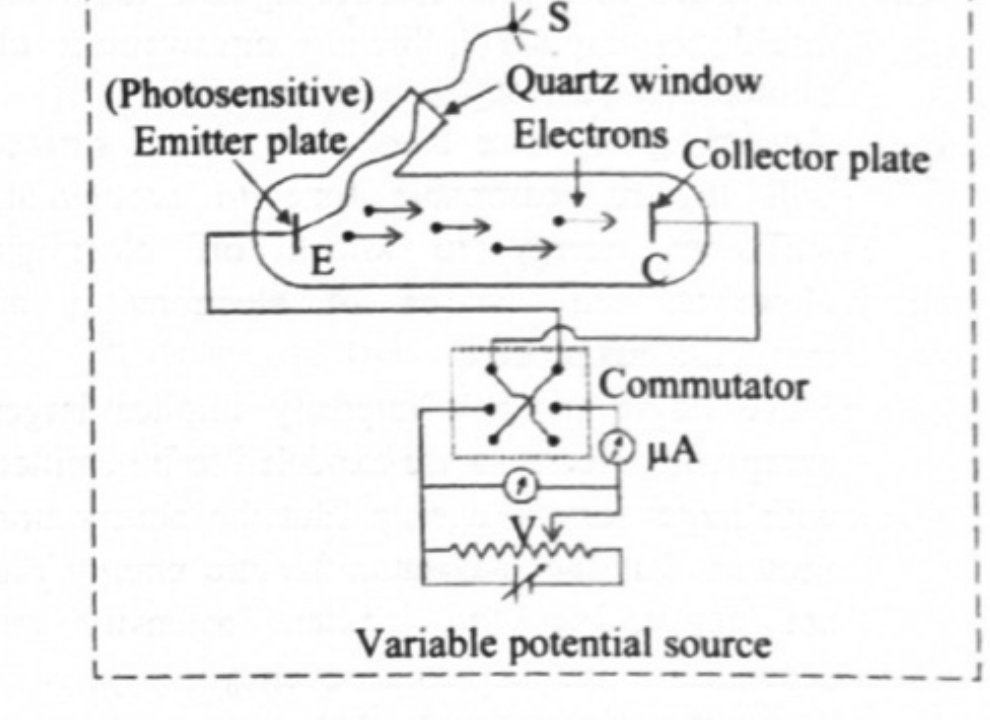 Maharashtra HSC board question — asked in October 2015Answer 1 ↓
 - 2
State Einstein's photoelectric equation.
Maharashtra HSC board question — asked in July 2018; March 2008Answer 2 ↓ - 3
What is photoelectric effect? Define: i. Stopping potential ii. Photoelectric work function.
Maharashtra HSC board question — asked in March 2019Answer 3 ↓ - 4
Define: i. Threshold frequency ii. Photoelectric work function
Maharashtra HSC board question — asked in February 2020Answer 4 ↓ - 5
Is it always necessary to use red light to get photoelectric effect?
Maharashtra HSC board question — asked in March 2022Answer 5 ↓ - 6
How does the wave theory of light fail to explain the observations from experiment on photoelectric effect? [Give any two points]
Maharashtra HSC board question — asked in July 2022Answer 6 ↓ - 7
Describe an experiment for the study of characteristics of photoelectric effect. OR With neat labelled circuit diagram, describe an experiment to study the characteristics of photoelectric effect.
Maharashtra HSC board question — asked in February 2023; July 2019; October 2009Answer 7 ↓ - 8
State Einstein's photoelectric equation. Hence, explain any two characteristics of photoelectric effect.
Maharashtra HSC board question — asked in July 2023Answer 8 ↓ - 9
Define photoelectric effect and explain the experimental set-up of photoelectric effect.
Maharashtra HSC board question — asked in February 2024Answer 9 ↓
Numericals
Every numerical set on this subtopic. Full working is at the end of the page.
- 10
The threshold wavelength for silver is 3800 Å. Calculate maximum kinetic energy in eV of photoelectrons emitted when ultraviolet light of wavelength 2600 Å falls on it. Also calculate stopping potential. [1 eV = J, Plank's constant = J-s, speed of light in vacuum = m/s]
Maharashtra HSC board question — asked in October 2008Answer 10 ↓ - 11
The photoelectric work function for a metal is 4.2 eV. If the stopping potential is 3 V, find the threshold wavelength and maximum kinetic energy of emitted electrons. [Velocity of light in air = m/s, Planck's constant = J – s, Charge on electron = C]
Maharashtra HSC board question — asked in March 2013Answer 11 ↓ - 12
Find the wave number of a photon having energy of 2.072 eV. Given: Charge on electron = C, Velocity of light in air = m/s, Planck's constant = J-s.
Maharashtra HSC board question — asked in March 2014Answer 12 ↓ - 13
The photoelectric threshold wavelength of a metal is 230 nm. Determine the maximum kinetic energy in joule and in eV of the ejected electron for the metal surface when it is exposed to a radiation of wavelength 180 nm. [Planck's constant: h = Js, Velocity of light: c = m/s.]
Maharashtra HSC board question — asked in October 2014Answer 13 ↓ - 14
The threshold wavelength of silver is 3800 Å. Calculate the maximum kinetic energy in eV of photoelectrons emitted, when ultraviolet light of wavelength 2600 Å falls on it. (Planck's constant, h= J.s., Velocity of light in air, c = m/s)
Maharashtra HSC board question — asked in March 2015Answer 14 ↓ - 15
The photoelectric current in a photoelectric cell can be reduced to zero by a stopping potential of 1.8 volt. Monochromatic light of wavelength 2200 Å is incident on the cathode. Find the maximum kinetic energy of the photoelectrons in joules. [Charge on electron = C]
Maharashtra HSC board question — asked in October 2015Answer 15 ↓ - 16
The photoelectric work function for a metal surface is 2.3 eV. If the light of wavelength 6800 Å is incident on the surface of metal, find threshold frequency and incident frequency. Will there be an emission of photoelectrons or not? [Velocity of light c = m/s, Planck's constant, h = Js]
Maharashtra HSC board question — asked in March 2016Answer 16 ↓ - 17
Light of wavelength 3000 Å falls on a metal surface having work function 2.3 eV. Calculate the maximum velocity of ejected electrons. (Planck's constant h = Js, velocity of light c = m/s, mass of an electron = kg)
Maharashtra HSC board question — asked in July 2016Answer 17 ↓ - 18
The work functions for potassium and caesium are 2.25 eV and 2.14 eV respectively. Is the photoelectric effect possible for either of them if the incident wavelength is 5180 Å? [Given: Planck's constant = J.s.; Velocity of light = m/s; 1 eV = J]
Maharashtra HSC board question — asked in March 2017Answer 18 ↓ - 19
If the work function of a metal is 3 eV, calculate the threshold wavelength of that metal. [Velocity of light = m/s, Planck's constant = J.s., 1 eV = J]
Maharashtra HSC board question — asked in July 2017Answer 19 ↓ - 20
If the total energy of radiation of frequency Hz is 6.63 J, calculate the number of photons in the radiation. [Planck's constant = J.s.]
Maharashtra HSC board question — asked in July 2017Answer 20 ↓ - 21
The work function for a metal surface is 2.2 eV. If light of wavelength 5000 Å is incident on the surface of the metal, find the threshold frequency and incident frequency. Will there be an emission of photoelectrons or not? (c = m/s, 1 eV = J, h = Js)
Maharashtra HSC board question — asked in March 2018Answer 21 ↓ - 22
The photoelectric work function for a metal surface is J. If the light of wavelength 5000 Å is incident on the surface of the metal, will there be photoelectric emission?
Maharashtra HSC board question — asked in February 2020Answer 22 ↓ - 23
The photoelectric work function for a metal is 4.2 eV. Find the threshold wavelength.
Maharashtra HSC board question — asked in March 2022Answer 23 ↓ - 24
In a photoelectric experiment, the stopping potential is 1.5 V. What is the maximum kinetic energy of a photoelectron?
Maharashtra HSC board question — asked in February 2024Answer 24 ↓
Answers & Solutions
Work the questions above first, then check yourself here. Each answer is set out the way it should be written in the paper.
Circuit diagram of experimental set-up for study of photoelectric effect:
Einstein's photoelectric equation:
The phenomenon of emission of electrons from a metal surface, when radiation of appropriate frequency is incident on it, is known as photoelectric effect. i. If increasingly negative potentials were applied to the collector in experiment of photoelectric effect, the photocurrent decreases and for some typical value (), photocurrent becomes zero. This value of is termed as cut-off or stopping potential. ii. The minimum amount of energy required to be provided to an electron to pull it out of the metal from the surface is called the work function of the metal.
i. The minimum frequency of incident radiation required to start a photoemission in any photosensitive material is known as threshold frequency. ii. [From 14.2, Q3] The phenomenon of emission of electrons from a metal surface, when radiation of appropriate frequency is incident on it, is known as photoelectric effect. i. If increasingly negative potentials were applied to the collector in experiment of photoelectric effect, the photocurrent decreases and for some typical value (), photocurrent becomes zero. This value of is termed as cut-off or stopping potential. ii. The minimum amount of energy required to be provided to an electron to pull it out of the metal from the surface is called the work function of the metal..(ii).
No. Any light possessing sufficient energy to initiate the photoemission can be used to get photoelectric effect.
The wave theory of electromagnetic radiation could not explain following observations of photoelectric effect. i. According to wave theory, the metal surface will require reasonable time to accumulate sufficient energy to knock off electrons. However, the ejection of electrons is an instantaneous process. ii. Since larger incident intensity implies larger energy, the electrons are expected to be emitted with larger kinetic energy. But the observation showed that the maximum kinetic energy did not depend on the incident intensity but depended on the incident frequency. iii. Wave theory expected photoelectrons to be emitted for any frequency. But observations indicated that for a given metal surface, some characteristic cut-off frequency existed below which no photoelectrons were emitted however intense the incident radiation was. (Any two points)
[From 14.2, Q1] Circuit diagram of experimental set-up for study of photoelectric effect:for Circuit diagram of experimental set-up i. A laboratory experimental set-up for the photoelectric effect consists of an evacuated glass tube with a quartz window. ii. The glass tube contains photosensitive metal plates. One is the emitter E and another plate is the collector C. iii. The emitter and collector are connected to a voltage source whose voltage can be changed and to an ammeter to measure the current in the circuit. iv. A potential difference of V, as measured by the voltmeter, is maintained between the emitter E and collector C. Generally, C (the anode) is at a positive potential with respect to the emitter E (the cathode). This potential difference can be varied and C can even be at negative potential with respect to E. v. When the anode potential (V) is positive, it accelerates the electrons. This potential is called accelerating potential. When the anode potential (V) is negative, it retards the flow of electrons. This potential is known as retarding potential. vi. A source S of monochromatic light of sufficiently high frequency (short wavelength m) is used.
[From 14.2, Q2] Einstein's photoelectric equation: for equation. Characteristics of Photoelectric effect: i. Photoemission occurs after the frequency of incident radiation is increased beyond certain minimum value known as threshold frequency . Threshold frequency is different for different material. ii. Photocurrent is directly proportional to the intensity of incident radiation when frequency and accelerating potential is kept constant. iii. For fixed intensity, the photocurrent increases with increase in voltage until it reaches a saturation value () where it remains constant. iv. There is no time lag between the incidence of light and emission of electrons. The process is instantaneous. v. Maximum kinetic energy of electrons depends on the frequency of incident radiations. vi. Increasingly negative collector potential reduces the photocurrent until it reaches zero at a specific value (), known as the cut-off or stopping potential. This stopping potential is directly proportional to frequency of incident radiation. (Any two characteristics)
[From 14.2, Q3] The phenomenon of emission of electrons from a metal surface, when radiation of appropriate frequency is incident on it, is known as photoelectric effect. i. If increasingly negative potentials were applied to the collector in experiment of photoelectric effect, the photocurrent decreases and for some typical value (), photocurrent becomes zero. This value of is termed as cut-off or stopping potential. ii. The minimum amount of energy required to be provided to an electron to pull it out of the metal from the surface is called the work function of the metal.Experimental set up: [From 14.2, Q1] Circuit diagram of experimental set-up for study of photoelectric effect:, Q. No.7 [(i) – (iv)]
Given: Å m, Å m To find: Maximum kinetic energy (K.E.), Stopping potential () Formulae: i. ii. Calculation: From formula (i), From formula (ii), eV V Ans: Maximum kinetic energy is 1.51 eV, stopping potential is 1.51 V.
Given: eV J, V, J-s, C, m/s To find: i. Threshold wavelength () ii. Maximum kinetic energy (K.E.) Formulae: i. ii. Calculation: i. From formula (i), Å ii. From formula (ii), J Ans: i. Threshold wavelength is 2959 Å. ii. Maximum kinetic energy of the emitted electrons is J.
Given: eV J, C, m/s, J-s To find: Wave number () Formula: Calculation: From formula, Ans: The wave number is .
Given: nm m, nm m, J s, m/s To find: K.E. (in joule and eV) Formula: Calculation: Using formula, J Ans: The maximum kinetic energy of the ejected electron is J or 1.5 eV.
Given: Å m, Å m To find: Maximum kinetic energy (K.E.) Formula: Calculation: From formula, Ans: Maximum kinetic energy of the photoelectron emitted is 1.509 eV.
Given: V, C, Å To find: Maximum kinetic energy (K.E.) Formula: Calculation: Using formula, J Ans: Maximum kinetic energy of emitted photoelectron is J.
Given: eV, Å m, m/s, Js To find: i. Threshold frequency () ii. Incident frequency () iii. If emission of photoelectrons possible Formulae: i. ii. Calculation: From formula (i), From formula (ii) Since incident frequency is less than threshold frequency i.e., , photoelectric emission will not be observed. Ans: i. Threshold frequency is Hz. ii. Frequency of incident light is Hz. iii. Emission of photoelectrons is not possible.
Given: Å m, kg, eV, Js, m/s To find: Maximum velocity () Formulae: i. ii. Calculation: From formula (i), Also, From formula (ii), Ans: The maximum velocity of electron is m/s
Given: eV J J, eV J J, Å m To find: Will the photoelectric effect occur for potassium and caesium with Å Formula: Calculation: From formula, Similarly, As incident wavelength () is smaller than threshold wavelength for potassium and for caesium i.e., . Photoelectric effect is possible for both of them. Ans: For Å wavelength, both potassium and caesium will exhibit photoelectric emission.
Given: eV J, J-s, C, m/s. To find: Threshold wavelength () Formula: Calculation: From formula, Ans: Threshold wavelength of the metal is m.
Given: J, Hz, Js. To find: Number of photons (n) Formula: Calculation: Using formula, Ans: The number of photons emitted in the radiation are .
Given: eV J, Å m, J.s, m/s To find: i. Threshold frequency () ii. Incident frequency () iii. If photoemission is possible? Formulae: i. ii. Calculation: Using formula (i), Hz Using formula (ii), Hz As, , there will be emission of photoelectrons. Ans: i. Threshold frequency is Hz ii. Incident frequency is Hz iii. There will be emission of photoelectrons.
Given: J, Å m Energy of incident radiation J Here, Since E is greater than , photoelectric emission will occur. Ans: Yes, photoelectric emission will occur.
Given: eV J To find: Threshold wavelength () Formula: Calculation: From formula, Ans: The threshold wavelength is 2959.8 Å.
Maximum kinetic energy of a photoelectron is given as,