14.4
Photo Cell
Dual Nature of Radiation and Matter · Maharashtra HSC
Theory
What a photo cell is
A photo cell is a device that makes use of the photoelectric effect and converts light energy into electrical energy.
Construction (the board's model answer)
- A photo cell consists of a semi-cylindrical photosensitive metal plate E, acting as the cathode, and a wire loop collector C, acting as the anode, supported in an evacuated glass or quartz bulb.
- The electrodes are connected to an external circuit having a high tension battery B and a microammeter.
- Instead of a photosensitive metal plate, the photosensitive material can be pasted in the form of a thin film on the inner walls of the glass bulb.
The diagram in words
Draw a circular (evacuated) bulb. Inside it, on the left, a thick semi-cylindrical plate E with its concave face turned towards the right — this is the cathode. At the centre of the bulb, facing the concave face, a small wire loop C — this is the anode. Incident light arrows strike the concave face of E from the right, and short arrows from E to C show the photoelectrons. Two leads leave the bulb: one from E and one from C. In the external circuit place a high tension battery B and a microammeter in series, with the anode C connected to the positive terminal of B.
Working
- When light of suitable wavelength falls on the cathode, photoelectrons are emitted from the photosensitive surface.
- These electrons are attracted towards the anode because of the applied electric field of the high tension battery.
- The resulting photocurrent is read on the microammeter. Its magnitude increases with the intensity of the incident light, which is what makes the photo cell useful as a light measurer.
Uses
- To operate control systems and in light measuring devices.
- Light meters in photographic cameras, to measure the intensity of light.
- To switch street lights on or off. The cathode for such a cell must respond to visible light, so a low work function metal such as potassium is used — zinc, aluminium and nickel all need ultraviolet.
- Counting devices and burglar alarms. A source of ultraviolet radiation is kept near the entrance of a mall or house so that its light falls on the cathode and a photocurrent flows. When a person passes through, the beam is interrupted and the photocurrent stops. That event operates a counter or sets off an alarm.
- The same arrangement, with an alarm, can be used to identify traffic law defaulters.
A point often asked
- A solar cell is not a photo cell in the sense used here. A photo cell works on the photo-emissive effect, in which electrons are actually ejected from a surface into an evacuated bulb; a solar cell works on the photo-voltaic effect, in which a potential difference is generated inside a semiconductor and no electrons are emitted.
Theory Questions Asked on This Subtopic
Real board questions. Answers are at the end of the page.
- 1
Draw a well labelled diagram of photoelectric cell.
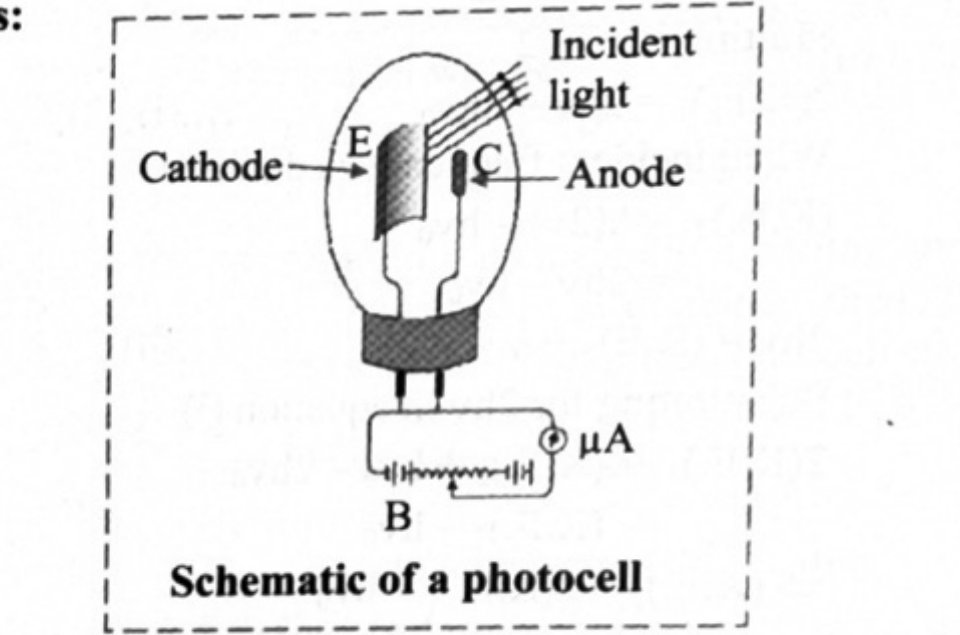 Maharashtra HSC board question — asked in October 2013Answer 1 ↓
 - 2
Describe the construction of photoelectric cell.
Maharashtra HSC board question — asked in March 2014Answer 2 ↓
Answers & Solutions
Work the questions above first, then check yourself here. Each answer is set out the way it should be written in the paper.
The question is a real board question. Its answer and working are ours — this paper was published without an official answer key.
Labelled diagram of a photoelectric cell
- The schematic of the photocell is as shown.
Construction
- i. A photo cell consists of a **semi-cylindrical photosensitive metal plate E**, acting as the cathode, and a **wire loop collector C**, acting as the anode.
- ii. Both electrodes are supported inside an **evacuated glass or quartz bulb**. (Instead of a metal plate, the photosensitive material may be pasted as a thin film on the inner wall of the bulb.)
- iii. The electrodes are joined to an external circuit containing a **high tension battery B** and a **microammeter** (marked uA in the figure, for A).
Working
- Light of a suitable wavelength falling on the cathode E ejects photoelectrons. The applied electric field drives them across to the anode C, and the microammeter records the resulting photocurrent.
- A photo cell converts light energy into electrical energy using the photoelectric effect. It is used in control systems, in light meters of photographic cameras, to switch street lights on and off, and in counting devices and burglar alarms.
Construction of photoelectric cell: i. A photo cell consists of a semi-cylindrical photosensitive metal plate E acting as a cathode and a wire loop collector C acting as an anode supported in an evacuated glass or quartz bulb. ii. The electrodes are connected to an external circuit having a high tension battery B and a micro ammeter A. iii. Instead of a photosensitive metal plate, the photosensitive material can be pasted in the form of a thin film on the inner walls of the glass bulb.